
The legal consequences of Ortega canceling elections do not run through one master switch. They run through several instruments already moving at different speeds: sanctions that compliance teams must apply now, a live foreign arrest warrant that depends on travel and extradition cooperation, UN findings that frame the record as crimes against humanity, and more ambitious jurisdictional theories that could matter only if a prosecutor or state actor chooses to test them.
That distinction matters because the July 19, 2026 announcement is only two days old. The promised implementing bill has not yet been published. The immediate question is therefore not whether a finished domestic legal act already exists, but which international accountability tracks were already active and are now sharpened by the open abandonment of electoral rule.
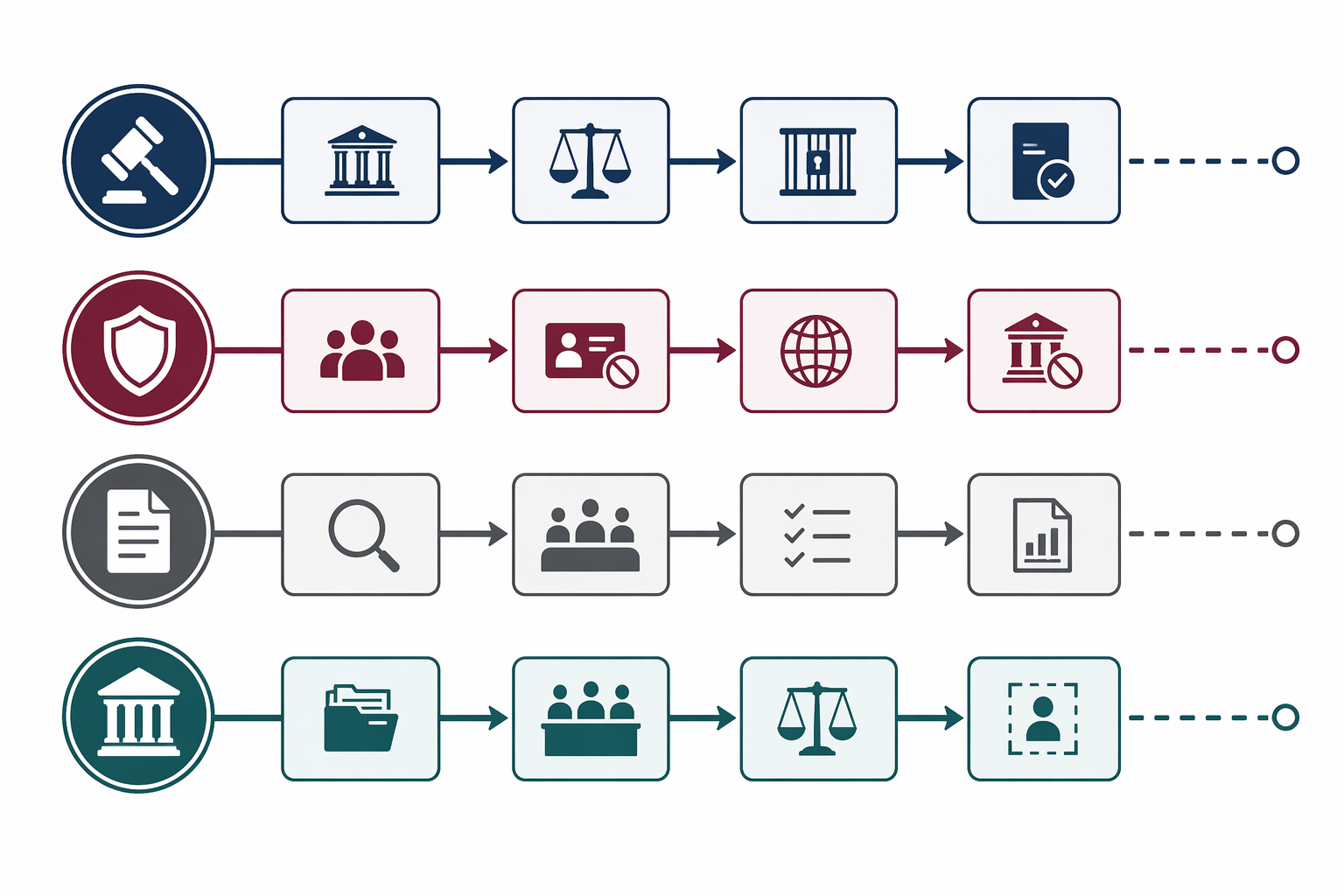
| Mechanism | What is already live | What it can do | Main enforcement limit |
|---|---|---|---|
| Sanctions | US, EU, UK, and Canadian measures against individuals, entities, and sectors | Freeze assets, restrict transactions, limit visas, and impose compliance obligations on regulated actors | Sanctions can isolate and disrupt revenue, but they do not themselves arrest, prosecute, or remove officials |
| Foreign criminal process | Argentine universal jurisdiction arrest warrants for Daniel Ortega and Rosario Murillo | Create a concrete judicial basis for detention if a cooperating state executes the warrant | Actual custody depends on travel, extradition law, and state cooperation |
| UN fact-finding and treaty pressure | UN Group of Human Rights Experts on Nicaragua findings of reasonable grounds to believe crimes against humanity were committed | Preserve and organize an evidentiary and legal record for future accountability | Fact-finding findings are not the same thing as a criminal conviction or an arrest power |
| ICC theory | A possible cross-border jurisdiction argument modeled on the Bangladesh/Myanmar precedent | Could, in theory, connect forced deportation or passport denial to conduct completed partly in Costa Rica | No publicly confirmed ICC Nicaragua investigation or prosecutor application is currently active |
| Regional and institutional pressure | OAS Democratic Charter findings and continuing treaty arguments | Support legal and diplomatic findings of democratic breach | Nicaragua’s withdrawal from the OAS and other bodies narrows institutional leverage |
Sanctions are the broadest operational consequence, not a substitute for prosecution
For lawyers and compliance officers, the most immediate consequences are still sanctions. They require present-tense decisions by banks, exporters, insurers, gold-sector counterparties, migration authorities, and counsel advising anyone with exposure to designated persons or entities.
The latest US action in the available record is Treasury OFAC’s April 16, 2026 designation of five individuals, including Maurice Ortega and Daniel Edmundo Ortega, and seven gold-sector companies alleged to generate revenue for the regime. The same release states that US visa restrictions cover more than 2,000 current or former Nicaraguan officials and notes proposed legislation, the “Restoring Sovereignty and Human Rights in Nicaragua Act of 2026,” that would codify and expand existing measures.[1]
The election-cancellation announcement does not have to create a new sanctions architecture to matter. It supplies fresh factual material for designation packages, visa decisions, legislative findings, and risk assessments. In practice, that means counsel should treat the announcement as an aggravating fact in an already active sanctions environment, not as the beginning of that environment.
The EU track is also already live. In September 2025, the Council of the European Union renewed restrictive measures against 21 individuals and three entities, extending them through October 2026. The same sanctions inventory records UK measures covering 17 individuals and Canadian measures covering 35 individuals.[2]
Those numbers should not be made to say more than they say. Adoption is not effectiveness. A designation can freeze assets within a jurisdiction, prohibit dealings, and make counterparties walk away. It does not prove behavioral change by the sanctioned government. It also does not create custody over Ortega or Murillo. The legal consequence is real, but it is administrative and financial unless paired with a criminal or immigration enforcement decision.
The Argentine warrant is the most concrete personal criminal mechanism
The strongest current criminal-law consequence is not hypothetical ICC jurisdiction. It is the Argentine universal jurisdiction arrest warrant. In December 2024, an Argentine federal judge issued international arrest warrants for Daniel Ortega and Rosario Murillo on charges reported to include torture and forced displacement.[3]
That matters procedurally. A warrant is a judicial act against named people. It identifies defendants, charges, and a forum claiming authority to proceed. It gives foreign police and courts something more concrete to evaluate than a communiqué, a sanctions press release, or an expert report. If Ortega or Murillo were to travel to a state willing and legally able to cooperate with Argentina, the warrant could become an immediate custody question.
Universal jurisdiction is doing the important work here. The theory permits certain grave international crimes to be investigated or prosecuted by a national court even when the alleged conduct occurred outside that state’s territory and was not committed by or against its nationals. It is not magic, and it is not self-executing across borders. It is a jurisdictional claim that still has to pass through domestic procedure, mutual legal assistance, arrest, and extradition or transfer rules.
The practical weakness is obvious but often omitted. A warrant does not place a defendant in the courtroom. It becomes potent when the person travels, when a transit or destination state recognizes the request, and when local courts do not block surrender. Ortega is unlikely to choose travel that exposes him to that risk. But low probability is not legal emptiness. The warrant changes the risk profile of movement, diplomacy, family travel, medical travel, and any future loss of territorial control.
The July 19 announcement may also matter to Argentine proceedings as additional evidence of political persecution and institutional closure, depending on the scope of the case and the materials submitted by complainants or prosecutors. That is different from saying the announcement itself automatically expands the warrant. The warrant is already live; any enlargement of charges or factual allegations would require further procedural action.
UN findings supply the evidentiary spine
The UN Group of Human Rights Experts on Nicaragua does not arrest anyone. Its importance is different. It collects, organizes, and characterizes conduct in a form that later prosecutors, sanctions authorities, asylum lawyers, treaty bodies, and national courts can use.
Human Rights Watch’s World Report 2026 describes the Group’s finding that there are “reasonable grounds to believe that authorities have committed crimes against humanity,” including murder, imprisonment, torture, sexual violence, forced deportation, and persecution on political grounds. The same body of reporting notes that the Group’s mandate was extended in April 2025.[4]
The phrase “reasonable grounds to believe” should be read carefully. It is not the standard for conviction. It is also not a casual political accusation. It is a formal fact-finding threshold used to say that the record supports serious legal characterization and further accountability steps. For later proceedings, that kind of record can help identify patterns, responsible institutions, victim categories, modes of persecution, and possible linkage evidence connecting senior officials to acts carried out by state agents.
The July 19 cancellation fits that record less as an isolated offense and more as evidence of an architecture: dismantled competition, exclusion of opponents, denationalization, forced exile, and now the declared end of elections. Readers looking for the treaty-breach analysis behind the electoral dimension can consult the related discussion of how Nicaragua’s election ban violates international law with limited remedies. The point here is narrower: GHREN findings help convert a political chronology into an evidentiary record that can be used outside Nicaragua.
The ICC route is legally interesting precisely because it is not yet an ICC case
Nicaragua is not a Rome Statute party. That fact is not the end of the ICC conversation, but it is the start of any competent one. There is no publicly confirmed ICC investigation or prosecutor’s application for Nicaragua in the materials here. Any article treating an ICC case as already opened is getting ahead of the record.
The plausible theory comes from the ICC’s Bangladesh/Myanmar approach to cross-border crimes. Opinio Juris has argued that, although Nicaragua itself is outside the Rome Statute, forced deportation and passport denial connected to Costa Rica could potentially create territorial jurisdiction because Costa Rica is a Rome Statute State Party.[5]
The logic is careful: if an alleged crime is completed partly on the territory of a State Party, the Court may have a jurisdictional hook even when other elements occurred in a non-party state. In the Myanmar/Bangladesh setting, the cross-border nature of deportation mattered because victims were forced across an international border into Bangladesh, a State Party. A Nicaragua theory would have to show an analogous jurisdictional link through conduct and consequences involving Costa Rica.
That is not the same as saying the theory will be accepted, that the Prosecutor will pursue it, or that the election cancellation itself supplies territorial jurisdiction. The cleaner argument would likely focus on forced deportation, exile, denial of return, or passport-related measures that have a cross-border component. The election cancellation may strengthen the narrative of persecution and exclusion, but the jurisdictional hinge would still have to be built with precision.
This is where the GHREN record and the ICC theory meet. Expert findings can help establish patterns and categories of conduct. They do not solve Rome Statute jurisdiction by themselves. A prosecutor would still need a case theory, evidence tied to charged crimes, admissibility analysis, and a path around non-party-state limits.

OAS and UN withdrawals narrow the forums, not the record
Nicaragua’s institutional withdrawals are best understood as enforcement constraints. They make some forums less useful and some remedies harder to press. They do not erase conduct that occurred before withdrawal, nor do they make external fact-finding, sanctions, or foreign criminal jurisdiction disappear.
Nicaragua’s withdrawal from the Organization of American States became effective on November 19, 2023. The OAS had found Nicaragua in breach of the Inter-American Democratic Charter, but withdrawal sharply limits what that forum can now do beyond political and legal denunciation.[5][6]
The same pattern appears in the 2025 withdrawals from UN bodies including the UN Human Rights Council, FAO, ILO, IOM, UNESCO, and UNHCR. Human Rights Watch’s World Report 2026 treats those exits as part of a broader self-isolation strategy.[4]
There is a tendency to overstate both sides of this point. Withdrawal is not an accountability force field. It does not prevent third states from imposing sanctions, an Argentine court from issuing a warrant, or UN experts from preserving evidence where mandates exist. But withdrawal does reduce access, cooperation, monitoring channels, and institutional pressure points. For a government trying to make accountability slower and more expensive, that is not a trivial achievement.
For the broader legal implications of Nicaragua’s democratic rupture, including the relationship between electoral obligations and international human rights instruments, see the companion analysis of Nicaragua’s election cancellation and its legal implications. For the domestic legal profession and institutional dismantling that preceded this moment, the relevant background is How Nicaragua’s Lawyer Purge Remade Its Political Future.
What the July 19 announcement changes
The announcement does not need to create a new cause of action to have legal consequences. It can affect how existing mechanisms assess intent, persistence, risk, and the availability of domestic remedies. A state that declares elections permanently over has supplied unusually direct evidence about the future availability of political participation and internal correction.
For sanctions authorities, it may support additional designations or legislative findings. For asylum and statelessness litigation, it may help show that exile and exclusion are not temporary accidents. For universal jurisdiction complainants, it may fit a pattern of persecution. For ICC theorists, it may strengthen the contextual element of crimes against humanity while still leaving territorial jurisdiction to be proven through cross-border conduct.
The implementing bill matters. If it is published, its text could create new evidence about institutional responsibility, named officials, legal mechanics, and the formal elimination of electoral processes. Until then, the safer position is that the announcement intensifies existing accountability tracks rather than completing a new statutory event.
The answer, narrowed
Ortega now faces real, plural, source-traceable legal consequences. The broadest operational pressure is sanctions. The most concrete personal criminal mechanism is the Argentine universal jurisdiction warrant. The most important evidentiary foundation is the UN GHREN crimes-against-humanity record. The most legally ambitious prosecution path is the ICC cross-border theory tied to Costa Rica.
None of those mechanisms should be mistaken for guaranteed enforcement. Sanctions require regulated actors and political maintenance. Warrants require custody. UN findings require a forum willing to use them. ICC jurisdiction would require a prosecutor, a theory, and a court willing to accept it. Nicaragua’s withdrawals from regional and UN bodies make cooperation less likely and institutional leverage thinner. The legal map is crowded; the center remains hard to reach.
References
- Treasury Sanctions Ortega-Murillo Regime Members and Companies for Repression and Gold Sector Exploitation, U.S. Department of the Treasury, April 16, 2026.
- Nicaragua: Council renews sanctions for a further year, Council of the European Union, September 29, 2025.
- Nicaragua's Ortega Faces Arrest Warrant in Argentina for Crimes Against Humanity, Tico Times, December 30, 2024.
- World Report 2026: Nicaragua, Human Rights Watch, 2026.
- Nicaragua: Can International Law Break the Cycle of Impunity?, Opinio Juris, July 28, 2025.
- OAS finds Nicaragua in breach of the Inter-American Democratic Charter, Buenos Aires Times.
Comments
Join the discussion with an anonymous comment.