
The Padilla-Durbin immigration fines action is not a bill, and it does not itself stop the fines. It is a July 17, 2026 oversight letter from Sen. Alex Padilla and Sen. Dick Durbin asking the Department of Homeland Security and the Department of Justice to halt the civil fines program, withdraw existing fines, stop collection efforts, and answer questions by July 31, 2026.[1] That distinction matters. A letter cannot repeal a regulation, vacate a judgment, or bind an agency the way a statute can. What it can do is fix a record: who was warned, what Congress was told, which legal authorities the agencies relied on, and which procedural shortcuts now sit in plain view.
The letter targets a revived civil penalty scheme under INA §274D, tied to violations of voluntary departure and removal-related obligations under INA §§240B(d), 274D(a)(1), and 275(b). The statutory pieces are not new. What is new is the scale, the collection posture, and the regulatory machinery built around them. The program described in the letter sends fines that can reach $1.8 million to immigrants whom the senators describe as including DACA recipients, adjustment applicants, trafficking survivors, VAWA petitioners, U visa petitioners, and people with other pending or humanitarian claims.[1]

What the July 17 letter actually asks DHS and DOJ to do
Padilla and Durbin’s request is direct but procedurally limited. They ask DHS and DOJ to stop issuing the fines, rescind fines already issued, suspend collection, and provide information about how the program is being run by the July 31 deadline.[1] They also press the agencies on whether notices are reaching people with pending relief applications and whether the government is pursuing collection against people who had no meaningful ability to contest the penalties before they became debts.[1]
The letter’s legal significance is therefore not that it creates a new defense. It gives lawyers, oversight staff, and judges a dated congressional document identifying the same pressure points now being litigated: notice, timing, review, proportionality, and the use of collection tools against people who may still be trying to regularize their status.
That is also why the popular shorthand around a “bill stop” can mislead. There is no standalone Stop Immigration Fines Act in the materials provided here. The July 17 action is oversight, not enacted law. The fines continue unless the agencies retreat, a court intervenes, Congress attaches consequences through appropriations or legislation, or individual collection cases fail.
The regulatory hinge: the June 2025 interim final rule
The letter points back to the rulemaking that made the current program workable at scale. On June 27, 2025, DHS published an interim final rule in the Federal Register that changed the procedures for civil penalties under INA §274D.[2] The rule did not invent the statutory penalty. It changed how the penalty could move from agency decision to enforceable debt.
Before the rewrite, the process included notice-of-intent-to-fine procedures and Board of Immigration Appeals review. The June 2025 IFR eliminated the notice-of-intent-to-fine step, shortened the contest period to 15 business days, and removed BIA jurisdiction over appeals from these penalties.[2] For a represented person with a stable address, a complete immigration file, and money to pay counsel immediately, 15 business days is still a tight clock. For someone who moved during removal proceedings, received notices at an old address, has a pending humanitarian petition, or first learns of the matter through a collection notice, it can be the whole case.
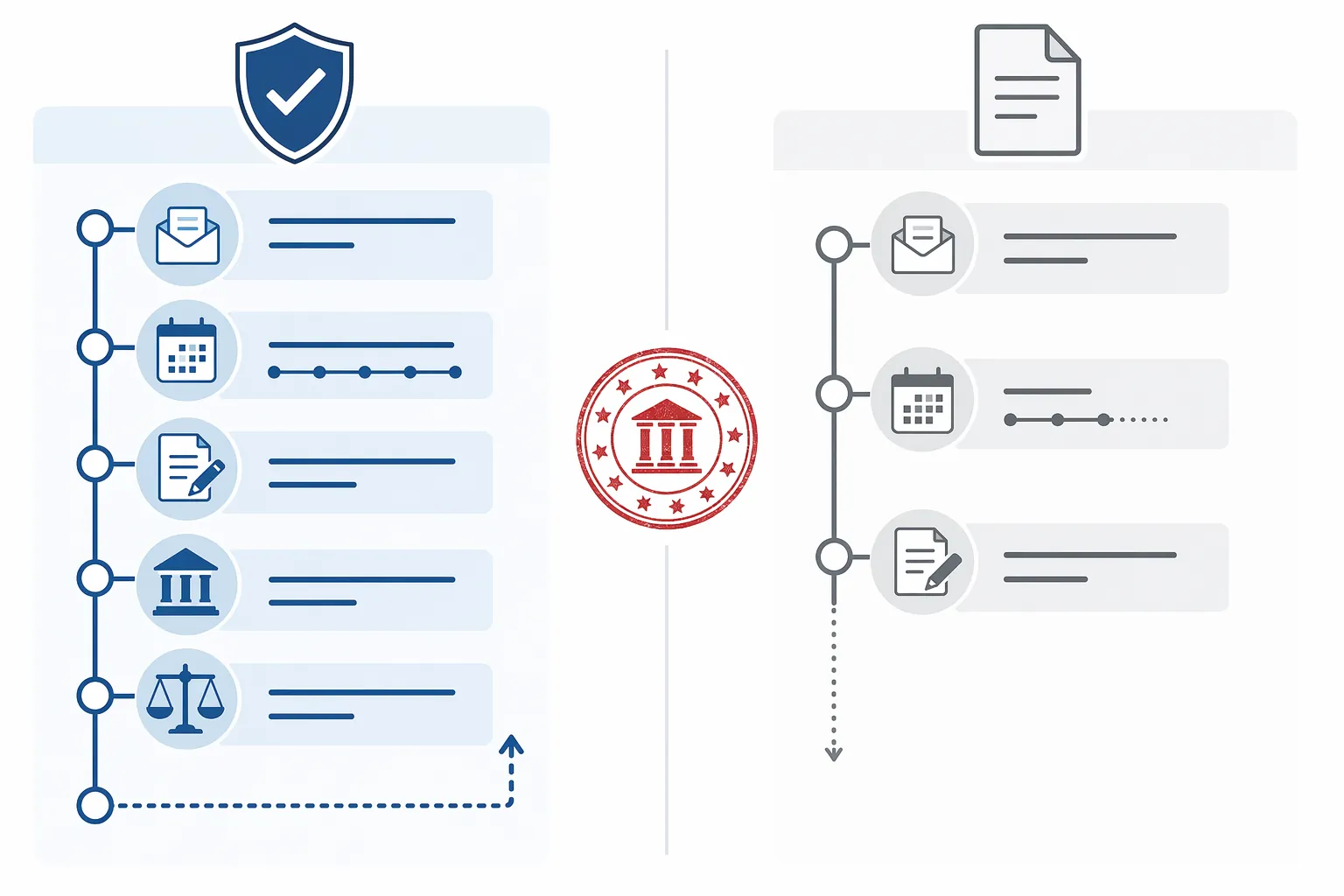
DHS characterized the IFR as procedural and invoked the foreign affairs function as part of its basis for bypassing ordinary notice-and-comment rulemaking.[2] Those characterizations now matter because the challenge is not only about sympathy for people who received enormous fines. It is about whether the agency could remove procedural protections through an interim rule while insisting that the change was procedural enough, or foreign-affairs-related enough, to avoid the usual pre-enforcement public testing.
| Procedural feature | What changed under the June 2025 IFR | Why it matters |
|---|---|---|
| Notice before fine | Notice-of-intent-to-fine procedures were eliminated. | The first document a person receives may carry far more immediate consequences. |
| Time to respond | The contest period was set at 15 business days. | Counsel must reconstruct immigration history, notice history, and relief posture almost immediately. |
| Administrative appeal | BIA review was removed. | The normal immigration appellate channel is no longer available for these civil penalties. |
| Rulemaking path | DHS treated the rule as procedural and foreign-affairs-related. | That classification is central to the APA challenge. |
The scale changed faster than the public explanation
The numbers should be read by date and source, not blended into one floating headline. Bloomberg Law reported 65,101 fines totaling about $36 billion as of March 2026.[3] Fox News later reported roughly 103,000 fines totaling about $84 billion, with $1.2 billion collected, as of July 2026.[4] Those figures may reflect program expansion, different cutoffs, different measures of assessed versus collected amounts, or other methodological differences. They should not be treated as interchangeable.
Even the lower March figure is large enough to change the character of the statute. A penalty provision that sat mostly dormant can look like a narrow enforcement tool on paper. A penalty provision generating tens of billions of dollars in assessments becomes something else: a mass administrative debt program layered onto removal proceedings, humanitarian applications, and federal collection systems.
That is the design question behind the $1.8 million notice. The amount does not arrive by accident. It depends on statutory cross-references, daily accrual, agency routing, a shortened contest window, the loss of BIA review, and collection mechanisms that can operate long after the immigration case that supposedly triggered the fine has become difficult to reconstruct.
Who is receiving the fines complicates the government’s absconder narrative
The Padilla-Durbin letter emphasizes that the fines are not landing only on people who simply disappeared after being ordered removed. The senators identify DACA recipients, people applying for green cards, trafficking survivors, VAWA petitioners, U visa petitioners, and others with pending or humanitarian claims among the affected groups.[1] Reporting by The Marshall Project similarly described $1-million-plus fines reaching DACA recipients, green card applicants, and trafficking survivors with pending relief.[5] EL PAÍS reported on the practical meaning of receiving a $1.8 million fine with 15 days to pay or respond.[6]
Those accounts do not prove that every fine is unlawful. They do show why the program cannot be analyzed only as a tool for people who refuse to leave. Immigration status is often procedural before it is final: a person may have an old removal order, a reopened case effort, a pending family petition, a humanitarian application, or a claim dependent on agency delay. If the fines process treats those differences as collection details rather than threshold questions, the burden shifts to the recipient to make the government see a file the government may already possess.
The reporting also matters because it shows the 15-business-day window in its real setting. The recipient has to determine whether the notice is a bill, an agency order, a court document, or a contestable penalty; locate counsel if possible; reconstruct old immigration notices; identify pending applications; and decide whether contesting the fine could expose other risks. A deadline that looks administrable in the Federal Register can function very differently at a kitchen table.
The class action is where the procedure is being tested
The central court-facing challenge is Maria L. v. Noem, filed in the District of Massachusetts in November 2025. Public Justice described the case as a challenge to the federal government’s civil penalty scheme, asserting Fifth Amendment due process claims, Eighth Amendment excessive fines claims, Seventh Amendment jury trial claims, and APA claims.[7] The Legal Aid Society’s case materials similarly identify the lawsuit as challenging the fines program and its procedures.[8]
The due process theory is the most immediately connected to the June 2025 IFR. If the government can impose life-altering civil penalties with limited notice, a 15-business-day contest period, and no BIA review, the question becomes whether the remaining process is meaningful before the debt hardens. The APA theory looks upstream, asking whether DHS lawfully used an interim final rule and whether its procedural and foreign-affairs justifications can carry the weight placed on them.[2][7]
The Eighth Amendment argument presses a different point: proportionality. A $1.8 million civil fine imposed on a person with little or no realistic ability to pay is not automatically unconstitutional merely because it is enormous. But the size of the fine, the conduct punished, the recipient’s circumstances, and the statutory purpose all become relevant to whether the penalty is excessive.[7]
The Seventh Amendment claim adds another layer because the government is not only assessing penalties inside an agency process; DOJ has also pursued collection in federal court. Bloomberg Law reported that the government had filed more than 50 collection lawsuits since September 2025 and described default judgments in that collection posture.[3] Once the matter moves from agency notice to federal debt collection, the absence of ordinary adjudicative safeguards becomes harder to treat as a paperwork issue.
The most recent litigation signal in the materials is limited. Law360 reported that migrants sought a stay of DHS’s “life-altering” fines and that the matter involved a July 22, 2026 oral argument on a stay motion.[9] Because only limited accessible reporting is available from that update, the safer conclusion is narrow: emergency relief was being actively litigated in late July 2026, but the ultimate procedural effect depends on the court’s orders, not on the existence of the motion.
Collection is not an afterthought
The fines program is not confined to threatening paper. DOJ collection suits, default judgments, private debt collection contracts, and Treasury offsets turn immigration penalties into ordinary debt-enforcement events with extraordinary origins. The Lever reported that four private debt-collection companies had contracts connected to the effort and described Treasury offset seizures of joint tax refunds, including from families with U.S. citizen spouses on active military duty.[10]
That collection posture changes who experiences the penalty. A spouse expecting a joint refund can feel the consequence. A legal aid lawyer may first discover the fine while trying to untangle an offset. A respondent may have missed the 15-business-day contest window before understanding that the document was not just another immigration notice. At least one $1.8 million fine reportedly grew to $2.3 million with fees, a detail that matters less as a dramatic anecdote than as evidence that the assessment is only the starting number once collection costs attach.[10]
This is also where fine rescission and self-departure incentives enter the analysis. Fox News reported administration claims involving a $2,600 stipend and fine rescission upon verified departure through the CBP Home app, along with about 100,000 app users and 2 million claimed voluntary departures.[4] The Marshall Project reported that attorneys and demographers disputed aspects of those figures and described the fines as pressure that may push immigrants to self-deport.[5] The important distinction is between use of an app, verified departure, and the effect of a massive fine on a person’s choice. Those are related facts, not the same measurement.
A dormant statute became a mass enforcement system
The historical baseline is thin but important. The Center for Immigration Studies, a pro-enforcement think tank, has described INA §274D as seeing no use from 1996 to 2017, 26 fines during the first Trump administration, and rescission under the Biden administration in 2021.[11] That account should be read with its institutional perspective in mind, but the narrow historical claim is useful: whatever one thinks of enforcement policy, this was not a routinely used mass penalty system for most of the statute’s life.
The current controversy therefore does not turn only on whether Congress authorized civil fines somewhere in the INA. Congress did. The harder question is whether an old civil penalty can be operationalized at modern scale through a rule that removes notice and appeal protections, then paired with federal debt collection tools against people whose immigration posture may still be legally active.
What the letter may change, and what it cannot
The Padilla-Durbin letter cannot by itself stop DHS from issuing fines, prevent DOJ from filing collection suits, vacate default judgments, or restore BIA review. Anyone facing a fine still has to treat the notice, contest deadline, collection posture, and any pending immigration relief as immediate legal problems.
Its value is institutional. It concentrates the factual allegations in one dated congressional demand. It ties the affected populations to the June 2025 IFR’s procedural changes. It gives litigants a public oversight document to cite when arguing that the agencies had notice of due process, excessive fines, jury trial, and APA concerns. It gives appropriators and committee staff a foundation for hearings, riders, document requests, or statutory amendments.
That is a narrower result than a “stop” bill, but it is not nothing. In administrative enforcement, records matter before remedies arrive. The July 17 letter does not end the fines program. It marks the point at which the program’s statutory basis, regulatory shortcut, affected populations, and collection apparatus were placed together in the congressional record while the same machinery was already under constitutional and APA challenge in court.
References
- Padilla, Durbin Demand DHS, DOJ Halt Improper $1.8 Million Fines on Law-Abiding Immigrants, padilla.senate.gov, July 17, 2026.
- Federal Register 90 FR 27439, Federal Register, June 27, 2025.
- Trump Is Taking Immigrants to Court, Seeking Millions in Fines, Bloomberg Law.
- Fox News report on immigration civil fines, CBP Home app use, and collections, Fox News, July 2026.
- How Fines of $1-Million-Plus May Pressure Immigrants to Self-Deport, The Marshall Project.
- A $1.8 million fine and 15 days to pay, EL PAÍS English.
- New Lawsuit Challenges Federal Government's Unconstitutional Civil Penalty Scheme, Public Justice, November 2025.
- Maria L. v. Noem case page, The Legal Aid Society.
- Migrants Seek Stay Of DHS' Life-Altering Fines, Law360, July 2026.
- The Lever reporting on immigration fine collection contracts and Treasury offsets, The Lever.
- DHS and DOJ Begin Imposing (Often Massive) Fines on Aliens Who Refuse to Leave, Center for Immigration Studies.
Comments
Join the discussion with an anonymous comment.