
Pamela Smart's new trial motion after 35 years reached a Merrimack County courtroom on July 20, 2026, in a posture that was both narrow and difficult: Smart appeared by video from Bedford Hills Correctional Facility in New York while Judge James Kennedy heard argument on whether alleged transcript errors at her 1991 trial can now support habeas relief.[1][2]
The question was not whether the case remains famous. It plainly does. The better question is whether this hearing gave Smart a legally usable path toward a new trial, or whether it mainly sharpened the reasons the state's dismissal motion remains hard to get around.

Smart's current petition turns on a specific claim about what jurors saw while they listened. Her lawyers say the trial transcripts included the words "killed," "busted," and "murder" even though those words were not audible on the original recordings, and that jurors received those transcripts while hearing muffled surreptitious audio.[3][4]
That is the part of the hearing worth taking seriously without overstating it. A transcript shown beside unclear audio is not a neutral courtroom prop if the writing supplies meaning the ear cannot reliably detect. But in habeas practice, a troubling possibility still has to pass through rules about preservation, prior litigation, newly discovered evidence, reliability, and prejudice. A judge does not grant a new trial because a new exhibit is interesting.
The transcript theory is about expectation, not just transcription
The most consequential factual dispute in the petition is not simply whether a court reporter or police transcript got three words wrong. It is whether those words, once placed on paper, could have trained jurors to hear what the recording itself did not clearly contain.
Smart's attorney Matthew Zernhelt described a commissioned forensic study involving 191 participants. According to coverage of the hearing, the study found that when participants were given a written transcript while listening to muffled audio, the written words produced an "insurmountable cognitive bias" toward those words even when the words were absent from the recording.[1]
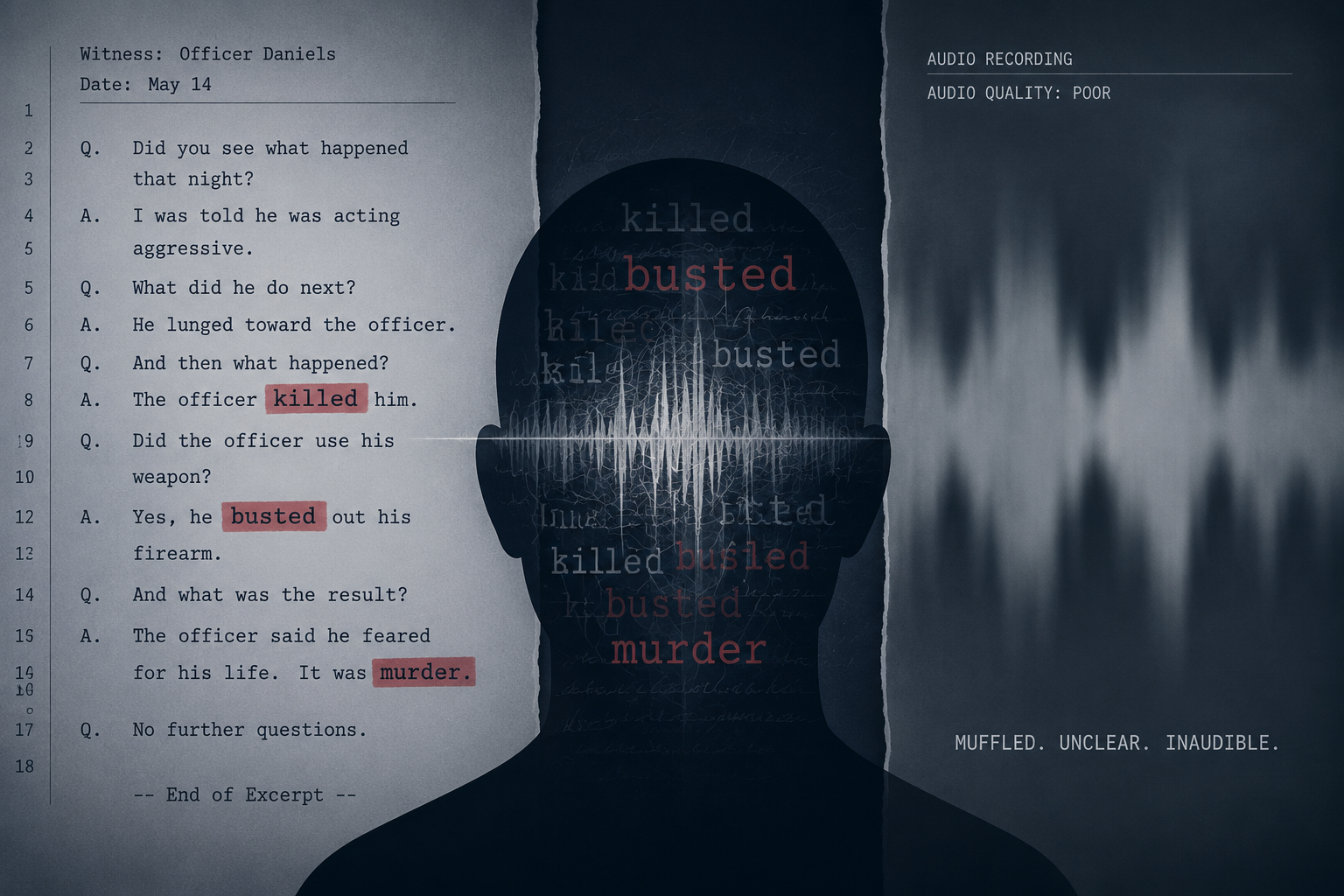
If that description is accepted, the argument has a cleaner shape than many late innocence claims. It does not ask the court to reweigh every piece of trial evidence after three and a half decades. It asks whether a specific trial procedure may have converted a visual cue into perceived auditory evidence. The alleged error matters because the jurors were not merely reading background material; they were using written language while trying to interpret disputed recordings.
The study also does work that an ordinary appellate argument could not. A lawyer can argue that transcripts are suggestive. A cognitive-bias study tries to show how suggestion operates: the written word becomes an expectation, the expectation becomes perceived sound, and the listener may remember the sound as if it came from the recording rather than the page. That is why Smart's team frames the study as newly developed science, not merely as a new lawyer's way of describing an old transcript objection.
The limitation is just as important. The study was commissioned for Smart's litigation, has not been peer-reviewed, and has not been independently published; its full methodology and data are not publicly available in the current reporting.[1][2] Those facts do not make it useless, but they do make any broad claim premature. A court may treat it as a litigation-generated expert submission rather than as settled science, especially at the dismissal stage.
| Question before the court | Why it matters |
|---|---|
| Were the challenged words actually inaudible on the recordings? | Without that predicate, the cognitive-bias theory loses much of its force. |
| Can the 191-participant study qualify as newly discovered evidence? | That is the bridge Smart needs between new science and habeas review. |
| Does the lack of peer review or public methodology limit reliability? | The court can find novelty insufficient if the study is not yet adequately tested. |
| Were these transcript issues already raised or available earlier? | A procedurally barred claim may fail before the court reaches the merits. |
The state is fighting on procedure first
The state's response is not built around proving that cognitive bias can never matter. Assistant Attorney General John Drennan's opposition argues that Smart's claims are procedurally barred because they were already raised on direct appeal or could have been raised earlier.[5]
That is a conventional habeas move, and a powerful one. Courts do not generally allow a petitioner to relitigate old claims by attaching a new label to them. If the court characterizes the petition as another transcript challenge, the state has a straightforward path: the claim was available long ago, the conviction has already been reviewed, and finality has legal weight.
The state also points to the trial judge's instruction that the recordings, not the transcripts, controlled if jurors perceived a conflict between them.[5][6] That instruction matters because appellate courts often presume jurors follow the court's directions. University of New Hampshire law professor Daniel Pi told WMUR it is "more likely than not that the state will prevail in its motion to dismiss" for that reason.[6]
The presumption is not a small technicality. It is one of the judiciary's practical operating assumptions. Without it, many trial-management tools would become appellate traps: limiting instructions, curative instructions, transcript-use instructions, and evidentiary boundaries would all become easier to defeat after verdict. Smart's petition asks the court, in effect, to consider whether cognitive science can show that this particular kind of instruction did not cure the problem.
That is the seam in the case. If the study is treated as genuinely new evidence about how transcript-induced expectation works, it may help Smart argue that earlier courts lacked the scientific basis now being offered. If the study is treated as a case-specific attempt to revive an old transcript issue, the procedural bar becomes the dominant fact. The hearing did not dissolve that distinction; it put it in front of Judge Kennedy.
The old trial matters here as procedural terrain
Smart was convicted in 1991 in connection with the 1990 killing of her husband, Gregg Smart, in a trial that became one of the first fully televised murder trials in the United States.[7] That media history explains why each new filing still becomes news. It does not answer the present habeas question.
The more relevant history is procedural. Smart's prior post-conviction efforts include a federal habeas petition denied in 2002 and affirmed in 2004, a New Hampshire Supreme Court petition denied in 2023, a commutation request denied by the Executive Council in 2022, and Governor Kelly Ayotte's denial of a new commutation hearing in May 2025.[7] Those events do not decide the current petition, but they explain why the state can argue that the case has had multiple rounds of review.
The release of the four co-conspirators also sits in the background, though it does less legal work than it often receives in public discussion. Billy Flynn and Patrick Randall were released in 2015 after 25 years; Vance Lattime was released in 2005; and Raymond Fowler was released in 2003.[7] That contrast is politically and emotionally obvious. It does not, by itself, establish that a conviction was constitutionally defective or that a new trial is required.
There is also reported uncertainty outside New Hampshire. Available reporting identifies a concurrent habeas filing in the Southern District of New York, but does not provide its status. That uncertainty should stay where it belongs: noted, not filled with speculation.
What the judge has to decide now
Judge Kennedy took the matter under advisement after hearing argument from both sides, with a ruling expected within 30 to 60 days of the July 20 hearing.[1][2] As of Q3 2026, no ruling has been issued in the available reports.
The first decision may be whether the petition survives the state's motion to dismiss at all. If it does not, the cognitive-bias study may remain a notable litigation exhibit without becoming a vehicle for a new trial. If it does, the court may have to confront more directly whether newly developed cognitive science can satisfy the legal demands placed on newly discovered evidence.
The phrase "newly discovered evidence" is doing real work here. Evidence can be newly commissioned without being newly discovered in the legal sense. A theory can be novel without being admissible. A study can be suggestive without being reliable enough to alter a judgment. And even reliable expert evidence may not excuse a claim that the court finds could have been litigated earlier.
That does not make the petition empty. The transcript claim identifies a concrete trial mechanism: written words allegedly supplied meaning while jurors listened to unclear audio. The 191-participant study gives that mechanism a cognitive-science vocabulary. For habeas purposes, however, vocabulary is not enough. The court still has to decide whether the study changes the legal posture of the claim, not merely whether it changes how the claim sounds.
The hearing therefore advanced Smart's argument in a limited way. It put before the court a serious question about transcript-induced expectation bias and about whether science developed after trial can reopen a closed record. It also exposed the central obstacle: the state does not need to disprove every cognitive-bias proposition if it persuades the court that the claims are barred, previously available, or insufficiently reliable at this stage.
For now, the law is left in that narrower place. Smart has introduced a novel question about transcripts, muffled recordings, and juror perception. Novelty is not the same as admissibility, reliability, or procedural escape. Judge Kennedy's pending decision will determine whether the study becomes a doorway into further review or another exhibit left outside the habeas gate.
References
- Pamela Smart seeks new trial in husband's 1990 murder, cites inaccurate transcripts, NHPR, July 20, 2026.
- Pamela Smart, serving life, seeks new trial as judge weighs petition, Daily Camera/AP, July 20, 2026.
- Pamela Smart says transcripts doomed her to prison, InDepthNH.org, July 20, 2026.
- Pamela Smart requests court reconsider her conviction 35 years later, Boston Herald, January 6, 2026.
- State asks court to dismiss Pam Smart's latest bid for freedom, InDepthNH.org, May 27, 2026.
- State seeks dismissal of Pamela Smart petition to overturn 1991 murder conviction, WMUR.
- Pamela Smart, Wikipedia.
Comments
Join the discussion with an anonymous comment.