
Panasonic's July 16, 2026 recall of the NB-G200 electric toaster oven is a small recall by product-count standards, but it is a useful one for consumer legal rights because the record is unusually clean. The U.S. Consumer Product Safety Commission notice identifies Recall No. 26-618, about 11,480 units sold in the United States and about 2,184 sold in Canada, and a specific defect: insufficient fiberglass insulation on the power cord, creating shock and fire hazards. The reported incident history is also specific: four reports of tripped breakers, one report of unit failure, and no reported fires or injuries as of the notice date.[1]
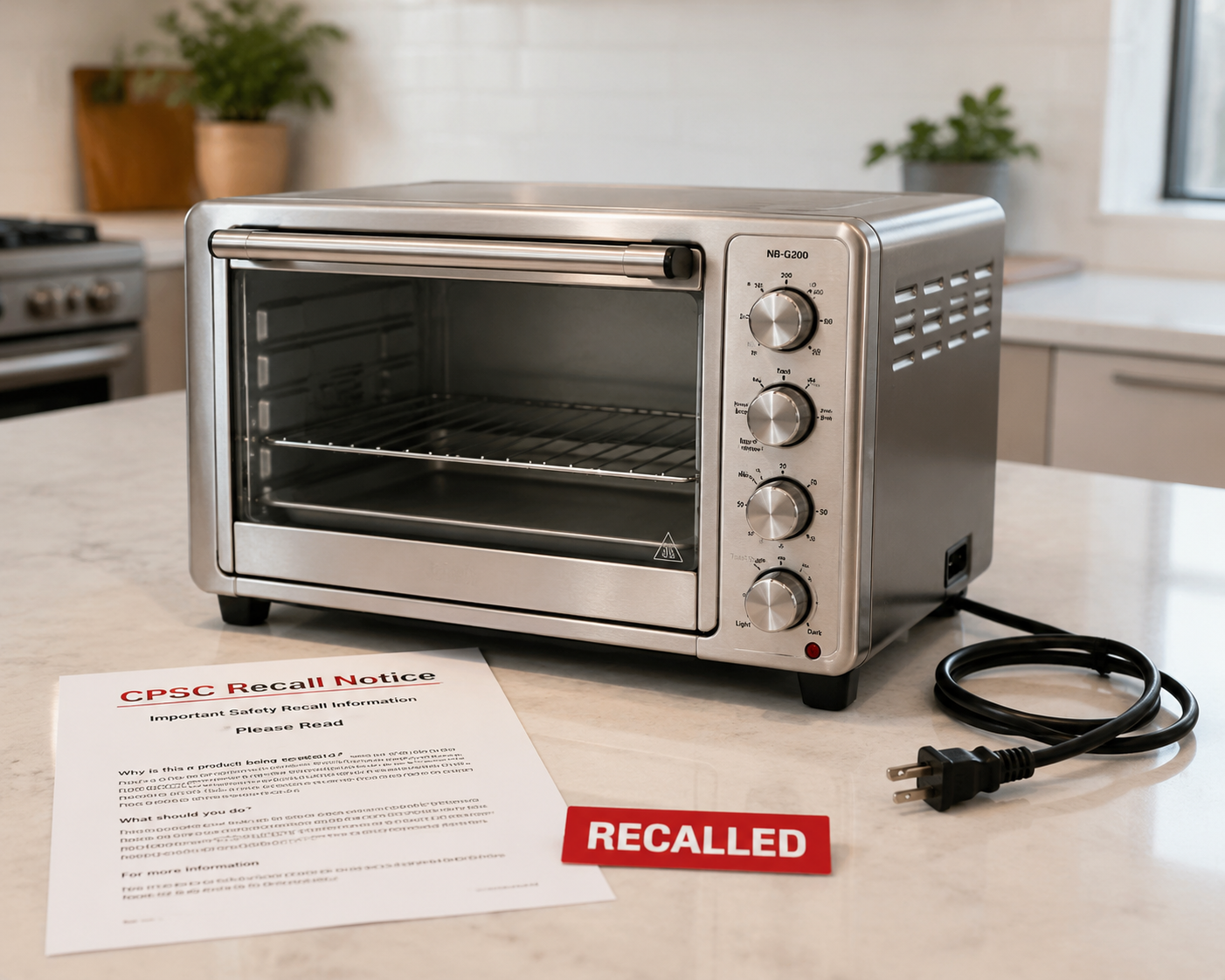
That combination matters. A recall notice is not a complaint, a verdict, or an admission that every purchaser has a damages claim. It is, however, a federal safety action with immediate consequences. For anyone tracking consumer legal rights after the Panasonic toaster recall, the first split is between rights that already exist under the recall remedy and claims that plaintiffs' lawyers may later try to plead under state product-liability law.
The Recall Remedy Is the Present Right
The CPSC notice gives consumers the instruction that drives the rest of the legal analysis: stop using the recalled toaster oven and contact Panasonic for a refund. The notice describes the remedy as a full refund and directs consumers to Panasonic's recall process.[1] Panasonic's own recall portal supplies the operational terms that consumers and retailers will actually have to navigate, including refund instructions and a no-receipt policy.[2]
That no-receipt term is not a minor customer-service detail. In many product recalls, the practical value of the remedy turns on whether the purchaser can still prove the transaction, identify the retailer, or locate a dated receipt. Panasonic's portal narrows that friction point by stating that a receipt is not required for the recall refund process.[2] For consumers, that makes the recall remedy less dependent on ordinary proof-of-purchase habits. For counsel, it also means the existing federal remedy should be evaluated before assuming that a purchaser's only path is litigation.
The remedy also defines what the consumer is being asked to give up. The instruction is not to keep using the oven while waiting to see whether the cord overheats, trips a breaker, or fails. The recall tells owners to remove a household appliance from service because the power cord insulation may be inadequate for safe use.[1] That creates familiar practical burdens--lost use, refund administration, disposal or return steps--but those burdens sit inside a concrete recall framework rather than an open-ended promise to make purchasers whole for every possible consequence.
What the Defect Finding Does, and Does Not, Prove
The CPSC's defect language will be the most important public document if later claims are filed. It fixes the product, the hazard, the affected population, and the incident history in a way that neither a retailer listing nor a law-firm intake page can. The identified condition is not a vague performance problem. It is insufficient fiberglass insulation on the power cord, tied by the agency notice to shock and fire hazards.[1]
In later litigation, that language could support several kinds of arguments. Plaintiffs may point to it when arguing that the product contained a design or manufacturing defect, that the risk was knowable, or that warnings and instructions were inadequate for the hazard. Defense counsel will press the narrower reading: the recall notice establishes the terms of a voluntary corrective action and describes reported incidents, but it does not by itself decide causation, damages, state-law defect standards, or punitive exposure.
The incident count is equally important because it keeps the posture honest. Four tripped breakers and one unit failure are not the same as burn injuries, kitchen fires, or property-loss claims. The CPSC notice reports no fires and no injuries.[1] That does not make the defect legally irrelevant; many product-liability theories concern unreasonable risk before catastrophic harm occurs. But it does affect the damages picture, class-certification incentives, and the likely distance between refund administration and personal-injury litigation.
Resale Is No Longer an Ordinary Marketplace Question
The recall also changes the position of anyone still holding inventory or considering resale. The CPSC notice states that it is illegal to sell, resell, or otherwise distribute recalled consumer products, citing the Consumer Product Safety Act's recall framework under 15 U.S.C. Section 2064.[1] That prohibition is separate from whether any individual purchaser has suffered an injury.
For retailers, secondary sellers, liquidators, and online marketplace participants, the legal significance is immediate. Once the product is recalled, the issue is not merely whether the item can be discounted, relabeled, or sold with a warning. Distribution of a recalled consumer product is itself restricted under the federal recall regime.[1] That is why recall compliance often becomes a supply-chain exercise as much as a consumer-notice exercise: inventory has to be identified, listings have to come down, customer-facing instructions have to match the approved remedy, and returned units cannot simply drift back into commerce.
The manufacturer-side reporting frame is also worth keeping in view, though it should not be overstated for this recall. CPSC business guidance explains that companies must report immediately, generally within 24 hours, when they obtain information that reasonably supports the conclusion that a product contains a defect that could create a substantial product hazard, while allowing a limited 10-working-day period for a firm to investigate when it is genuinely uncertain whether reporting is required.[3] That guidance explains the compliance architecture behind voluntary corrective actions; it does not add facts about when Panasonic first knew of the NB-G200 issue.
Why Plaintiff-Side Interest Still Matters
The early plaintiff-side signal is real but should be kept in its lane. Johnson//Becker's page states that the firm is accepting cases involving the Panasonic toaster oven recall and describes potential product-liability claims connected to the recalled units.[4] That is a litigation-market signal, not the same thing as a filed class complaint, a judicial finding, or a settlement program beyond the recall remedy.
As of July 19, 2026, the materials reviewed for this article did not establish that a class action complaint had been filed over the NB-G200 recall. That distinction matters because a law-firm intake page can precede a lawsuit by days, weeks, or forever. It may reflect genuine investigation, client screening, and theory development; it may also never mature into a filed pleading if the facts do not support damages, common issues, or viable state-law claims.
If claims are filed, the most likely theories would follow the shape of the public defect record. A design-defect theory could focus on the adequacy of the power-cord insulation and whether a safer feasible design should have been used. A failure-to-warn theory could focus on whether consumers received adequate warnings about shock or fire risk before the recall. Warranty or consumer-protection theories could appear as well, but the present record most strongly supports analysis around defect, notice, and remedy rather than a broad claim of realized injury.
The absence of reported injuries does not end that analysis. Plaintiffs sometimes pursue economic-loss theories on the ground that consumers paid for a product later identified as unsafe, or that the recall remedy did not fully compensate them for the loss of use and related inconvenience. Those theories are highly dependent on state law, product representations, warranty terms, and the adequacy of the recall remedy. The CPSC notice would be useful evidence in that fight, but it would not relieve plaintiffs of proving the elements of their chosen claims.
The Practical Posture on July 19, 2026
The cleanest current statement is narrower than much of the early recall commentary may suggest. Consumers who own the Panasonic NB-G200 have a defined recall remedy: stop using the product and pursue the refund process identified by CPSC and Panasonic.[1][2] Sellers and distributors face an active federal prohibition on resale or distribution of recalled units.[1] Lawyers have begun looking for clients, but the public materials reviewed here do not yet turn that solicitation into filed litigation.[4]
For legal professionals, the document to keep closest is still the recall notice. It supplies the defect description, the incident baseline, the unit count, and the remedy terms. If litigation follows, that notice will likely become an evidentiary anchor for both sides: plaintiffs will use it to frame risk and notice; defendants will use its limits--especially the absence of reported fires or injuries--to resist overstatement. The recall creates present rights and compliance duties now. Liability remains a later question.
References
- Panasonic Recalls Electric Toaster Ovens Due to Shock and Fire Hazards, U.S. Consumer Product Safety Commission, July 16, 2026
- NB-G200/205 Product Recall Information July 2026, Panasonic
- Duty to Report to the CPSC: Your Rights and Responsibilities, U.S. Consumer Product Safety Commission
- Panasonic Toaster Ovens Recall Lawsuit, Johnson//Becker
Comments
Join the discussion with an anonymous comment.