
The Tour de France story became a legal story in the least sporting way possible: not with a mountain attack or a disputed time gap, but with a Paris judge authorizing anti-doping officials to wake riders in the middle of the night. Jonas Vingegaard and Tadej Pogačar were reportedly tested at about 2 a.m. and 5 a.m. during the July 18–19, 2026 window, after authorization from a juge des libertés et de la détention, or JLD, at the Paris judicial court.[1]
That detail matters more than the hour on the hotel clock. Late or early testing is not, by itself, alien to anti-doping systems. The unusual feature is the institutional route: French authorities confirmed that the JLD was contacted pursuant to Article L.232-14-4 of the French Sports Code, a provision that allows nocturnal anti-doping controls only after judicial authorization under specified conditions.[2]
The available record remains thin in exactly the places lawyers would want it to be thick. The JLD order has not been published. The application materials have not been published. The International Testing Agency has not disclosed whether the samples were blood, urine, or both, or which substances or methods were being targeted. So the question is not whether anyone doped. On the public facts, that cannot responsibly be answered. The question is what legal mechanism allowed anti-doping officials to obtain a kind of coercive access that ordinary sports rules do not usually route through a judge.
What Article L.232-14-4 adds
Article L.232-14-4 is not a general license for inconvenient testing. As described in the reporting on the Tour controls, the provision requires a judicial officer to authorize the control, and the statutory standard is framed around “serious and concordant suspicions” of an anti-doping violation, along with a risk that evidence could disappear if the control does not occur during the otherwise protected nighttime period.[3]
The provision also matters because of who decides. The JLD is not part of the cycling anti-doping chain of command. The judge is asked to authorize an intrusion before it occurs, in a procedure that resembles the structure of a criminal search-warrant application: an authority presents reasons; the affected person is not present; the judge decides whether the legal threshold is met. That resemblance should not be overstated. This is not a criminal prosecution, and the testing remains anti-doping enforcement. But the architecture is familiar from coercive public-law procedure: independent pre-authorization before entry into a protected sphere.
The Paris prosecutor’s confirmation therefore does more than authenticate a news cycle. It identifies the legal hinge. The JLD was not merely notified after the fact. The judge was contacted under the French Sports Code provision that makes authorization part of the condition for the nighttime control.[2]
There is also a proportionality component. The French mechanism requires strict proportionality between the infringement of individual rights and the anti-doping objective pursued.[3] That requirement is easy to flatten into a general fairness phrase, but it is doing more specific work. It asks whether this particular intrusion, at this particular time, is justified by the evidentiary need asserted to the judge.
The comparison is not night testing versus no night testing
The useful comparison is narrower. It is not that French law permits night testing while international anti-doping rules forbid it. WADA’s International Standard for Testing and Investigations contemplates testing between 11 p.m. and 6 a.m. where there are valid grounds for doing so.[4] The UCI Anti-Doping Rules similarly recognize that sample collection during that nighttime period may occur on the basis of a serious and specific suspicion.[5]
| Issue | French Article L.232-14-4 route | WADA/UCI internal testing route |
|---|---|---|
| Decision-maker | JLD provides independent judicial authorization | Anti-doping authorities operate within internal testing framework |
| Suspicion language | Serious and concordant suspicions | Valid grounds under WADA; serious and specific suspicion under UCI |
| Procedure | Ex parte application before the control | No ordinary requirement of external judicial pre-authorization |
| Rights framing | Strict proportionality requirement under French-law mechanism | Regulatory anti-doping compliance framework |
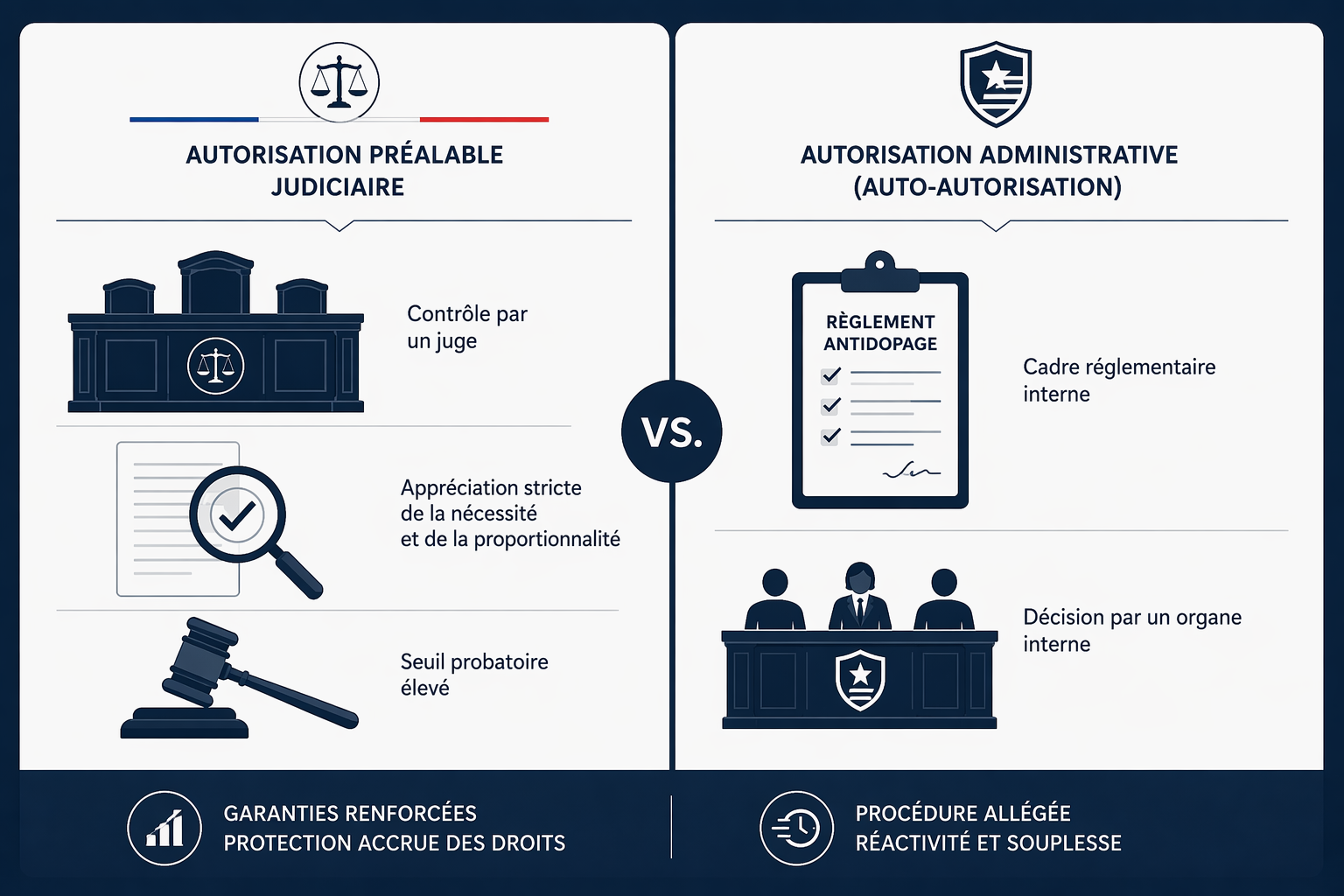
That difference is not semantic tidiness. “Serious and concordant suspicions” is not the same phrase as “serious and specific suspicion.” The public materials do not allow a confident ranking of every possible application of those standards, but the French formulation is at least more formalized and is placed before an independent judicial actor. The UCI standard remains internal to the anti-doping system. Article L.232-14-4 brings in a judge before the rider’s door is knocked on.
Anti-doping rules already know how to be inconvenient. They are designed around surprise, whereabouts obligations, and the preservation of time-sensitive biological evidence. French law did not invent that need; it changed the institutional safeguard attached to one particularly intrusive use of it.
Why investigators would want this tool
There is a serious enforcement argument for flexibility. In April 2026, ITA Director General Benjamin Cohen said he favored the possibility of nighttime testing where there are “very concrete suspicions,” and the ITA has defended the need for effective testing in circumstances where timing can affect detection.[6] That is not a theatrical concern. Elite anti-doping enforcement often operates against substances, methods, and dosing patterns where delay may matter.
But the public record does not identify the concrete suspicion in this case. It does not identify the biological matrix collected. It does not identify a targeted substance or method. Without the order or application, any attempt to connect the 2 a.m. and 5 a.m. controls to a particular microdosing theory would be speculation dressed as legal analysis.
That restraint cuts both ways. The absence of public detail does not prove overreach. Search-warrant-style mechanisms are often opaque at the authorization stage because disclosure can compromise an investigation. The same feature that protects evidence, however, also leaves the affected person and the public unable to evaluate whether the suspicion was substantial or thin.
The rider complies first
The ex parte character of the procedure is the point at which the legal safeguard becomes procedurally lopsided. The rider is not present when the authorization is sought. Counsel does not test the factual basis for suspicion before the judge. The rider learns of the decision when compliance is required.
At that moment, the anti-doping regime leaves little practical room for resistance. Under the UCI rules, refusal or failure to submit to sample collection can itself constitute an anti-doping rule violation, regardless of what the uncollected sample would have shown.[5] That is a sensible enforcement rule in ordinary testing: a system built on surprise controls cannot function if athletes can decline whenever the timing is inconvenient. In the Article L.232-14-4 setting, it also means the rider cannot realistically litigate the sufficiency of suspicion at the hotel-room threshold.
The riders’ union response captured the other side of that bargain. The CPA questioned the use of intrusive methods and asked for clarity about how and why such nighttime controls are deployed.[2] That objection should not be read as a demand for athlete immunity from testing. It is a demand for an account of process when anti-doping enforcement borrows the posture of coercive public authority.
The “first application” claim needs careful handling
Several reports treated the Tour episode as an unprecedented use of the French provision. The stronger version of that claim appears to trace back to an unnamed anti-doping source cited by L’Équipe, who said this was the first application of Article L.232-14-4 since its enactment in 2015.[7]
That may be true. It is also not the same as an official institutional confirmation. On the materials currently public, the careful formulation is that this appears to be the first known or first reported application since 2015, based on the L’Équipe-sourced anti-doping account. The difference matters because “first-ever” language tends to carry more authority than the available sourcing can bear.
The Paris prosecutor’s office did confirm the judicial authorization route, and other cycling outlets reported that the tests were formally authorized at the Paris judicial court.[8] That confirmation is enough to analyze the mechanism. It is not enough, by itself, to reconstruct the confidential evidentiary showing made to the JLD.
A judicial safeguard without an obvious remedy
Article L.232-14-4 gives anti-doping officials something valuable: access to an unusually intrusive testing window when a judge is persuaded that serious and concordant suspicions and evidentiary risk justify it. It gives riders something too, but only in a limited sense: the intrusion must be pre-authorized by someone outside the anti-doping apparatus.
What it does not obviously provide is a meaningful after-the-fact remedy if the suspicion proves unfounded and the samples are negative. The rider has still been awakened, subjected to a coercive control, and placed under an investigative shadow during the Tour’s most visible weeks. The judicial authorization may have been perfectly lawful on the information presented. The sample may reveal nothing. Those two propositions can coexist.
France has shown a path for anti-doping controls that uses independent judicial authorization to unlock nocturnal testing under a formal suspicion threshold. It is more legally structured than ordinary internal testing rules, and in that respect it is a safeguard. But the rider still complies first, cannot contest the suspicion at the point of control, and may have no corresponding remedy if the suspicion leads nowhere.
References
- Vingegaard's and Pogacar's night-time doping tests authorised by Paris judge, The Guardian, July 20, 2026.
- Judge approved night-time Tour de France doping tests, AFP via France24, July 20, 2026.
- Inside the rulebook: why Pogačar and Vingegaard were tested overnight, VeloRa Cycling, July 20, 2026.
- International Standard for Testing and Investigations, World Anti-Doping Agency.
- UCI Anti-Doping Rules, Union Cycliste Internationale.
- Why were Tour de France riders tested in the middle of the night?, Cyclingnews, July 21, 2026.
- L'Équipe anti-doping source report on Article L232-14-4 first application, L'Équipe.
- Paris judicial court authorization reporting on Tour de France night tests, Cycling Up To Date, July 20, 2026.
Comments
Join the discussion with an anonymous comment.