
Nolberto Meza was working when the chase reached him. On June 20, 2026, the Venezuelan immigrant delivery driver was riding a moped on the Taft Bridge in Washington, D.C., when a stolen Kia fleeing U.S. Park Police struck and killed him, according to reports on the incident and the family’s civil claims.[1]
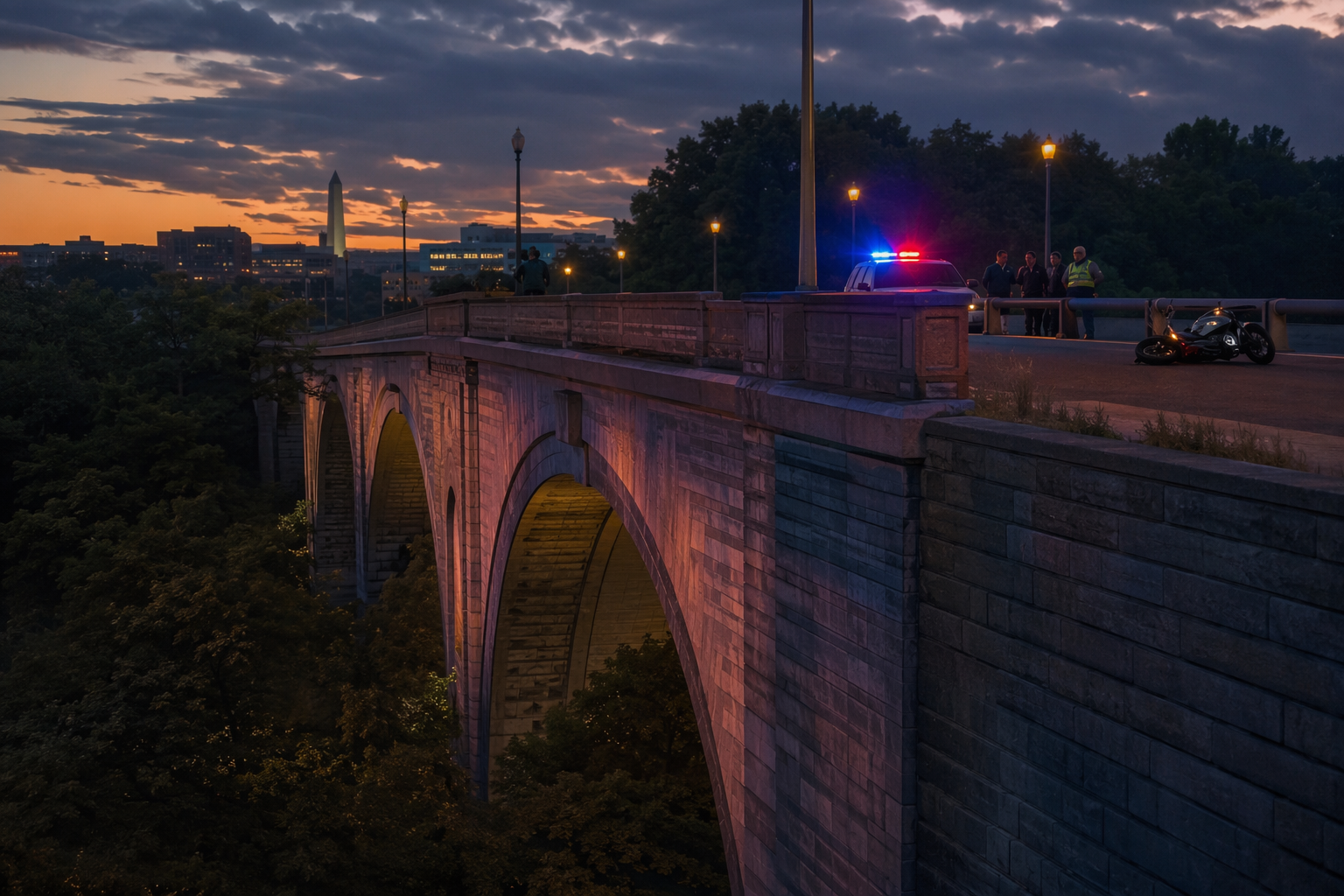
The pursuit was not simply an officer’s split-second departure from settled practice. Before August 2025, Park Police policy limited pursuits to suspects in violent crimes such as murder, rape, aggravated assault, robbery, burglary, kidnapping, and arson. A temporary policy change put in place on August 14, 2025 replaced that restriction with a standard allowing chases for any violation, and the policy had not been rescinded when Meza was killed.[2]
That is the hinge in the lawsuit now taking shape. The family’s case is not only about whether the driver of the Kia bears civil responsibility. It is about whether the federal government can be held liable for changing the rules in a way that made this chase permissible in the first place.
The policy shift matters because it changed the answer before the chase began
A pursuit policy does its most important work before anyone turns on lights and sirens. It tells officers which suspected violations justify the danger of a chase and which do not. Under the prior Park Police rule, a stolen vehicle pursuit would have required analysis through a narrower violent-crime lens. Under the August 2025 temporary policy, the reported pursuit of the stolen Kia fit within the newly relaxed standard because chases were permitted for any violation.[2]
The White House executive order signed on August 25, 2025, titled “Additional Measures to Address the Crime Emergency in the District of Columbia,” supplied the broader federal crime-control setting for the D.C. policy shift.[3] The operational Park Police change had already been codified on August 14, according to reporting on the policy, and remained in force through Meza’s death.[2]
The government will have room to argue that the order and the chase are not the same thing. That distinction matters. Executive language, agency implementation, officer discretion, the fleeing driver’s conduct, and Meza’s death are separate links. But the family’s strongest institutional theory begins with a blunt factual point: the old rule would have narrowed pursuit authority; the new rule widened it; the chase that killed Meza occurred under the widened rule.
Interior Secretary Doug Burgum’s later remark that the policy change was “so much fun,” reportedly made during an August 26, 2025 cabinet meeting, is not proof of negligence by itself.[2] It is, however, the kind of statement plaintiffs’ lawyers notice because it may color how a court or jury understands the seriousness with which officials weighed foreseeable risk.
The FTCA is the cleanest institutional route, but not an easy one
For claims aimed at the Park Police and the federal decision structure behind the pursuit, the Federal Tort Claims Act is the most natural starting point. It lets plaintiffs seek damages from the United States for certain negligent acts by federal employees, often by translating the claim into the kind of negligence or wrongful death theory that would apply to a private actor under state law.
In Meza’s case, the FTCA theory would likely focus on negligent policy, negligent implementation, failure to train, or failure to control pursuit practices after the August 2025 relaxation. The family would need more than the fact that Meza died. They would need to show that federal actors adopted or maintained a pursuit rule that created an unreasonable risk, that officers acted within that risk, and that the risk materialized in a way the law treats as sufficiently connected to the death.
That last part is where the case tightens. A court can accept that the policy permitted the chase and still ask whether the fleeing driver’s conduct was an intervening criminal act that cuts off federal liability. The family’s answer will be that flight is not an unforeseeable bolt from the sky in a police pursuit case. It is the very behavior pursuit policy is supposed to anticipate.
The government’s answer is equally predictable. It will likely argue that officers were responding to public danger created by a stolen vehicle, that the immediate lethal conduct came from the fleeing driver, and that policy choices about when to pursue require discretion. If the court treats the August 2025 change as a protected policy judgment rather than a negligent operational decision, the FTCA path narrows sharply.
Officer-level claims have a different problem
Civil rights lawyers will also look at officer-level claims. Section 1983 is the familiar vehicle when state or local officials violate constitutional rights under color of state law. Park Police officers are federal officers, which makes the fit more complicated. A plaintiff looking for a constitutional damages remedy against individual federal officers generally runs into the narrower and more contested Bivens framework rather than ordinary §1983 practice.
That distinction is not academic. A state police chase case may move through established §1983 channels, with disputes over deliberate indifference, substantive due process, seizure, and qualified immunity. A federal Park Police case asks a threshold question about whether the court will recognize or extend an individual-capacity damages remedy at all. The family may plead officer-level theories, but those claims do not substitute neatly for an FTCA theory against the United States.
The facts also matter differently for individual officers. The question is not simply whether the August 2025 policy was unwise. It is whether the officers’ pursuit decisions, under the circumstances they faced, violated a legally enforceable constitutional standard. If the pursuit complied with the relaxed policy, that may help the officers on internal-rule compliance while hurting the government on policy causation. The same fact can point in opposite directions depending on the defendant.
The fleeing driver remains a defendant in the story, even if not the whole story
A state wrongful death claim against the fleeing driver is the most straightforward moral claim and probably the simplest civil theory to understand. The driver fled, the chase continued, the Kia struck Meza, and Meza died. Nothing about federal policy erases the driver’s role.
But that claim does not answer the institutional question. Civil plaintiffs often pursue multiple defendants because different actors may have contributed to the same death in different ways. The fleeing driver may be the immediate cause. The family’s federal theory asks whether Park Police policy created the conditions under which that immediate cause became more likely and more dangerous.
The collapse of the criminal case against the fleeing suspects complicates that route. D.C. prosecutors dropped second-degree murder and related charges against the driver and passenger in the Meza case, citing insufficient evidence.[1] That does not bar a civil wrongful death case, which uses different standards and procedures. It does remove a possible source of factual leverage: there will be no criminal conviction, at least on those dropped charges, for the family to point to as an adjudicated account of the chase.
The data puts pressure on the public-safety rationale
The government does not have to prove that every pursuit is safe. It will argue that some pursuits are necessary because letting suspects flee creates its own danger. That argument is strongest when the suspected offense is grave and the need for immediate apprehension is obvious. It is weaker when pursuit authority expands across a much broader category of violations.
The pursuit-risk record is not a mystery. A 2023 vehicle-pursuits report associated with the Police Executive Research Forum and the Justice Department’s Office of Community Oriented Policing Services reported that crashes occur in at least 30% of pursuits and that more than 20% of serious injuries are inflicted on people who were not involved in the pursuit.[4]
The same policy debate is sharpened by the reported initiating reasons for pursuits. DOJ-linked data cited in the pursuit-policy discussion indicates that more than 90% of pursuits are initiated for traffic violations.[4] That figure does not prove what happened in Meza’s case by itself, and a stolen vehicle is not merely a broken taillight. But it does undercut any broad claim that expanded pursuit authority operates only at the outer edge of violent necessity.
A 2024 JAMA Network Open study identified 4,415 pursuit fatalities between 2017 and 2021.[5] That number is not a verdict on the Park Police, and it does not establish causation in Meza’s lawsuit. It does make one point hard to dismiss: fatal pursuit outcomes are a known category of risk, not a freak legal abstraction discovered after the fact.
Meza was also not the first fatality linked in reporting to the relaxed Park Police pursuit policy. Eighteen-year-old Josue Chavez was killed in a Park Police pursuit in March 2026, after the same policy change.[2] Two deaths do not prove a pattern sufficient for liability on their own. They do make it harder to treat the Taft Bridge crash as an unforeseeable one-off detached from the August 2025 decision.
Where the family’s case is strongest, and where it can still fail
The strongest part of the family’s case is the sequence. The Park Police had a narrower chase rule. The rule changed. The new rule permitted pursuits for any violation. The policy remained in place. Officers pursued a stolen Kia. The chase reached Taft Bridge. Meza, who was delivering food on a moped, was killed.[1][2]
That sequence gives plaintiffs a cleaner causation story than many policy-liability cases. They do not have to argue only that the government failed to predict a vague danger. They can argue that pursuit crashes and bystander injuries were a documented risk, that the government relaxed a rule designed to limit exposure to that risk, and that the exact kind of harm occurred.
The hard part is translating that story into legal responsibility. Courts do not impose liability merely because a policy made a tragedy possible. They ask whether the policy was a proximate cause, whether intervening conduct broke the chain, whether the challenged decision is shielded by immunity or discretionary-function principles, and whether the applicable cause of action reaches the defendant the family has sued.
On proximate cause, the family’s best framing is foreseeability. If a policy authorizes more pursuits, and pursuit data shows meaningful crash and bystander-injury risks, then a bystander death during a newly authorized chase is not remote in the ordinary sense. The government’s best framing is attenuation. It will point to the fleeing driver, the stolen Kia, the real-time decisions on the road, and the gap between a high-level public-safety policy and a particular collision.
On immunity, the government will likely describe the August 2025 shift as a policy judgment made in response to D.C. crime conditions. Plaintiffs will try to recast the issue as operational negligence: not whether federal officials may fight crime, but whether they may discard a violent-crimes-only pursuit restriction without adequate regard for a known class of bystander deaths.
On the dropped charges, the family has a practical evidentiary problem rather than a complete legal defeat. Without a criminal case moving forward on second-degree murder and related charges, plaintiffs may have less access to developed prosecution theories, sworn testimony, and judicial findings about the fleeing suspects’ conduct. Civil discovery can still build a record, but it will have to do more work.
The real test is whether policy causation counts
Meza’s family does not need to prove that every Park Police pursuit under the relaxed policy was unlawful. The civil case turns on a narrower proposition: whether this policy change foreseeably enabled this pursuit, and whether that connection is strong enough for a court to treat the United States or individual officers as legally responsible for a bystander’s death.
That is also where the government’s defense will concentrate. It will try to move the court’s attention away from the August 2025 rule and toward the stolen Kia, the fleeing driver, and the emergency conditions of the chase. The family will try to keep the policy in the frame because the policy is what changed the answer before the chase began.
A federal court may ultimately decide that the causal chain is too attenuated from the executive order and temporary pursuit policy to support liability. Or it may decide that when the government relaxes a rule limiting high-risk chases, leaves that change in force, and a non-involved delivery driver is killed in the resulting pursuit, the policy decision is not background noise. It is part of the case.
References
- The Park Police allow chases. One just ended in a deliveryman's death. — The Washington Post, June 27, 2026
- Trump changed the rules for Park Police. Now an innocent man is dead. — Popular Information
- Additional Measures to Address the Crime Emergency in the District of Columbia — White House, August 25, 2025
- PERF/DOJ Vehicle Pursuits Report — Police Executive Research Forum / U.S. Department of Justice Office of Community Oriented Policing Services, 2023
- JAMA Network Open pursuit fatalities study — JAMA Network Open, 2024
Comments
Join the discussion with an anonymous comment.