
The Pentagon's more than $200 billion supplemental request turns the Iran war into a spending fight before it is anything else. Congress has not declared war and has not enacted a specific authorization for the conflict, so the request lands in the one place where Article I still has obvious force: the decision about whether money flows at all. [1][2]
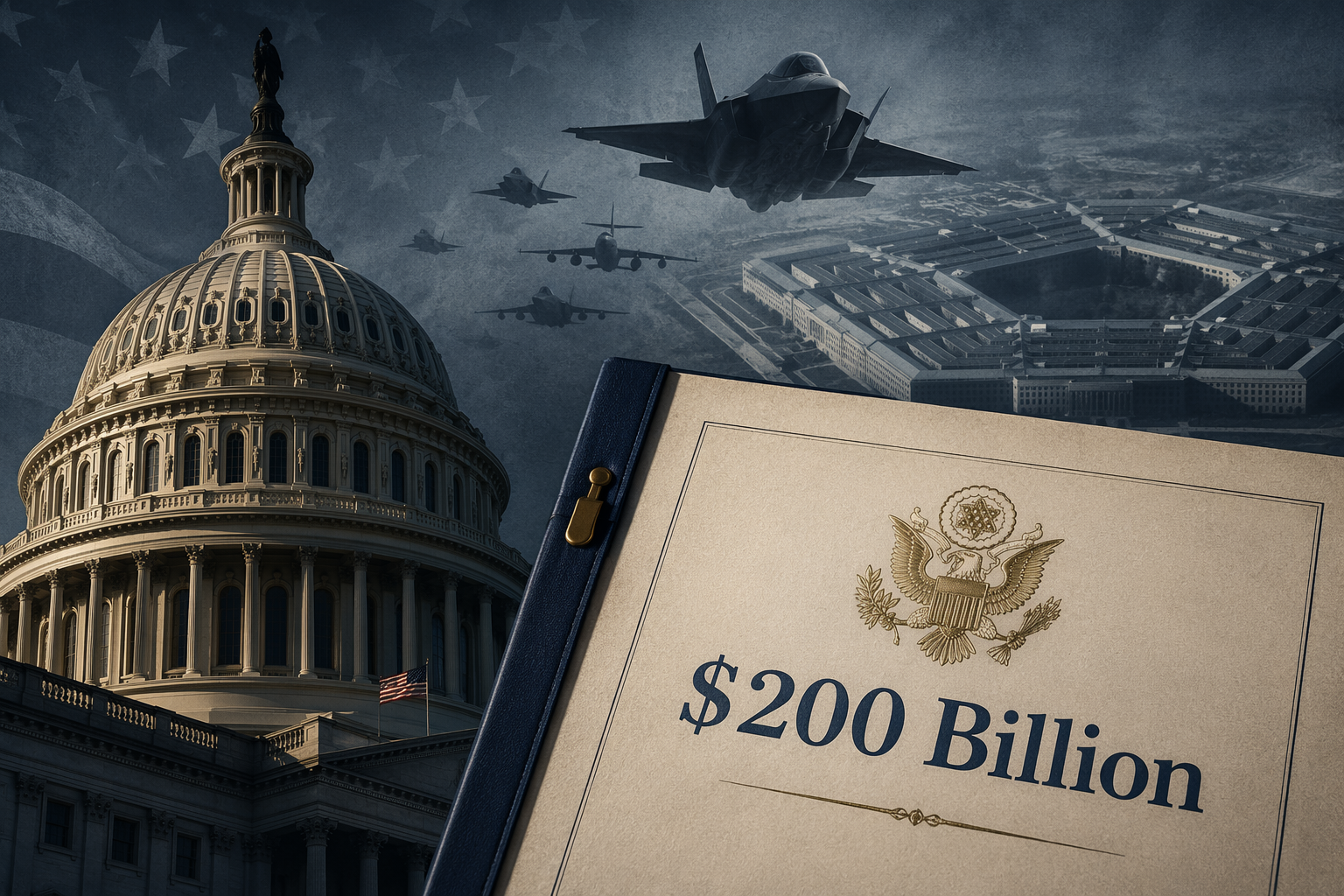
Where Article I Bites
The legal importance of the request is not the dollar figure by itself. It is the fact that a war the political branches have not formally authorized still depends on a supplemental appropriation to keep going. That is the moment when Congress's power of the purse stops being a slogan and becomes the only concrete leverage the legislature has left.
A 2018 OLC opinion captured the core point in plain terms: 'the use of force cannot be sustained over time without the acquiescence, indeed the approval, of Congress, for it is Congress that must appropriate the money to fight a war or a police action.' [3] That does not settle every constitutional argument, but it does identify the strongest one. If Congress wants to constrain an unauthorized conflict, it does not need to prove the war unlawful in the abstract. It needs to refuse or condition the money that sustains it.
The administration's Article II theory is vulnerable for the same reason. A Brookings study group concluded in March 2026 that a nation-state conflict of this magnitude exceeds any prior OLC Article II-only theory. [4] That is a careful formulation, not a dramatic one: it means the executive's claimed inherent authority is already at the edge of what prior lawyers have been willing to say, while Congress's appropriations power remains textually plain.
What Congress Can Actually Use
Congress does not have to invent a new procedure to try to shut the spigot. The available tools are ordinary, but they work differently in practice.
| Tool | What it does | Main constraint |
|---|---|---|
| Standalone prohibition bill | Directly bars funding for the war or a defined activity | Clean text, but easy to stall if leadership will not move it |
| NDAA amendment | Places a funding restriction on defense authorization legislation | Can travel farther than a freestanding bill, but still faces conference and veto risk |
| Appropriations rider | Attaches a restriction to the money bill itself | Strongest leverage on paper, but only if appropriators keep it in the final package |
If Congress adds a restriction after hostilities begin, the legal debate usually runs through Youngstown's 'lowest ebb' framework, where presidential power is weakest when the executive acts against congressional will. Lawfare's June analysis treats that as the right organizing lens, but it is still an interpretive frame rather than a judicial answer. [6]
Precedent Without Illusion
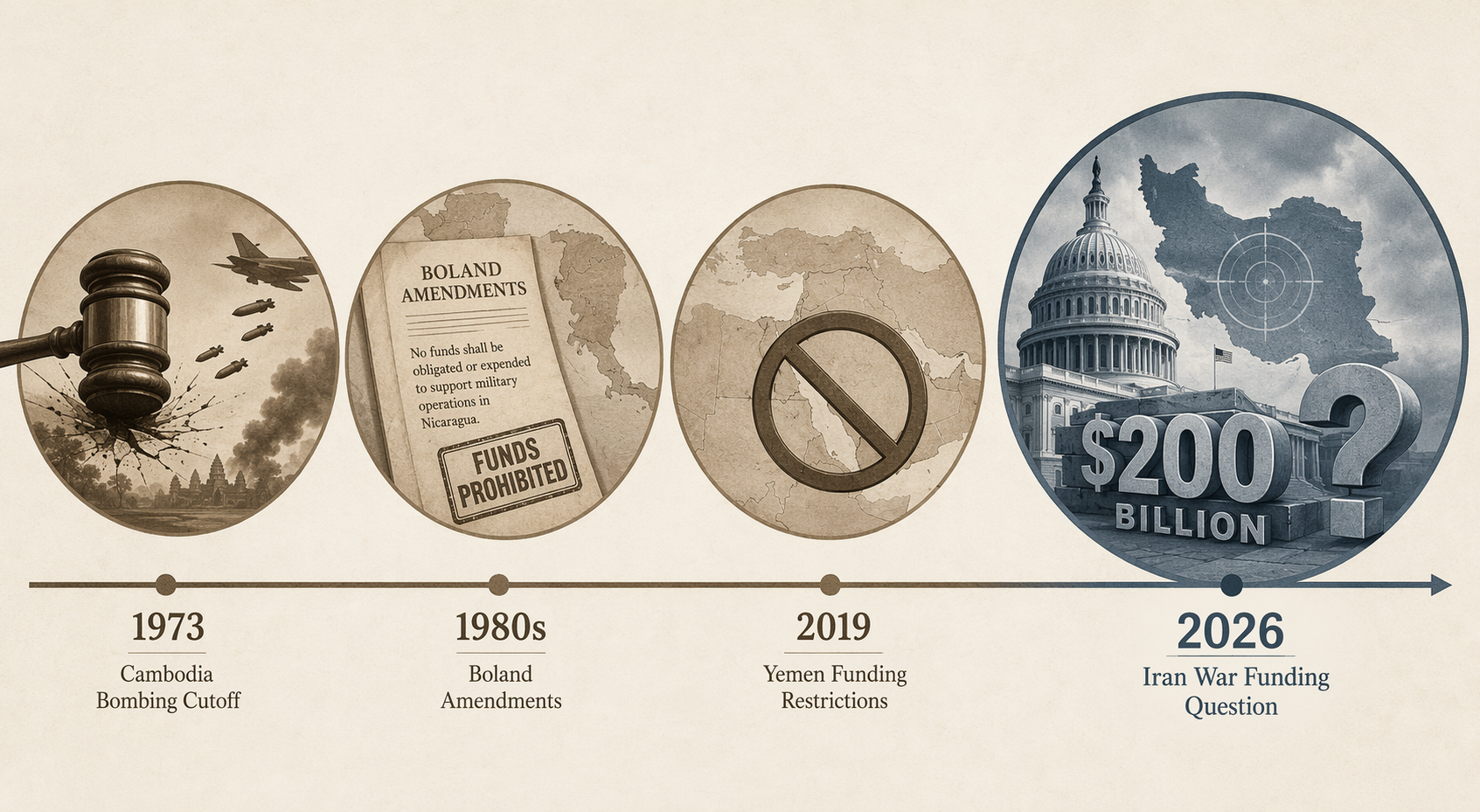
The historical record shows that Congress has used funding pressure before. The 1973 Cambodia bombing cutoff, the Boland Amendments, and the 2019-2021 Yemen funding restrictions all show that appropriations language can reach into an ongoing conflict. [3][5] The harder lesson is that enactment is not the same thing as sustained leverage. Once a war is underway, Congress often proves more willing to announce a limit than to hold it in place when the political cost rises.
None of those precedents is a perfect template for the present fight. Cambodia involved a different operational setting. Boland was about covert aid. Yemen produced narrower funding restrictions than a full stop. Taken together, they support the narrower claim that Congress can impose real limits on military activity, not the broader claim that it will do so reliably when troops are already in the field.
Politics Sets The Limit
With Republicans controlling both chambers, that gap between power and practice is where the current Congress matters most. Speaker Johnson said he supported 'what's needed' but had not seen the detailed request. Rep. Rosa DeLauro called the $200 billion figure 'outrageous,' and Rep. Betty McCollum said she would not 'write blank checks.' [1] Those are the reactions of members who know the size of the ask is politically awkward, but they are not yet the reactions of a chamber prepared to deny the money outright.
The fiscal backdrop makes the request even harder to absorb. CBO projected a $1.9 trillion annual deficit before any supplemental, and the national debt had already surpassed $39 trillion. [1] That does not answer the war-powers question, but it does explain why the request invites scrutiny that goes beyond ordinary appropriations politics.
Congress has the constitutional power to try to defund or terminate an unauthorized war through riders, prohibition bills, or other binding funding limits. The harder question is whether a Republican-controlled Congress will choose to use that power against a supplemental this large. On the present evidence, the legal lever exists, but the political will to pull it remains weak.
References
- Pentagon seeks more than $200 billion in supplemental funding — AP News, March 19, 2026
- H.J.Res. 176 — GovInfo
- War Powers and Trump Iran Strikes — Just Security, February 28, 2026
- Using Military Force in Iran: Domestic and International Law Questions — Brookings, March 10, 2026
- Abandoning the Separation of Powers in Times of War — SCOTUSblog, March 2026
- What Congressional Resolutions Mean for the War in Iran — Lawfare, June 10, 2026
Comments
Join the discussion with an anonymous comment.