
The sharpest legal issue in the Pentagon’s current casualty secrecy fight is not a missing spreadsheet. It is an official finding that the machinery built to produce lawful casualty disclosures may no longer be working. In May 2026, the Defense Department Inspector General reported that the department “may not comply” with its civilian casualties and harm policy, a policy the IG described as “required by Federal law.”[1] That phrasing matters. It does not accuse the department of a one-off delay or a disputed redaction. It points to a compliance system at risk of failing at the level where reports are gathered, reviewed, and made possible.
Congress has not left casualty disclosure to administrative grace. It has enacted overlapping reporting duties for civilian casualties, hostilities, and civilian-harm mitigation. The current record raises a narrower and more serious question than whether the Pentagon is generally secretive: whether the department has preserved legal obligations on paper while removing the offices, data systems, and review structures needed to satisfy them.
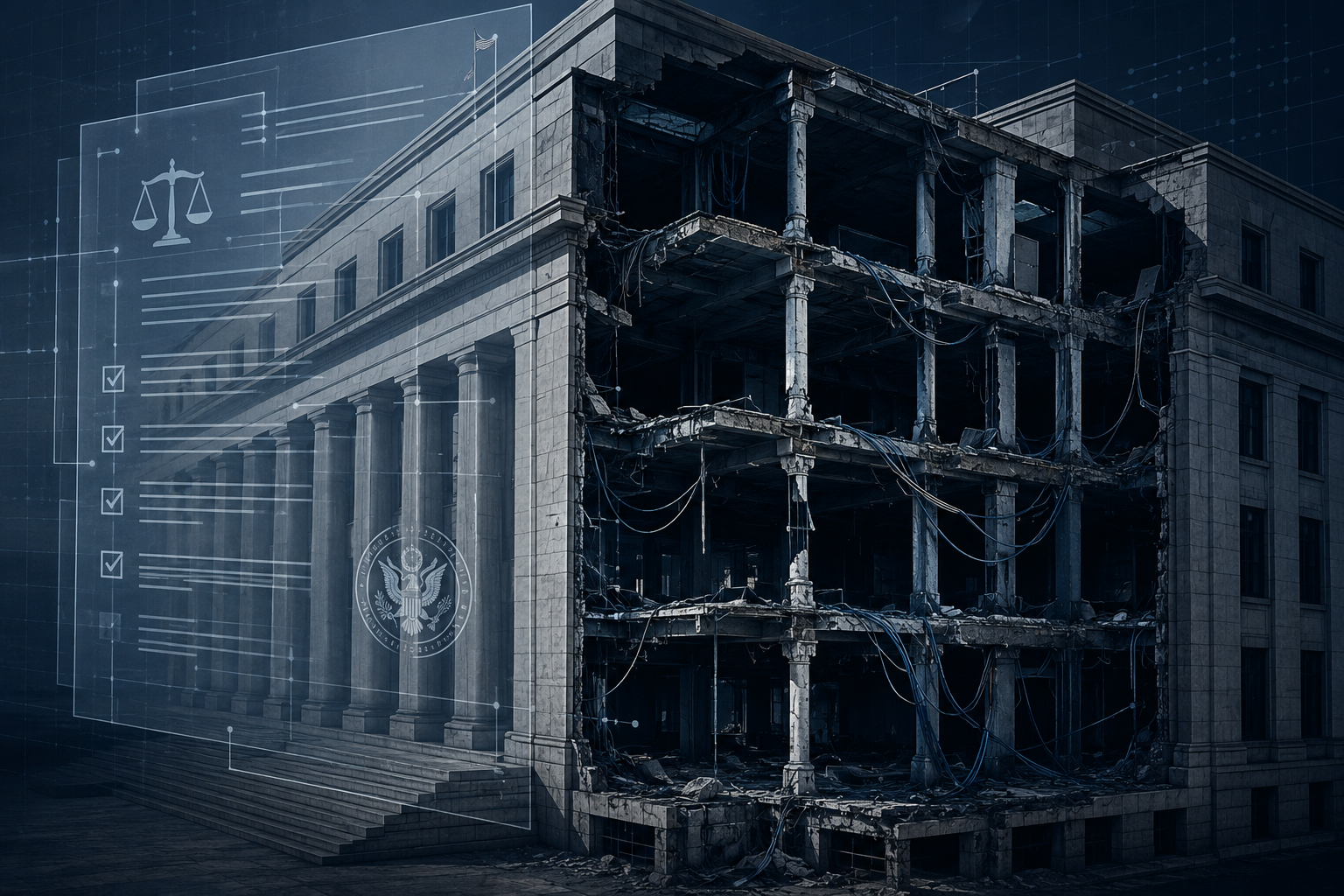
The statutory duties are not decorative
The basic legal architecture begins with annual civilian casualty reporting. Section 1057 of the FY2018 National Defense Authorization Act requires the Defense Department to provide Congress with an annual report on civilian casualties caused by U.S. military operations.[2] The obligation is not merely to answer press questions when convenient. It is a recurring statutory reporting duty to Congress.
Congress later added a faster reporting channel for hostilities. Section 1230 of the FY2024 NDAA requires the president to report to Congress within 48 hours on certain hostilities and to include casualty counts.[3] That provision is aimed at immediacy. It recognizes that casualty information loses oversight value when it arrives only after the operational and political decisions it was meant to inform have already hardened.
A third piece is institutional rather than report-by-report. Section 1082 of the FY2023 NDAA required the Civilian Harm Mitigation and Response Action Plan and the Civilian Protection Center of Excellence.[4] That is the part easiest to underestimate. Congress did not only ask the Pentagon to count civilian harm after the fact. It required a framework for preventing, tracking, analyzing, and responding to it.
| Legal requirement | What it is designed to do | Why the current dispute turns on it |
|---|---|---|
| FY2018 NDAA Section 1057 | Annual civilian casualty reporting to Congress | Creates a recurring disclosure duty that depends on reliable collection and review |
| FY2024 NDAA Section 1230 | 48-hour hostilities reporting to Congress with casualty counts | Makes delay itself legally important when hostilities and casualties are involved |
| FY2023 NDAA Section 1082 | Civilian harm mitigation structures, including the Civilian Protection Center of Excellence | Requires an operating institutional framework, not just a policy memo |
| 10 U.S.C. § 130b | Permits withholding certain personally identifying information of covered personnel | Protects PII, but does not itself explain withholding from Congress or aggregate casualty counts |
Those provisions do different work, but they share a practical dependency: someone inside the department has to collect incident reports, assess credibility, reconcile conflicting battlefield information, maintain data systems, and prepare disclosures. A statutory duty can remain formally alive while being made operationally inert.
The compliance apparatus is the legal story
The May 2026 IG report is significant because it treats implementation as measurable, not aspirational. The report evaluated the department’s implementation of its Civilian Harm Mitigation and Response policy and concluded that the department “may not comply” with that policy.[1] In ordinary oversight language, that is a warning about more than optics. It means the structures that translate a congressional mandate into agency practice may be insufficient, unavailable, or disregarded.
The public record now includes allegations that the Civilian Harm Mitigation and Response program was cut by approximately 90% in staffing, that data management platforms were defunded, and that the steering committee responsible for senior-level coordination was dissolved.[5] Each of those changes has a different administrative label. Together, they point in the same direction: the department allegedly removed the ordinary means by which civilian-harm information would be gathered, standardized, escalated, and reported.
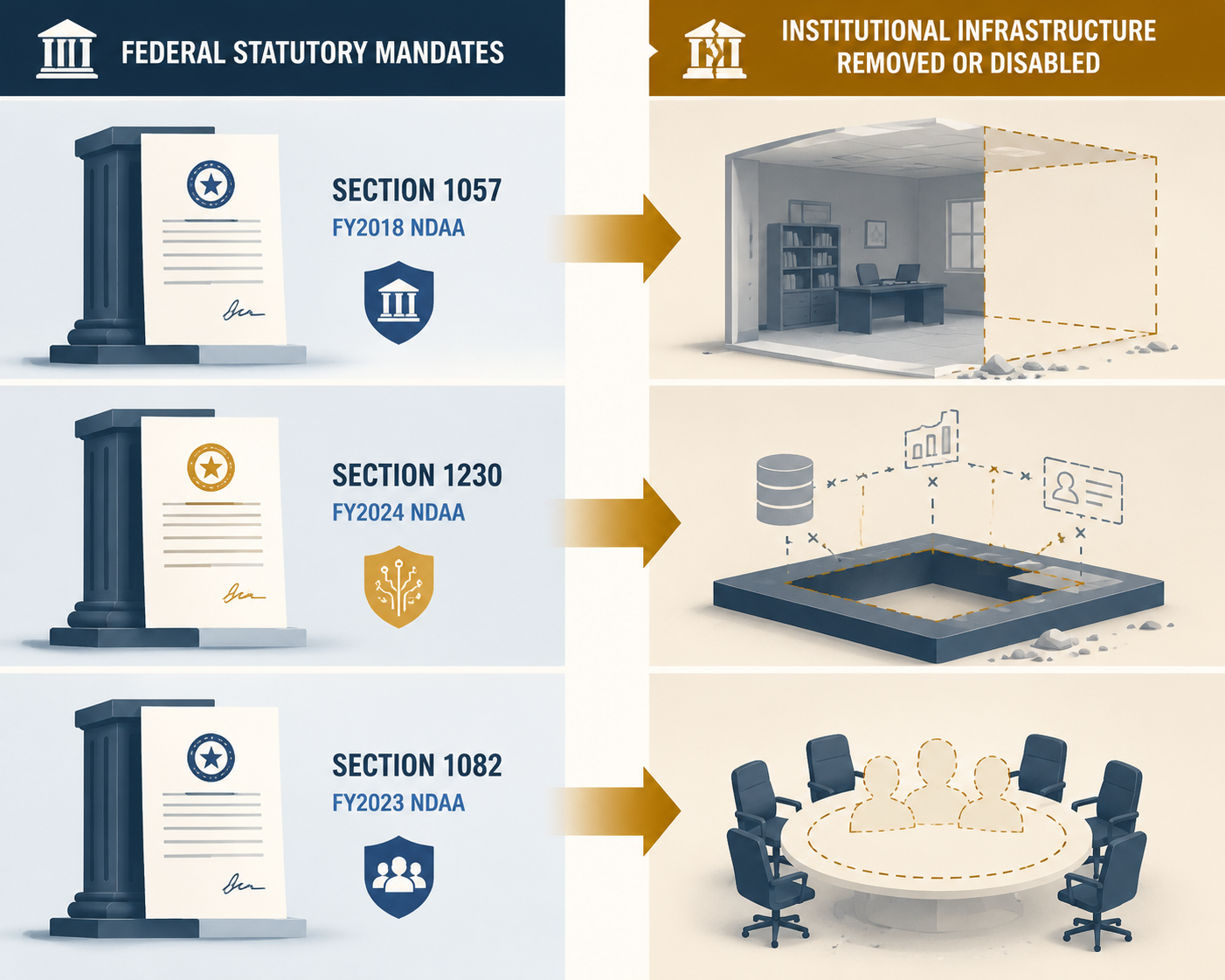
That distinction is central. A department can miss a deadline because a combatant command is still validating information. It can withhold a name because disclosure would identify a service member in a covered overseas unit. It can classify operational details when disclosure would reveal sensitive sources, methods, or military plans. Those are familiar legal and operational categories. They do not automatically account for dismantling a civilian-harm office, cutting the analysts who work the cases, defunding the databases that preserve the record, and dissolving the committee that makes senior officials answer for implementation.
Civilian casualty reporting is not produced by a single final reviewer reading a battlefield press release. It requires incident intake, geolocation, weapons analysis, witness and partner-force information where available, deconfliction with intelligence channels, and a decision about whether an allegation is credible enough to report. The facts in the current record do not show merely that the Pentagon has asserted secrecy. They show an alleged administrative pattern in which the tools Congress required for civilian-harm compliance were reduced or removed.
This is why the IG’s “may not comply” language carries more weight than an outside accusation would. An inspector general evaluation does not bind a court, and it is not a judicial ruling that a specific statute has been violated. But it is an official oversight record that the department’s implementation of a federally required civilian-harm policy may fall short.[1] In the legal architecture of casualty disclosure, that is load-bearing evidence.
What 10 U.S.C. § 130b does, and does not, explain
The troop-casualty side of the dispute requires a different legal lens. The Pentagon has authorities that protect service-member privacy and operational security. One of them, 10 U.S.C. § 130b, permits the withholding of personally identifying information of certain personnel assigned to overseas, sensitive, or routinely deployable units, including information such as name, rank, and duty address.[6]
Section 130b is narrower than many public discussions suggest. It is a PII statute. It does not authorize withholding from Congress.[6] Nor does its text obviously answer why the department could refuse to provide aggregate casualty counts that do not identify individual service members. A total number of troops killed or wounded in a conflict is not the same legal object as a roster containing names, ranks, and duty locations.
That does not mean every aggregate figure must always be public in real time. Classification law and operational-security concerns may apply in particular circumstances, especially if a casualty number would reveal a unit’s size, location, mission, or vulnerability. But the legal rationale has to fit the thing withheld. A statute protecting personally identifying information is a poor match for categorical refusal to provide non-identifying totals, particularly to Congress.
Aggregate casualty numbers are where the rationale thins
The Intercept reported in April 2026 that roughly 750 U.S. troops had been wounded or killed since October 2023, including more than 15 killed in the Iran war, based on its review of available information.[7] CENTCOM, according to that reporting, provided figures that omitted multiple known incidents and then did not answer close to a dozen clarification requests.[7] The same account quoted a defense official describing the pattern as a “casualty cover-up.”[7]
Those figures should be read carefully. They are journalistic findings, not official casualty totals. The point is not that The Intercept’s count has replaced the Pentagon’s. It is that independent reporters were able to identify incidents that appeared absent from the figures CENTCOM supplied, while the command declined repeated opportunities to reconcile the record.[7] In a statutory environment where Congress has required casualty reporting, unexplained silence becomes part of the legal problem.
The distinction between withholding names and withholding counts is not academic. If the department says a wounded service member’s identity is protected, Section 130b may be directly relevant. If the department withholds the number of wounded service members from lawmakers, the statute cuts the other way because it expressly does not authorize withholding from Congress.[6] If the department withholds aggregate totals from the public, Section 130b may protect the underlying identities, but it does not by itself supply a complete explanation for suppressing the total.
This is the vulnerability in the current posture. The public record does not yet show a court holding that the Pentagon’s casualty withholding is unlawful. It also does not show a clean statutory basis for treating aggregate casualty figures as though they were the same thing as protected personnel identifiers. That gap matters most when Congress is the requesting body, because the department’s ordinary withholding tools are weakest where statutory oversight duties are strongest.
Congress is treating dismantling as a possible legal violation
The congressional response has focused less on a single casualty number than on the alleged dismantling of civilian-harm safeguards. Senators Elizabeth Warren and Chris Van Hollen opened an investigation into Secretary Pete Hegseth’s role in dismantling the military’s civilian-harm prevention guardrails, and a group of 10 Democratic lawmakers described the conduct under review as a “potential violation of federal law.”[8] Their letter posed 20 questions to Hegseth and set a July 9, 2026 response deadline.[8]
That inquiry is not a judicial finding either. It is partisan in the ordinary sense that it comes from Democratic lawmakers investigating a Republican administration official. But the legal theory behind it is not merely partisan rhetoric. It tracks the same institutional concern raised by the IG report: when Congress mandates a civilian-harm framework, the executive branch may not be free to hollow it out while claiming the reporting duty remains intact.
The July 9 deadline also has practical significance now that it has passed. Unless and until the department provides a public account that reconciles the staffing cuts, defunded platforms, dissolved committee, and statutory mandates, the oversight record remains asymmetrical: Congress has identified a possible violation, the IG has identified possible noncompliance, and the department has not publicly supplied a legal theory that resolves the mismatch.
Press access is related, but not the center of the casualty statutes
The press-access litigation around the Pentagon belongs in the same transparency climate, but it should not be mistaken for the statutory casualty-disclosure question. In NYT v. Hegseth, Judge Friedman ruled in March 2026 that the Pentagon’s press credential policy violated the First Amendment.[9] The New York Times later argued that the Pentagon’s interim policy was designed to circumvent the court’s order.[9] Separate reporting described the dispute over credentialing and press restrictions as the department attempted to revise its access rules.[10]
That litigation concerns press access and constitutional limits on credentialing policy. It does not decide whether the Pentagon has complied with Section 1057, Section 1230, or Section 1082. Still, it gives context to the casualty dispute because reporters cannot independently test official casualty claims when access narrows, records are delayed, and the department declines to clarify discrepancies. A press policy can make a statutory reporting problem harder to see, even if it is not the source of the statutory duty.
Why independent verification matters
The civilian-casualty record has long depended on outside pressure because official assessments have not always captured what later field reporting finds. FOIA litigation by journalist Azmat Khan and the Reporters Committee for Freedom of the Press helped obtain 5,400 pages of internal Pentagon records concerning civilian casualties.[11] The litigation and reporting revealed evidence of systematic undercounting, including a comparison in which children were present in 62% of strikes Khan visited on the ground but appeared in 27% of the corresponding Defense Department documents.[11]
That history does not prove that every current withheld figure is wrong. It proves something more limited and more useful: official casualty systems can miss harm that independent investigation later documents. When the same department then reduces the civilian-harm staff and systems designed to improve those assessments, the legal concern is not speculative. It sits on top of a documented verification problem.
Older transparency data points in the same direction. The Project On Government Oversight found that FOIA withholding increased 16% from 2014 to 2018 under prior Pentagon secrecy directives.[12] That period is not the Hegseth Pentagon, and it should not be treated as evidence of the present administration’s specific legal compliance. It does show that the department has previously used administrative policy to reduce disclosure without necessarily changing the underlying statutes.[12]
The legal issue is capacity, not just refusal
A useful way to frame the current record is to separate three questions. First, does a statute require reporting? For civilian casualties, hostilities reporting, and civilian-harm mitigation structures, the answer is yes in defined contexts.[2][3][4] Second, does a withholding authority apply to the specific information at issue? For service-member PII, Section 130b may apply; for aggregate casualty counts, the fit is less apparent, especially in communications with Congress.[6] Third, has the department maintained the institutional capacity to comply? That is where the IG report and the reported dismantling of the CHMR program converge.[1][5]
The third question is the one that gives the dispute its legal weight. Agencies often defend secrecy at the point of release: this line is classified, that name is protected, this report is predecisional. Here, the record suggests something upstream. If the civilian-harm office lacks staff, if data platforms are defunded, and if the senior steering committee no longer exists, then the problem may arise before anyone reaches a final redaction decision. The department may lack, or may have chosen not to maintain, the system needed to know what it is legally obliged to report.
That is not a technicality. Congress can require an annual report, but the report is only as lawful as the process that generates it. Congress can require 48-hour hostilities reporting, but speed depends on channels that preserve and elevate casualty information. Congress can require a civilian protection center, but the mandate means little if the center is stripped of personnel and tools. A disclosure statute does not enforce itself from the U.S. Code.
No court has yet ruled that the Hegseth Pentagon’s casualty withholding or civilian-harm restructuring violates a specific federal statute. The current record supports a more careful conclusion: there is a serious statutory-compliance concern. The Pentagon appears to have maintained the formal existence of casualty disclosure duties while disabling, or allowing the disabling of, the systems needed to meet them.
References
- Evaluation of the DoW’s Implementation of the Civilian Harm Mitigation and Response, DoD Inspector General, May 2026,
- Copy 3, Just Security,
- NDAA, Civilians in Conflict,
- Pentagon report: Iran casualty civilian, Stars and Stripes, May 19, 2026,
- Hegseth Trump war civilian casualties Elizabeth Warren Pentagon, ProPublica,
- 10 U.S. Code § 130b - Personnel in overseas, sensitive, or routinely deployable units: nondisclosure of personally identifying information, Cornell Legal Information Institute,
- Iran War US casualty numbers Trump Hegseth, The Intercept, April 1, 2026,
- Warren, Van Hollen Open New Investigation Into Hegseth’s Role in Dismantling Military’s Civilian Harm Prevention Guard Rails, Senator Elizabeth Warren,
- New York Times says Pentagon is ignoring court order on press access, PBS,
- BBC report on Pentagon press access dispute, BBC,
- Azmat Khan civilian casualties, Reporters Committee for Freedom of the Press,
- The Pentagon War on Transparency, Project On Government Oversight,
Comments
Join the discussion with an anonymous comment.