
The puzzle is easy to state and harder to keep in its procedural lane. Peter Navarro and Steve Bannon both defied subpoenas from the House Jan. 6 Committee. Both were convicted of contempt of Congress under 2 U.S.C. § 192. Both served roughly four-month prison sentences. Yet by July 22, 2026, Bannon’s conviction had been vacated by the Supreme Court, while Navarro’s had just been affirmed by the D.C. Circuit.
That does not, by itself, prove inconsistency. On April 6, 2026, the Supreme Court vacated Bannon’s conviction and remanded after the government moved to dismiss the case “in the interests of justice,” citing concerns about the willfulness instruction used at trial.[1] On July 21, 2026, a unanimous D.C. Circuit panel affirmed Navarro’s conviction on the merits, rejecting his executive-privilege theory and emphasizing the absence of evidence that the privilege had actually been invoked.[2]
The useful question is not whether the two men deserved different outcomes. It is why the records gave the Justice Department and the courts different routes. The answer turns less on executive privilege as an abstract doctrine than on what was in the file: Bannon had a written direction from Trump’s counsel; Navarro had his own account of a short call. That difference mattered because contempt under § 192 requires willfulness, and willfulness is where a defendant’s reliance on counsel can become more than atmosphere.
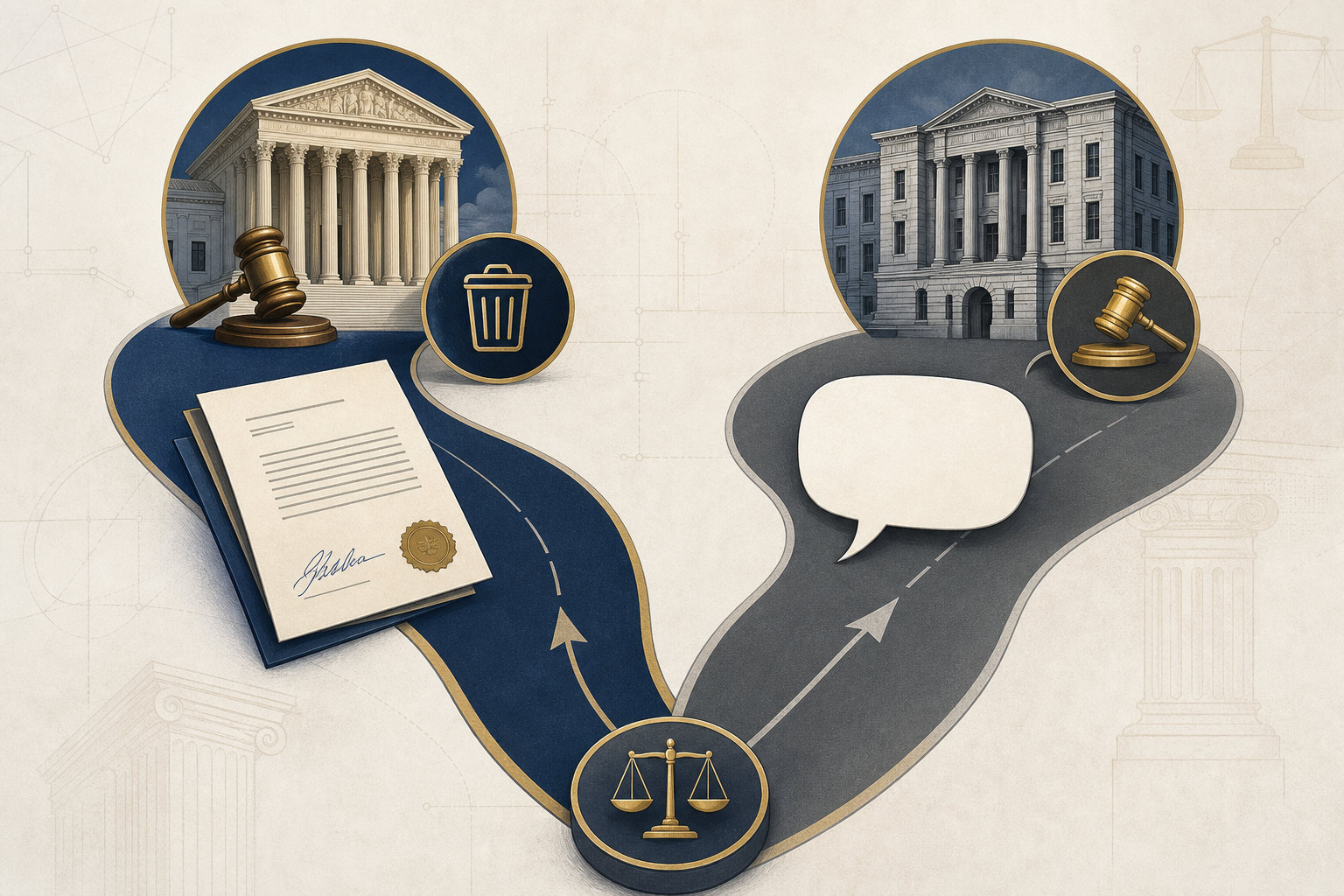
The Same Statute, Different Records
Navarro and Bannon reached court through the same statutory doorway. Section 192 makes it a misdemeanor for a summoned witness to refuse to answer questions or produce papers before Congress. The government’s burden was not merely to show noncompliance; it had to prove the refusal was willful.
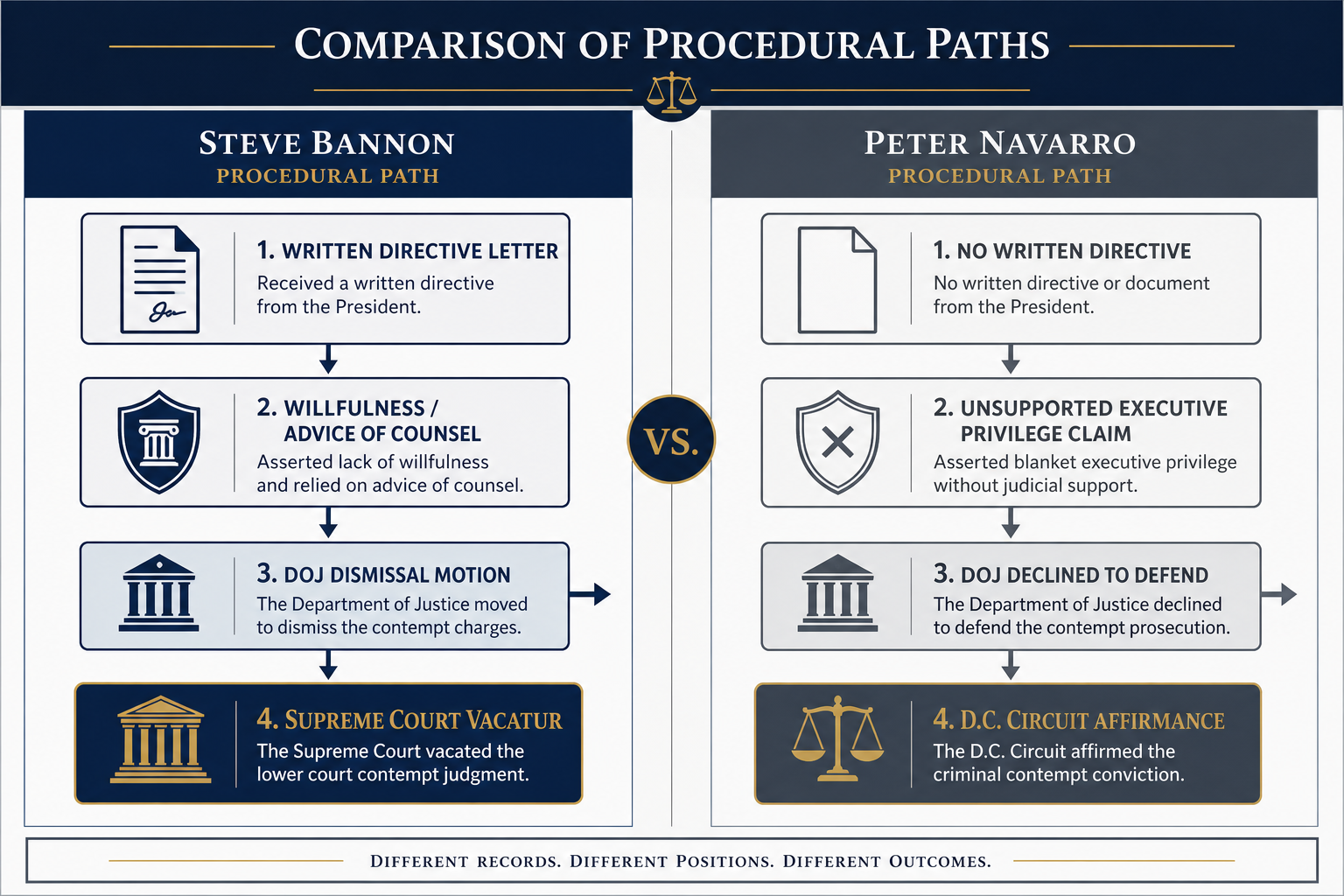
That is where the cases begin to separate. Bannon’s position rested on a written letter from former President Donald Trump’s counsel directing him to assert immunities and not produce documents or testimony. Navarro did not have a comparable written instruction. He did not retain counsel for his committee dealings and instead relied on his account that Trump had invoked executive privilege during a brief phone call. Lawfare’s analysis by Varun Kurup and Walter Shaub treated that “directive distinction” as central, and also used it to explain why Mark Meadows and Dan Scavino, who had direction letters, were not prosecuted.[3]
That paper trail did not make Bannon’s legal theory automatically correct. A letter from a former president’s lawyer is not a congressional subpoena’s off switch. But it did give Bannon a concrete object around which to build an advice-of-counsel and willfulness argument: he could say not only that he believed privilege applied, but that he had been instructed in writing by Trump’s counsel to proceed that way.
Navarro’s record looked different. The D.C. Circuit did not have a letter from Trump, a lawyer’s instruction, or a contemporaneous invocation document to examine. It had Navarro’s assertion that such an invocation occurred. Judge Patricia Millett, writing for a panel that also included Judges Cornelia Pillard and J. Michelle Childs, put the point in evidentiary terms: “a court cannot simply take a defendant at his word that the President invoked privilege.”[2]
That sentence does a good deal of work. It does not announce that executive privilege can never matter in a contempt prosecution. It says a defendant cannot turn executive privilege into a merits defense by unsupported assertion. Courts need something to assess: who invoked the privilege, when, over which materials or testimony, and by what authority. Navarro’s account did not give the courts enough of that.
Why Bannon’s Vacatur Was Not a Merits Win on Privilege
Bannon’s April 2026 result can be easy to overread because the final visible act came from the Supreme Court. But the Court did not issue a full opinion endorsing Bannon’s privilege theory. It granted the government’s request to vacate and remand after the Justice Department, now under the Trump administration, said the case should be dismissed in the interests of justice because of concerns about the willfulness instruction at trial.[1]
That distinction matters. The Bannon vacatur was not a Supreme Court holding that a former president’s executive-privilege instruction defeats a Jan. 6 Committee subpoena. It was a procedural result produced by the government’s own motion, grounded in the criminal mens rea problem. The government chose to carry Bannon’s willfulness objection; the Court cleared the way for dismissal by vacating and remanding.[1]
The directive letter explains why that willfulness objection had more purchase in Bannon’s case than in Navarro’s. If a defendant receives a written instruction from counsel connected to the former president, a trial court’s treatment of advice-of-counsel evidence becomes significant to whether the jury had a fair way to assess willfulness. Without such a writing, Navarro’s argument had to do different work. It had to persuade the courts that his own unsupported privilege account could block or undermine the contempt conviction.
That is also why the comparison to Meadows and Scavino is not just political color. The Justice Department’s charging decisions around Jan. 6 subpoena defiance treated written direction letters as consequential. One may disagree with where that line was drawn, but it was a line tied to proof. It separated a record that permitted advice-of-counsel litigation from one that asked the court to infer an invocation from the defendant’s say-so.[3]
The Government Did Not Ask for the Same Thing
The second difference is procedural and just as important. In Bannon’s case, the Justice Department affirmatively moved to dismiss. In Navarro’s case, the Justice Department declined to defend the conviction on appeal but did not ask the D.C. Circuit to vacate it or dismiss the prosecution.[4]
That left the D.C. Circuit with a different judicial task. It was not reviewing a government motion to unwind the prosecution in the interests of justice. It was deciding Navarro’s appeal on the merits. The panel therefore examined the executive-privilege argument in the ordinary appellate posture and concluded that Navarro had not shown an invocation capable of changing the result.[2]
The political dimension is not invisible. Both prosecutions were brought under the Biden administration; the later dismissal posture in Bannon and non-defense posture in Navarro came under the Trump administration. But motive does not substitute for motion practice. A Justice Department that declines to defend a conviction has not necessarily given an appellate court the same vehicle as a Justice Department that moves to dismiss a case and asks for vacatur.
| Case | Record feature | Government posture | Appellate result |
|---|---|---|---|
| Bannon | Written direction from Trump’s counsel | Moved to dismiss in the interests of justice | Supreme Court vacated and remanded |
| Navarro | No comparable written directive; unsupported privilege account | Declined to defend but did not seek vacatur | D.C. Circuit affirmed on the merits |
What the D.C. Circuit Actually Held
The Navarro opinion is narrow in one respect and sharp in another. It does not resolve every hard question about congressional subpoenas directed at former presidential advisers. It does make clear that a defendant cannot create an executive-privilege defense merely by asserting that the president invoked the privilege.
The panel also refused to let Bannon’s intervening vacatur distort the privilege analysis. Navarro argued, in effect, that his position should benefit from the government’s treatment of Bannon. The D.C. Circuit answered that, on the privilege issue, the difference between the two cases was “vanishingly small.”[2]
That line is easy to miss because Bannon won procedural relief and Navarro did not. But the panel’s point was that Bannon’s privilege theory would not have fared better if the court had reached the same merits question. Bannon’s meaningful difference was not a stronger executive-privilege doctrine. It was the written-counsel record and the government’s willingness to turn that record into a willfulness-based dismissal motion.
This is where Navarro’s case remains connected to the mens rea problem rather than separated from it. The unresolved pressure point under § 192 is not whether a former president can utter the words “executive privilege” and immunize a witness from contempt. It is how juries should be instructed when a defendant claims he relied on counsel or official direction in refusing to comply. That is the issue explored in Lex Machina Review’s earlier piece, “Peter Navarro’s Contempt Case Leaves a Mens Rea Question Open,” and it is the issue Bannon’s vacatur brought back to the surface.
The Remaining Stakes Are Doctrinal
The immediate carceral stakes had largely expired before these appellate outcomes. Navarro reported to prison in March 2024 to serve a four-month sentence for contempt of Congress.[5] Bannon likewise served a four-month sentence in 2024 before the Supreme Court acted in 2026.[1]
That timing changes what matters now. The question is no longer whether either man will avoid the prison term already imposed. It is what the cases leave behind for future contempt prosecutions involving subpoenas, executive-privilege assertions, and claimed reliance on lawyers or presidential direction.
As of July 22, 2026, Bannon’s case had been remanded but not yet formally dismissed. Navarro’s lawyer, Abhishek Kambli, has said he will “move swiftly” with further appeal, but no en banc petition or certiorari petition had been filed at that point.[2] Those next steps may arrive, but they are not yet part of the record.
There is therefore no necessary contradiction between vacating Bannon’s conviction and affirming Navarro’s. Bannon had a written-counsel record that supported a challenge to willfulness, and the government affirmatively moved to dismiss. Navarro had no comparable directive, pressed an unsupported privilege theory, and received a merits ruling after the government declined to defend but did not seek vacatur. The hard question left by the pair is still the willfulness standard under 2 U.S.C. § 192, not a broad victory or defeat for executive privilege.
References
- Supreme Court clears the way for Bannon contempt case to be dismissed, NPR, April 6, 2026.
- DC Circuit upholds Trump adviser Peter Navarro's contempt conviction, Courthouse News.
- Lawfare analysis by Kurup and Shaub, Lawfare.
- DOJ stops defending contempt conviction of Peter Navarro amid appeal, Washington Post, September 2025.
- Peter Navarro reports to prison after Supreme Court rejects his last-ditch bid to remain free, CNN, March 19, 2024.
Comments
Join the discussion with an anonymous comment.