
Peter Navarro's Jan. 6 subpoena contempt conviction now has the procedural shape most contempt fights never reach. On July 21, 2026, a DC Circuit panel upheld his two misdemeanor convictions for refusing to comply with the House Jan. 6 committee's subpoena, after a case that had already moved through indictment, trial, sentencing, federal custody, and an appeal complicated by the Justice Department's later refusal to defend the conviction.[1]
That makes the Navarro case useful for a reason narrower than the politics that produced it. It is a full criminal-contempt docket under 2 U.S.C. § 192: a congressional subpoena, noncompliance, a House referral, a Justice Department prosecution, evidentiary limits on a privilege defense, a jury verdict, a custodial sentence, and appellate review. The legal question running through it was not whether executive privilege exists. It was whether a former adviser could treat it as a personal shield without proof that the president, or someone authorized by him, had invoked it.
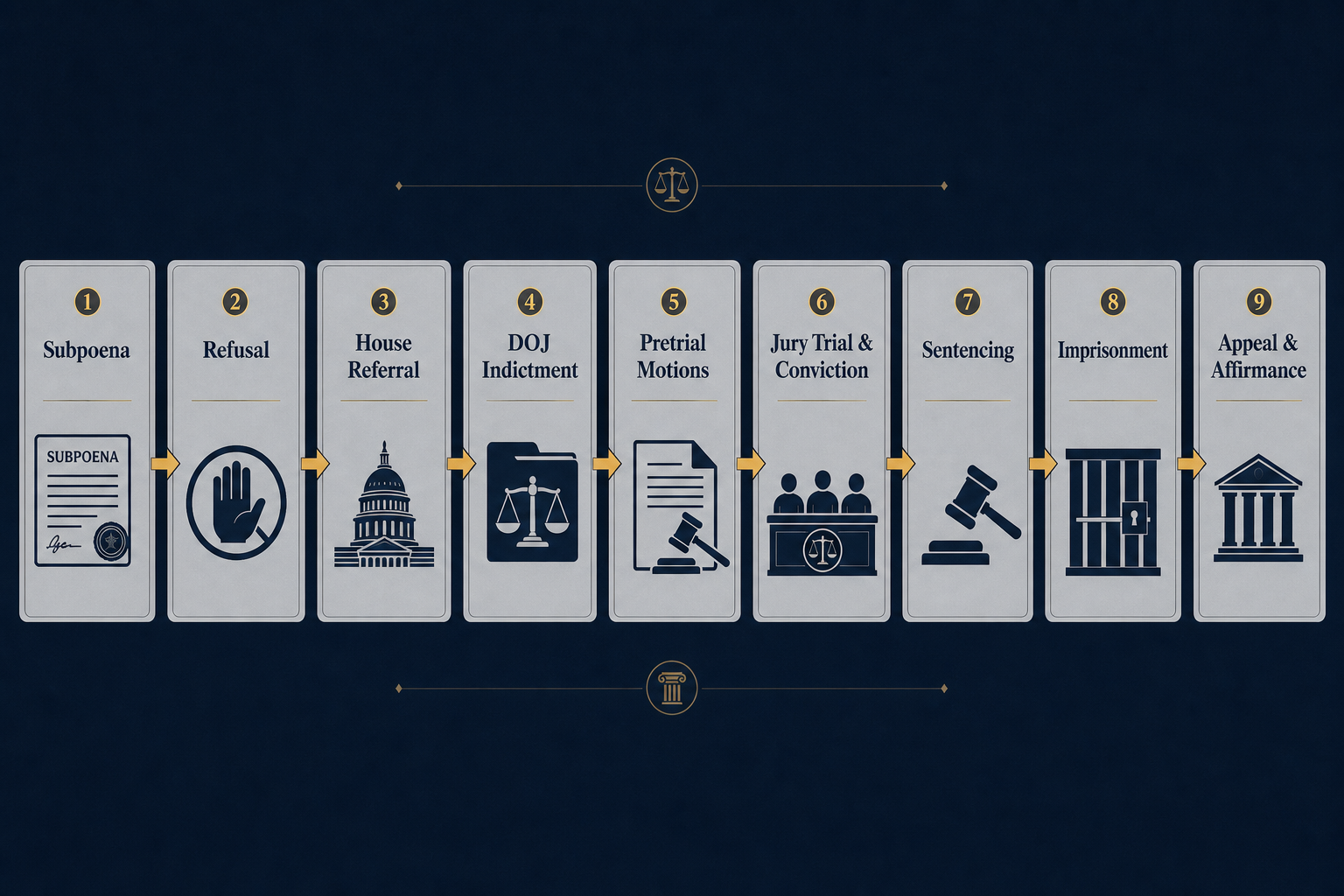
The Complete Timeline
| Phase | Date or period | What happened | Legal significance |
|---|---|---|---|
| Jan. 6 committee subpoena | February 2022 | The House committee subpoenaed Navarro for testimony and documents related to Jan. 6 and his described election-certification strategy. | The subpoena created the legal duty that later supported the contempt charges. |
| Refusal | February 2022 | Navarro refused to appear or produce documents, asserting executive privilege. | His response became the central factual predicate for the later criminal case. |
| House contempt referral | Feb. 23, 2022 | The House voted 220-203 to refer Navarro for contempt. | The referral sent the matter to the Justice Department for possible prosecution. |
| Indictment | June 2022 | A federal grand jury indicted Navarro on two contempt counts. | One count concerned documents; the other concerned testimony. |
| Pretrial privilege ruling | August 2023 | Judge Amit Mehta barred Navarro from presenting an executive-privilege defense at trial. | The court found Navarro had not shown that Donald Trump formally invoked privilege. |
| Trial and conviction | Sept. 7, 2023 | A jury convicted Navarro on both counts after about four hours of deliberation. | The trial was short, and the defense called no witnesses. |
| Sentencing | Jan. 25, 2024 | Navarro received four months in prison and a $9,500 fine. | The sentence made the contempt conviction custodial, not merely symbolic. |
| Imprisonment | Mar. 19-July 2024 | Navarro reported to federal prison and served his sentence. | He became the first former White House official imprisoned for contempt of Congress. |
| Appeal and affirmance | July 21, 2026 | The DC Circuit affirmed the convictions. | The reported holding rejected a unilateral privilege theory without presidential authorization. |
The table is the clean version. The docket is messier, and the important legal shifts occur at the points where the case stopped being a political dispute and became a proof problem.
Why The Committee Wanted Navarro
The House Jan. 6 committee subpoenaed Navarro because he had described involvement in a plan he called the “Green Bay Sweep,” a strategy that involved using Republican members of Congress to delay certification of the Electoral College vote.[4] That point matters because it explains relevance. It does not require turning this contempt case into a full retelling of Jan. 6.
Congressional contempt begins with a demand that the recipient either comply, negotiate, or state a legally cognizable basis for refusal. Navarro did not simply object after extended review. In the DC Circuit's account as reported by Roll Call and Courthouse News Service, he replied to the subpoena within three minutes, asserting executive privilege before he had read it.[1][2]
That small fact carried more legal weight than the louder public rhetoric around the case. A privilege claim can require careful line-drawing: what communications are covered, who holds the privilege, whether it has been invoked, whether it has been waived, and whether competing institutional needs overcome it. A three-minute blanket refusal looks different. It gave courts a concrete reason to doubt that Navarro was making a document-by-document or question-by-question claim grounded in actual presidential authorization.
From Noncompliance To A Criminal Referral
After Navarro refused to comply, the House voted on Feb. 23, 2022, to refer him for contempt of Congress by a 220-203 vote.[1] A House referral is not itself a conviction, and it does not make imprisonment inevitable. It is the institutional handoff: Congress certifies the refusal, then the executive branch decides whether to prosecute under the criminal contempt statute.
The Justice Department obtained an indictment in June 2022. The charges were divided in the ordinary way for this kind of subpoena case: one count for refusing to produce documents and one count for refusing to appear for testimony.[4] That division matters because a witness cannot necessarily defeat a document count by arguing about testimony, or a testimony count by arguing about document production. The subpoena imposed separate obligations.
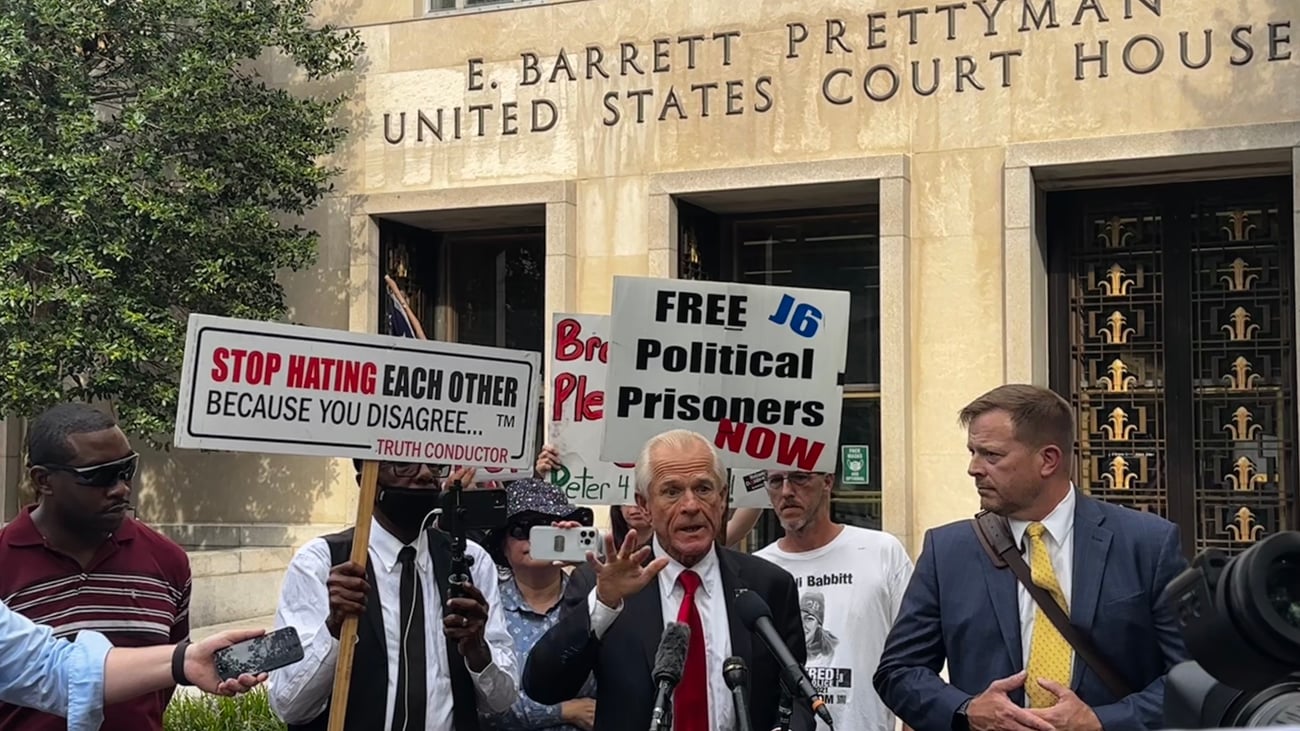
The Pretrial Ruling That Shaped The Trial
The decisive evidentiary fight came before jurors heard the case. Navarro wanted to argue that executive privilege excused his refusal. U.S. District Judge Amit Mehta did not allow that defense to go to the jury, finding that Navarro had failed to show that Trump had formally invoked executive privilege over the subpoenaed material or testimony.[5][6]
That ruling is easy to overread. It did not establish that executive privilege can never matter when Congress subpoenas a former presidential adviser. It instead turned on proof and authority. Privilege belongs to the presidency, not to the former aide as a free-floating litigation instrument. If the defendant cannot show that the privilege was actually invoked by the person who holds it, the jury is not asked to treat the assertion as a defense.
The ruling also separated Navarro's public posture from the trial record. A defendant may say outside court that he believed he was bound by presidential confidentiality. Inside court, the question was narrower: what evidence could be admitted to show a legally operative privilege invocation? Judge Mehta's answer left the prosecution with a straightforward case about subpoena service, nonappearance, and nonproduction.
A Short Trial With A Narrow Record
Navarro's trial ended on Sept. 7, 2023, with convictions on both contempt counts after about four hours of jury deliberation.[4] The defense called no witnesses.[4][6] Those facts are not decorative. They show what the pretrial ruling did: it narrowed the case to whether the committee issued a valid subpoena, whether Navarro knew about it, and whether he failed to comply.
Once the privilege theory was excluded, there was little room for the jury to conduct its own separation-of-powers inquiry. Jurors were not asked to decide whether a president should be able to protect confidential advice in the abstract. They were asked whether Navarro violated the statute after receiving a subpoena requiring documents and testimony.
That is why the case became a particularly clean example of criminal contempt procedure. The constitutional vocabulary remained in the background, but the trial turned on ordinary evidentiary gates: what proof had been produced, what defenses had a legal foundation, and what remained for the jury after those rulings.
Sentencing And The Move From Symbol To Custody
On Jan. 25, 2024, Judge Mehta sentenced Navarro to four months in prison and imposed a $9,500 fine.[5] At sentencing, Mehta rejected Navarro's claim of political persecution in unusually direct terms: “You are not a victim. You are not a political prisoner. You have made yourself a criminal.”[5]
The sentence mattered because criminal contempt of Congress can otherwise look, from the outside, like a collision of speeches: Congress denounces noncompliance, a witness denounces Congress, and the public absorbs another procedural quarrel as partisan weather. A custodial sentence changed the consequence. Navarro reported to prison on Mar. 19, 2024, after the Supreme Court declined to keep him out of custody while his appeal continued.[7]
He served the sentence from March to July 2024 and became the first former White House official imprisoned for contempt of Congress.[1][7] That distinction should be stated carefully. It does not mean he was the first person punished for congressional contempt. It means this particular status marker — former White House official, imprisoned for contempt of Congress — attached to him after the sentence was carried out.
The Appeal Became Less Routine After DOJ Changed Position
By the time Navarro's appeal moved toward decision, the government side of the case had changed in an unusual way. In September 2025, the Justice Department under President Trump declined to continue defending Navarro's conviction on appeal.[8] That did not erase the jury verdict or vacate the district court judgment. It meant the appellate court was no longer receiving the ordinary full-throated defense of the conviction from the department that had prosecuted it.
The appeal was argued in December 2025.[1] The issue still returned to the same evidentiary center: whether Navarro could rely on executive privilege without showing that the president, or an authorized designee, had invoked it. The procedural oddity of DOJ's changed position did not turn the appeal into a new trial. It left the DC Circuit to review the conviction and the legal rulings that had structured the case below.
What The DC Circuit Reportedly Held
The July 21, 2026 ruling is fresh enough that this account relies on detailed court reporting rather than an independently reviewed full opinion text. Those reports quote Judge Patricia Millett's panel opinion as holding that the authority to invoke executive privilege “rests with a president or his designee,” and that “a court cannot simply take a defendant at his word” when he claims privilege was invoked.[1][2][3]
That reported holding supplies the limiting principle. The court did not need to say that executive privilege is categorically unavailable to former advisers. It held, as reported, that Navarro could not unilaterally convert a privilege assertion into a defense without evidence that the privilege holder authorized it.[1][2][3]
The panel also addressed the comparison to Steve Bannon, another Trump ally prosecuted after defying a Jan. 6 committee subpoena. Courthouse News Service reported that the DC Circuit viewed the distinction between Bannon's advice-of-counsel theory and Navarro's unilateral executive-privilege theory as “vanishingly small.”[2] The comparison matters because Bannon's contempt conviction was vacated by the Supreme Court in April 2026, while Navarro's was affirmed by the DC Circuit in July 2026.[2]
Even there, the useful point is procedural rather than theatrical. Bannon and Navarro both refused Jan. 6 committee subpoenas and were convicted. Their cases then diverged on appeal. Navarro's appeal, as reported, failed because the court required proof of authorization for the privilege claim and would not let the defendant's assertion supply that missing fact.
What Each Stage Proved — And What It Did Not
The Navarro timeline is tempting to compress into a single lesson about congressional power. That would make it less accurate. Each stage answered a different question.
- The subpoena stage showed that the Jan. 6 committee sought information from Navarro about a certification-delay strategy he had publicly discussed.
- The refusal stage showed that Navarro asserted executive privilege instead of appearing, producing documents, or negotiating compliance.
- The referral and indictment stages showed how congressional contempt becomes a criminal case only after the House acts and prosecutors bring charges.
- The pretrial stage showed that an executive-privilege defense requires admissible proof of presidential invocation, not only a defendant's stated belief.
- The trial stage showed how narrow a contempt case can become once privilege is excluded from the jury's consideration.
- The appeal showed that the DC Circuit, as reported, treated presidential authorization as the central missing link in Navarro's theory.
Just as important, the case did not prove every broader proposition sometimes attached to it. It did not abolish executive privilege for former advisers. It did not say Congress automatically wins every subpoena fight. It did not depend on a jury deciding whether Navarro's politics were acceptable. The operative consequence came from a more technical failure: Navarro did not establish that the privilege he invoked had been invoked by the person legally empowered to do so.
Current Posture After The July 2026 Affirmance
As of July 22, 2026, the operative judgment is the DC Circuit's July 21 affirmance of Navarro's convictions.[1] Sources reporting on the decision noted possible next steps, including seeking rehearing by the full DC Circuit or filing a petition at the Supreme Court.[1] No such possible next step has changed the affirmance.
That is where the timeline presently stops. The case matters because it forced each claim into the next procedural box: subpoena, refusal, referral, indictment, trial limits, conviction, sentence, custody, appeal. By the end of that sequence, the controlling reported principle was narrow and consequential: executive privilege authority rests with the president or an authorized designee, and courts need evidence of that authorization before a defendant can use the claim to avoid a congressional subpoena conviction.
References
- Appeals court upholds contempt of Congress conviction for Navarro — Roll Call, July 21, 2026
- DC Circuit upholds Trump adviser Peter Navarro's contempt conviction — Courthouse News Service
- Appeals court upholds Peter Navarro's convictions for defying Jan. 6 subpoena — Washington Post, July 21, 2026
- Trump White House official Peter Navarro convicted of contempt after defying House Jan. 6 subpoena — PBS News
- Ex-Trump adviser Peter Navarro sentenced to 4 months for contempt of Congress — NPR, January 25, 2024
- 5 takeaways from Peter Navarro's contempt trial — The Hill
- Ex-Trump adviser Peter Navarro reports to prison on contempt of Congress conviction — NBC News
- DOJ stops defending contempt conviction of Peter Navarro amid appeal — Washington Post, September 8, 2025
Comments
Join the discussion with an anonymous comment.