
The useful thing about the Brad Pitt children name-change legal process is not that the petitioners are famous. It is that the public filings, as reported, show the ordinary California adult name-change route doing exactly what it is designed to do: move a personal request through a public petition, notice, objection, and court-review system. California’s general name-change statutes sit in Code of Civil Procedure sections 1275 through 1279.6, with the adult petition requirements, publication rule, objection procedure, and background-check provision doing most of the work here.[1]
That adult point matters immediately. Shiloh Jolie, Zahara Jolie, and Maddox Jolie are being discussed in the press as Brad Pitt and Angelina Jolie’s children, but the reported petitions are adult petitions, not minor-name-change proceedings. CNN reported in July 2026 that Zahara and Maddox had filed to drop Pitt from their legal names, with Zahara’s hearing set for September 28, 2026, and Maddox’s hearing expected in mid-September 2026.[2] BBC News reported that Shiloh filed in 2024 shortly after turning 18.[3]
This article relies on those media reports where they cite court records; it does not represent an independent review of the Pitt-Jolie children’s individual court files. The procedural analysis, however, comes from the statutory framework itself.
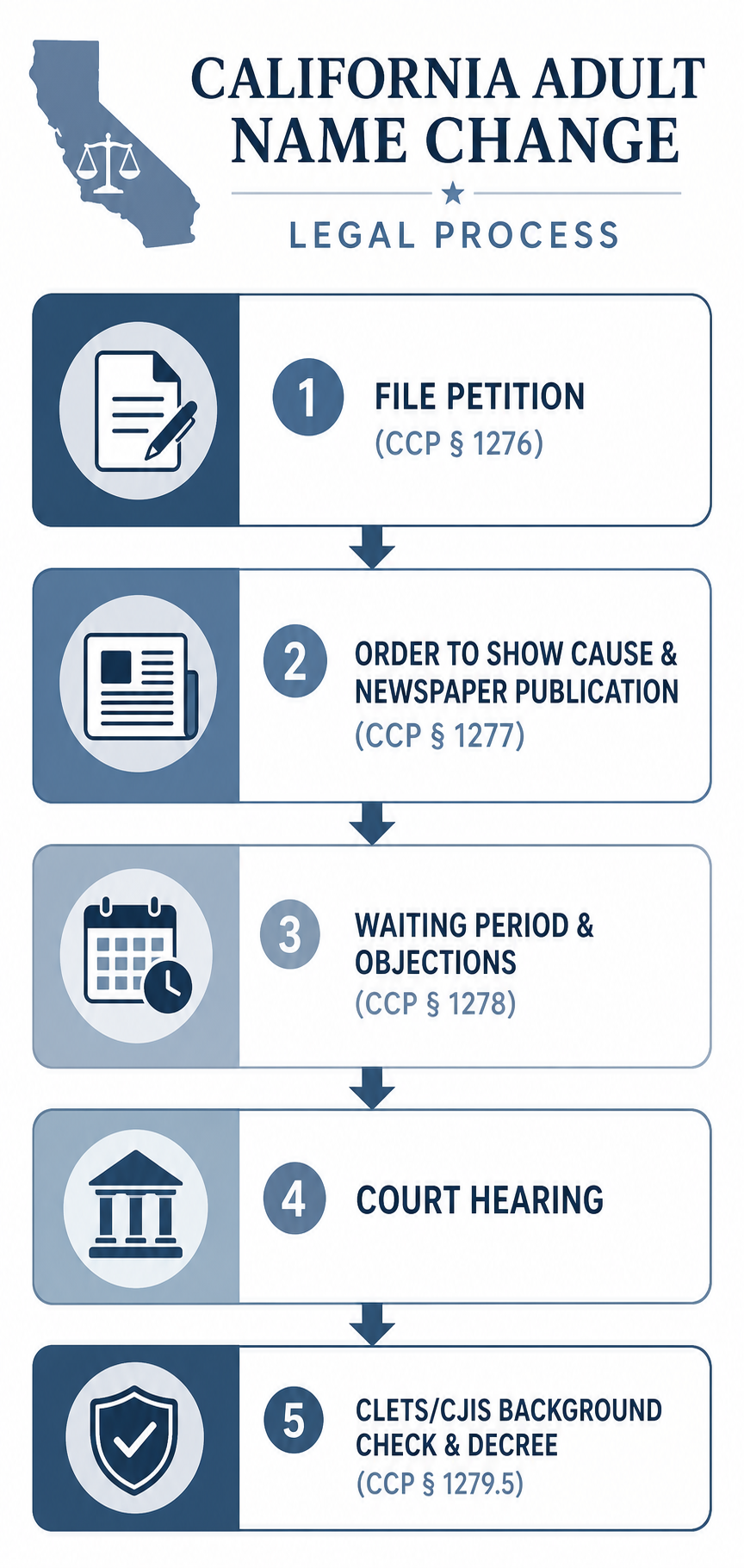
The Adult Track Starts With the Petitioner, Not the Parent
Under CCP section 1276, a person seeking a name change files a verified petition in the proper superior court. For an adult, the petitioner signs for herself or himself; the statute separately addresses petitions brought on behalf of minors. The petition must include identifying information, the proposed name, the reason for the requested change, and declarations under penalty of perjury.[1]
That is why parental consent is the wrong first question for these reported filings. A parent’s approval may be important in a minor proceeding, and family-law reporters understandably reach for that frame when a celebrity family is involved. But once the petitioner is an adult, the case is no longer organized around whether Brad Pitt consents or whether a court should decide a child’s best interests between competing parents.
The minor track is different. California self-help materials describe notice issues when one parent seeks to change a child’s name, and minor cases can require notice to a non-consenting parent and a best-interest review.[4] For that separate problem, see when courts allow a child’s name change without a father’s consent. It is a useful contrast precisely because it is not the procedural lane these adult petitions appear to occupy.
| Adult name-change step | California procedure | Pitt-Jolie example reported |
|---|---|---|
| Petition | Adult petitioner files a verified petition under CCP section 1276. | Shiloh, Zahara, and Maddox were reported to have filed as adults. |
| Order to show cause and publication | Court issues an order to show cause; publication generally runs once a week for four successive weeks. | Shiloh’s notice was reported in the Los Angeles Times; Zahara and Maddox were reported in the Los Angeles Daily Journal. |
| Objection window | Written objections are due before the hearing deadline set by statute. | Public coverage has focused on hearing dates, not on any reported objections. |
| Court action | If statutory conditions are met, the court may grant the petition, sometimes without live appearance if no proper objection is filed. | Zahara and Maddox were reported as awaiting September 2026 hearings. |
| Background check | CCP section 1279.5 requires a CLETS/CJIS-related sex-offender registry check. | No celebrity-specific exception appears in the statutory text. |
Filing Is Only the First Public Step
A filed petition does not itself complete a California name change. The filing starts the court process, but the petitioner still must move through notice, possible objection, and judicial action. That is one place where celebrity coverage tends to compress the story: “drops Pitt” sounds completed, while the court file usually shows a request still traveling through a statutory sequence.
For Shiloh, BBC News reported that she filed to remove Pitt from her surname in 2024 after turning 18, and that the publication step cost $130.[3] The Los Angeles Times reported that notice of Shiloh’s petition appeared in its classified section and quoted her attorney saying Shiloh was “merely following legal process.”[5] That sentence is doing more procedural work than most headlines: publication is not a dramatic flourish, and it is not a celebrity penalty. It is the notice mechanism the statute contemplates.
For Zahara and Maddox, CNN reported that their petitions were published in the Los Angeles Daily Journal, a legal newspaper often used for notices, with hearing dates set in September 2026.[2] The publication venue may make the filings feel more visible because of the names attached, but legally it is the same kind of public-notice step that routinely turns private identity decisions into searchable courthouse procedure.
What the Order to Show Cause Does
Under CCP section 1277, after the petition is filed, the court issues an order to show cause directing interested persons to appear and show why the requested name change should not be granted. The statute ties that order to publication, and the incorporated publication rule requires publication once a week for four successive weeks.[1]
Current statutory text reflected in the annotated materials sets the return date for the order to show cause no less than six weeks and no more than twelve weeks from the date the order is made. That timing point is worth checking carefully because older summaries may still describe a shorter four-to-eight-week window from pre-amendment language.[1]
The reported September 2026 hearing dates for Zahara and Maddox should be read in that procedural light, not as a special delay or a private family negotiation. A hearing date is the court’s return point for the order to show cause. Until the court grants the decree, the legal change is not final.
Publication Is Notice, Not a Moral Verdict
The publication requirement is often the least intuitive part for non-lawyers. People understandably ask why an adult who wants a personal name change has to announce it in a newspaper. California’s answer is procedural rather than sentimental: the law gives creditors, government agencies, and other interested persons a chance to object before a court changes the public legal identity attached to the petitioner.[1]
That does not mean publication proves controversy. It means the petition has reached the notice stage. Shiloh’s Los Angeles Times notice and the reported Daily Journal notices for Zahara and Maddox show compliance mechanics, not a judicial finding about the family or the merits of the name change.[2][5]
The reported $130 publication cost for Shiloh is one of the more useful details in the coverage because it pulls the story back into ordinary administration.[3] Publication costs vary by newspaper and case posture, but the existence of a fee is not unusual. It is a reminder that this process is made of forms, notices, deadlines, and clerk processing before it is made of entertainment-page meaning.

The Objection Window Is Where Precision Matters
CCP section 1278 governs objections and the court’s response. Under the current statutory procedure, any written objection must be filed at least two court days before the hearing. If no timely written objection is filed, the court may grant the petition without a live appearance by the petitioner.[1]
That rule is easy to misread in a high-profile case. A listed hearing date does not necessarily mean a contested courtroom scene is coming. It may simply be the return date by which the court confirms whether statutory notice was completed, whether any objection was filed, and whether the petition can be granted. If a proper objection is filed, the court has a live dispute to address; if not, the statute allows a more administrative ending.
The reported information about Zahara and Maddox establishes hearing dates, not outcomes. CNN reported Zahara’s hearing for September 28, 2026, and Maddox’s hearing for mid-September 2026.[2] As of the current date of July 22, 2026, those reported hearings remain future procedural events. It would be premature to write as if the court has already granted either petition.
What a Court Is Actually Checking
In an ordinary adult petition, the judge is not holding a custody trial by another name. The court is checking whether the petition satisfies statutory requirements, whether notice was properly handled, whether any objection raises a legally cognizable issue, and whether any statutory bar or required inquiry applies.
That includes the background-check provision in CCP section 1279.5. The statute requires a search of the sex offender registry through CLETS and the Criminal Justice Information System process for name-change petitioners.[1] Nothing in the reported Pitt-Jolie filings suggests a special exemption from that step, and the statute does not create one because a petitioner is famous or because a parent is famous.
Public Use of a Name Is Not the Same as a Court Decree
A person may use a shortened name socially, professionally, or in credits before a court decree is entered. That public use can explain why a filing attracts attention, but it should not be treated as proof that the legal change is complete. People reported that Maddox had dropped Pitt from professional credits before the 2026 court filing coverage.[6] That is context for how the name may appear publicly; it is not a substitute for the court’s decree.
The same caution applies to shorthand phrases like “ditch surname” or “drops Pitt.” They may describe the practical or requested change, but the legal process still turns on the petition, publication, objection deadline, court action, and required checks. Legal professionals and reporters should separate a person’s public-facing name from the status of the court order.
What the Pitt-Jolie Petitions Do—and Do Not—Show
The reported filings show the basic California adult name-change path in an unusually visible form. Shiloh’s 2024 petition and publication detail illustrate the filing-and-notice stage. Zahara’s and Maddox’s 2026 reports illustrate the same path moving toward scheduled judicial review. Together, they are a useful public example of how CCP sections 1276, 1277, 1278, and 1279.5 operate in sequence.[1][2][3][5]
- They do not show a celebrity-only procedure; the cited statutory steps apply generally to adult petitioners.
- They do not make parental consent the central procedural issue because the reported petitioners filed as adults.
- They do not prove that a hearing will be contested; an objection must be timely filed for that assumption to have procedural weight.
- They do not establish final legal outcomes for Zahara or Maddox while their reported hearing dates remain pending.
For practitioners, the practical lesson is not hidden in family history. Confirm the petitioner’s adult status, file the verified petition in the proper superior court, obtain and publish the order to show cause, calendar the objection deadline, check whether appearance can be waived or avoided under local practice if no objection is filed, and account for the required background search. For journalists, the discipline is similar: distinguish a requested change from a granted decree, and distinguish adult procedure from minor-name-change litigation.
These petitions are newsworthy because of the surname. They are legally useful because, on the reported record, they appear to be moving through the same California adult process available to any eligible petitioner. Before relying on that process in a real matter, verify the current statutory text, the county’s local forms and hearing practices, and the actual docket entries in the case at issue.
References
- California Name Change Laws – Legal Reference, EZ Name Change.
- Brad Pitt’s kids ditch surname, CNN, July 16, 2026.
- Brad Pitt and Angelina Jolie’s daughter Shiloh files to drop Pitt from surname, BBC News.
- Change your child’s name when only one parent is asking, California Courts Self-Help Guide.
- Shiloh Jolie-Pitt name change notice, Los Angeles Times, July 22, 2024.
- Angelina Jolie and Brad Pitt’s son Maddox drops Pitt last name in credits, People.
Comments
Join the discussion with an anonymous comment.