
By the morning after the July 19 final, the 2026 World Cup had turned a lawyerly distinction into a balance-sheet problem. Kalshi reportedly processed about $40 billion in World Cup wagers through CFTC-regulated event contracts, while traditional sportsbooks handled roughly $4 billion, according to third-party analytics cited by NPR.[1] Even if those figures move as final post-tournament data comes in, the direction of the mismatch is already hard to treat as a rounding error.
The tax split is sharper than the volume split. State-licensed sportsbooks such as DraftKings pay gaming taxes that range from 6.7% in Nevada to 51% in New York, while prediction-market operators generally avoid state gaming taxes by treating the same customer demand as federally regulated contracts rather than state-regulated wagers.[1] NPR’s analysis estimated that this structure could avoid about $4 billion annually in state gaming taxes.[1]

That pairing is the core regulatory problem for DraftKings after the World Cup. It is not simply that a new format found demand during a global tournament. It is that one route into the market carries state licensing, tax, responsible-gaming, and enforcement burdens, while another route claims federal commodities oversight places it beyond most of that apparatus.
Last reviewed: July 20, 2026. The timing matters because the World Cup final was one day earlier, and several handle figures now circulating are estimates, projections, or third-party reports rather than audited final market totals.
The Same Match, Two Legal Wrappers
A state sportsbook asks whether France will win, Brazil will cover, or a total will go over. A prediction market can frame the adjacent proposition as an event contract: whether a defined event will occur by a defined time. The customer experience can look close enough for the tax consequence to feel artificial, but the legal wrapper changes the regulator.
For DraftKings, the distinction is not academic. A state sportsbook license is not just permission to take bets. It is a bundle of obligations: market-access deals, tax filings, geolocation, age verification, responsible-gaming controls, advertising limits, audits, and exposure to state enforcement. Prediction markets operating under the event-contract theory argue that the Commodity Futures Trading Commission is the relevant overseer, not each state gaming commission.
North Carolina has already supplied a useful benchmark because it tried to tax prediction markets at 6%, while its online sportsbook rate is 23%.[1] That proposal does not eliminate the asymmetry; it measures it. Even a state willing to bring prediction markets into its revenue system appears to be contemplating a rate far below the sportsbook burden.
| Regulatory path | Representative treatment described in current reporting | Why it matters for DraftKings |
|---|---|---|
| State-licensed sportsbook | State gaming taxes from 6.7% in Nevada to 51% in New York | DraftKings plans around state-by-state licensing, taxation, and compliance obligations |
| CFTC-regulated event contract | Generally no state gaming tax in most states under the prediction-market model | A competing product can reach similar demand with a lighter state burden |
| North Carolina proposal | 6% prediction-market tax compared with 23% online sportsbook tax | A state-level compromise still leaves a large rate gap |
The reported handle comparison needs caution. NPR cited Ticker Tracker and Sportsbook Review data for the roughly $40 billion Kalshi figure and roughly $4 billion sportsbook figure.[1] Bettors Insider separately reported Deutsche Bank’s projection of $3.3 billion in U.S. sportsbook handle for the World Cup, a lower reference point than the $4 billion sportsbook estimate.[2] Those are not interchangeable measurements, and none should be read as a final official post-event accounting the day after the tournament.
But uncertainty over the exact denominator does not dissolve the compliance issue. If the final sportsbook number settles closer to $3.3 billion than $4 billion, the legal question becomes more severe, not less: why did a federally framed event-contract channel appear to capture so much more soccer-related trading interest than the state-licensed sportsbook channel?
The Tax Arbitrage Is Now Too Large To Treat As A Definition Fight
Gaming law often tolerates formal distinctions. A contest, a sweepstakes, a fantasy product, a pari-mutuel pool, and a fixed-odds wager can all sit in different boxes. The strain here is that the World Cup made the boxes compete for the same event, the same users, and the same money, while assigning very different public obligations to each box.
DraftKings can object to that structure without asking anyone to feel sorry for DraftKings. The more serious complaint is institutional: a state may invite sportsbooks into a regulated market, set a tax rate, demand compliance infrastructure, and then watch a federal-contract theory route comparable volume around the state framework. At that point, the state’s bargain with licensed operators becomes unstable.
The estimated $4 billion in annual state gaming tax avoidance is especially important because it moves the issue away from vocabulary.[1] If the only question were whether a contract technically differs from a bet, the dispute could remain inside agency memoranda and enforcement letters. A multi-billion-dollar tax difference turns the classification question into a fiscal and competitive allocation problem.
That does not prove prediction markets are unlawful gambling. It also does not prove state sportsbook regulation is obsolete. It proves the two systems are now regulating economically adjacent conduct under conflicting assumptions. For compliance departments, that is the unmanageable part: not that the law is strict, but that the first question is which law gets to be strict.
Litigation Has Replaced Administrative Line-Drawing
The legal map no longer looks like ordinary regulatory friction. More than 20 state lawsuits reportedly argue that prediction markets amount to unlicensed gambling, while Arizona has brought criminal charges and Minnesota has imposed an outright ban.[1][3] On the other side, the Trump CFTC has filed federal counter-lawsuits against states, asserting federal preemption over event contracts.[1][3]
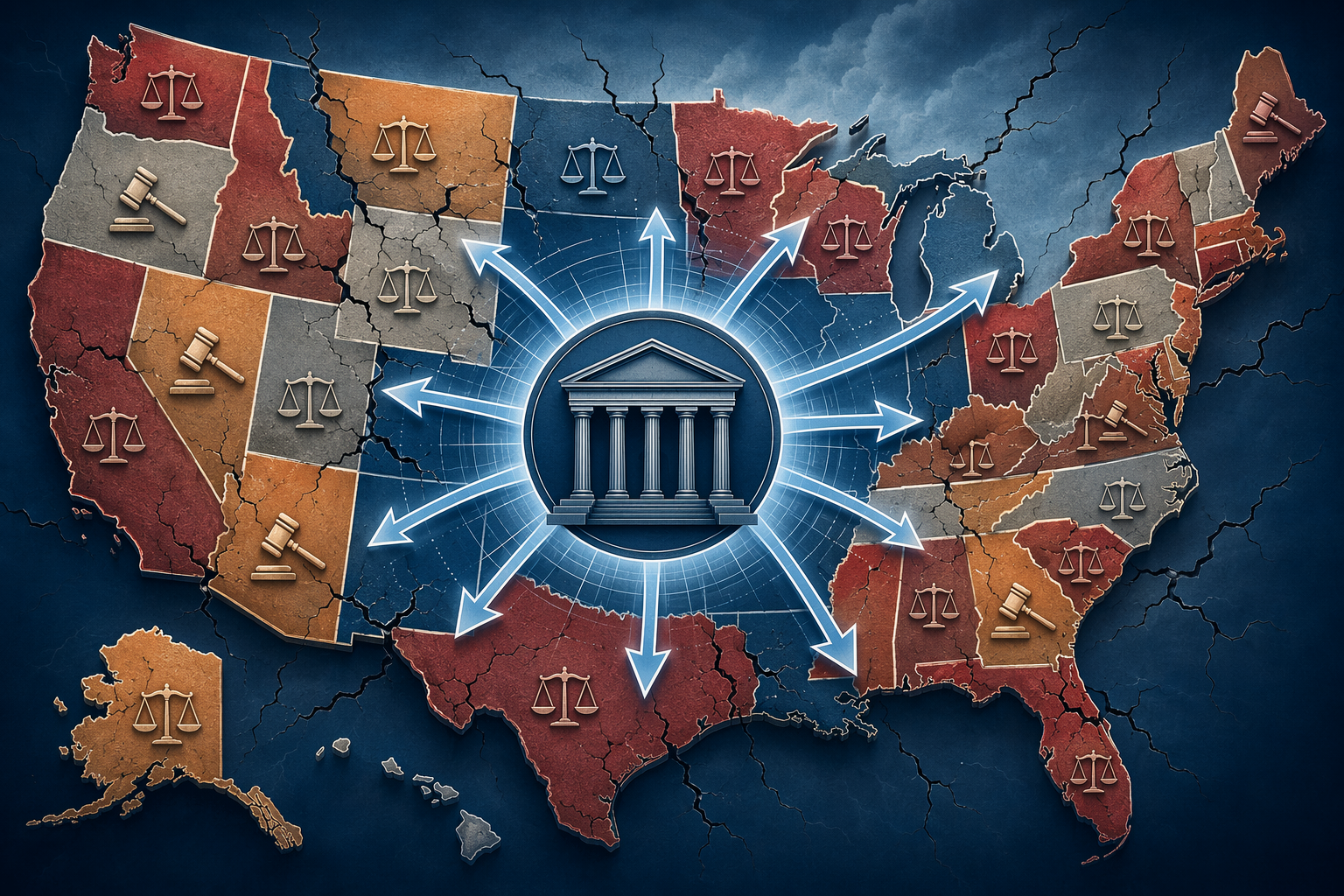
Those postures matter more than the docket count itself. States are not merely asking for better disclosure or local registration. They are asserting that the activity falls within gambling law. The CFTC’s preemption position is not merely procedural. It asserts that state gambling enforcement cannot override federally regulated event-contract markets.
That is the point at which ordinary compliance planning runs out of tools. A licensed sportsbook can plan for a new tax rate. It can plan for a new advertising rule. It can plan for an enforcement settlement. It cannot confidently plan around a live contradiction in which one regulator describes a product category as illegal gambling and another treats it as federally supervised market activity.
The likely Supreme Court path should be treated as a structural forecast, not an outcome prediction. The current posture creates federal-state questions that are difficult to resolve by negotiation alone, particularly if state criminal enforcement and federal preemption claims continue in parallel. That does not mean the Court will necessarily bless prediction markets or restore state control. It means the operating model for a national platform may be defined by judicial allocation of authority rather than by product design.
This is different from league-centered gambling enforcement, where a private rulebook, employment consequence, and public regulator may all operate in layers. The NFL examples discussed in How a Single NFL Gambling Violation Triggers Three Legal Layers and What the Ryan Gold Suspension Reveals About NFL Gambling Enforcement show overlapping consequences, but not this direct collision between state gambling jurisdiction and federal commodities oversight.
DraftKings Cannot Simply Choose One Side
DraftKings’ own World Cup numbers show why abstention is not a serious business answer. Bettors Insider reported that DraftKings saw a fivefold handle increase compared with the 2022 Qatar World Cup.[2] Soccer demand was real inside the licensed sportsbook channel; the problem is that an even larger reported flow moved through a different regulatory frame.
The company’s prediction-market response should therefore be read as a hedge. DraftKings Predictions gives the company a way to participate in the channel that Kalshi helped normalize, while its core sportsbook business remains tied to state licensing and state tax rates. That is not a clean pivot. It is participation in a model that also weakens the assumptions behind DraftKings’ most regulated business line.
Citizens JMP analysts have forecast that prediction markets could be worth $1 billion to DraftKings by 2030 if the company captures 20% to 30% market share.[4] The useful part of that forecast is not the optimism. It is the implicit admission that DraftKings may need a second regulatory posture while the first remains expensive, exposed, and still essential.
That dual posture creates hard internal questions. A sportsbook compliance team has to maintain state-by-state controls that a prediction-market competitor may argue are irrelevant. A product team has to decide whether a contract format belongs beside a sportsbook offering, outside it, or behind separate legal infrastructure. A government-affairs team has to defend the state model without sounding like it is asking regulators to protect incumbents from a more efficient wrapper.
The uncomfortable possibility is that DraftKings may be right to complain and right to imitate at the same time. It can preserve arguments that state-licensed sportsbooks are being treated incoherently while also entering prediction markets because customer demand and competitor behavior leave no room for a purist position.
The European Warning Is A Spillover Signal, Not The Main Event
Closing Line reported that nine European gambling regulators, from Belgium, France, Germany, Italy, the Netherlands, Poland, Portugal, Spain, and Switzerland, issued a joint warning that prediction markets raise risks of illegality, fraud, and addiction.[4] Because the available record relies on that secondhand account rather than the original joint statement, the warning should be treated cautiously until the underlying release and full signatory list are verified.
Even with that caveat, the European note is useful as a spillover signal. Regulators outside the United States appear to recognize the same boundary problem: when a product is economically close to gambling but legally described as a market contract, the usual tools for licensing, taxation, consumer protection, and addiction controls may not attach in the expected way.
For U.S. legal professionals, however, the decisive conflict remains domestic. The question is not whether other jurisdictions dislike prediction markets. The question is whether U.S. state gaming law can coexist with a federal commodities framework that allows event contracts to absorb demand that state legislatures thought they had legalized, taxed, and supervised through sportsbooks.
What The World Cup Changed
The World Cup did not create the event-contract dispute. It made the dispute visible at a scale that compliance departments, state regulators, and sportsbook boards cannot comfortably bracket as experimental. The reported Kalshi volume, the sportsbook estimates, the tax-rate gap, and the litigation map now point in the same direction: the classification question determines who pays, who licenses, who polices, and who can scale nationally.
For DraftKings, the dilemma is not whether sports demand exists. Its own World Cup growth suggests that it does.[2] The dilemma is whether that demand will be governed mainly by state sportsbook law, by CFTC-supervised event-contract markets, or by a court-imposed boundary between the two.
That is why the post-final numbers matter even before they are final. They show that the current state-by-state sports betting framework and federally regulated prediction markets cannot comfortably govern the same underlying activity while imposing such different tax and compliance consequences. After Q3 2026, the operating model for DraftKings and its competitors may depend less on who writes the best soccer market and more on which institution gets the last word.
References
- Kalshi sports betting prediction markets DraftKings FanDuel World Cup, NPR, July 17, 2026.
- 2026 World Cup Sets All-Time Betting Records as FanDuel and DraftKings Report Best Soccer Numbers in History, Bettors Insider, June 25, 2026.
- World Cup bets prediction markets tax advantage sports gambling, Fortune, July 12, 2026.
- DraftKings World Cup Data Shows Split, Closing Line.
Comments
Join the discussion with an anonymous comment.