
The PROMISE Act is worth watching less because it is another Social Security reform bill than because it tries to build a legislative machine around insolvency. Introduced on July 14, 2026, by a bipartisan group of senators, S.4979 would not itself set a final benefit or revenue package; it would create a sequence for forcing one onto the congressional agenda before the Old-Age and Survivors Insurance trust fund reaches depletion.[1]
That distinction matters for legal professionals. A benefits lawyer, financial-institution counsel, compliance officer, government-relations attorney, or legal ops leader does not need an AI tool to recite that Social Security politics are difficult. The harder problem is knowing when a procedural event has occurred that changes what a client, board, product team, or policy committee needs to prepare for.
As of Q3 2026, the PROMISE Act has not had committee hearings, markups, or floor votes. Any analysis of AI monitoring here is therefore based on the bill’s described procedure and available tool capabilities, not on implementation experience. That limit should make the tracking question sharper, not softer: if the bill is designed around procedural gates, the first professional task is to identify those gates before they pass quietly.

The PROMISE Act Is a Procedure Before It Is a Policy Outcome
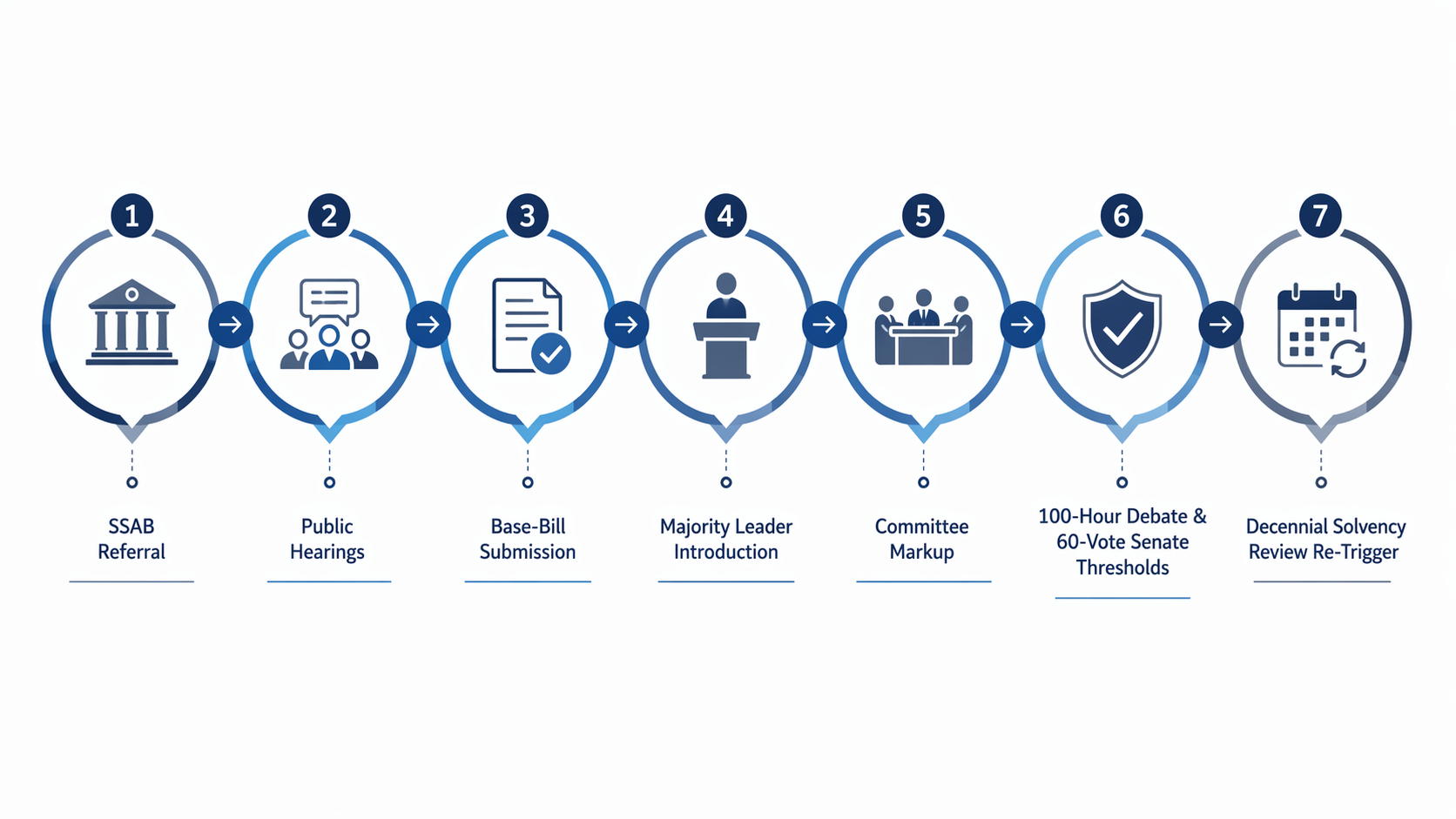
The Committee for a Responsible Federal Budget describes the PROMISE Act as a process that begins by sending Social Security solvency work to the Social Security Advisory Board, which would hold public hearings and develop a legislative proposal. The SSAB would then submit a base bill to Congress, after which congressional leaders and committees would move through a defined fast-track path.[2]
BPC Action’s fact sheet adds two features that are especially important for monitoring: the bill would allow 100 hours of floor debate, and in the Senate, substitute amendments and final passage would require 60 votes. It also describes a bipartisan failsafe structure intended to keep the process moving if the initial path stalls.[3]
| Procedural point | What changes for a legal team |
|---|---|
| SSAB referral and public hearings | The issue moves from general solvency debate into a record-building process with testimony, stakeholder positions, and early policy contours. |
| SSAB base-bill submission | A concrete legislative vehicle appears, giving counsel text to summarize, compare, and route internally. |
| Majority leader introduction | The proposal moves from advisory development into congressional procedure, making timing and chamber strategy more important. |
| Ways & Means and Finance markup path | Committee action can change the operative text and reveal which provisions have institutional support. |
| 100 hours of floor debate | Amendment strategy, public statements, and stakeholder reactions become time-sensitive intelligence. |
| 60-vote Senate thresholds | Viability analysis must account for a supermajority requirement for substitute amendments and final passage. |
| Decennial solvency review re-trigger | Monitoring does not end with one bill cycle; the process can become a recurring governance obligation. |
For a legal team, that sequence is more useful than a generalized alert for “Social Security reform.” Each step creates a different kind of work product. A hearing may call for a stakeholder memo. A base bill may require a provision-by-provision comparison. A markup notice may trigger an internal escalation. A 60-vote threshold affects procedural viability, not the substantive merits of any one benefit formula.
Where AI Monitoring Actually Has Work to Do
The useful AI question is not whether a platform can “understand” Social Security. It is whether the platform can map a live government source to a preassigned watchlist, summarize what changed, preserve the citation trail, and send the right alert to the right person without converting uncertainty into a false conclusion.
SSAB referral and hearings
The first intelligence window is the move to the Social Security Advisory Board and the start of public hearings. At this stage, the record matters before the bill text does. Elder-law attorneys may want to know whether testimony starts shaping client questions about benefit timing. Financial firms may want to know whether witnesses are discussing retirement-income disclosures, annuity assumptions, or benefit adequacy. Government-relations lawyers may need to identify which stakeholder groups are becoming visible.
An AI tracking platform can help if it distinguishes hearing announcements, witness lists, written testimony, and summaries of testimony. Those are not interchangeable. A hearing notice tells a team to prepare coverage; a witness list tells it whose position may matter; written testimony gives text that can be quoted or summarized; a hearing summary is already one layer removed from the source.
Base-bill submission
The SSAB base bill is the point where monitoring becomes document work. A platform should be able to detect the submission, retrieve the source text, compare it against prior drafts or public recommendations, and produce a first-pass summary that remains tied to the underlying language. That is where legal review begins, not where it ends.
For a benefits practice, the immediate question may be whether the text touches eligibility age, benefit formula adjustments, payroll tax treatment, claiming behavior, or transition rules. For in-house counsel, the question may be whether retirement-product disclosures, customer communications, or scenario illustrations need to be reviewed. The same source document can create different assignments depending on the watchlist.
Leader introduction and committee markup
Once the majority leader introduction and committee path come into play, timing starts to matter as much as content. House Ways & Means and Senate Finance are not generic committees for this subject. If a markup notice appears, a legal team may have only a narrow window to explain the current text, identify proposed changes, and decide whether internal stakeholders need a same-day briefing.
This is where manual tracking becomes fragile. Someone can check Congress.gov, committee pages, newsletters, and policy press releases every morning and still miss a late notice or a revised amendment. AI does not make the calendar predictable, but it can reduce the chance that a defined procedural event is sitting in a source feed while the responsible lawyer is still working from yesterday’s assumptions.
Floor debate, substitutes, and the 60-vote line
The 100-hour debate period and 60-vote Senate requirements create a different kind of alert. A platform should not merely say that debate is underway. It should identify substitute amendments, procedural votes, sponsor changes, and text revisions, then separate those facts from commentary about political momentum. BPC Action’s description of the 60-vote requirement makes this a legal-process fact that should be tracked precisely.[3]
That distinction matters in client communications. “A substitute amendment has been filed” is a source-based update. “The bill is likely to pass” is a prediction. “Clients should change claiming strategies” would be legal or financial advice requiring a much different review. AI tools can assist the first task and may inform the second; they should not be allowed to smuggle the third into an alert.
The decennial review trigger
The decennial solvency review is easy to treat as a back-end detail, but it may be the most operationally durable feature of the PROMISE Act structure. If enacted as described, the process would not be a one-time scramble around a single bill. It would create a recurring monitoring obligation around Social Security solvency review.[2]
Legal ops teams should care about that because recurring obligations are where tool configuration either pays for itself or becomes another abandoned dashboard. A watchlist can be designed around the review trigger, the relevant agencies and committees, document types, assigned reviewers, and escalation thresholds. That is more concrete than buying a platform because it advertises legislative AI.
Why the Solvency Clock Belongs in the Monitoring Plan
The solvency backdrop should not swallow the procedural analysis, but it explains why legal teams cannot dismiss the bill as ordinary Washington positioning. The 2026 Social Security Trustees Report projects depletion of the OASI trust fund in the fourth quarter of 2032, with continuing income sufficient to pay 78% of scheduled benefits after depletion. Put plainly, the current Trustees’ figure implies a 22% reduction from scheduled benefits if Congress does not act before depletion.[4]
Some public materials still circulate older 24% benefit-cut figures based on prior-year assumptions. For current legal analysis in 2026, the 22% Trustees figure is the safer reference point because it comes from the latest Trustees summary.[4]
State-level exposure adds another reason to build monitoring before the legislative path accelerates. CRFB’s “No State Spared” material uses state-level data to show that Social Security insolvency would not be concentrated in a few jurisdictions; the consequences would reach beneficiaries across the country.[5] For law firms and institutions with multistate client bases, that does not mean every alert should be treated as equally urgent everywhere. It means the alert taxonomy should allow state relevance, client concentration, and business-line exposure to be sorted quickly.
What to Ask of an AI Legislative Tracking Platform
AI adoption statistics are useful context, but they do not prove that any particular platform is fit for PROMISE Act tracking. Filevine’s 2026 Legal AI Trust Index reports that 75% of surveyed legal professionals who use AI save 1 to 5 hours per week, but the survey sample was 115 respondents with a credibility interval of plus or minus 13 percentage points.[6] That supports a modest point: legal professionals are already reporting time savings from AI. It does not prove that AI legislative monitoring will catch a markup notice, interpret Social Security procedure correctly, or reduce malpractice risk.
For PROMISE Act monitoring, the selection standard should be tied to the workflow. Plural Policy describes capabilities such as policy tracking, alerts, legislative intelligence, and monitoring across jurisdictions.[7] Law Tech AI describes an AI policy tracker with jurisdiction-specific alerts and business-impact assessment features.[8] LEGALFLY and Darrow discuss broader AI legal research and lawyer-support tools, including research assistance, document analysis, and case or claim intelligence.[9][10] Those descriptions are useful only to the extent they map to a defined task.
- Source detection: Can the tool monitor official bill, committee, agency, and hearing sources rather than relying only on secondary summaries?
- Procedural classification: Can it distinguish introduction, referral, hearing notice, markup, amendment, floor debate, vote, and review trigger?
- Citation trail: Does every summary point back to the official text, notice, transcript, or report that supports it?
- Watchlist matching: Can alerts be routed by practice area, jurisdiction, client type, product line, or committee responsibility?
- Impact framing: Can the platform separate what happened, who may care, and what still requires legal review?
A small firm evaluating broader AI adoption can treat legislative tracking as one use case within a larger tool decision. The same questions that matter for research, confidentiality, verification, and workflow fit also matter here; a general selection framework such as how to choose a legal AI tool for your small law firm in 2026 can help keep the purchasing conversation from drifting into feature-counting.
A Practical Watchlist for PROMISE Act Work
The watchlist should start with events, not opinions. A legal team can always add political analysis after the source event is captured. The dangerous gap is the reverse: a stream of commentary with no reliable indication that the base bill was submitted, a committee markup was noticed, or an amendment changed the operative text.
| Watch item | Primary user | Immediate output |
|---|---|---|
| SSAB hearing notice, agenda, witness list, and testimony | Government relations, benefits counsel | Hearing coverage plan and stakeholder summary |
| SSAB base-bill submission | Benefits counsel, legal research team | Provision summary with citations to bill text |
| Majority leader introduction or fast-track movement | Government relations, executive briefing team | Procedural status update and timing note |
| Ways & Means or Finance markup notice | Policy counsel, compliance lead | Same-day escalation and amendment tracker |
| Substitute amendment or floor debate development | Government relations, client advisory team | Text comparison and procedural viability note |
| Senate 60-vote threshold event | Government relations, board briefing team | Vote-status analysis separated from policy advice |
| Decennial solvency review trigger | Legal ops, compliance, institutional counsel | Recurring monitoring calendar and assigned reviewer workflow |
The outputs should be deliberately plain. “Prepare a client alert” is not always the right next step. Sometimes the right output is a two-line internal note: the hearing was scheduled; no text has changed; the benefits team will review testimony when posted. In other situations, a markup notice may justify a same-day meeting because the text could change before the next scheduled policy call.
Predictive analytics can have a place in that workflow, especially for triaging scarce attention. But predictions should be labeled as predictions. A platform may estimate whether a bill is likely to move or identify sponsors and committees associated with prior activity; it still cannot turn a four-day-old bill with no hearings or votes into a settled legal outcome.
What Not to Let the Tool Do
The most serious error is not missing a clever AI feature. It is letting the system collapse tracking, analysis, prediction, and advice into one undifferentiated alert. A Social Security hearing is not a statutory change. A committee markup is not final passage. A 60-vote requirement is not a guarantee of defeat. A solvency projection is not an individualized claiming recommendation.
Legal teams should also avoid treating vendor descriptions as independent proof of effectiveness. Vendor pages can identify available capabilities, such as jurisdiction-specific alerts, policy tracking, predictive analytics, or business-impact assessments.[7][8] They do not establish that the tool will correctly classify every PROMISE Act event, capture every official document, or produce summaries that satisfy a lawyer’s duty of competence and supervision.
A defensible workflow keeps humans in the consequential positions. AI can detect the event, assemble the source material, draft a summary, compare text, and route the alert. A lawyer or qualified professional should decide whether the event changes advice, disclosure language, client communications, lobbying strategy, or board reporting.
The Q3 2026 Bottom Line
For legal teams, the PROMISE Act is not a request for a passage forecast. It is a preparedness question. The bill creates a sequence of defined procedural triggers; the solvency clock gives those triggers practical significance; and AI legislative tracking tools are useful only when they are configured around the actual work those triggers create.
As of July 18, 2026, no hearing, markup, or vote has occurred. The risk for legal professionals is not that they will fail to know every political development in advance. The risk is that a defined procedural event will occur, the client or institution will expect an informed answer, and the monitoring system will still be waiting for someone to check manually.
This article provides editorial analysis of AI tools and legislative developments. It is not legal advice.
References
- Social Security reform, CNBC, July 14, 2026,
- PROMISE Act Jumpstarts Path Toward Saving Social Security, Committee for a Responsible Federal Budget,
- Fact Sheet: The PROMISE Act, BPC Action,
- A Summary of the 2026 Annual Reports, Social Security Administration,
- No State Spared, Committee for a Responsible Federal Budget,
- 2026 Legal AI Trust Index Survey Report, Filevine,
- Solutions, Plural Policy,
- AI Policy Tracker, Law Tech AI,
- Best AI Tools for Legal Research, LEGALFLY,
- AI Tools for Lawyers, Darrow AI,
Comments
Join the discussion with an anonymous comment.