
A celebrity wedding privacy plan now has to survive more than an overeager guest with a phone. At the reported July 2026 Swift-Kelce wedding, the privacy stack included tiered NDAs, staff restrictions, device bans, alleged scanning for Meta smart glasses and hidden cameras, inherited venue facial-recognition infrastructure, controlled professional media capture, and drone precautions. That is not one policy. It is a chain of handoffs, and every handoff is a place where the legal theory can become an operational leak.
The event is better read not as celebrity theater, but as a stress test for event privacy, AI-enabled security, NDA drafting, and biometric-risk management. The controls appear to have been layered because no single instrument could do the job: an NDA cannot identify smart glasses at a checkpoint; a device scan cannot decide whether a harassment disclosure is protected; facial recognition cannot tell a vendor what they may post after midnight; and drone countermeasures run into legal limits that private security cannot wish away.
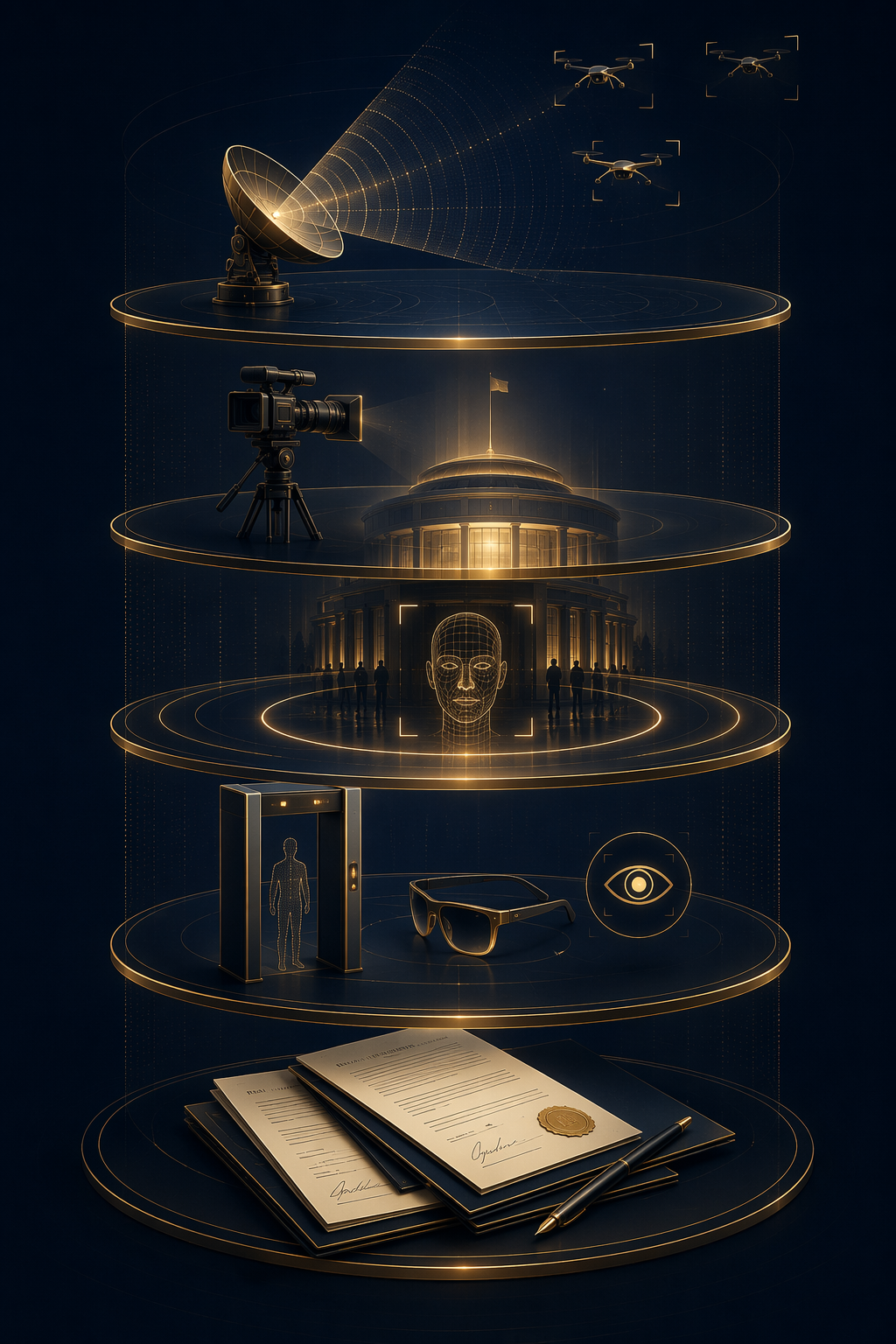
| Privacy layer | What it tries to control | Legal-security pressure point |
|---|---|---|
| Tiered NDAs | Speech, posts, vendor disclosure, staff conduct | Enforceability, carve-outs, differential treatment, breach proof |
| Device and AI-recording controls | Phones, smart glasses, hidden cameras, ambient capture | Consent, search scope, unclear detection technology |
| Venue facial recognition | Entry screening and exclusion infrastructure | Biometric notice, discrimination concerns, pending litigation and scrutiny |
| Professional-only media capture | Approved images and release timing | Contract control over photographers, editors, storage, and distribution |
| Drone countermeasures | Aerial intrusion and long-range recording | Airspace authority, anti-jamming limits, uncertain state-law overlays |
The NDA Is Only as Strong as the People It Actually Reaches
The syndicated account of the wedding’s “Special Ops” privacy tactics described a serious secrecy operation around the event, but the more legally interesting fact is narrower: Bloomberg reporting, cited by Complex, said one staff member was terminated within 24 hours for violating the privacy regime.[1][2] That is the kind of detail that separates aspirational confidentiality from enforcement. Someone had to identify the act, decide it violated the applicable restriction, and impose a consequence quickly enough for other workers to understand that the policy was not decorative.
Page Six reported a tiered structure in which the couple’s inner circle was treated differently from outer-circle guests and staff.[3] That design is not unusual in high-net-worth events, and it is more defensible than pretending the best friend, the caterer, the driver, and the temporary floral assistant all present the same risk. But it creates its own drafting burden. If one group is exempt or lightly bound while another group is tightly restricted, the contract should make the categories intelligible. A vague “everyone must keep everything private” instruction leaves too much room for confusion when a planner, vendor, or guest later argues that the rule did not apply to them in the same way.
A wedding NDA should identify protected information by function, not mystique. The useful categories are mundane: location details before arrival, vendor identities, floor plans, guest lists, seating charts, security procedures, unpublished photographs, video, audio, livestreams, overheard personal information, and post-event commercial use. The more a clause tries to cover “anything relating to the wedding,” the more it invites an overbreadth fight. The more it names the materials that actually create harm, the easier it is for a staffer to comply and for counsel to prove breach.
General NDA enforceability analysis still matters here: confidentiality obligations tend to be stronger when they are clear, supported by consideration, limited in scope, and tied to legitimate business or privacy interests rather than personal embarrassment alone.[4] Wedding-industry reporting also reflects that NDAs have moved from celebrity novelty to a recurring tool for luxury and high-profile events.[5] Adoption, however, is not effectiveness. A signed packet does not tell a banquet captain what to do when a guest asks for the Wi-Fi password, or whether a hairstylist may post a mirror selfie that reveals the room.
The hardest clauses are the ones that should not be drafted broadly. California’s Silenced No More Act limits the use of confidentiality provisions to suppress disclosure of harassment, discrimination, or retaliation claims.[6] Even outside California, that policy concern should change how counsel writes a celebrity-event NDA. A privacy clause can bar the publication of security routes, unpublished images, or a private ceremony recording without purporting to gag a worker from reporting unlawful conduct. If the wedding involves staff flown across jurisdictions, the safest drafting posture is not maximal silence. It is a clean separation between event privacy and protected disclosures.
AI complicates the breach question because exposure may no longer require a classic leak. A vendor might not post the seating chart, but a sequence of seemingly harmless details—arrival timing, floral deliveries, road closures, background audio, location metadata—could allow outsiders to infer what the NDA was meant to protect. Existing NDA doctrine is better at direct disclosure than probabilistic inference. Lawyers can reduce the gap by defining prohibited conduct to include uploading protected event materials into third-party AI tools, using event data to generate derivative images or summaries, and sharing metadata-rich files outside approved systems. They should not pretend the clause will answer every causation problem after the fact.
Phones Are the Easy Device Problem
Device bans at celebrity weddings used to be discussed as etiquette. In 2026, they are closer to evidence control. Yahoo and Reality Tea reported phone-ban measures and device restrictions around the Swift-Kelce event.[7] Those reports should be read as event coverage, not as a technical audit, but the operational logic is obvious: if a guest cannot carry a phone into the room, the most common path to unauthorized photos, video, audio, location tagging, and instant posting is reduced.
The harder question is what happens after phones. Reuters reported that Meta had sold millions of Ray-Ban Meta smart glasses by late 2025, and ZDNet reported the figure as 7 million units.[8][9] The International Bar Association, in commentary reported by Canadian Lawyer, raised concerns about privacy and recording risks from Meta smart glasses, including the practical difficulty of recognizing when recording is occurring.[10] That is the problem a modern wedding checkpoint now faces: a recording device may look like ordinary eyewear, and the person wearing it may not think of it as a camera in the same way they think of a phone.
Some coverage of the wedding described scanning for Meta smart glasses and hidden cameras.[1][7] The sources do not explain the scanning technology in enough detail to say how it worked, what it detected, whether it was manual, electronic, visual, or vendor-assisted, or how false positives were handled. That uncertainty matters. “AI security” is too often used as a glamour label for ordinary bag checks and staff vigilance. If counsel is approving a device-screening protocol, the vendor should describe the method, the data collected, the retention period, who sees any alerts, and what happens when a guest refuses inspection.
The protocol should also avoid turning a privacy measure into an uncontrolled search. A defensible plan starts before arrival: notice in the invitation packet, a separate vendor memo, signage at the checkpoint, a secure device-check process, exceptions for medical and accessibility devices, and a supervisor authorized to resolve disputes. Staff should not be improvising around prescription eyewear, assistive technology, or religious garments while a line of guests waits behind them. That is where privacy plans often fail: not in the idea of a ban, but in the thirty seconds when a low-paid worker has to enforce it against someone with social power.
There is also a consent problem hiding inside the guest experience. A guest may consent to surrender a phone; a worker may be required to comply as a condition of a shift; a performer, driver, or contractor may be operating under a separate services agreement. Those are not the same legal posture. The same checkpoint can involve invitees, employees, independent contractors, union labor, venue personnel, and public-safety officers. A single “no devices” sign is rarely enough to allocate those differences.
Facial Recognition Arrives with the Venue, Not the Couple
The biometric layer is different because the couple may not be the only actor choosing it. Madison Square Garden’s facial-recognition practices were already the subject of litigation and public scrutiny before any wedding entered the picture. The New York State Bar Association Journal described the controversy around facial recognition at entertainment venues, including MSG’s use of the technology and the legal disputes it generated.[11] That history changes the risk analysis. A client can rent or use a prestigious venue and inherit a privacy architecture that has its own litigation record.
In Hutcher v. MSG, litigation arose from MSG’s exclusion of lawyers affiliated with firms suing MSG entities; in Gross v. MSG, plaintiffs challenged aspects of the company’s use of facial recognition and exclusion practices.[12][13] Those cases are not wedding cases, and they should not be treated as if they answer every private-event question. Their value is more practical: they show that venue biometrics can create disputes over notice, exclusion, access, retaliation, and the permissible use of identity-matching systems in places that are also public accommodations or major entertainment venues.
Biometric law is fragmented. BCLP’s biometric laws tracker reflects a patchwork of state requirements rather than one national rule, with different approaches to notice, consent, retention, private rights of action, and covered identifiers.[14] For an event lawyer, that means the facial-recognition question cannot be answered by asking whether the technology is impressive. The useful questions are more basic: whose system is it, what database is being matched, what notice has been given, what legal basis supports collection, how long templates are retained, whether any guest or worker can opt out, and whether the couple receives or controls any biometric information.
If the venue’s system is already operating for security reasons, counsel still has work to do. The event agreement should identify whether facial recognition will be active during the wedding, whether event-specific watchlists will be used, whether any biometric data will be shared with the client or the client’s security team, and who responds to a misidentification. A false match at a concert is serious; a false match at a celebrity wedding, where press attention and private security may amplify the moment, can become reputational harm before anyone reads the contract.
Biometric controls also sit awkwardly beside anti-leak goals. A couple may want to keep out stalkers, paparazzi, or known disruptive actors. A venue may want to enforce its own exclusion list. Guests and workers may reasonably object to having their faces scanned to attend or staff a private celebration. None of those positions is frivolous. The lawyer’s job is to keep them from collapsing into a single word—security—when the legal rights and operational consequences are different.
Professional Media Control Is Contract Work, Not Magic
Professional-only media capture is the least exotic layer and one of the most important. If guests and staff are restricted from recording, the approved photo and video teams become the primary custodians of the event’s visual record. Their contracts should do more than state that the couple owns the images. They should cover assistants, second shooters, editors, cloud storage, backup drives, delivery platforms, portfolio use, social posting, subcontractors, deletion obligations, and breach notice.
The mistake is treating the photographer as a creative exception to the privacy plan. In practice, the photographer has more access than almost anyone: getting-ready rooms, family interactions, seating arrangements, security placement, unpublished décor, private vows, and guests who may have their own safety concerns. A good media protocol tells the photo team what not to capture, where not to stand, which rooms are off limits, how files are named and transferred, and who has authority to approve any release.
AI belongs in this contract too. Photographers and editors increasingly use automated culling, enhancement, tagging, transcription, and generative tools. If unpublished wedding media is uploaded into a third-party service, the privacy issue is no longer only whether a person leaked a photo. It is whether the couple’s private event materials were used, stored, analyzed, or retained outside the agreed chain of custody. The clause does not need to ban every editing tool; it needs to require disclosure and approval for tools that ingest event media or metadata.
Drones Expose the Limits of Private Security
Drone precautions are the layer where clients most often want a military answer and lawyers have to give a jurisdictional one. Event teams can use tents, sightline control, perimeter planning, law-enforcement coordination, airspace monitoring, and rapid reporting. They cannot simply jam a drone because it is annoying, intrusive, or hovering near a private celebration.
California AB 2113 was reported as a proposal that would create a 400-foot restriction around certain private events, but the available research did not confirm its final enacted status.[15] That uncertainty should be preserved rather than smoothed over. Proposed state restrictions may signal legislative concern, but they do not automatically give a private security team authority to disable aircraft. Federal limits matter as well: the Preventing Emerging Threats Act addresses counter-drone authority in a way that does not hand general jamming power to private parties.[16]
A realistic drone plan is therefore procedural. Identify the airspace issues before the event, coordinate with local law enforcement where appropriate, document sightings, preserve evidence, avoid unlawful interference, and design the venue so the most sensitive moments are not visible from predictable aerial angles. That may be less satisfying than a hard perimeter, but it is closer to what private counsel can actually authorize.
Costs Do Not Prove Coverage
Reality Tea, citing TMZ, reported a security-cost figure exceeding $160,000 for NYPD-related wedding security.[17] That number is useful only with a caveat. It is secondary entertainment reporting, not an itemized public contract, and it does not show which controls were funded, who paid, or how much protection any dollar bought. A large security number may reassure a client, but it does not answer whether the NDA reached the temporary bartender, whether smart-glasses screening was lawful, or whether a venue biometric system had the right notice protocol.
The better audit is control-by-control. For NDAs: who signed, when, in what language, with what carve-outs, and under what consequence. For devices: what was banned, what was checked, where items were stored, and how exceptions were handled. For biometrics: whose system operated, what notice was provided, and what data moved. For media: who touched the files and which tools processed them. For drones: who monitored, who reported, and who had lawful authority to act.
AI Threats Do Not Fit Neatly Inside Wedding Law
Deepfakes and AI-generated content add another layer that is adjacent to, but not identical with, wedding privacy. StackCyber’s deepfake legislation tracker and MultiState’s AI-generated-content law tracker both reflect a rapidly changing state-law landscape.[18][19] Those laws may address election deception, intimate imagery, impersonation, labeling, or synthetic media in different ways. They do not amount to a single celebrity-event privacy code.
That matters because the injury from a high-profile wedding leak may be synthetic. A bad actor may create a fake first-look video, fabricate vows, generate a guest-list image, clone a voice, or combine one genuine background image with invented details. Traditional controls still help: fewer images, fewer recordings, fewer metadata trails, fewer uncontrolled uploads. But the legal response may depend on publicity rights, defamation, platform policies, synthetic-media statutes, copyright, contract claims, or harassment law. No one clause carries all of that.
Counsel can at least reduce avoidable exposure. Vendor agreements should restrict AI training and uploads. Media teams should watermark working files or use controlled galleries where appropriate. Security teams should preserve logs when fake content appears so investigators can distinguish a direct leak from synthetic fabrication. Public-relations staff should know which approved images can be released quickly to blunt obvious fakes. These are not glamorous measures. They are the difference between a client having evidence and a client having only suspicion.
The Playbook Has to Admit What It Does Not Know
The Swift-Kelce wedding is a useful case study because the reported controls map the modern risk surface unusually well. It is also imperfect evidence. The Wall Street Journal piece was available through syndication rather than direct review of the paywalled original.[1] The reported security cost came through TMZ as cited by Reality Tea.[17] The device-scanning method was not technically described.[1][7] The final legal status of AB 2113 was not confirmed in the available research.[15] Those limits do not make the event irrelevant; they make it a better model for how lawyers should handle source confidence.
A serious celebrity-event privacy plan should therefore be layered and documented, but not theatrical. The NDA should be enforceable and humane. The device policy should be specific enough for workers to administer. The biometric layer should be treated as a regulated system, not a venue amenity. The media plan should follow the files after the last dance. The drone plan should respect the limits of private authority. Current law does not unify event privacy, biometric regulation, AI surveillance, NDA limits, synthetic-media harm, and counter-drone controls into one clean playbook. Attorneys have to build the stack themselves, and they have to mark the places where the facts or the law remain unsettled.
References
- Taylor Swift and Travis Kelce’s Wedding Is Getting the Special Ops Treatment, To Vima / Wall Street Journal syndication
- Taylor Swift and Travis Kelce Wedding Staffer Reportedly Fired Within 24 Hours, Complex / Bloomberg
- Taylor Swift and Travis Kelce Wedding Guests Reportedly Face Tiered NDA Rules, Page Six
- Are Non-Disclosure Agreements Enforceable?, Weinberg Legal
- Wedding NDAs Are Becoming a Luxury Event Trend, THE WED
- Silenced No More Act, California Civil Rights Department
- Taylor Swift and Travis Kelce Wedding Reportedly Bans Phones and Recording Devices, Yahoo / Reality Tea
- EssilorLuxottica, Meta Extend Smart Glasses Partnership, Reuters
- Meta Has Sold 7 Million Pairs of Ray-Ban Smart Glasses, ZDNet
- IBA Raises Privacy Concerns Over Meta Smart Glasses, Canadian Lawyer
- Facial Recognition Technology at Entertainment Venues, New York State Bar Association Journal
- Hutcher v. Madison Square Garden Entertainment Corp., New York State Unified Court System
- Gross v. Madison Square Garden Entertainment Corp., New York State Unified Court System
- U.S. Biometric Laws & Pending Legislation Tracker, BCLP
- California AB 2113, California Legislative Information
- Preventing Emerging Threats Act of 2018, Congress.gov
- Taylor Swift and Travis Kelce Wedding Security Costs Reportedly Exceed $160K, Reality Tea / TMZ
- Deepfake Legislation Tracker, StackCyber
- Artificial Intelligence 2026 Legislation, MultiState
Comments
Join the discussion with an anonymous comment.