
For the client asking whether the 2026 public charge rule means green card denial because of Medicaid or food stamps, the clean answer is: not automatically, but the counseling answer is no longer the same answer attorneys could give under the 2022 rule. The July 2026 final rule rescinds the 2022 framework and is reported to take effect on September 18, 2026; after that date, officers may consider benefit use under a totality-of-circumstances test rather than applying the 2022 rule’s categorical exclusions.[1]
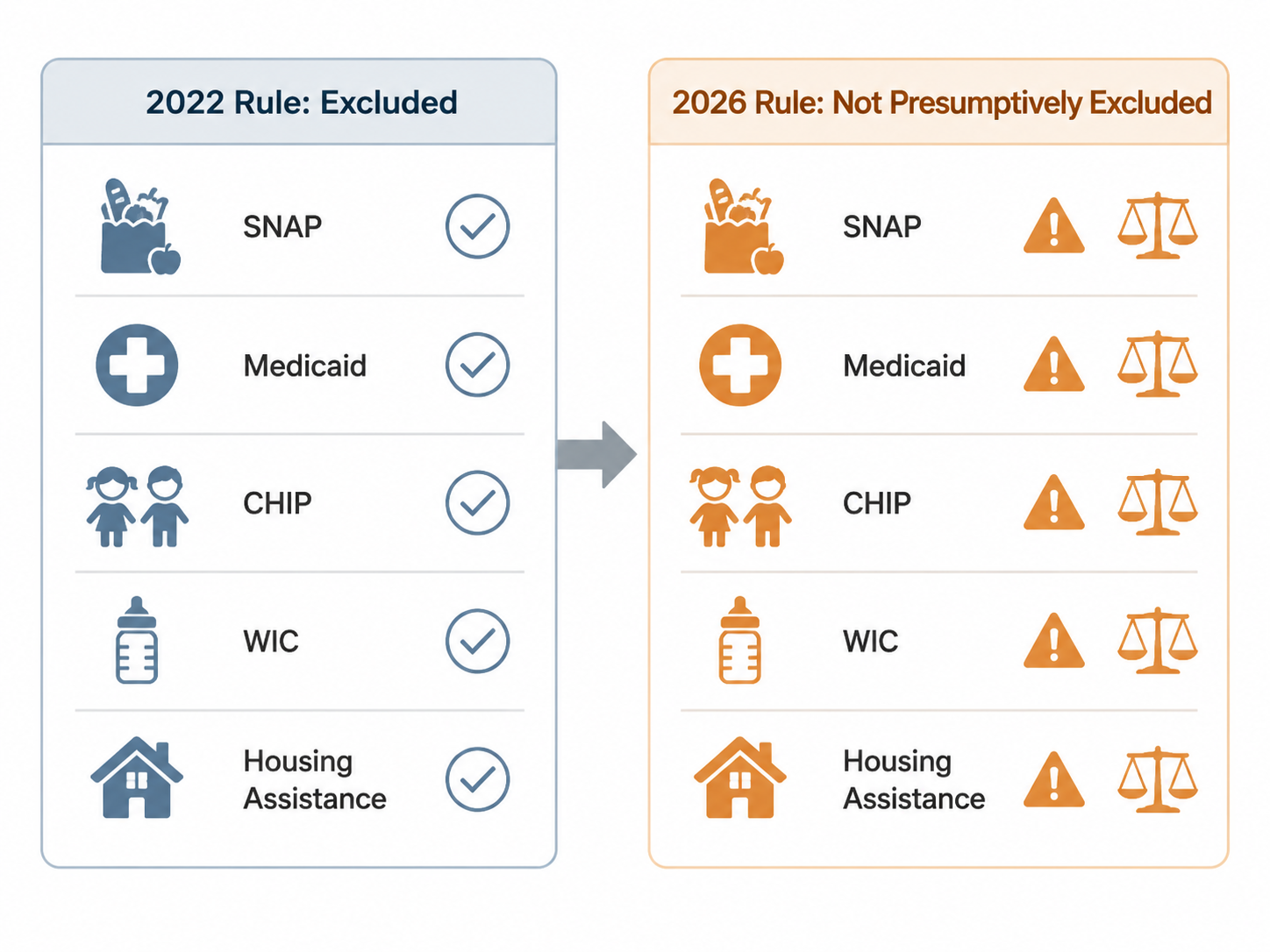
That distinction matters. A client who received SNAP, most Medicaid, CHIP, WIC, or housing assistance was not treated, under the 2022 rule, as having used a benefit that counted in the public charge inadmissibility analysis, except for long-term institutionalization at government expense.[2] Under the 2026 rule, the reported change is not that any one of those benefits now guarantees a denial. It is that the prior safe harbor disappears.

The Rule Change in Counseling Terms
The 2022 rule gave attorneys a bright-line way to answer a common intake question. If the benefit was noncash nutrition assistance, ordinary Medicaid, CHIP, WIC, public housing, or Section 8 assistance, the benefit itself was outside the public charge calculation. The USCIS Policy Manual reflected that framework by limiting the relevant public benefits to cash assistance for income maintenance and long-term institutionalization at government expense, while excluding several noncash and supplemental programs.[2]
The November 19, 2025 proposed rule took aim at that structure by proposing to remove the 2022 rule’s defined benefit list and exclusions.[3] The July 2026 final rule, as reported, completes that rescission.[1] Attorneys should still verify the exact Federal Register text of the final rule before treating any phrasing as operative, but the practical direction is clear enough for triage: the old exclusion list is not the post-September counseling baseline.
| Benefit or benefit use | 2022 framework | 2026 framework reported for September 18, 2026 |
|---|---|---|
| SSI, TANF, state or local cash assistance for income maintenance | Counted as public benefits relevant to public charge analysis.[2] | Remain core benefits historically associated with public charge analysis; still weighable. |
| Long-term institutionalization at government expense | Counted as relevant public benefit use.[2] | Remains weighable. |
| SNAP / food stamps | Expressly excluded from consideration.[2] | No longer presumptively excluded; may be considered in the totality assessment.[1][3] |
| Most Medicaid | Excluded, except for long-term institutionalization at government expense.[2] | No longer presumptively excluded; ordinary Medicaid use may be weighed with other factors.[1][3] |
| CHIP | Excluded from consideration.[2] | No longer presumptively excluded; a child’s CHIP enrollment may become a fact in the household assessment, subject to totality analysis.[3][4] |
| WIC | Excluded from consideration.[2] | No longer protected by the 2022 exclusion; specific treatment should be verified against the final Federal Register text.[1][3] |
| Public housing and Section 8 | Excluded from consideration.[2] | No longer presumptively excluded; may be considered as part of the discretionary assessment.[1][3] |
| Benefits received by family members | Not attributed to the applicant under the 2022 framework.[2] | The 2022 protection is eliminated; family-member benefit use may be considered in the totality analysis, though it does not independently make the applicant inadmissible.[4] |
Excluded Is Different From Not Automatically Fatal
The hardest counseling sentence is the one in the middle: the benefit is no longer excluded, but it is also not a standalone denial ground. That is where careless advice does the most damage. Telling a client that Medicaid or SNAP now “causes” green card denial overstates the rule. Telling the same client that nothing has changed understates the loss of the 2022 safe harbor.
Under a totality-of-circumstances test, benefit receipt becomes one fact among others. The problem is not only the fact itself; it is that the fact no longer drops out of the analysis at the threshold. An officer can put it in the file, weigh it against income, assets, age, health, education, family size, employment history, and affidavit-of-support evidence, and then make a forward-looking judgment about whether the applicant is likely to become primarily dependent on the government.
That is a meaningful change in risk allocation. Under the 2022 framework, an attorney could often tell a parent that a child’s CHIP enrollment was not a public charge problem for the parent’s I-485. Under the 2026 framework, the more careful answer is that the child’s benefit use should not be treated as an automatic bar, but it may no longer be screened out before discretion begins.
Family Benefits Move Into the Main File
Family-member benefits are not a side issue. They are often the actual fact pattern: a U.S.-citizen child has Medicaid or CHIP, a mixed-status household receives SNAP, or a pregnant family member used WIC. The 2022 rule’s value was that it let attorneys separate the applicant’s admissibility from benefits properly received by someone else in the household.[2]
The 2026 approach removes that bright line. MPI’s commentary on the proposal warned that the rescission would allow officers to consider benefits received by family members, including U.S.-citizen children, as part of the broader public charge assessment.[4] That does not mean the child is being found inadmissible, and it does not mean the child’s CHIP enrollment is legally equivalent to the parent’s receipt of cash assistance. It means the fact may enter the officer’s picture of household support and future dependence.
For intake, the practical adjustment is straightforward: do not ask only whether the applicant personally receives SSI, TANF, or institutional long-term care. Ask what the household receives, who receives it, who is eligible in their own right, when it started, whether it is ongoing, and whether the applicant’s financial evidence can explain the household picture without panic or concealment.
The Other Factors Still Matter, and Some Are Easy to Miss
Benefits are only one part of the renewed discretionary analysis. Public charge has always been forward-looking, and the 2026 framework makes that forward-looking judgment more open-ended. The research record identifies age, health, English proficiency, family size, education, and low-skilled employment history as factors that can be weighed, with State Department guidance in February 2026 directing consular officers to treat factors such as being under 18 or over 61, certain health conditions, limited English, and other characteristics as negative factors.[5]
This is where benefit use alone can be a misleading proxy for case risk. A household’s Medicaid use may be explainable by a child’s eligibility; the applicant may also have a strong affidavit of support, steady employment, and no personal cash assistance history. Another applicant may have no current benefit use but several negative factors in the officer’s totality review. The rule change makes both conversations less mechanical.
KFF’s analysis found that 69% of recent green-card holders had at least one characteristic that could count against them under the new public charge approach.[5] That number should not be read as a projected denial rate. It measures exposure to at least one negative factor, not the number of applicants who will be refused permanent residence.
The Denial Risk Is Smaller Than the Fear Risk
The best available estimates separate two different consequences: actual green card denials and fear-driven disenrollment from benefits. MPI estimated that no more than 167,000 noncitizens, less than 1% of 22.1 million noncitizens, could be denied green cards based on current benefit use alone.[6] That estimate is useful because it cuts against the claim that every Medicaid or SNAP user becomes inadmissible.
But it does not make the rule harmless. DHS’s own Regulatory Impact Analysis for the November 2025 proposed rule projected $8.97 billion annually in reduced federal and state transfer payments and estimated 422,748 people losing Medicaid or CHIP coverage at the midpoint disenrollment rate of 10.3%.[7] Those figures come from the proposed rule’s RIA, not the July 2026 final rule, and they are agency estimates rather than independent projections. They still give attorneys a concrete way to understand why clients may stop benefits even when their individual legal risk has not been fully assessed.
That distinction belongs in the counseling script. Legal risk and behavioral risk are not the same thing. A family may disenroll because it fears the immigration consequence; the fact that the fear is understandable does not prove that disenrollment is legally necessary.
The September 18 Filing Line
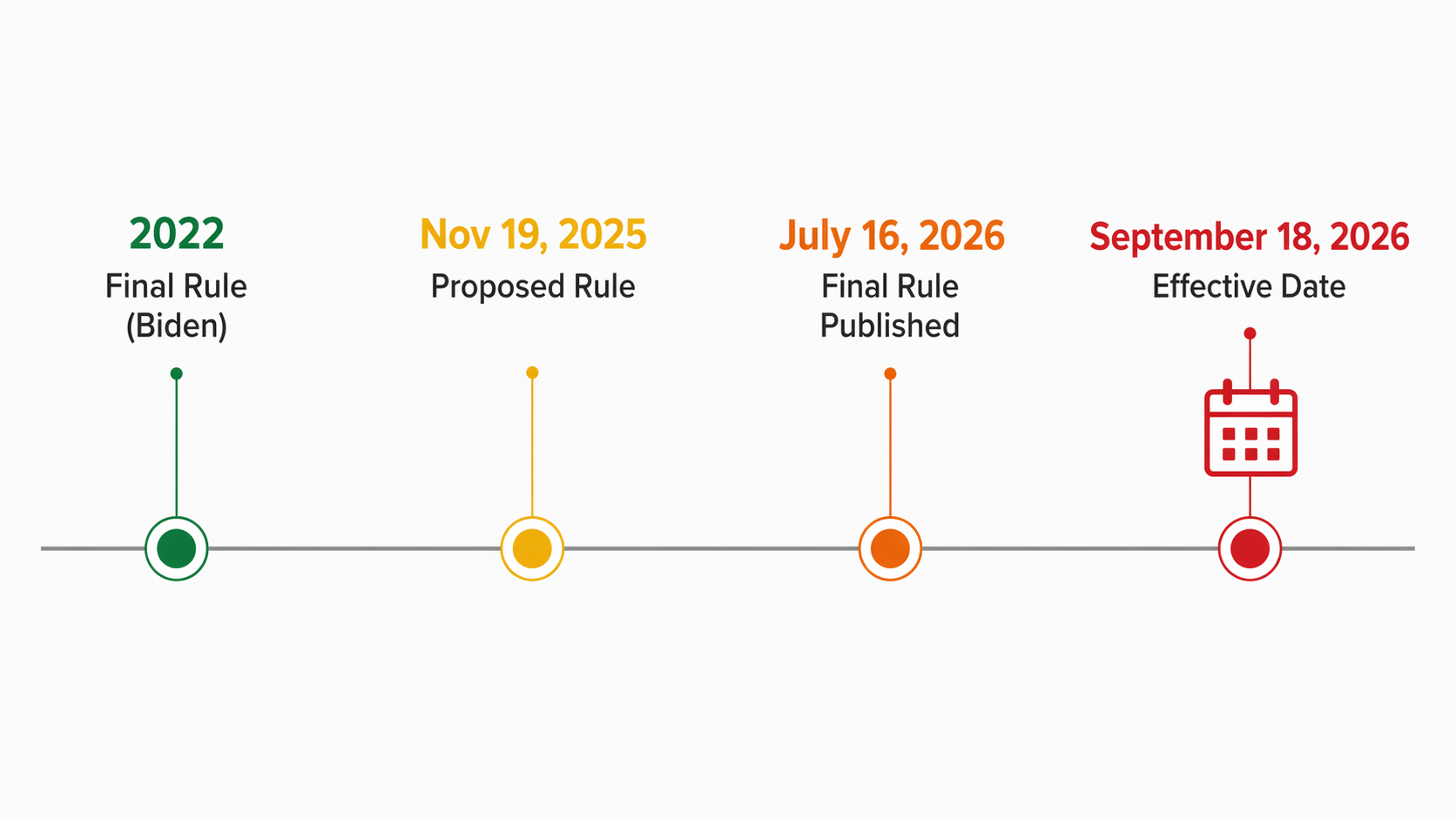
The operative calendar is short. The 2022 final rule supplied the benefit exclusions attorneys have been using. DHS published the proposed rescission on November 19, 2025.[3] The final rule was reported on July 16, 2026, with an effective date of September 18, 2026.[1]
| Date | Practical significance |
|---|---|
| 2022 final rule | Creates the bright-line exclusions for SNAP, most Medicaid, CHIP, WIC, housing assistance, and family-member benefit use.[2] |
| November 19, 2025 | DHS publishes the proposed rescission in the Federal Register.[3] |
| July 16, 2026 | Final rule is reported as published, rescinding the 2022 framework.[1] |
| September 18, 2026 | Reported effective date for the new framework.[1] |
For pending work, that date creates the obvious pressure point. If an adjustment packet is otherwise ready and the client’s facts include SNAP, Medicaid, CHIP, WIC, housing assistance, or benefits received by U.S.-citizen children, the difference between filing before and after September 18 may affect which public charge framework applies. That is not a reason to file a sloppy or incomplete case. It is a reason to stop treating public charge review as a final checklist item.
The intake consequence is immediate. Ask public charge questions early enough to make a filing decision, not after medicals, translations, fee checks, and sponsor documents are already lined up. If the case cannot be filed before the effective date, build the file for discretion rather than pretending the 2022 exclusions still control.
Who Still Falls Outside Public Charge Inadmissibility
The public charge ground does not apply to every immigration category. USCIS guidance identifies exemptions for refugees, asylees, VAWA self-petitioners, T visa holders, U visa holders, Special Immigrant Juveniles, and applicants adjusting under the Cuban Adjustment Act, the Haitian Refugee Immigrant Fairness Act, and similar humanitarian provisions.[2]
Those exemptions should be checked before any benefit-risk conversation gets too far. A client in an exempt category should not be put through the same fear analysis as a family-based adjustment applicant who is subject to INA 212(a)(4). The first counseling question is not “which benefits?” but “does public charge apply to this applicant at all?”
What Attorneys Can Responsibly Say Now
A responsible client answer has to hold the line on both sides. Medicaid, food stamps, CHIP, WIC, or housing assistance do not automatically deny a green card. At the same time, after the 2026 rule takes effect, those benefits are no longer protected by the 2022 categorical exclusions, and family-member benefit use may no longer be kept out of the analysis at the threshold.
- Verify the final Federal Register text before relying on any precise wording from secondary summaries.
- Identify whether the applicant is in an exempt humanitarian or special category before analyzing benefits.
- Separate personal benefit use from household and family-member benefit use, but do not assume family benefits remain irrelevant after September 18.
- Distinguish cases that can be filed before the effective date from cases that must be documented for the new totality test.
- Avoid advising clients that benefits are either harmless or fatal without reviewing the full public charge profile.
For practices that also advise F-1 and J-1 clients, the public charge rescission intersects with separate nonimmigrant-status planning concerns discussed in How Public Charge and D/S Rules Reshape International Student Visas. But for green card counseling, the central operational change is simpler: the 2022 exclusion list is gone, and discretion is back in the room.
References
- Trump revives public charge rule, The Hill
- USCIS Policy Manual, Volume 8, Part G, Chapter 9 - Public Charge Ground of Inadmissibility, USCIS
- Public Charge Ground of Inadmissibility, Federal Register, November 19, 2025
- Trump Administration Public Charge Rule Would Amplify Harms to Immigrant Families, Migration Policy Institute
- Nearly 8 in 10 Immigrants Who Entered the U.S. Without Legal Permanent Resident Status Have at Least One Characteristic That Could Count Against Them Under the New Public Charge, KFF
- Public-Charge Rule Could Lead to Denial of Green Cards for Up to 167,000 Noncitizens Based on Benefits Use Alone, Migration Policy Institute
- Public Charge Changes Will Have Far-Reaching Consequences for Children, Pregnant Women, and Families and Sow Fear in Immigrant Communities, Georgetown University Center for Children and Families, November 21, 2025
Comments
Join the discussion with an anonymous comment.