
Quantum computing stocks gave boards a clean headline in late June: policy support, capital formation, and a sector rally all arrived at once. Fortune reported that after the June 22 executive orders, Quantinuum rose 13%, Infleqtion rose 12%, D-Wave rose 2%, and IBM rose 5% on the day.[1] For anyone advising on quantum computing stocks, AI-adjacent infrastructure, or emerging-technology investment risk, the price action is not the legal point. It is the reason the legal point is now harder to ignore.
The more durable development came a month earlier and then crystallized on June 22. On May 21, 2026, the Department of Commerce announced letters of intent totaling $2.013 billion with nine companies, including IBM at $1 billion, GlobalFoundries at $375 million, and seven quantum companies receiving between $38 million and $100 million each; NIST described the transactions as the first time the U.S. government had taken direct non-controlling equity stakes in quantum companies.[2] That is not ordinary sector promotion. It changes the way investors, contractors, counterparties, and public-company lawyers should read the federal government’s role in the market.

The rally came with a federal compliance clock
The two June 22 orders should be separated. Executive Order 14413, “Ushering in the Next Frontier of Quantum Innovation,” supplies the industrial-policy signal: federal coordination, commercialization support, workforce development, and a national push to accelerate quantum technology.[3] Executive Order 14412, “Securing the Nation Against Advanced Cryptographic Attacks,” supplies the sharper legal hook: migration away from vulnerable cryptography and toward post-quantum cryptography on a defined government timeline.[4]
That distinction matters because investment commentary tends to collapse both orders into a single “government backs quantum” story. Counsel should not. One order helps explain why the market sees policy-backed upside. The other creates operational pressure for agencies, contractors, suppliers, and regulated companies whose systems, products, or services rely on cryptographic protections that may become inadequate as quantum capabilities mature.
| Federal action | What it changes for legal review |
|---|---|
| May 21, 2026 CHIPS letters of intent | $2.013B in proposed funding and direct non-controlling government equity stakes; relevant to investment diligence, government-rights review, and public-company risk narratives.[2] |
| EO 14413 | Signals federal support for quantum innovation and commercialization; important context for sector valuation, contracting strategy, and policy exposure.[3] |
| EO 14412 | Creates the central compliance timetable for post-quantum cryptography migration, including deadlines tied to key establishment and digital signatures.[4] |
| FAR contractor requirements | A developing contractor-compliance channel; important, but still in proposed-rule form and therefore not the same as a final binding FAR clause. |
| BIS export controls | Already relevant to hardware, technical data, deemed exports, and foreign-national access where controlled quantum-computing thresholds are met. |
For legal teams, the combination of quantum stocks, AI-linked infrastructure, and investment risk is also a diligence checklist. A company may be attractive because quantum, AI, and federal industrial policy are converging. The same company may also be exposed because its encryption roadmap, government-contracting posture, export-control program, or securities disclosure controls have not caught up with the legal consequences of that convergence.
EO 14412 turns post-quantum migration into a board-level timing issue
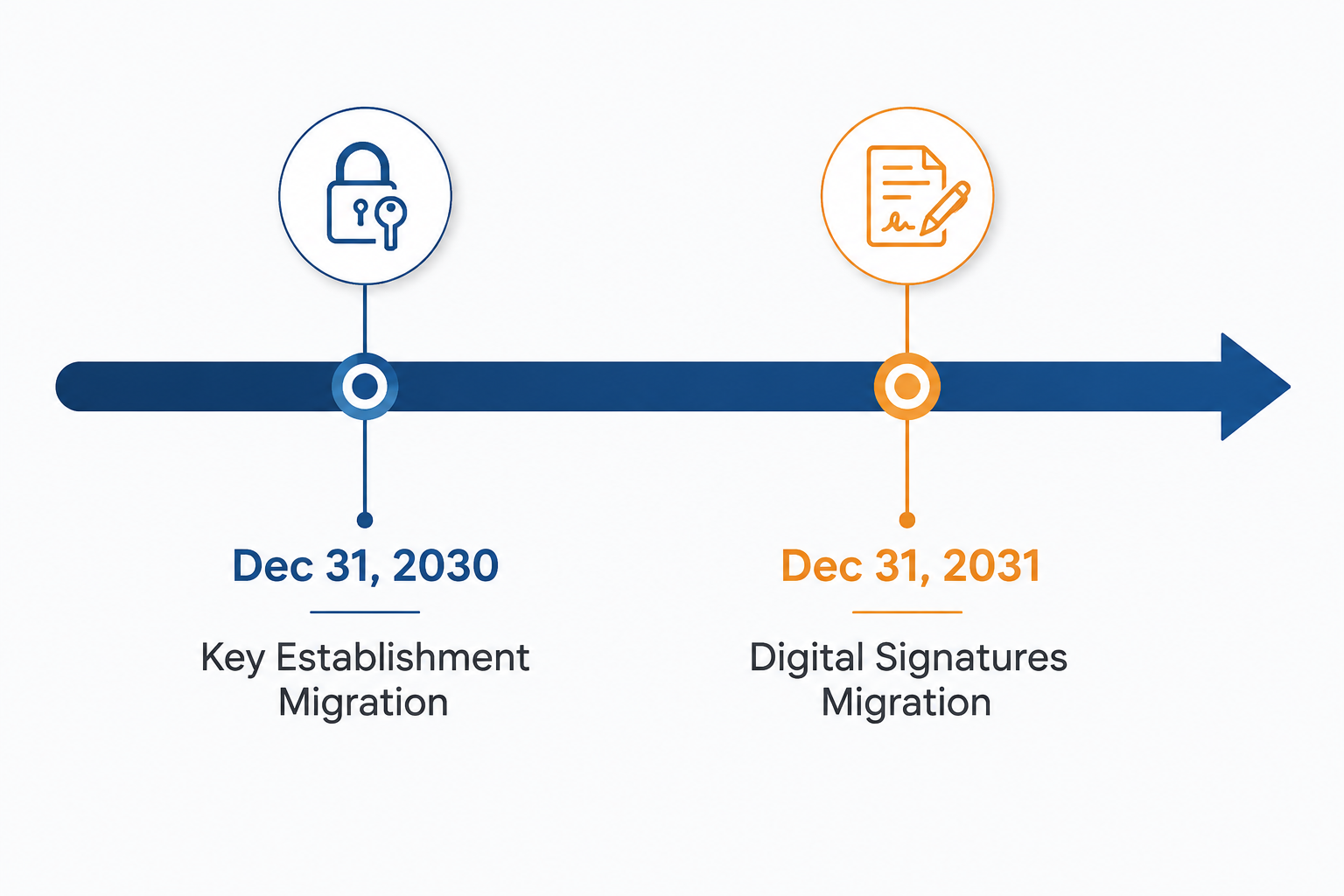
The most concrete dates in the June package are not valuation milestones. EO 14412 sets December 31, 2030, as the deadline for migration of key establishment, and December 31, 2031, as the deadline for migration of digital signatures.[4] Those dates are far enough away to invite delay and close enough to expose poor governance. Cryptographic migration is not a software patch that legal can ask engineering to complete at the end of the decade.
A defensible migration program starts with inventory. Counsel should expect to ask which products, customer environments, internal systems, certificates, embedded devices, data archives, vendor connections, and long-lived contracts rely on algorithms that will need replacement. The answer will not sit entirely in the legal department. It will require engineering, security architecture, procurement, product, sales, and records-retention input.
The legal issue is not merely whether a company can meet the government’s end dates. It is whether the company can explain, before then, why its timeline is reasonable. A public company that treats post-quantum cryptography as a distant technical item may later have to justify that posture after a breach, a contract dispute, a failed procurement, or a disclosure challenge. The best record will usually be contemporaneous: a cryptographic asset inventory, a prioritization method, board or committee reporting, vendor questionnaires, budget approvals, exception handling, and documented reasons for sequencing.
The contractor problem is real, but not final
Federal contractor obligations require a more careful verb tense. Law-firm summaries of the June orders describe expected Federal Acquisition Regulation activity and contractor-facing cybersecurity requirements, but the FAR piece remains in proposed-rule form rather than a final clause that can be pasted into every compliance memo as if already settled.[5] That does not make it irrelevant. It means counsel should track the rulemaking, identify likely covered contracts, and avoid telling business teams that the final obligation is already known.
For contractors and subcontractors, the immediate work is preparatory. Which contracts involve federal information systems, cryptographic services, secure communications, cloud environments, identity management, hardware supply, or software that may become part of a federal migration pathway? Which solicitations or renewals may require representations about post-quantum readiness? Which suppliers are indispensable but unable to give credible migration assurances? Those questions are answerable before the FAR text is final, and they are more useful than a generic statement that quantum regulation is coming.
BIS controls make quantum a talent and access-control issue
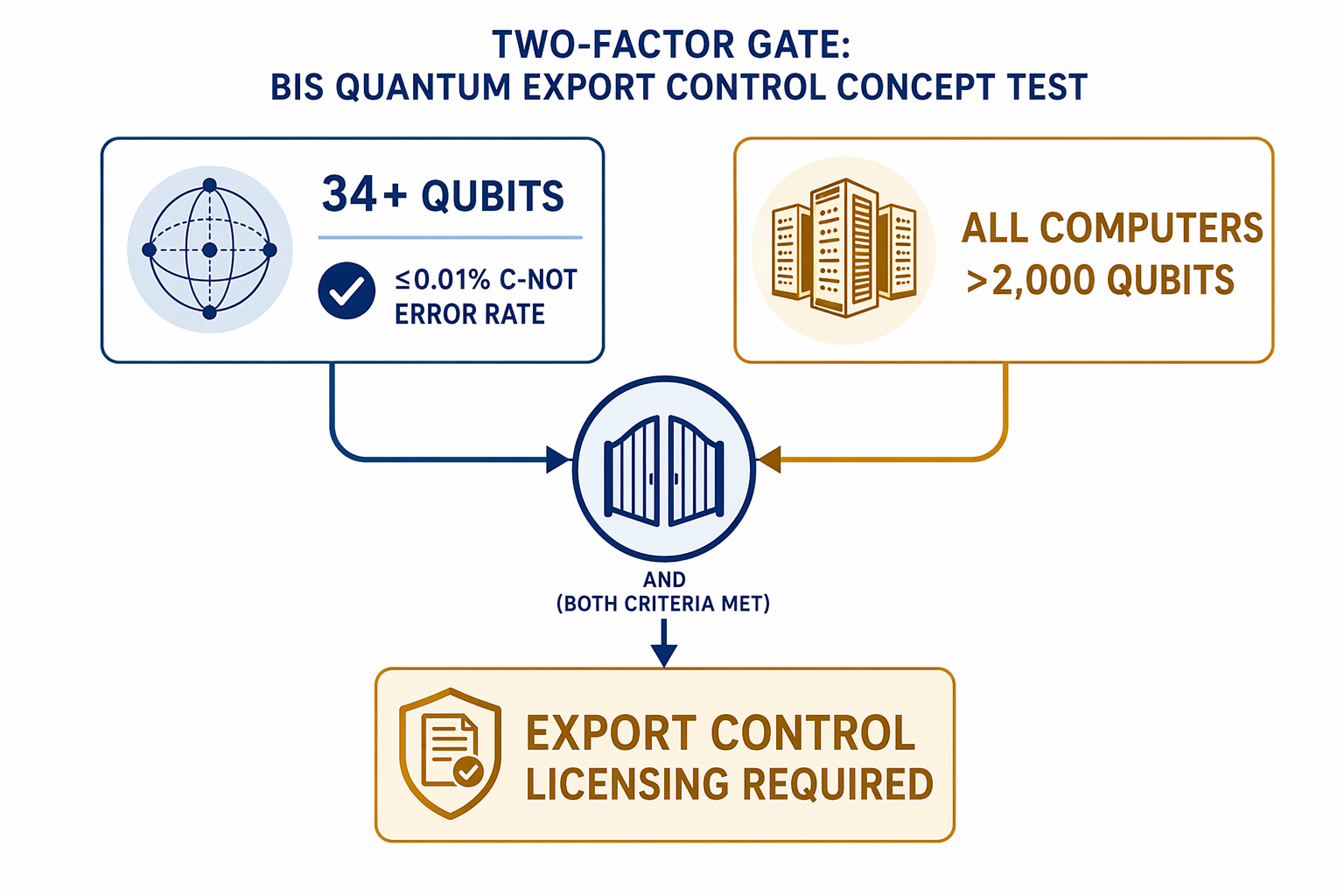
The export-control analysis is where a quantum growth story can become uncomfortable for companies built around global research teams. Skadden’s Global Legal Insights chapter describes the Bureau of Industry and Security framework for quantum computers meeting a two-factor control test: quantum computers with 34 or more qubits at a C-NOT error rate of 0.01% or less, and all quantum computers with more than 2,000 qubits.[6] Those thresholds matter because they give counsel something more useful than the word “advanced.” They identify when hardware and related technology may move into a licensing analysis.
The hard cases will not always look like exports in the commercial team’s sense of the word. BIS restrictions can also implicate deemed exports: releases of controlled technology to foreign nationals in the United States. Skadden notes that nearly half of U.S. quantum companies employ foreign nationals requiring licenses.[6] For a sector that depends on scarce scientific talent, that point belongs near the top of the legal risk memo, not in an appendix.
A useful export-control review should map at least four things: the technical characteristics of the quantum computer or component; the technology and software that employees can access; the nationality and location of personnel with access to controlled items or information; and the company’s collaboration channels with universities, customers, suppliers, cloud partners, and foreign affiliates. Counsel should be suspicious of any conclusion that starts and ends with the shipment of a physical machine.
This is also where investment diligence and employment practice intersect. A buyer, lender, strategic investor, or public-company acquirer evaluating a quantum target should not ask only whether the target has leading researchers. It should ask whether those researchers can lawfully access the technology they need, whether license applications are pending, whether internal controls are documented, and whether technical collaboration has outrun the company’s export-control classification work.
Disclosure risk is narrower than hype, but broader than a quantum-specific SEC rule
There is no binding SEC rule that says public companies must make a stand-alone “quantum risk” disclosure. That should end one kind of overstatement. It should not end the analysis. Existing materiality principles, cybersecurity disclosure expectations, and risk-factor practice can still require an issuer to address quantum exposure where the risk is material to its business, operations, technology, customers, or controls.
The SEC Investor Advisory Committee’s December 2024 recommendation on AI disclosure is not a quantum rule, but it is a useful marker for how regulators and investors may evaluate emerging-technology disclosure discipline. The committee recommended disclosure concepts including defining “AI,” discussing board oversight, and explaining integration into operations.[7] A company that is already telling investors an AI-and-quantum story should expect questions about whether its governance and risk disclosure are as developed as its growth narrative.
FINRA’s 2025 report on quantum computing for the securities industry is likewise not a public-company quantum disclosure rule. It is still relevant because it treats quantum computing as a technology with implications for securities firms, cybersecurity, and market infrastructure.[8] For broker-dealers, asset managers, financial institutions, and vendors serving them, that kind of supervisory reference point can become important when exam teams, clients, boards, or litigants ask whether the company recognized the issue early enough.
“Harvest now, decrypt later” is the bridge from future technology to present legal duty
The disclosure issue becomes more concrete when the data is already being collected. A&O Shearman identifies the “harvest now, decrypt later” threat: adversaries may take encrypted data now and wait for future quantum capability to decrypt it.[9] That theory matters to lawyers because it weakens the easy answer that quantum risk is only a future event. If sensitive data has a long useful life, current encryption choices, current retention decisions, and current migration delays may be judged later against what the company knew or should have known.
That does not mean every issuer needs a quantum paragraph in its next Form 10-K. It means counsel should test materiality with the actual business in mind. A payment processor, defense supplier, cloud security vendor, health-data platform, semiconductor company, government contractor, or financial institution may have a different disclosure profile from a company whose quantum exposure is remote or speculative. The legal question is whether omission or generic disclosure would leave investors without information a reasonable investor would consider important.
The same analysis applies to affirmative statements. If a company markets itself as quantum-ready, post-quantum secure, AI-quantum enabled, federally aligned, or uniquely positioned for government quantum demand, disclosure controls should test whether those statements are supportable. Securities exposure often begins when an optimistic business narrative is more specific than the company’s internal controls can justify.
The litigation map is visible, even if the cases are not inevitable
The likely lawsuit categories are not mysterious. Skadden and A&O Shearman identify patent litigation, trade secret disputes, antitrust issues, negligence claims, and disclosure-related claims as plausible quantum-computing legal risk areas.[6][9] That list should not be converted into a prediction that every quantum-adjacent company is headed for court. It should be used to decide which records to create now.
Patent disputes are likely to follow technical differentiation and crowded commercialization. Trade secret disputes may follow employee mobility, joint development, academic collaboration, and contractor relationships. Antitrust issues may arise where government support, scarce infrastructure, cloud access, standards activity, or platform control affect competition. Negligence and disclosure claims are more likely to turn on whether a company had a reasonable process for identifying and managing cryptographic and cybersecurity risk.
The remedial work is ordinary in form but demanding in execution: classify assets; document controls; review statements; align contracts with technical reality; preserve export-control records; track agency deadlines; and keep board materials accurate without turning them into discoverable marketing decks. Lawyers do not need to become quantum physicists to do that work. They do need enough technical fluency to know when a comforting answer is not yet an answer.
Market forecasts are context, not a substitute for legal triage
The market-size narrative remains unsettled. The available estimates cited in sector commentary vary materially: roughly $1.08 billion to $1.9 billion for 2026, $8 billion to $20 billion for 2030, and $170 billion to $198 billion for 2040. Those ranges may help explain investor attention, but they should not be treated as consensus or used to paper over company-specific compliance risk.
The same caution applies to AI-quantum convergence. The commercial logic is obvious enough: quantum technology may matter to optimization, simulation, cryptography, materials, and AI infrastructure. But for legal professionals advising investment committees, public-company management, or transaction teams, the more immediate question is whether the company’s regulatory obligations are keeping pace with its story. A company that benefits from quantum enthusiasm may also inherit quantum-adjacent obligations through cryptography, contracts, export controls, data security, or disclosure.
What counsel should verify before treating the upside story as investable
A legal review of quantum computing stocks and AI-linked investment opportunities should begin with source discipline. Which obligations come from EO 14412, which come from EO 14413, which are still proposed FAR requirements, which arise under BIS controls, and which are disclosure judgments under existing securities-law principles? Mixing those categories may make a memo sound urgent, but it makes the advice weaker.
- PQC migration: identify whether the company owns, operates, sells, or depends on systems that must migrate key establishment by December 31, 2030, or digital signatures by December 31, 2031.
- Federal contracting: determine whether the company is a prime contractor, subcontractor, supplier, cloud provider, security vendor, or technology partner likely to be affected by forthcoming FAR requirements.
- Export controls: classify quantum hardware, software, and technology; evaluate the BIS two-factor thresholds; and review deemed-export exposure for foreign-national employees and collaborators.
- Disclosure controls: compare public statements about quantum, AI, cybersecurity, government support, and post-quantum readiness against internal documentation and board reporting.
- Litigation posture: preserve evidence of reasonable decision-making, especially around cryptographic inventory, migration sequencing, vendor reliance, technical representations, and risk-factor updates.
The June 2026 watershed did not make quantum investing safe, and it did not make every quantum risk immediately material. It did something more legally useful: it attached dates, agencies, thresholds, and disclosure questions to a sector that was already attracting capital. For counsel, that is the practical inflection point. The upside story and the compliance story now have to be read together.
References
- Quantum computing stocks surge after Trump signed executive orders backing the sector, Fortune, June 23, 2026.
- Department of Commerce Announces Letters of Intent With 9 Companies for $2 Billion, NIST, May 21, 2026.
- Ushering in the Next Frontier of Quantum Innovation, White House, June 22, 2026.
- Securing the Nation Against Advanced Cryptographic Attacks, White House, June 22, 2026.
- New Executive Orders and Government Strategy Advance US Quantum Innovation, Skadden, June 2026.
- Quantum Computing Laws and Regulations 2026 – USA, Skadden/Global Legal Insights.
- Disclosure of AI's Impact on Operations, SEC Investor Advisory Committee, December 2024.
- Quantum Computing and the Implications for the Securities Industry, FINRA.
- The opportunities and legal risks of quantum computing, A&O Shearman.
Comments
Join the discussion with an anonymous comment.