
The jail phone was never designed to be a booth. For Mac Dre, it became one anyway. While incarcerated, he used monitored jail calls as the channel for finished recordings, turning the same institutional line used for family contact, payment collection, and facility surveillance into the path by which music left custody and reached listeners.[1]
That is the cleanest way into the legal problem because it refuses the usual separation between art and administration. A person in custody can speak rhythmically into a handset, have the audio captured outside the facility, and later see the result treated as a song. But inside the jail-phone system, the same sound may also be a recorded inmate communication, a vendor-managed data file, a billable event, a monitored security object, and, if prosecutors want it, potential evidence.
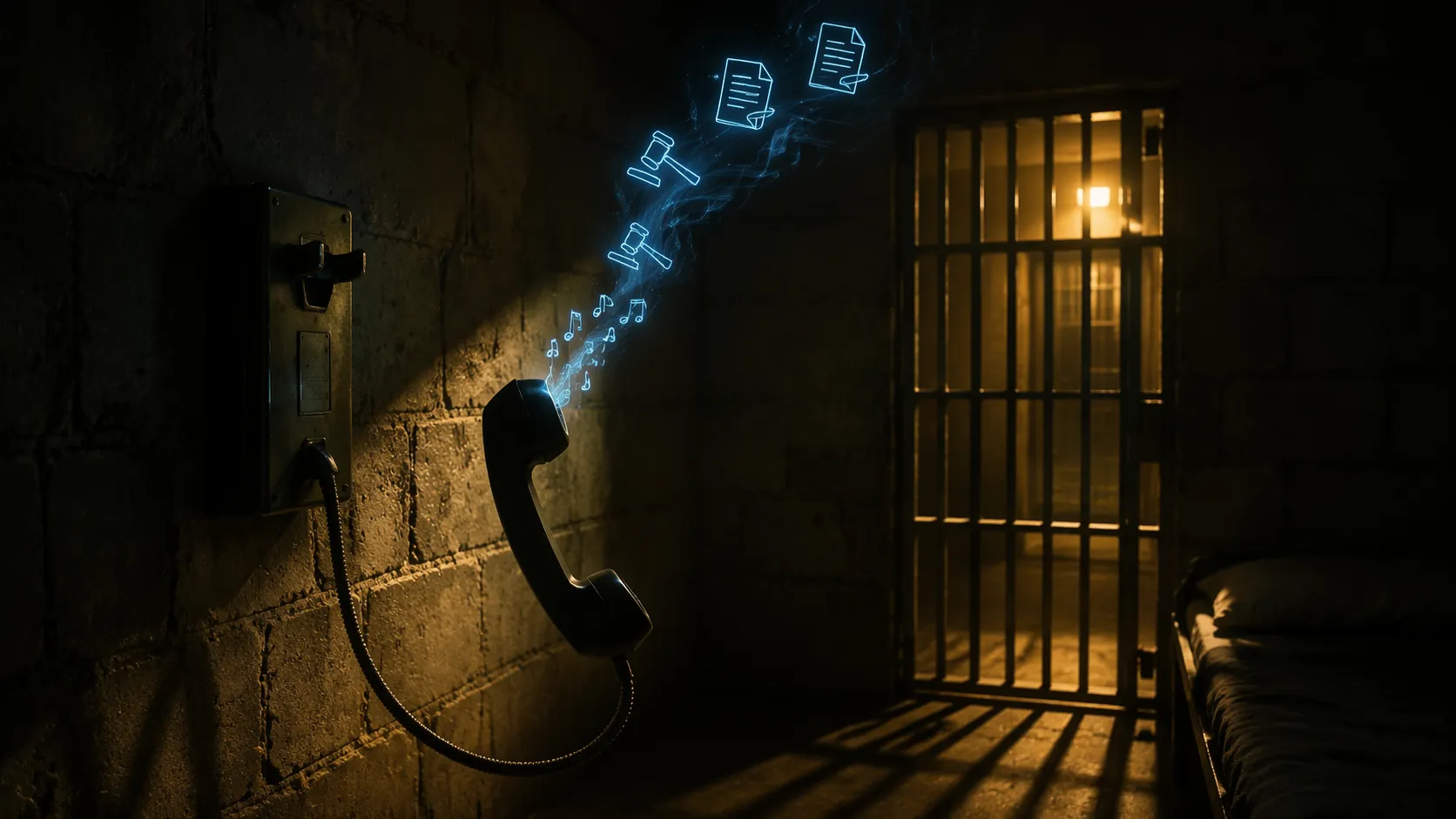
That overlap is why inmates recording music from jail phone systems face legal issues that do not fit neatly into a single doctrine. The First Amendment may protect creative expression, but prison speech is filtered through deference to security and administration. Copyright may vest in the author, but prison-technology contracts and property controls can interfere with access, registration, and exploitation. Privacy objections often fail because monitored jail calls carry warnings and are treated as non-private. And once the recording is in government hands, the expressive character of the work does not automatically keep it out of a criminal courtroom.
| Stage | What the recording is legally treated as |
|---|---|
| Creation | Speech by an incarcerated person, subject to prison rules and Turner-style penological-interest review |
| Transmission | A monitored communication moving through a vendor system, often with notice that calls are recorded |
| Storage and accounts | A file or account-related asset shaped by contracts, balances, device access, and facility policy |
| Distribution | Potential copyrighted expression that may still collide with prison rules or third-party copyright claims |
| Courtroom use | Potential evidence, including lyrics or recorded statements, with limited privacy-based suppression arguments |
The First Amendment protects expression, then prison doctrine narrows the room
Prison systems do not get to erase artistic expression by calling it inconvenient. The more difficult question is what happens after officials supply a security rationale. In prison-speech cases, courts generally ask whether a restriction is reasonably related to legitimate penological interests, the framework associated with Turner v. Safley. That standard leaves space for First Amendment claims, but it also gives prisons substantial room to defend restrictions as security, order, rehabilitation, or administrative measures.
The instability of that protection showed up clearly in New York. The state prison system reversed a directive restricting incarcerated people from publishing creative work after First Amendment challenges and public scrutiny, a result that matters because it was a policy reversal, not a broad Supreme Court ruling establishing a nationwide rule for prison art.[2]
For a jail-phone recording, that distinction is not academic. A ban on sending out a finished track, a discipline ticket for recording lyrics by phone, a refusal to allow publication, and a restriction on receiving royalties may all be defended differently. Some measures regulate speech directly. Others are framed as phone-use rules, anti-commercial rules, contraband controls, gang-intelligence policies, or limits on third-party coordination. The constitutional claim changes depending on which lever the facility pulled.
That is also why the most confident slogans about prison music tend to be the least useful in litigation. Saying that a song is protected speech starts the analysis; it does not finish it. Counsel still has to identify the rule, the government interest, the available alternatives, the burden on guards and other incarcerated people, and whether the policy is being applied evenly or as a disguised content restriction.
The monitored line turns the studio take into a government record
The jail phone does not merely transmit the performance. It records it under rules that usually warn callers they are being monitored. That warning has done heavy work in privacy litigation.
In Washington, State v. Archie and State v. Modica rejected privacy claims involving jail calls, with courts relying on the monitored nature of the calls and the notice given to callers. Prison Legal News reported the decisions as holding that there was no privacy right in the recorded jail calls at issue.[3]
For music made over the same type of line, the consequence is severe. The caller may intend the words as a verse, a draft, or a performance for an outside producer. The system receives them as a recorded inmate call. If prosecutors later obtain the call, the Fourth Amendment route to suppression may be closed before the argument about art even begins.
That does not mean every lyric should be admissible. It means the fight often moves elsewhere: relevance, unfair prejudice, character evidence, hearsay, authentication, expert testimony, and the risk that jurors will treat a genre convention as autobiography. Those evidentiary arguments are narrower than a privacy claim, and they require judges to do work the surveillance architecture has already made easier for the government.
Broadnax v. Texas sits in that pressure zone. The Marshall Project reported in March 2026 that a Supreme Court petition was pending in a case involving rap lyrics used as evidence, and the reporting placed the case within a broader debate over courts’ treatment of rap as proof of criminal intent or identity.[4] That source establishes the petition posture as of March 2026; it does not establish whether the Court later granted certiorari, denied it, or otherwise resolved the case.
Broadnax matters for jail-phone music even if the precise procedural vehicle is not a jail-phone copyright dispute. Once an incarcerated artist records through a monitored system, the government may possess both the performance and the metadata around it. The evidentiary question then becomes whether the legal system can distinguish a recorded creative act from a confession-shaped object simply because the state captured it through prison infrastructure.
Contract terms and property controls can separate creators from their own work
Copyright law starts from a premise that sounds friendlier to the artist than prison administration usually does: original expression fixed in a tangible medium belongs to its author unless some other rule changes that result. But prison-phone and prison-technology systems can complicate the practical control of the work long before anyone litigates copyright ownership.
The JPay controversy showed why lawyers read prison-tech terms of service closely. In 2015, Gizmodo, with the Electronic Frontier Foundation’s involvement in the investigation, reported that JPay’s terms purported to claim broad ownership over content transmitted through its system; the company later indicated it would not enforce the clause against the family at the center of the story, but the reporting did not establish a clean judicial ruling invalidating the provision.[5]
That posture matters. A vendor’s retreat from a public controversy is not the same thing as a holding that incarcerated users retain all intellectual-property rights in everything they send. It is a pressure point. It tells counsel to ask what the governing terms said when the recording moved, whether the person assented, whether the clause was enforceable, what state contract law applies, and whether any facility policy separately restricted commercial use.
The Florida digital-music litigation adds a different property problem. There, the dispute was not about inmates composing songs over a phone line but about purchased digital music that became unusable after a contract change. EFF wrote in 2018 that Florida prisoners had bought 6.7 million songs at $1.70 each before access was cut off after a vendor transition.[6] Prison Legal News later covered the class action, Demler v. Inch, as a Takings Clause case challenging the confiscation of the music.[7]
The remedy was telling. The case settled in 2020 for $3.9 million in media credits, valued at $1 per credit, rather than cash damages paid directly to class members.[8] That settlement did not turn prison media purchases into ordinary property held under ordinary market conditions. It showed that when a prison-technology product disappears, the remedy may be mediated through the same closed ecosystem that created the dispute.
For an incarcerated musician, those two examples point in different directions but toward the same practical warning. Ownership of the copyright, control of the file, access to the account, ability to register the work, and ability to receive value from the work are not the same right. A person may have a plausible authorship claim and still be unable to retrieve the recording, prove the chain of custody, pay registration fees, communicate safely with collaborators, or prevent a vendor term from becoming a litigation expense.
The Copyright Alliance’s 2024 protocol for incarcerated copyright registrants is useful precisely because it treats incarceration as an administrative barrier, not a metaphysical exception to authorship. The protocol addresses how incarcerated people can interact with copyright-registration processes, which is narrower than saying registration solves the ownership and access problems created by prison technology.[9]
Privilege failures and account seizures show how much power sits outside copyright
The same surveillance system that captures music also captures legally sensitive communications unless safeguards work. Securus faced litigation over recorded attorney-client jail calls, and the ABA Journal reported on Austin Lawyers Guild v. Securus in 2014 as a Sixth Amendment challenge to recorded jail phone calls.[10] EJI later reported that Securus settled litigation over illegal recording of attorney-client calls for $3.7 million in 2020.[11]
That does not make every recorded music call a Sixth Amendment violation. It does show that prison telecom systems are not neutral pipes in the way ordinary consumer phone service is imagined to be. They are configured, contracted, audited, billed, and monitored. When a privileged call is mishandled, the harm is constitutional. When a music call is captured, the harm may be evidentiary or commercial. The same architecture can produce both.
Account control is another non-copyright lever. Prison Legal News reported in 2022 that GTL, now ViaPath Technologies, agreed to a $67 million class-action settlement over allegations involving the seizure of prepaid account balances after 90 days of inactivity.[12] For families and incarcerated users, that kind of dispute is about money first. For creators, it also matters because communication credits and prepaid accounts are part of the cost of making, transmitting, and coordinating work from custody.
The music industry adds still another layer when prison distribution uses outside catalogs or unlicensed tracks. Litigation involving UMG Recordings and Centric Group over mixtapes distributed in prisons showed that prison music distribution can collide with conventional publisher and label claims, not only with prison-specific constitutional disputes.[13][14] That is a different fact pattern from an inmate recording original vocals by jail phone, but it is a useful reminder that the prison setting does not suspend ordinary copyright enforcement by third parties.
What counsel should isolate before calling it a jail-phone music case
The first question is not whether the recording is art. It may be. The first legal question is what the system did to it and which actor is relying on that treatment.
- Identify the channel: facility phone, tablet messaging, prison email, contraband cellphone, or outside recording equipment. Each route creates different notice, monitoring, and policy issues.
- Separate the claimant: incarcerated creator, outside collaborator, family account holder, vendor, facility, prosecutor, publisher, or civil class member.
- Pin down the remedy: suppression, injunction, damages, account credits, policy reversal, contract interpretation, copyright registration, or evidentiary limitation.
- Do not collapse monitoring into ownership. A vendor or facility may possess a recording without owning the copyright in the composition or sound recording.
- Do not collapse authorship into admissibility. A lyric can be protected expression and still become evidence if the court admits it under ordinary evidence rules.
Mac Dre’s jail-phone recordings remain powerful because they make the whole pipeline visible. The creative act is real. So is the cage around it. The phone that carries the verse is also the phone that warns of monitoring, runs through a vendor contract, charges someone’s account, stores a record, and may later provide the state with usable courtroom material.
The current law does not treat music made from jail phones as one stable category. It treats it as prison speech when officials restrict it, as monitored communication when prosecutors seek it, as intellectual property when authorship is asserted, as account activity when vendors bill for it, and as institutional data when the facility stores it. Inmates can and do create music through jail phones. The legal system is still more comfortable treating the resulting work as a monitored institutional artifact than as a protected artistic object with settled expressive, proprietary, and evidentiary status.
References
- Mac Dre jail-phone album reporting, The Marshall Project, April 5, 2026, themarshallproject.org/2026/04/05/mac-dre-jail-phone-redemption-songs
- New York prisons First Amendment reporting, The Marshall Project, June 10, 2023, themarshallproject.org/2023/06/10/new-york-prisons-first-amendment
- Washington privacy cases reporting on State v. Archie and State v. Modica, Prison Legal News, December 15, 2009, prisonlegalnews.org/news/2009/dec/15/...
- Texas music Supreme Court rap execution reporting, The Marshall Project, March 28, 2026, themarshallproject.org/2026/03/28/texas-music-supreme-court-rap-execution
- How a Prison Email Service Steals IP Rights to Everything You Send, Gizmodo, 2015, gizmodo.com/how-a-prison-email-service-steals-ip-rights-to-everythi-1702489394
- Florida prisoners digital music analysis, Electronic Frontier Foundation, 2018, eff.org/deeplinks/2018/08/...
- Demler v. Inch class-action reporting, Prison Legal News, June 5, 2019, prisonlegalnews.org/news/2019/jun/5/...
- Demler v. Inch settlement reporting, Prison Legal News, July 1, 2020, prisonlegalnews.org/news/2020/jul/1/...
- Copyright Protocol 2024, Copyright Alliance, 2024, copyrightalliance.org/wp-content/uploads/2024/10/CopyrightProtocol-2024-1.pdf
- Recorded jail phone calls violate 6th Amendment, class action says, ABA Journal, 2014, abajournal.com/news/article/recorded_jail_phone_calls_violate_6th_amendment...
- Securus attorney-client call settlement reporting, Equal Justice Initiative, 2020, EJI 2020 settlement report
- GTL/ViaPath prepaid account settlement reporting, Prison Legal News, April 1, 2022, prisonlegalnews.org/news/2022/apr/1/...
- UMG Recordings v. Centric Group lawsuit reporting, Prison Legal News, June 3, 2016, prisonlegalnews.org/news/2016/jun/3/...
- UMG Recordings v. Centric Group lawsuit reporting, Billboard, 2015, billboard.com/music/music-news/...
Comments
Join the discussion with an anonymous comment.