
The phrase “referee police detention legal controversy” sounds as if it describes one category of event. In 2026, it has been used around two very different stories: Somali FIFA referee Omar Artan being refused entry at Miami International Airport, and Slovenian referee Slavko Vinčić again facing public scrutiny over a 2020 police detention in Bosnia after his World Cup final appointment. The cases sit close together in public discussion because both involve elite referees, law enforcement, and World Cup-adjacent reputational damage. Legally, they begin in different places.
Artan’s case was not domestic police custody after lawful entry. CBS News reported that he arrived at Miami International Airport on June 6, 2026, from Istanbul, carrying a valid visa and diplomatic passport, and was denied entry by U.S. Customs and Border Protection. CBP cited “derogatory information including association with suspected members of terror organizations,” and the report noted Somalia’s inclusion on the Trump travel ban list of 39 countries, as well as the Immigration and Nationality Act Section 8235 expedited-removal authority referenced in the account.[1] Al Jazeera also reported that U.S. officials confirmed the denial of entry.[2]
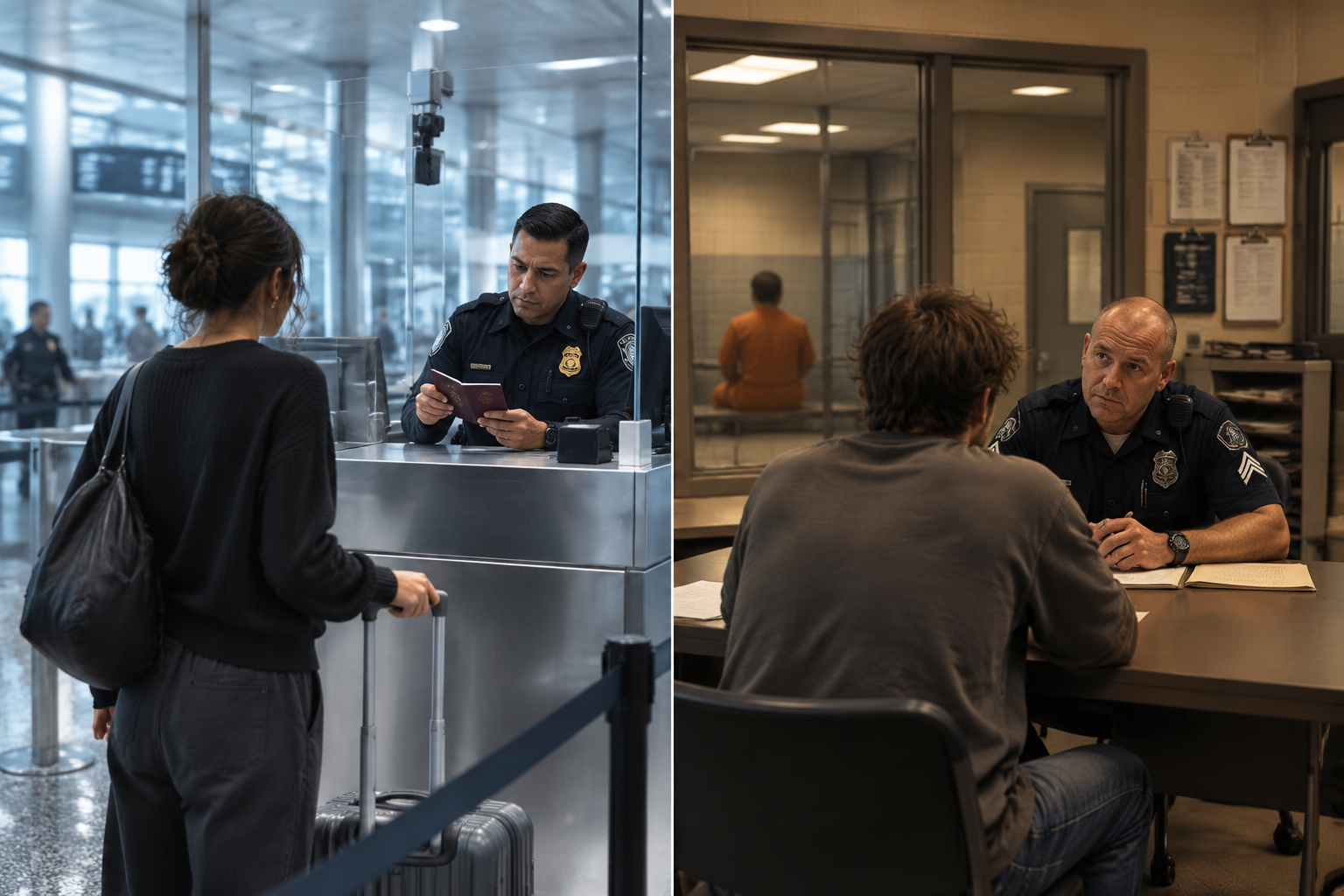
That distinction is not semantic housekeeping. A valid visa may be powerful evidence of prior authorization to seek admission, and a diplomatic passport may carry obvious political weight. Neither converts the airport inspection point into the same legal setting as a street stop or police-station arrest after entry. At the border, the immediate question is admissibility. The government officer is deciding whether the traveler may enter; the traveler has not yet crossed into the constitutional posture that lawyers instinctively associate with ordinary domestic seizure.
Artan’s Visa Did Not Put Him Past the Border
The hard part of Artan’s case is that the facts most likely to move a lay reader are not the facts that do the most legal work. He reportedly had a valid visa and diplomatic passport. He was also, according to NPR’s account of the reaction in Somalia, “hailed as a hero at home.”[3] Those details matter to diplomacy, reputation, and fairness in the ordinary sense. They do not erase the border doctrine that makes admission a separate act from visa issuance.
A visa is permission to travel to a port of entry and request admission. It is not a final adjudication that the person must be admitted under all later-discovered or later-asserted circumstances. That is why CBP’s explanation matters even if its public wording remains unsatisfying. The phrase “derogatory information” is broad, and its breadth is precisely what makes the border setting so unforgiving. If the officer’s admissibility decision is framed around national-security or terrorism-associated information, the practical space for immediate outside correction is narrow.
The travel-ban context sharpens the point without resolving the case in Artan’s favor. CBS described Somalia as one of the countries on the 39-country Trump travel ban list and noted that the World Cup-related exemption did not eliminate individual officer discretion.[1] That combination is easy to misunderstand. An exemption can keep a class of sports personnel from being categorically blocked, while still leaving an individual traveler exposed to a case-specific inadmissibility judgment.
For immigration lawyers, this is the asymmetry that public accounts often flatten. The visible event looks like a person being stopped by an officer. The governing premise is not the same as a domestic arrest. In ordinary U.S. policing, the instinct is to ask what suspicion justified the stop, whether probable cause existed, how long the detention lasted, and what court can review it. At the border, the admission decision rests on a different allocation of sovereign power, and the ordinary Fourth Amendment frame does not travel intact.
Why the Fourth Amendment Analogy Misleads
The Fourth Amendment remains useful here only as a contrast. In a domestic police encounter, it supplies the familiar vocabulary of searches, seizures, reasonableness, warrants, probable cause, and suppression. A National Law Review discussion of the Fourth Amendment in sports-related police encounters treats that domestic framework as the starting point for analyzing government conduct around athletes and sporting contexts.[4] That is not Artan’s posture at the airport.
Calling Artan’s exclusion “police detention” imports the wrong legal architecture. CBP may physically control a traveler during inspection, secondary screening, and removal processing; the practical experience may be coercive and opaque. But the legal question is still admission. The remedial question is not “Was there probable cause for a domestic arrest?” It is closer to “Who had authority to decide admissibility, what statute or executive policy applied, and is there any meaningful forum to challenge the decision before the consequence is complete?”
That is where Artan’s case becomes most severe. The reported CBP rationale, the travel-ban environment, and the expedited-removal reference all point toward a process in which the official decision can be fast, consequential, and thinly reviewable from the outside.[1] The public may see a referee excluded from a global sporting event. The legal system sees a noncitizen at the threshold of entry facing an admissibility determination.
There is also no useful legal precision in treating diplomatic discomfort as a remedy. NPR’s account of Artan’s standing in Somalia helps explain why the incident had force beyond one airport decision.[3] It does not identify a process that would compel admission, require disclosure of the underlying derogatory information, or restore the lost assignment in real time. Public vindication and legal review are different currencies.
FIFA’s Deference Leaves the Referee Exposed
FIFA’s public position matters less for what it promises than for what it declines to promise. CBS and Al Jazeera both quoted FIFA as stating: “A host government ultimately determines who receives a visa and who is admitted into their country.”[1][2] That is a legally cautious sentence. It avoids suggesting that FIFA can override sovereign admission decisions, and it gives little comfort to an official whose ability to work depends on crossing the host state’s border.
The institutional gap is not hard to locate. Referees operate inside FIFA’s tournament structure, but the host government controls the border. A sports organization may accredit, appoint, schedule, and replace. It cannot, on the information available here, force CBP to admit a particular official. The practical consequence is that a referee can lose the assignment without any sports-disciplinary finding against him.
That gap is sometimes obscured by the way international sport talks about guarantees. Tournament planning depends on assurances about visas, credentials, transportation, and security. Those assurances can reduce administrative friction for a class of participants. They do not necessarily create an individual, enforceable right against a border officer who says the person is inadmissible for security-related reasons.
Vinčić Shows the Other Half of the Problem
Vinčić’s resurfaced controversy belongs in the same article only because it shows the opposite legal posture. According to AS USA, he was briefly detained in May 2020 during a Bosnia police raid connected to an investigation into prostitution, drug trafficking, and weapons possession. He was released without charge, and the Slovenian Football Association said he was “simply attending a social gathering.” The controversy returned to public attention when he was appointed as a 2026 World Cup final referee.[5]
That is closer to what most readers mean when they say “police detention.” Police acted inside a domestic criminal-law setting. The referee was physically detained in connection with an investigation. The relevant legal environment was Bosnia, not the United States, so it would be wrong to export U.S. Fourth Amendment doctrine as if it directly governed the raid. The better comparison is structural: domestic policing generally brings some legal standard for deprivation of liberty, some route to release, and some possibility of later challenge.
On the reported facts, the formal criminal-law consequence ended favorably for Vinčić. He was released without charge.[5] That matters. It means the state did not convert the detention into a prosecuted accusation. It also means the strongest legal remedy may already have occurred: the person was let go, without a charge that would need to be dismissed or defended.
The residue is reputational rather than neatly remedial. A release without charge does not force the internet, media summaries, selection debates, or credentialing conversations to forget the raid. For a referee whose authority depends on perceived neutrality and judgment, the absence of a criminal case does not prevent the incident from being used as a shadow fact. That is not the same injury as border exclusion, but it is a familiar one: the process ends before the stigma does.
The Remedies Gap Is Different in Each Case
Artan and Vinčić therefore sit on opposite sides of a remedies problem. Artan’s difficulty is front-loaded. The decision at the border can prevent performance of the assignment before a meaningful challenge can be mounted, especially where the government invokes security-related information and expedited-removal authority.[1] The legal injury, professional disruption, and diplomatic embarrassment occur immediately.
Vinčić’s difficulty is back-loaded. The legal system, at least as reported, did not continue against him. He was released without charge.[5] Yet the old detention can be revived whenever his appointment becomes newsworthy. The absence of charges is a defense to a legal accusation; it is less effective against insinuation.
| Issue | Omar Artan | Slavko Vinčić |
|---|---|---|
| Immediate legal setting | U.S. border admission decision | Domestic police detention in Bosnia |
| Reported official action | Denied entry at Miami International Airport | Briefly detained during a police raid |
| Reported formal outcome | Excluded from entry | Released without charge |
| Main procedural problem | Limited real-time review of admissibility decision | Legal release did not erase reputational use of the incident |
| Why the public label misleads | It sounds like ordinary police custody after entry | It sounds as if release without charge ended all consequences |
That comparison also shows why FIFA’s host-government statement operates as a hinge. For Artan, it marks the outer limit of what a sporting body is prepared to claim against border authority. For Vinčić, it highlights a different institutional problem: appointment bodies can decide that a prior incident does not disqualify an official, while public controversy may still treat the incident as permanently relevant. In neither case does the referee receive a clean procedural shield from the sports system itself.
The Useful Label Is the Narrow One
The temptation to group both stories under “referee detention” is understandable. It is also where the analysis begins to fail. Artan’s case is a border exclusion and admissibility controversy. Vinčić’s case is a domestic police detention and reputational-continuity controversy. Both can damage a referee’s career. Both can place FIFA in a reactive posture. They do not activate the same rights, the same decision-maker, or the same route to review.
For professional readers, the practical judgment is modest but important: “referee police detention legal controversy” is not a sufficient legal category unless the setting is specified. Border exclusion and domestic police detention move through different legal regimes, different review mechanisms, and different forms of afterlife.
References
- CBS News report on Omar Artan’s denial of entry at Miami International Airport, CBS News, June 2026.
- Al Jazeera report confirming U.S. denial of entry to Omar Artan, Al Jazeera, June 2026.
- NPR coverage of Omar Artan reaction in Somalia, NPR, June 10, 2026.
- Fourth Amendment and Sport, The National Law Review.
- AS USA article on Slavko Vinčić’s 2020 Bosnia detention controversy, AS USA, 2026.
Comments
Join the discussion with an anonymous comment.