
The 2025 ADA docket did not spread evenly across the market. Seyfarth Shaw counted 8,667 federal ADA Title III filings in 2025, including 3,117 web-specific cases, a 27% year-over-year increase.[1] UsableNet's 2025 review put food-service businesses at 21% of digital accessibility cases and found that 45% to 46% of federal digital cases targeted repeat defendants.[2] A separate State/Miami Herald court-filing analysis put food-service businesses at 34.65% of all ADA lawsuits in 2025, or 1,368 cases.[3]

The 2025 docket is not one number
| Source | Scope | 2025 figure | Why it matters |
|---|---|---|---|
| Seyfarth Shaw | Federal ADA Title III filings | 8,667 total filings; 3,117 web-specific cases; 27% YoY increase [1] | Broad federal volume, not restaurant-specific |
| UsableNet | Digital accessibility cases | Food-service businesses were 21% of cases; 45% to 46% were repeat-defendant cases [2] | Digital-only pressure, with a repeat-player pattern |
| The State / Miami Herald | ADA lawsuits in court-filing review | 1,368 food-service cases; 34.65% of all 2025 ADA lawsuits [3] | A different methodology, but the same sector keeps showing up |
Those figures should not be averaged together. They describe different slices of exposure: federal Title III volume, digital accessibility claims, and a broader court-filing review of ADA suits against food-service businesses. For counsel, that distinction matters because a website demand letter, a premises-access complaint, and a repeat-filer campaign do not move the same way in settlement talks or in motion practice.
What the money looks like when the letter arrives
Settlement pressure is usually highest before anyone files. Practitioner guides put pre-litigation demand letters at $5,000 to $20,000, out-of-court settlements around $30,000, court judgments around $85,000, and post-filing settlements with mandatory remediation at $30,000 to $150,000 or more.[4][5][6] Those are ranges, not promises, and the spread is part of the leverage: jurisdiction, venue, plaintiff counsel, and the defendant's remediation record all change the number.
The serial-plaintiff ecosystem is the reason the same fact pattern keeps coming back. The Guardian's July 2026 reporting on small-business ADA suits in New York City showed the repeat-defendant model in the open, including cafes and restaurants that were hit more than once.[7] That is the part counsel should watch first: not whether the claim sounds opportunistic, but whether it fits a filing pattern that already produced settlements for the same firms and similar allegations.

Where counsel actually has leverage
Physical and digital exposure are different problems
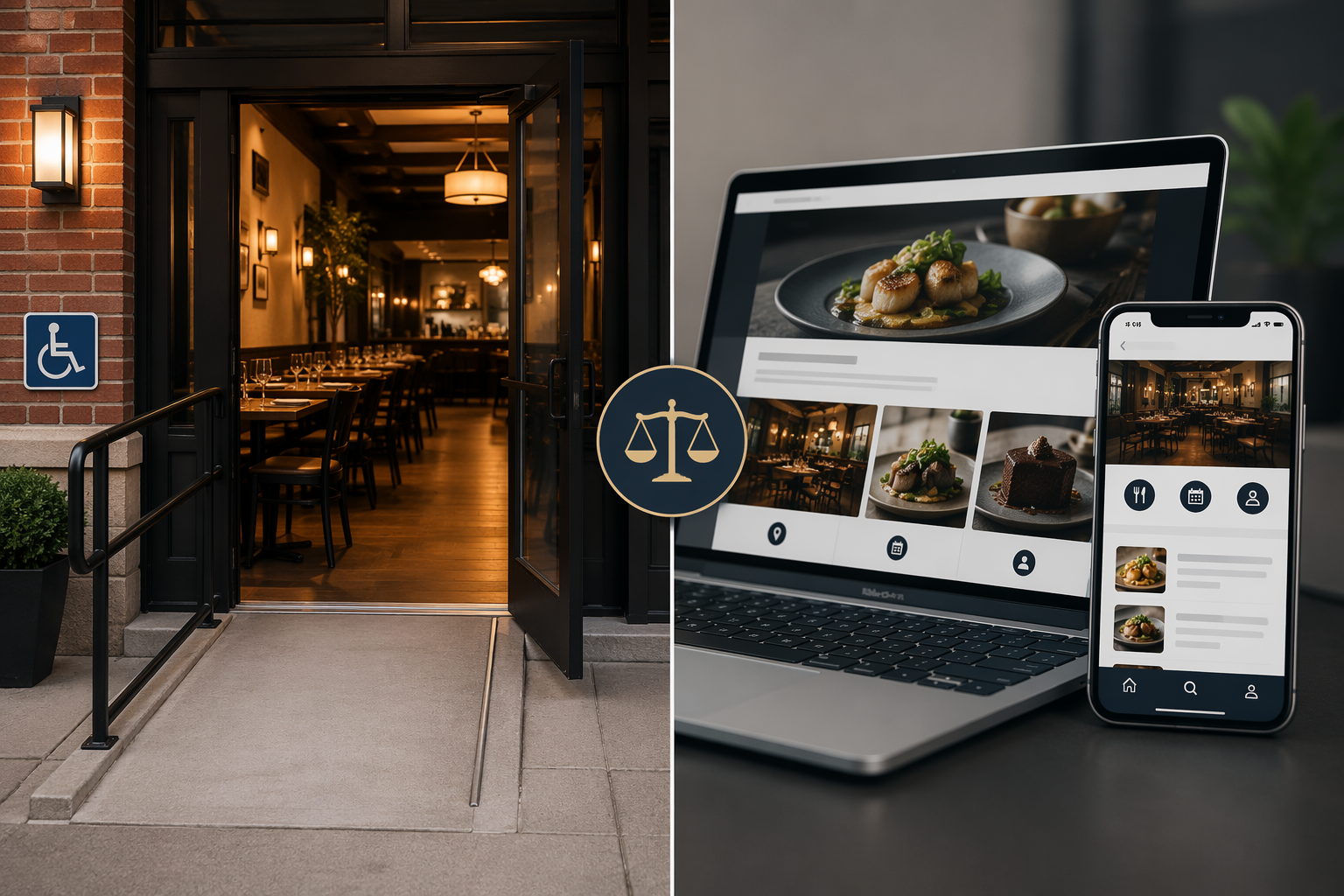
ADA restaurant accessibility splits into at least two legal questions. The physical side turns on barrier removal and the "readily achievable" standard, which is business-size-sensitive rather than absolute.[8] The digital side is usually framed around website and app accessibility, where WCAG 2.1 AA is the benchmark courts and regulators keep reaching for even when the ADA text itself does not read like a software manual. That is why overlay widgets rarely solve the problem: they may change the presentation layer, but they do not cure bad code, missing labels, or inaccessible booking and ordering flows.
That distinction also changes how you advise the client. A premises claim can sometimes be sequenced around what is readily achievable now and what should be budgeted next quarter. A website claim usually needs actual remediation, not a cosmetic overlay and a marketing memo. If the file mixes both, counsel should separate them quickly instead of treating one settlement number as if it resolved the whole case.
The tax side matters because it gives the client something more concrete than reassurance. The IRS disabled-access credit can reach $5,000 a year for qualifying small businesses, and the separate deduction can reach $15,000 a year for eligible barrier-removal spending.[9] For many restaurant groups, that does not erase remediation cost, but it changes how defensible the spend looks in a budget meeting.
The bipartisan ADA 30 Days to Comply Act, H.R. 6453, introduced in December 2025, would create a 30-day cure period before litigation, but its status as of July 2026 remains unconfirmed.[10] That makes it worth tracking as a possible leverage shift, not as present relief.
The public-enforcement ceiling sometimes cited is $75,000 for a first violation and $150,000 for a later one,[11] but that is only the DOJ penalty frame, not a universal measure of private-suit exposure. And the April 2026 Federal Register extensions for DOJ Title II deadlines apply to government entities, not private restaurants, so they are not a useful shield in a restaurant demand letter.[12] Counsel who blur those categories usually create false comfort for clients who need a narrower, better target.
The practical defense frame is plain: identify whether the claim is physical, digital, or both; test whether the alleged fix is actually readily achievable; check whether the plaintiff is part of a repeat-filer pattern; and treat overlay widgets as evidence of effort only when they sit on top of real remediation. Restaurants remain in the highest-risk lane, but the law still gives defense counsel usable paths if the exposure is separated cleanly instead of being flattened into one vague accessibility crisis.
References
- ADA Title III filings analysis, Seyfarth Shaw, 2025, Seyfarth Shaw
- 2025 digital accessibility lawsuit report, UsableNet, 2025, UsableNet
- ADA lawsuit filing analysis, The State / Miami Herald, 2025, The State
- ADA settlement guidance, accessible.org, date not available, accessible.org
- ADA settlement guidance, WCAGsafe, date not available, WCAGsafe
- ADA settlement guidance, Accessibility.build, date not available, Accessibility.build
- Serial ADA lawsuits against small businesses, The Guardian, July 11, 2026
- ADA barrier-removal guidance, ADA.gov, date not available
- Disabled Access Credit, IRS Form 8826, IRS, date not available
- ADA 30 Days to Comply Act, H.R. 6453, Congress.gov, introduced December 2025
- ADA Title III penalty amounts, Operandio, date not available
- April 2026 DOJ Title II deadline extensions, Federal Register, April 2026
Comments
Join the discussion with an anonymous comment.