
The new answer to “what are the penalties for violating restricted airspace?” starts before the dollar figure. For qualifying drone operations, the FAA’s 2026 enforcement bulletin changes the default path: if the operation endangers the public, violates established airspace restrictions, or furthers another crime, legal enforcement is now the expected response, and any move away from that path requires joint approval by the relevant program office director and the FAA Chief Counsel, as described in aviation-law analysis of Compliance and Enforcement Bulletin No. 2026-1.[1]
That procedural inversion matters more than the headline number. A client may hear “$75,000” and think in terms of a worst-case ticket. Counsel has to see the file differently: civil penalty exposure, certificate action, possible revocation, possible suspension of other airman privileges, and, in a narrower class of security-related cases, criminal referral risk. Those are not interchangeable consequences.
The FAA Reauthorization Act of 2024 raised the civil penalty ceiling for drone-related violations to $75,000 per violation, and the exposure can be counted per violation rather than per flight; third-party reporting on the 2026 enforcement posture emphasizes that a single drone operation can generate multiple penalty counts.[2] NBAA’s coverage of DOT and FAA penalty increases likewise treats the higher civil penalty amounts as part of a broader aviation civil-enforcement inflation and statutory-adjustment environment, not as a drone-only press slogan.[3]
The 2026 change is a default-rule change, not merely a higher fine
Before 2026, many FAA drone matters could be handled through compliance actions, education, corrective training, or administrative remedies, depending on the facts. That did not mean operators were immune from legal enforcement. It did mean that the agency’s starting posture often left room for a corrective, non-punitive resolution.
The 2026 bulletin changes the leverage point. For UAS operations within its covered categories, legal action is no longer the escalation that must be specially justified. It is the baseline. A less severe path requires affirmative approval at senior levels, according to Dawn Zoldi’s analysis of the bulletin as additive to FAA Order 2150.3C.[1] Because the underlying Order 2150.3C PDF was not available here as a fully parsed source, the specific description of the bulletin’s changes rests on FAA public materials and cited aviation-law analysis rather than a line-by-line quotation of the Order.
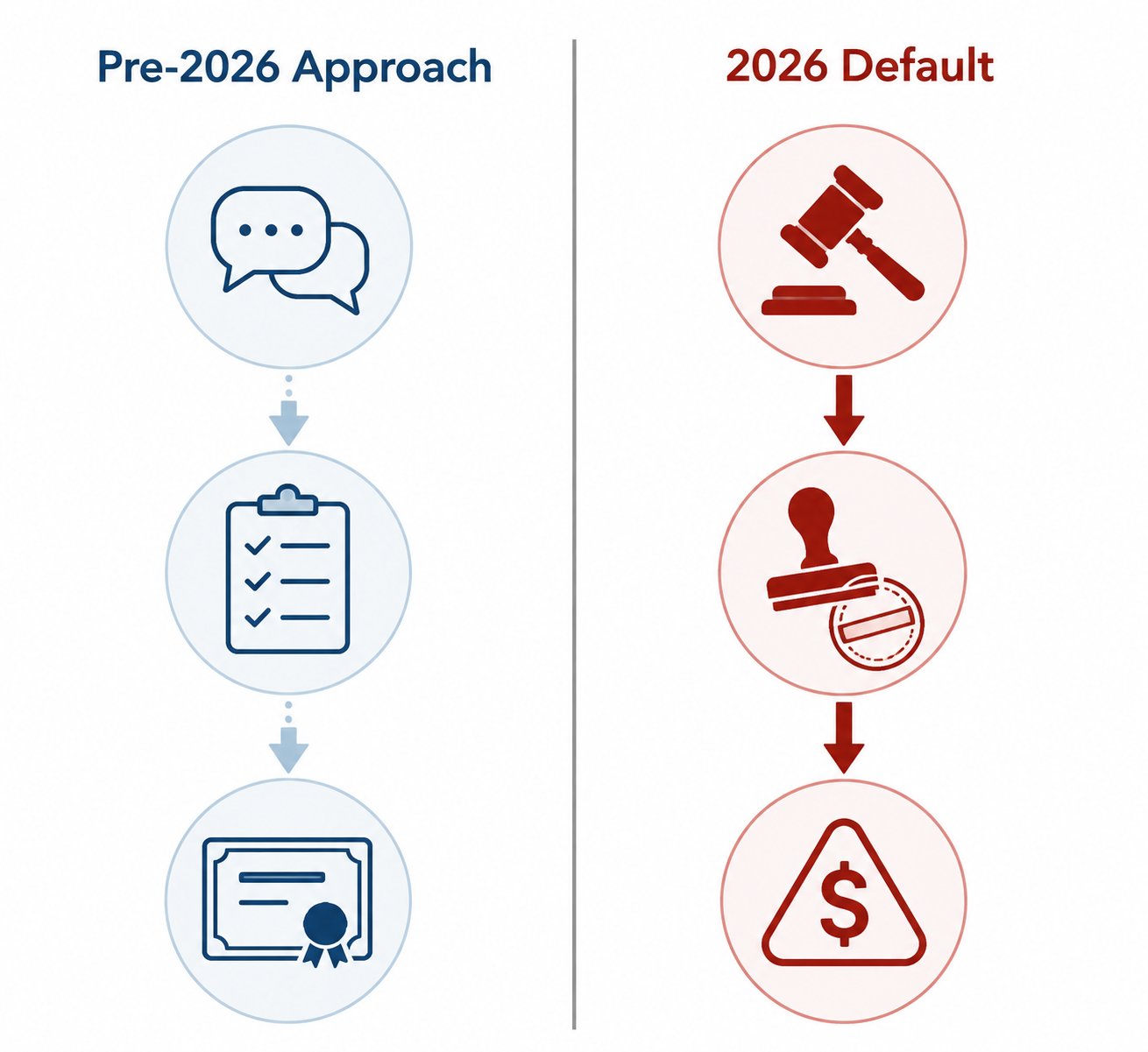
For legal practitioners, that is a client-counseling problem. The first conversation can no longer assume that a clean record, cooperation, or after-the-fact training will keep the matter outside legal enforcement if the operation falls into one of the bulletin’s covered categories. Those facts may still matter. They may affect sanction arguments, settlement posture, or aggravation and mitigation. But they do not appear to control the initial track in the same way.
| Consequence | What it means in counseling terms |
|---|---|
| Civil penalty | A monetary FAA enforcement remedy. For drone-related violations, the current ceiling can reach $75,000 per violation, and one operation may generate multiple counts. |
| Certificate suspension | A temporary loss of certificate privileges for a stated period. Reported 2025 FAA drone certificate actions included suspensions ranging from 30 to 300 days. |
| Certificate revocation | A termination of certificate privileges requiring later requalification if the person seeks the privilege again. Under the 2026 UAS posture, revocation can be pursued as a remedial response to lack of care, judgment, or responsibility. |
| Cascading airman consequences | A UAS violation by a Part 107 holder may affect not only the remote pilot certificate but also other airman or ground instructor certificates the person holds. |
| Criminal exposure | A separate DOJ matter, not an automatic FAA civil consequence. It is especially tied to knowing or willful violations of security-related TFRs under 49 U.S.C. § 46307. |
Civil penalties: the $75,000 ceiling is per violation
The most visible number is the $75,000 maximum civil penalty for drone-related violations. It is serious, but it is easy to misstate. The point is not that every restricted-airspace violation produces a $75,000 fine. The point is that the ceiling applies per violation, so charging architecture matters. An operation that involves unauthorized flight in restricted airspace, unsafe operation, lack of authorization, or related regulatory violations may create several alleged counts from one factual episode.[2]
That makes early fact development unusually important. Counsel needs the location, time, authorization history, NOTAM or TFR status, aircraft registration facts, pilot certification status, purpose of the operation, communications with event security or law enforcement, and whether the flight interfered with emergency response or another protected operation. The legal exposure is assembled from those facts, not from the client’s impression that it was “just a drone.”
Available 2025 data gives useful scale, but not a complete restricted-airspace dataset. In its 2025 drone-enforcement release, the FAA said fines across 18 operations ranged from $1,771 to $36,770, with the highest penalty tied to interference with wildfire emergency response.[4] Those figures show actual enforcement range in a public FAA release; they do not prove what the agency will seek in every restricted-airspace matter under the 2026 bulletin.
Certificate action is where the 2026 posture becomes professionally dangerous
A civil penalty is painful. Certificate action can be career-altering. For Part 107 holders, the 2026 enforcement posture described by aviation-law commentators contemplates pursuing certificate revocation and civil penalties at the same time: revocation as remedial action based on demonstrated lack of care, judgment, or responsibility, and a civil penalty as punitive action.[1]
The cascading feature deserves more attention than it usually gets. A remote pilot certificate may not be the only certificate in the file. If the drone operator also holds a Part 61 airman certificate, or another airman or ground instructor certificate, the violation can threaten privileges beyond the UAS operation itself, according to third-party readings of the FAA’s 2026 bulletin and its relationship to Order 2150.3C.[1]
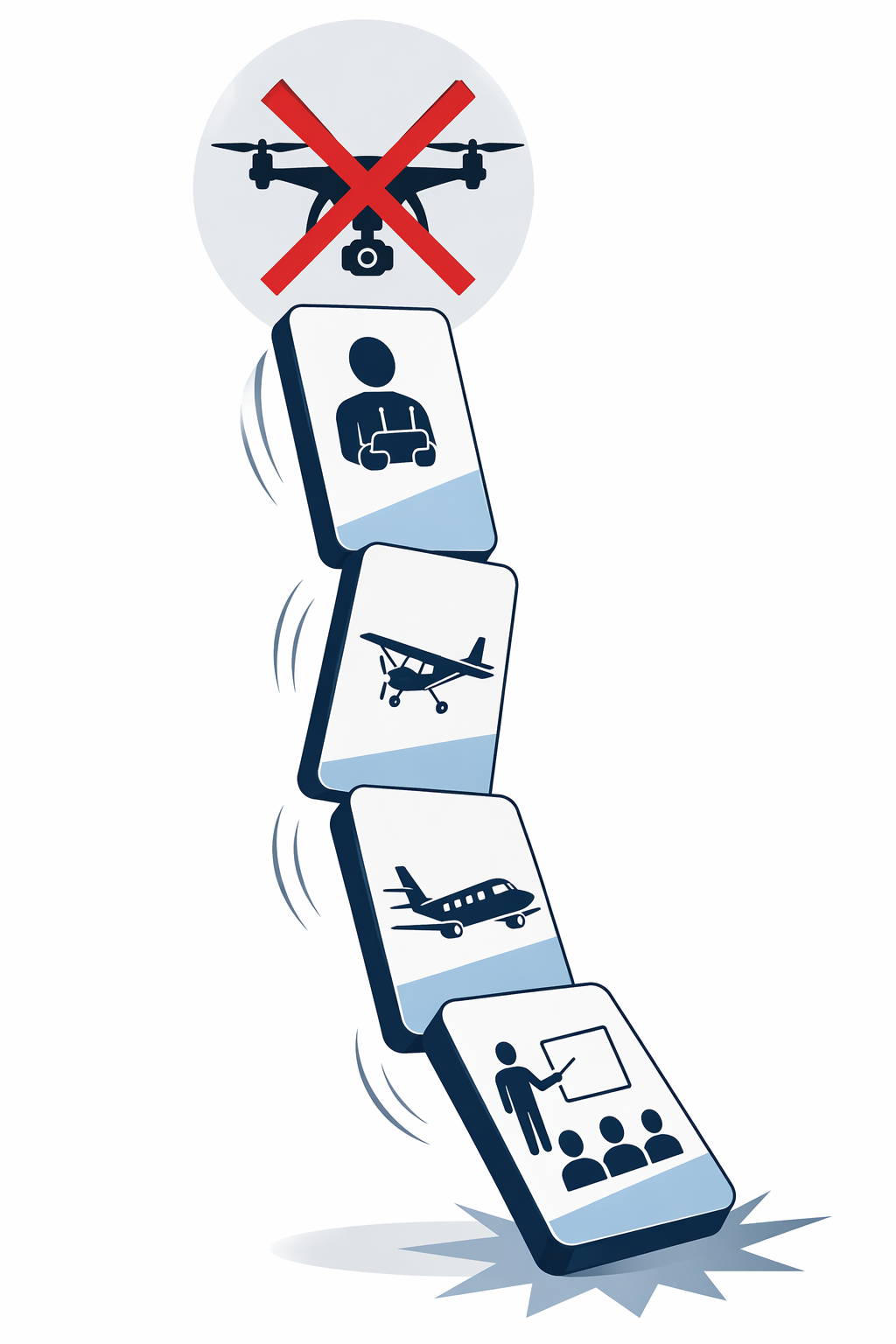
This is the scenario lawyers should catch early: a private pilot, commercial pilot, or instructor treats a drone flight as a side job or casual favor, then learns that the alleged UAS violation may be used as evidence of deficient judgment across certificate holdings. The client may have thought the exposure was a business expense. The real problem may be the loss or suspension of aviation privileges that have nothing to do with the revenue from that particular flight.
The FAA’s 2025 release reported certificate suspensions ranging from 30 to 300 days and one emergency revocation involving a September 2025 Mar-a-Lago incident.[4] Rupprecht Law’s discussion of FAA TFR punishments describes a 30-to-90-day suspension range as a baseline for a simple TFR violation by a certificate holder, with more severe sanctions for aggravated facts such as intentional conduct, collisions, or endangerment.[5]
The prudent reading is bounded. The public materials do not establish that every unauthorized restricted-airspace operation will produce revocation of every certificate the operator holds. They do support a narrower, more consequential point: when a Part 107 holder is accused of a covered UAS violation, certificate exposure should be analyzed from the first intake call, not after the civil penalty demand arrives.
DETER does not rescue unauthorized restricted-airspace cases
The FAA’s DETER program is relevant mostly because of what it excludes. In April 2026, the FAA announced a program to accelerate enforcement of certain minor first-time drone violations.[6] But unauthorized operations in restricted airspace are carved out and continue through standard enforcement, according to the FAA’s description of the program.[6]
That exclusion should prevent a common counseling error. A client who has heard about expedited resolution may assume the agency has created a diversion lane for first-time drone mistakes. For ordinary minor matters, that may be worth examining. For unauthorized restricted-airspace operations, it should not be the working assumption.
Recent enforcement examples calibrate the risk, but they do not form a sentencing grid
The FAA’s public enforcement releases are useful because they show that the agency is not treating drone matters as paperwork-only violations. In one newsroom release, the FAA said it proposed $341,413 in civil penalties against drone operators in a single enforcement cycle.[7] In another, the agency described 2025 fines ranging from $1,771 to $36,770, certificate suspensions, and an emergency revocation.[4]
Those examples should be used carefully. They are press-release and commentary data, not a fully crawled spreadsheet of all restricted-airspace outcomes. The FAA’s enforcement reports exist as a broader source category for closed enforcement actions, but the granular public materials reviewed here do not allow a clean table tying every restricted-airspace fact pattern to a specific sanction outcome.[8]
Still, the examples sharpen the intake questions. Was there interference with wildfire response, law enforcement, military operations, stadium security, presidential movement, or emergency aircraft? Was the TFR security-related? Was the operation commercial? Did the operator hold Part 107 privileges? Did the same person hold manned-aircraft certificates? Was there prior FAA contact? Did the operator ignore geofencing, remote ID, LAANC, NOTAM, or direct warnings? The answer to each question can move the matter from a contained civil penalty discussion toward certificate and aggravation analysis.
Do not collapse civil enforcement and criminal prosecution
There is a separate criminal-law lane, but it is narrower than many public summaries suggest. Knowing or willful violations of security-related TFRs issued under 49 U.S.C. § 40103(b)(3) may be prosecuted under 49 U.S.C. § 46307 as Class A misdemeanors, carrying up to one year of imprisonment and a $100,000 criminal fine.[5] AOPA’s issue brief on increased penalties for pilots who violate restricted airspace likewise treats criminal consequences as tied to particular restricted-airspace and security contexts, not as a universal consequence of every airspace mistake.[9]
That distinction matters in both directions. Overstating criminal exposure can make a client distrust the rest of the advice. Understating it can leave counsel unprepared when the facts involve security-related temporary flight restrictions, intentional conduct, or law-enforcement attention. FAA civil enforcement and DOJ prosecution are not the same proceeding, and the presence of one does not automatically establish the other.
For a wider example of the federal aviation enforcement ecosystem outside ordinary FAA civil penalties, aviation-related prosecutions such as laser-strike cases show why counsel should keep agency enforcement, criminal statutes, and sentencing exposure in separate analytical boxes rather than treating them as one generic aviation penalty cloud.
What counsel should identify before advising on exposure
The first intake should establish which enforcement universe the matter belongs to. A recreational-looking drone flight can become an aviation certificate matter quickly, but not every bad fact triggers the same consequence. The disciplined approach is to separate the facts that determine track, count structure, certificate exposure, and criminal risk.
- Identify the airspace restriction: TFR, restricted area, security-related TFR, event restriction, emergency-response restriction, or another FAA-imposed limitation.
- Determine whether the operation falls within the 2026 bulletin categories: endangering the public, violating established airspace restrictions, or furthering another crime.
- Confirm every certificate the operator holds, including Part 107, Part 61 airman certificates, and ground instructor certificates.
- Separate civil penalty exposure from certificate action. They may be pursued together, but they serve different sanction functions.
- Assess count multiplication. One flight may produce multiple alleged violations, and the $75,000 ceiling is per violation.
- Do not assume DETER applies. Unauthorized restricted-airspace operations are excluded from that expedited program.
- Screen separately for criminal exposure, especially knowing or willful conduct involving security-related TFRs.
The executive branch has also pushed toward more technology-enabled airspace enforcement. Analysis of the June 2025 Executive Order “Restoring American Airspace Sovereignty” describes it as a driver of accelerated drone detection and enforcement integration.[1] That does not justify speculation that every violation will be automatically detected or maximally charged. It does mean that compliance advice should not depend on low visibility as a risk-control strategy.
The narrower conclusion lawyers should carry into the first client call
The 2026 FAA posture does not mean every restricted-airspace violation results in the maximum civil penalty, certificate revocation, or criminal prosecution. That would be an overread of the available materials and a poor way to advise clients.
The change is narrower and more important: for qualifying UAS restricted-airspace violations, legal action is now the presumptive track, departures from that track require senior approval, civil penalties can be charged per violation up to the higher statutory ceiling, and Part 107 certificate holders may face certificate consequences that reach beyond the drone certificate itself. A client who holds both remote-pilot and manned-aircraft privileges should hear that before discussing settlement numbers.
References
- Hammer and Nails: The FAA's UAS Enforcement Order Just Made 'Legal Action' the Default — Autonomy Global
- Ignoring drone rules? FAA can fine you $75K — DroneDJ
- DOT, FAA Increase Civil Penalties for Aviation Violations — NBAA
- FAA Steps Up Drone Enforcement in 2025 — FAA
- FAA TFR Violation Punishments — Rupprecht Law
- FAA Launches New Program to Accelerate Enforcement of Drone Violations (DETER) — FAA
- FAA Proposed $341,413 in Civil Penalties Against Drone Operators — FAA
- Enforcement Reports — FAA
- Issue Brief: H.R. 3465 — A Bill to Increase Penalties for Pilots Who Violate Restricted Airspace — AOPA
Comments
Join the discussion with an anonymous comment.