
Larry David’s July 17 HBO sketch gave the phrase “RFK Jr. polio vaccine sketch legal controversy” a convenient search handle, but the legal controversy is not, at least so far, a defamation fight over the sketch. Episode 4 of Life, Larry and the Pursuit of Unhappiness features a character named “Bobby” who echoes anti-vaccine themes associated with Robert F. Kennedy Jr.; David’s character tells him, “Drop dead, Bobby,” and adds, “If some idiot, some moron, ever put you in charge, that would be a dark day for humanity,” before the episode sends the character off to a psychiatric ward.[1]
The personal oddity is real enough to explain why the sketch traveled: David had introduced Kennedy to Cheryl Hines, and Hines has said she believes David stopped speaking to her because “Bobby’s in the administration.”[2] But that is texture, not the claim. As of July 21, 2026, there is no reported RFK Jr. or HHS lawsuit over the HBO sketch. The stronger legal reading is that David’s “Bobby” is an obvious political parody of a public official, while the harder legal fights sit underneath the joke: an Administrative Procedure Act challenge to Kennedy’s vaccine-policy changes, unresolved FDA petition activity involving the polio vaccine, and a compensation-program petition that raises governance questions for vaccine regulation.

The sketch is the legally easy part
A public official who wants to sue over this kind of sketch begins in difficult terrain. New York Times Co. v. Sullivan requires a public official plaintiff to prove actual malice in a defamation action: knowledge of falsity or reckless disregard for truth. Hustler Magazine v. Falwell adds the more directly relevant parody rule. Where a work is so exaggerated that a reasonable viewer would understand it as satire rather than a factual report, the First Amendment blocks liability for the insult.
That distinction matters here. The “Bobby” character is recognizable enough for the audience to get the target, but the sketch is not framed as documentary accusation. It is a scripted HBO comedy scene, built around blunt ridicule, absurd escalation, and an institutional punchline. The more recognizable the target, the more the sketch functions as political commentary; the more theatrical the setting, the harder it is to repackage the scene as a factual representation.
That does not make the sketch legally irrelevant. It makes it a useful index. The joke points viewers toward a live public-law dispute over whether Kennedy’s vaccine-policy moves can survive ordinary administrative-law constraints. The parody doctrine is settled enough to protect David. The administrative record around federal vaccine policy is not settled at all.
The active legal front is AAP v. Kennedy
The central lawsuit is not Kennedy versus Larry David. It is the July 2025 action brought by the American Academy of Pediatrics, the American College of Physicians, and the American Public Health Association against Kennedy over vaccine policy. The plaintiffs challenged Kennedy’s May 2025 COVID vaccine removals and his January 2026 reduction of recommended childhood vaccines from 17 to 11.[3]
That is where the legal machinery becomes concrete. On March 16, 2026, Judge Brian E. Murphy issued a preliminary injunction blocking the January 2026 childhood-schedule changes, finding that HHS likely violated the Administrative Procedure Act, and staying the appointments of 13 Kennedy-picked members of the Advisory Committee on Immunization Practices.[4][5]
A preliminary injunction is not a final merits judgment, and “likely violated” is not the same as “did violate” after final adjudication. But it is a meaningful procedural event. It freezes the challenged changes while the litigation proceeds, constrains the agency’s ability to operationalize the new schedule, and signals that the court saw enough statutory vulnerability to interrupt the policy shift before final judgment.
The ACIP stay is just as important as the schedule block. Vaccine recommendations do not emerge from a single press statement. They move through advisory structures, agency review, and institutional reliance by physicians, health systems, insurers, and public-health programs. Staying 13 appointments prevents a newly configured advisory body from becoming the procedural engine for the disputed policy while the APA challenge remains live.
| Legal front | What is actually pending | What should not be overstated |
|---|---|---|
| HBO sketch | A protected political parody of a recognizable public official | No reported RFK Jr. or HHS lawsuit over the sketch as of July 21, 2026 |
| AAP v. Kennedy | APA litigation challenging vaccine-policy changes, with a preliminary injunction blocking the January 2026 schedule changes and staying 13 ACIP appointments | The injunction is not a final merits ruling |
| FDA and vaccine petitions | Unresolved petition advocacy, including Aaron Siri’s 2022 ICAN petition involving IPOL | The FDA has not been shown to have granted the IPOL petition |
The appeal posture keeps the controversy live. The injunction and ACIP stay are now part of a broader fight over whether HHS can reconfigure vaccine policy through the kind of process Kennedy used, or whether the APA imposes procedural limits that make those changes unlawful unless the agency builds a legally adequate record and follows the required process.
The Reuters context sharpens the stakes without deciding the case
Reuters reported on July 14, 2026, that Kennedy initially pushed to eliminate the entire 17-disease childhood vaccine schedule and proposed $5 billion in NIH spending to study a vaccine-autism link, but encountered internal and White House resistance.[6] That reporting does not prove the APA claims. It does, however, explain why the AAP plaintiffs’ procedural challenge is not a narrow quarrel over wording on a schedule. It sits inside a broader institutional fight over who can alter federal vaccine policy, how quickly, and through what record.
That is also why the sketch lands differently from ordinary political mockery. David’s line about a “dark day for humanity” is not legal analysis, and it does not need to be. Its public function is indexing: it compresses a complicated administrative-law dispute into a cultural scene that non-specialists can recognize. Lawyers should then uncompress it.
Why the polio-vaccine reference points to Aaron Siri
The polio-vaccine resonance in the sketch is not random background noise. Aaron Siri, a lawyer closely associated with Kennedy’s vaccine-policy circle, filed a 2022 petition on behalf of the Informed Consent Action Network asking the FDA to withdraw or suspend approval of IPOL for infants, toddlers, and children.[7] The Guardian also reported that Siri petitioned regulators to revoke approval of the polio vaccine and described additional vaccine-related petition activity.[8]
Two limits are necessary. First, a petition is not agency action. The FDA has not been shown, in the record described here, to have granted Siri’s 2022 IPOL petition. Second, petition practice is a lawful regulatory tool. The legal significance is not that Siri filed petitions; lawyers file petitions. The significance is that this petition strategy operates in the same policy ecosystem as Kennedy’s attempted restructuring of federal vaccine recommendations.
The reported activity extends beyond IPOL. Siri has filed 13 additional petitions seeking pauses in vaccine distribution, and in March 2026 he petitioned to add more than 300 injury types to the Vaccine Injury Compensation Program.[7][8] That latter move is not the same kind of regulatory ask as the IPOL petition. It concerns the compensation architecture around vaccine injuries, not the FDA approval status of a specific vaccine. But for public-law observers, it belongs in the same file because it shows pressure being applied across multiple institutional points: approval, distribution, recommendation, and compensation.
The VICP issue also carries a professional-risk dimension. Siri’s firm litigates more than 400 pending VICP claims, while the March 2026 petition seeks to expand the categories of compensable injury. That fact should be treated as a governance and conflict-management question, not as a substitute for deciding the petition on the merits. Agencies routinely receive petitions from interested parties. The question is whether the agency process recognizes the interest, manages it transparently, and produces a defensible administrative record.
Three disputes, three different legal categories
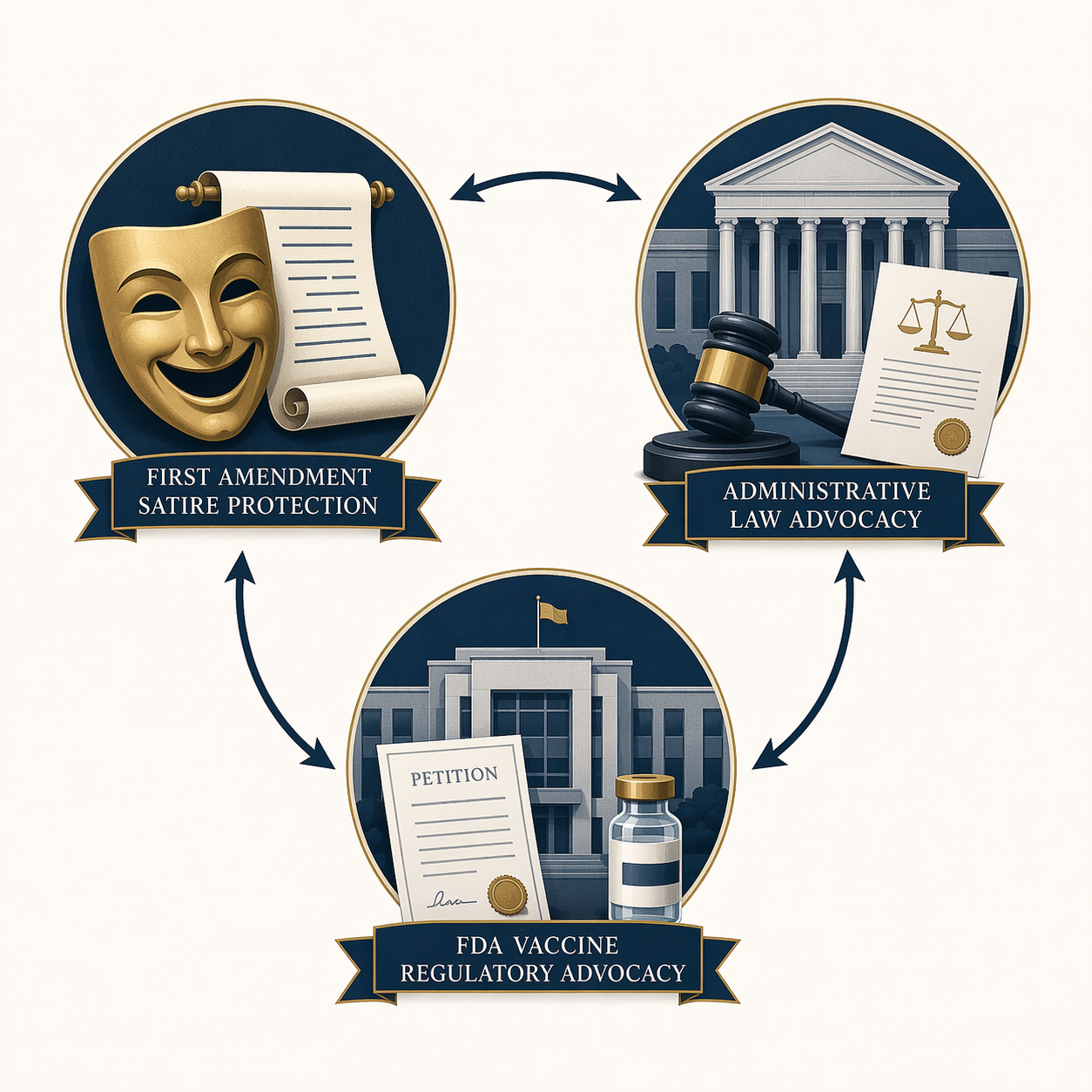
It is tempting to collapse everything into a single “RFK Jr. vaccine controversy.” That is descriptively convenient and legally sloppy. The sketch, the AAP lawsuit, and the Siri petitions sit in different legal categories.
- The HBO sketch is a speech dispute only in the atmospheric sense. Under First Amendment doctrine, a defamation or emotional-distress claim by a public official over obvious parody would face steep barriers.
- The AAP case is an administrative-law dispute. Its center is not whether Kennedy’s policy views are popular or unpopular, but whether HHS likely violated the APA when it changed vaccine policy and reconfigured advisory participation.
- The Siri petitions are regulatory advocacy. They may influence agency workload, public attention, and policy pressure, but they do not become final law unless the relevant agency acts through an appropriate process.
Those categories lead to different consequences. A media lawyer evaluating David’s exposure would look for factual assertions, actual malice, and audience understanding. A health-law litigator tracking AAP v. Kennedy would read the injunction, the administrative record, and the First Circuit posture. A regulatory lawyer watching the Siri petitions would ask what docket is open, what statutory authority the petitioner invokes, what scientific record the agency has before it, and whether any final agency action has occurred.
The common thread is institutional authority. The sketch mocks the prospect of Kennedy controlling vaccine policy. The AAP lawsuit tests whether Kennedy’s actual vaccine-policy changes can survive APA review. The Siri petitions show how vaccine opponents can press parallel claims through FDA and compensation-program channels. The legal controversy behind the sketch is not that comedy may be actionable. It is that comedy has made a dispersed public-law fight easier to see.
What to watch without pretending to know the result
For legal professionals, the next useful questions are procedural rather than theatrical. In the AAP case, the First Circuit appeal will determine whether Judge Murphy’s injunction and ACIP stay remain in place, narrow, or fall away. For the FDA petition, the key event would be agency action on the 2022 IPOL request; until then, the petition remains pressure, not policy. For VICP, the governance question is whether the compensation-program process can evaluate a large proposed expansion while managing the petitioner’s professional stake in pending claims.
The comedy is the most legally secure part of the story. David’s sketch sits within familiar First Amendment protection for public-official parody. The unsettled terrain is the federal vaccine-policy apparatus around it: the APA limits on abrupt administrative change, the legal status of Kennedy’s reworked childhood schedule, the stayed ACIP appointments, and the unresolved regulatory petitions that keep polio vaccine policy in the frame.
References
- Larry David Mocks RFK Jr. in New HBO Show: Drop Dead, Bobby — Variety
- Larry David Unleashes Tirade Against Old Friend RFK Jr. — The Daily Beast
- Health organizations sue RFK Jr. over vaccine policy — NPR
- Federal judge blocks Kennedy's changes to childhood vaccine policy — CIDRAP
- Federal judge puts RFK Jr.'s new vaccine schedule, advisers on ice — Politico, March 16, 2026
- Inside RFK Jr.'s push to dismantle decades of U.S. vaccine policy — Reuters, July 14, 2026
- RFK Jr.'s lawyer and top ally asked FDA to revoke approval of a polio vaccine — ABC News
- RFK Jr key adviser petitioned regulators to revoke approval of polio vaccine — The Guardian
Comments
Join the discussion with an anonymous comment.