
The legally interesting feature of Halliburton's July 2026 unconventional gas award is not that Aramco bought more services. It is that Aramco again appears to have placed a major oilfield service provider inside a contracting structure where the contractor must make an integrated promise before the field work has had a chance to become inconvenient. Halliburton says the long-term award covers integrated stimulation and completion services for Aramco's unconventional gas program, including project management, hydraulic fracturing, coiled tubing, wireline, completion tools, testing, OCTIV Auto Frac, and Sensori real-time fracture analytics.[1] One day later, Halliburton separately announced lump sum turnkey, or LSTK, contracts with Aramco for onshore oil re-entry work covering 285 wells, including drilling, completions, and workovers.[2]
Those two announcements should be read together, but not collapsed into one contract. The gas award is not publicly labeled LSTK in the release. The onshore award is. The more careful inference is that the gas contract sits within the same Aramco procurement habit: integrated scope, contractor coordination, bundled execution responsibility, and a buyer that prefers to move cost and performance uncertainty out of the operator's hands where the market will accept it.

What the 2026 Documents Actually Show
Public contract analysis has to begin with the words available, not the clauses one wishes were available. Halliburton's 2026 gas announcement uses the language of a long-term integrated services award. The 16 July 2026 onshore announcement uses the explicit LSTK label. The gas release also describes the award as part of a broader multi-billion contract framework, but the precise value of the gas contract is not disclosed in the public materials.[1][2]
| Public source | Relevant language | Legal significance |
|---|---|---|
| 2026 unconventional gas award | Integrated stimulation and completion services; project management; fracturing; coiled tubing; wireline; completion tools; testing; real-time analytics | Shows a bundled service promise across multiple operational interfaces, but does not publicly use the LSTK label |
| 2026 onshore oil re-entry award | Lump sum turnkey contracts covering 285 wells, including drilling, completions, and workovers | Confirms Aramco's contemporaneous use of LSTK procurement for complex onshore execution packages |
| 2018 unconventional gas award | Three-year, 2+1, lump sum turnkey stimulation services contract | Provides the prior Halliburton-Aramco unconventional gas precedent for turnkey-style risk transfer |
That distinction matters. A lawyer cannot responsibly infer governing law, arbitration venue, liquidated damages, termination for convenience, indemnity caps, warranty regime, or force majeure drafting from a press release. But public sources can still support a risk-allocation reading. When a repeat buyer uses LSTK language in the same procurement cycle and previously used LSTK language with the same contractor in the same unconventional gas program, the pattern is not incidental.
The 2018 Precedent Is Doing More Work Than the Headline Suggests
The earlier Halliburton-Aramco unconventional gas award was not merely a commercial milestone. Halliburton described the 2018 contract as a three-year, 2+1, lump sum turnkey stimulation services arrangement for Aramco's unconventional resources program.[3] Aramco's own announcement similarly emphasized unconventional gas stimulation and included a statement from Mohammed Y. Qahtani that the contract carried "a strong component" supporting Aramco's In-Kingdom Total Value Add program.[4]
In a stimulation-only LSTK arrangement, the contractor is already taking on a difficult bundle: mobilization, crews, pumping capacity, chemicals, scheduling, safety performance, field documentation, and the commercial risk that execution costs do not behave as neatly as the bid model. The operator still owns the reservoir and the development objective. But the service provider is no longer selling isolated time-and-material inputs; it is selling a delivered work package against a price and schedule architecture negotiated before the trouble is fully visible.
The 2026 gas award expands that earlier model. Halliburton's scope now includes not only hydraulic fracturing, but project management, coiled tubing, wireline, completion tools, and testing, with digital fracture analytics tied into the operational package.[1] Industry reporting described the 2026 award as an expansion of Halliburton's role in Aramco's unconventional gas program and identified the same integrated completion and stimulation services package.[5]
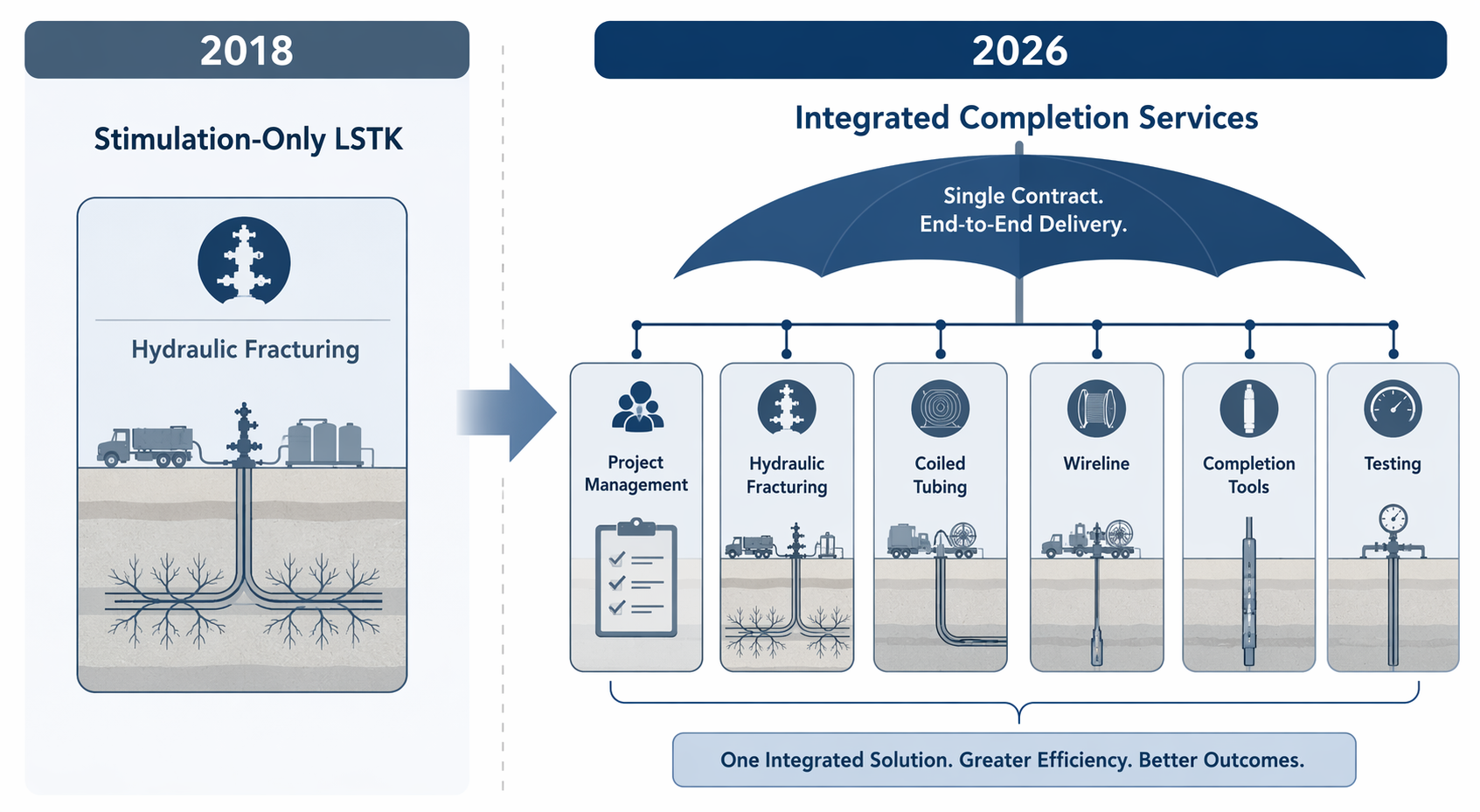
That is a legal shift even if the press release presents it as an operational one. More service lines mean more interfaces that can fail. A coiled tubing delay can affect completion sequencing. Wireline availability can affect testing. Completion tools can become the factual center of a performance dispute. Project management language makes it harder for the contractor to argue that it was merely one vendor among many. The more integrated the promise, the more likely the contractor will be asked to absorb coordination risk that would otherwise sit with the operator or be fought over among separate suppliers.
How LSTK Risk Usually Lands on the Service Provider
LSTK is not a punishment. For a disciplined buyer, it is a way to buy certainty: a defined work package, a defined price structure, a contractor-managed execution chain, and fewer open-ended reimbursable claims. The commercial bargain can be perfectly legitimate. The hard part is that the bargain often becomes most visible only after cost growth, schedule compression, or performance ambiguity appears in the field.
For Halliburton's 2026 gas package, the public materials point to five risk categories that counsel would want to test against the actual contract.
- Cost absorption: if the price is fixed or substantially turnkey in operation, labor, equipment, supply chain, maintenance, standby, and remobilization overruns may be contractor problems unless change-order language gives a clear path back to Aramco.
- Schedule exposure: integrated services make sequencing part of the bargain. Delay analysis will turn on whether slippage arose from contractor-controlled resources, operator-provided inputs, reservoir conditions, approvals, or interface failures.
- Bundled performance responsibility: when fracturing, coiled tubing, wireline, completion tools, testing, and project management are sold together, it becomes harder to isolate underperformance as someone else's narrow scope.
- Technology deployment: OCTIV Auto Frac and Sensori are not decorative product names in this context; they are represented capabilities embedded in the service commitment.
- Local-content execution: Saudi workforce, in-Kingdom manufacturing, and supplier-development commitments can affect qualification, performance measurement, and commercial leverage.
The important drafting questions are therefore practical rather than theatrical. What is the contractor's relief if Aramco changes well sequencing? What happens if equipment import timing conflicts with local procurement commitments? Are analytics deliverables measured by deployment, availability, data quality, operational outcome, or some mixture of all four? Does a missed local-content commitment create pricing consequences, procurement consequences, default consequences, or only relationship consequences? None of those answers is public.
Integrated Services Turn Interface Problems Into Contract Problems
The phrase "integrated stimulation and completion services" sounds commercially smooth. In dispute files, integration is often where the facts become untidy. A single provider may gain efficiencies by controlling more of the work, but it also loses some of the defensive distance that a narrower service scope would provide. If the contractor manages the package, the operator will ask why the package did not perform as promised.
That does not mean Halliburton has accepted unlimited reservoir risk. Public materials do not support that conclusion. In unconventional gas work, the boundary between service performance and subsurface outcome is precisely where contracts need careful drafting. A fracturing platform can be deployed correctly without guaranteeing a particular production result. Completion tools can meet specification while a well disappoints. Testing can produce reliable data that the reservoir refuses to make attractive. The legal question is where the contract draws the line between service deliverable, operational result, and field-development expectation.
That line will matter more in the 2026 package than it did in the 2018 stimulation-only precedent because Halliburton's public scope now spans a larger part of the well delivery chain.[1][3] A broader scope creates more opportunities to earn margin through coordination, but also more opportunities for the operator to describe a failure as integrated underperformance rather than a discrete service defect.
Technology Commitments Are Not Just Marketing
Halliburton's 2026 announcement says it will deploy OCTIV Auto Frac, described as the Kingdom's first fully integrated intelligent fracturing platform, together with Sensori real-time fracture analytics.[1] World Oil reported the same technology elements in its coverage of the award.[5] Those statements have legal weight because proprietary technology can become part of the commercial expectation even when the public does not show the operative warranties.
Technology deployment creates at least three different risks. The first is performance: whether the system is available, compatible, staffed, calibrated, and producing usable real-time data. The second is documentation: whether the contractor can prove that the system performed as represented when a completion result is challenged months later. The third is know-how control: whether training, localization, data access, or operational integration gives the customer practical exposure to proprietary methods without crossing whatever IP boundaries the contract preserves.
The public record does not say that Halliburton transferred ownership of intellectual property, agreed to source-code access, or accepted production guarantees tied to OCTIV or Sensori. It supports a narrower but still important conclusion: advanced digital fracturing capability is part of the bargain being publicly sold, and that makes deployment, data integrity, and technology governance part of the risk conversation.
IKTVA Changes the Contract Reading
For foreign service providers in Saudi Arabia, local content is not a soft reputational overlay. Fragomen's 2023 analysis describes Aramco's IKTVA score as a primary evaluation metric during procurement and supplier selection.[6] In the 2018 Halliburton-Aramco announcement, Aramco expressly tied the unconventional gas stimulation contract to support for the In-Kingdom Total Value Add program.[4] Aramco has also reported that iktva reached 70% local content and added $280 billion to the economy.
That changes how counsel should read the 2026 award. Halliburton's local manufacturing and Saudi workforce commitments are not simply corporate citizenship language. In an Aramco procurement environment, they can affect qualification, bid evaluation, supplier ranking, operational staffing, subcontracting, factory planning, and future award eligibility. A service provider that prices only the field execution and treats localization as a parallel compliance report is likely under-reading the commercial architecture.
IKTVA also complicates the usual turnkey assumption that the contractor can freely optimize its supply chain. A contractor may want the cheapest qualified component, the fastest available crew, or the most experienced expatriate specialist. The procurement framework may reward or require a different mix: in-Kingdom manufacturing, Saudi workforce development, local supplier participation, and documented domestic value creation. Those choices can raise cost, slow substitution, or narrow the pool of acceptable subcontractors. In a turnkey-style deal, that pressure often sits with the contractor unless the contract makes relief available.
The contract-specific IKTVA targets for the 2026 gas award are not public. Nor is the score methodology for this contract. The legal point is therefore not that a particular local-content breach would trigger a particular remedy. The point is that IKTVA has become a procurement condition with operational consequences, and the Halliburton-Aramco sequence shows it moving alongside the expansion of integrated field responsibility.
Jafurah Explains the Timing, Not the Whole Legal Story
Jafurah is the context for why these risk allocations matter at scale. Aramco announced in 2021 that it had awarded $10 billion in subsurface and EPC contracts for Jafurah development.[7] OGJ later reported that Aramco awarded $25 billion in Phase 2 contracts in 2024 and that first unconventional shale gas output from Jafurah began in December 2025.[8] By July 2026, the legal issue is less whether Saudi unconventional gas will be developed and more how production-phase execution risk is allocated as the program expands.
Production-phase scaling is where integrated promises are tested. Early-stage development can tolerate more experimentation, more one-off coordination, and more executive attention. Repeated well delivery is less forgiving. Crews rotate, equipment wears, local suppliers need supervision, data systems must be made routine, and performance documentation becomes evidence rather than paperwork. If a contractor has accepted a turnkey-style package, its project controls and legal notices must mature at the same pace as the field program.
The Related 285-Well LSTK Award Confirms the Procurement Pattern
The 16 July 2026 onshore oil re-entry award is important because it removes any doubt that Aramco was using LSTK terminology in the same contracting season. Halliburton described those awards as LSTK contracts for 285 wells, covering drilling, completions, and workovers.[2] That is not the same as the unconventional gas contract, and it should not be cited as if it were. But it is strong evidence of Aramco's willingness to package complex well work under turnkey contracting language.
From a service-provider perspective, that pattern matters more than the label on any single press release. A buyer that repeatedly uses turnkey structures across adjacent well programs is signaling what it values: price discipline, contractor-managed interfaces, compressed procurement administration, and fewer open reimbursable seams. For Halliburton and similarly situated contractors, the recurring question is whether the internal risk register is as integrated as the sales language.
What Practitioners Should Not Infer
The public record is useful, but it is incomplete in the places lawyers most want certainty. There is no public text of the 2026 gas contract. There is no public disclosure of governing law, arbitration venue, seat, language, liability cap, delay liquidated damages, performance liquidated damages, termination rights, warranty exclusions, change-order thresholds, deemed acceptance mechanics, or audit rights. The same caveat applies to the 2018 contract and the 2026 onshore LSTK contracts.
That absence should restrain the analysis. It is fair to say that the 2026 Halliburton-Aramco unconventional gas contract appears to extend a systematic Aramco risk-transfer procurement model. It is too much to say, from public sources alone, exactly how the contract allocates every delay day, every underperforming stage, every data failure, or every localization shortfall. The legal signal is visible. The operative risk mechanics remain in the agreement.
For counsel reviewing comparable Saudi oilfield service agreements, the practical lesson is to start where the press release usually ends: fixed-price exposure, relief events, interface responsibility, technology commitments, IKTVA deliverables, documentation standards, and dispute escalation. In Aramco's hands, integrated services language is rarely just a description of convenience. It is often the commercial frame through which cost, schedule, and performance risk are moved.
References
- Aramco Awards Halliburton Long-Term Contract for Unconventional Gas Program, Halliburton, July 2026.
- Halliburton Awarded LSTK Contracts by Aramco for Onshore Oil Re-Entry, Halliburton, 16 July 2026.
- Saudi Aramco Awards Halliburton Contract for Unconventional Gas Stimulation, Halliburton, 2018.
- Saudi Aramco Awards Halliburton Contract for Unconventional Gas Stimulation, Aramco, 2018.
- Halliburton Expands Role in Aramco's Unconventional Gas Program, World Oil, 15 July 2026.
- Aramco's iktva Program: Transforming Saudi Arabia's Oil and Gas Industry, Fragomen, 2023.
- Aramco Awards Contracts Worth $10bn for Vast Jafurah Field Development, Aramco, 2021.
- Aramco Lets Stimulation, Completion Services Contract for Unconventional Gas Development, Oil & Gas Journal, 25 June 2026.
Comments
Join the discussion with an anonymous comment.