
When a traffic dispute becomes a felony file
A road-rage case changes character the moment a firearm enters the scene. What starts as reckless driving, disorderly conduct, or simple assault can move into aggravated assault with a deadly weapon, deadly conduct, attempted murder, homicide exposure, or a firearm-status prosecution, even when the gun is never fired. In Texas charge summaries, a displayed gun alone can support aggravated assault with a deadly weapon, a second-degree felony carrying 2-20 years, before the encounter ever becomes a shooting [4][5].
The reason this is not a corner case is plain in the national counts. Everytown reports that road-rage shooting deaths doubled from 58 in 2018 to 118 in 2023, injuries more than doubled from 160 to 365, and someone was shot every 18 hours on average in 2023 [1]. The Trace and Houston Public Media also describe Texas as a pressure point: a 450% increase in incidents from about 83 in 2014 to about 456 in 2023, with Texas recording 741 gun-related road-rage incidents from 2014 through 2023, 72% of them ending with someone shot, 146 people killed, and more than 430 wounded [2][3].
Those figures are useful as pressure markers, but they are not perfect incident counts. The Trace's Data Hub notes that the underlying GVA-style dataset undercounts some events, especially in rural areas [6].

The escalation ladder
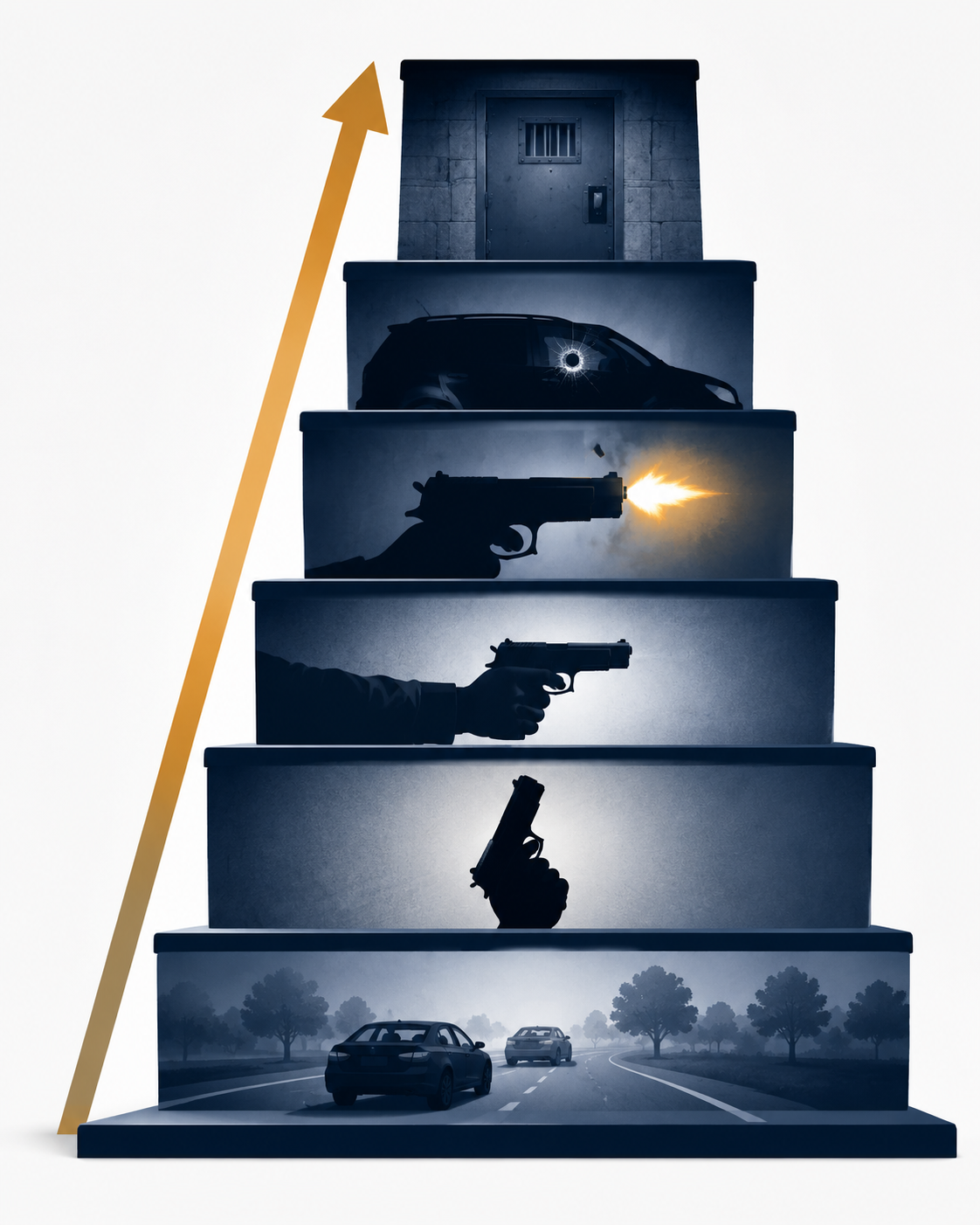
| Trigger | Common charge path | Why it matters |
|---|---|---|
| No firearm | Reckless driving, disorderly conduct, or simple assault | Usually stays in misdemeanor territory unless the facts add serious injury or another aggravator. |
| Firearm displayed | Aggravated assault with a deadly weapon | Defense-firm summaries place this at Texas second-degree felony exposure, even without a shot fired [4][5]. |
| Firearm pointed | Aggravated assault or, in stronger intent cases, attempted murder | Pointing sharpens the intent question and usually changes how prosecutors read the encounter. |
| Shot fired generally | Deadly conduct or reckless discharge | The case moves from threat to discharge, which raises both charging severity and public-safety risk. |
| Shot fired into an occupied vehicle | Texas first-degree felony after SB3031 | Texas SB3031, effective Sept. 1, 2025, set this at 5-99 years or life [7]. |
| Injury or death | Aggravated assault, homicide, or murder exposure | Once a victim is hit, prosecutors can stack the firearm facts with the resulting harm. |
| Prohibited possessor | Felon-in-possession or related firearm-status prosecution | Federal and state firearm counts can travel alongside the road-rage case [14]. |
Texas is the current anchor
Texas matters here because SB3031 made the discharge line much steeper. The statute, effective Sept. 1, 2025, elevated shooting at an occupied vehicle to a first-degree felony, with exposure of 5-99 years or life [7]. For practitioners, that is the cleanest current-law example of how a road-rage firearm fact can jump from a street altercation to top-tier felony exposure.
That distinction is why the charged event is not defined by emotion or volume. It is defined by what the weapon did: whether it was only shown, pointed, fired into the air, or fired at a vehicle already occupied by another person.
Self-defense narrows quickly
Self-defense arguments get much narrower once the encounter keeps moving. In Florida, state highway patrol officials said stand-your-ground does not immunize road-rage shootings in a Collier County case that produced nine felony counts [8].
North Carolina shows the same practical problem from another angle: following, re-engaging, or failing to disengage can destroy a self-defense claim under N.C.G.S. sections 14-51.3 and 14-51.4 [9]. Michigan adds a similar obstacle for the driver who wants to claim lawful protection while still in motion, because the standard turns on whether the response was honestly and reasonably defensive [10].
Other state markers
Wisconsin, Arizona, and New York/DC materials are best used as comparison points rather than templates. They all place road-rage firearm conduct in felony territory, but the label, range, and charging path still turn on the local code [11][12][13]. That is useful in charge review because it shows how fast the same handgun fact can move from a traffic case to a serious violent-felony file, even before anyone is injured.
Federal exposure can run alongside the state case when the driver is a prohibited possessor. In the ATF's Brandon, Mississippi matter, a convicted felon received 8 years for a road-rage shooting, a reminder that firearm possession alone can supply an additional prosecution track [14].
Collateral consequences
The case file does not end with the top count. Once a firearm is part of the incident, defense and charging analysis usually has to account for loss of gun rights, professional licensing issues, immigration consequences, and sentencing-enhancement exposure. Those consequences may not decide the initial charge, but they often shape plea posture and the real cost of the case.
References
- Road Rage Shootings Remain Alarmingly High — Everytown Research & Policy
- Texas Cracks Down on Road Rage Shootings — The Trace, July 2025
- Houston Public Media road-rage shooting analysis — Houston Public Media, May 2024
- Texas aggravated assault with a deadly weapon guidance — BRCK Criminal Defense Attorneys
- Texas assault and deadly weapon penalties — Law Office of Kevin Bennett
- The Trace Data Hub methodology — The Trace Data Hub
- Texas SB3031 road-rage shooting coverage — The Trace, July 2025
- Road rage shootings do not fall under stand-your-ground — Florida Politics, May 2024
- North Carolina self-defense and road-rage incidents — Powers Law Firm
- Michigan road-rage self-defense standard — Barone Defense Firm
- Wisconsin road-rage firearm penalties — Wolff & Sonderhouse
- Arizona road-rage assault framework — Michael Alarid Defense
- New York and DC road-rage penalty reference — Daeryun Law
- Convicted Felon Sentenced to 8 Years for Road Rage Shooting — ATF
Comments
Join the discussion with an anonymous comment.