
On May 27, 2026, Robinhood said it was opening live equities trading to third-party AI agents through the Model Context Protocol, and its support page says the firm does not "control, supervise, monitor, recommend, or audit" those agents [1][2]. Robinhood also described the product as beta-stage and equities-only [1][2]. That is the important shift: this is not a chatbot that points a customer toward a trade; it is a permissioned path for an outside model to initiate one.

What Changed On May 27
MCP matters because it standardizes the handoff between the customer's agent and the broker-dealer system. Once the agent can move from suggestion to execution, the legal problem changes. The question is no longer whether the model sounds persuasive. It is who authorized the agent, what the broker knew about that authorization, and where the supervisory duty starts when the order path is partly outside the firm's direct control.
The support page tries to draw a bright line by saying Robinhood does not "control, supervise, monitor, recommend, or audit" AI agents [2]. That sentence is useful precisely because it narrows Robinhood's claimed role. It also highlights the tension at the center of the launch: the broker opens the channel, but the broker says the agent is not its own.
What The Letter Asked
That is why the June 25 Foster-Sherman letter matters. Summarized by WealthManagement, the lawmakers sent 13 questions to SEC Chair Atkins and asked whether use of third-party AI agents changes or limits broker-dealer obligations under federal securities laws, with a July 31 response deadline [3]. The letter does not prove the launch is unlawful. It does show that lawmakers think the current vocabulary may not fit the product.
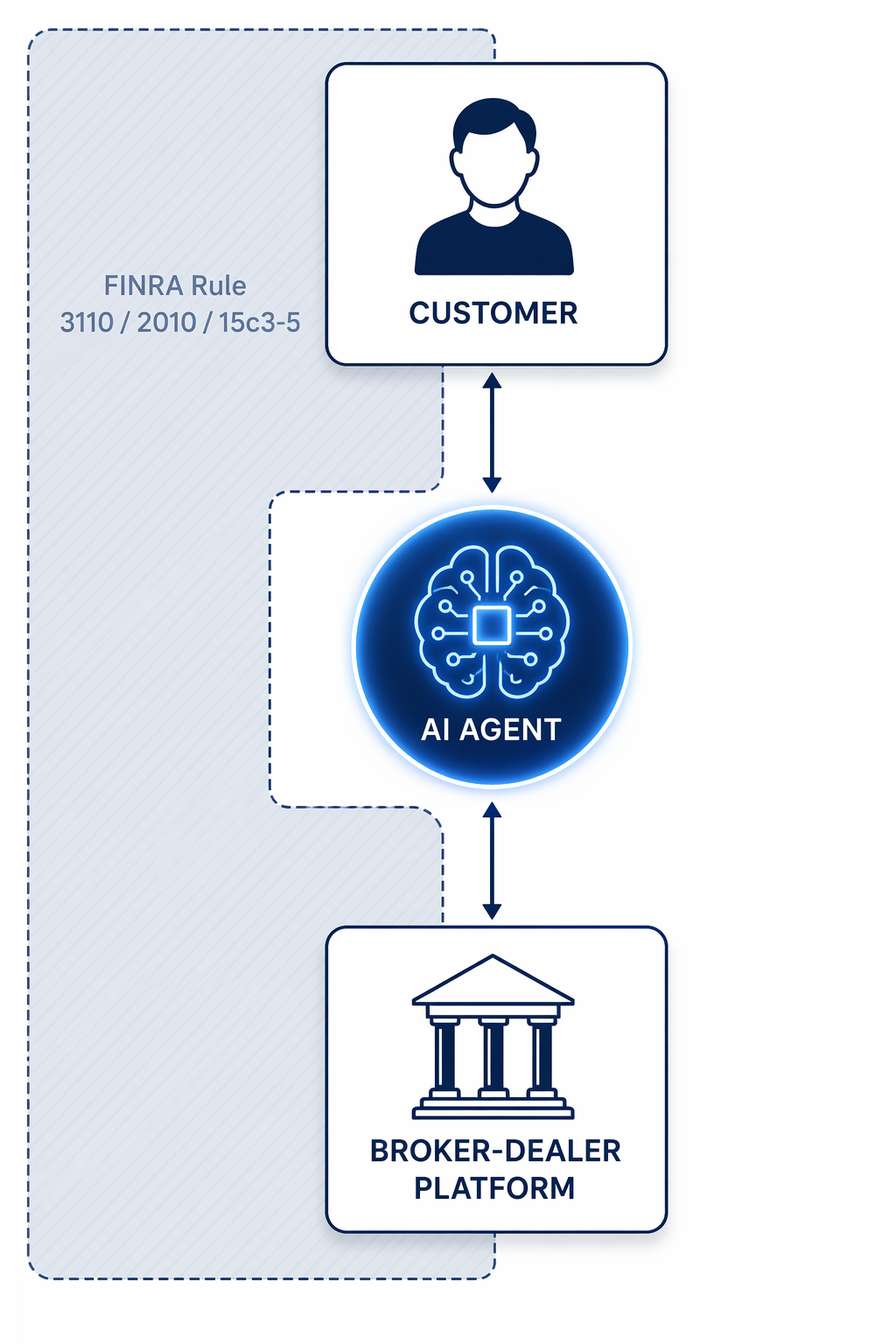
Where Current Rules Fit
Current SEC and FINRA rules still provide the only available hooks, and they are all human-centered. Rule 3110 points toward supervision, Rule 2010 toward commercial honor and just standards of conduct, and Rule 15c3-5 toward market-access risk controls. Each rule helps, but none was drafted for a third-party model that can place orders under customer authorization.
- Rule 3110 assumes the firm can build a supervisory system around a person, desk, or process that it can review.
- Rule 2010 can reach how the feature is described and governed, but it does not itself answer whether the broker must treat the model as an actor inside the control stack.
- Rule 15c3-5 is the closest analog because it deals with order-entry controls, yet the rule was built for firm and customer routing, not for autonomous outside software with its own prompts, memory, and policy choices.
What the rules do not settle is where the compliance map gets drawn. If the customer authorizes the agent, but the broker-dealer opens the channel, then a firm still has to answer who approves access, what exception review exists, how the agent is identified in records, and when repeated prompt-driven orders become a supervisory problem instead of a product issue.
Robinhood's Own Record
Robinhood's own public record makes the tension harder to dismiss. At FINRA's May 2026 conference, Chief Legal Officer Daniel Gallagher said AI platforms like Claude can give financial advice with little broker oversight [4]. Robinhood's AI in Financial Services policy says the company supports responsible AI in financial services [5]. Those are not contradictory enough to settle the issue, but they are contradictory enough to make the supervision question feel operational rather than theoretical.
That is also why Robinhood CEO Vlad Tenev's July 2 CNBC comment matters. He said AI agents will have human-like capability in trading [6]. The remark is future-facing rather than accusatory, but it reinforces the same point: Robinhood is not treating agentic trading as a toy interface layered on top of brokerage; it is treating it as a trading mechanism with real order consequences.
As of July 21, 2026, the launch is less a verdict than a test case. Robinhood has shown that a retail broker can let third-party AI agents touch live equities trading while disclaiming direct control over the agents themselves. Regulators now have to decide whether existing supervisory rules can stretch across that boundary, or whether agentic finance needs its own category of obligations.
References
- Robinhood is now open to agents — Robinhood Newsroom — May 27, 2026
- Agentic trading overview — Robinhood Support
- Lawmakers Press SEC on AI Trading Agent Oversight — WealthManagement — June 25, 2026
- AI platforms give financial advice with little oversight, Robinhood lawyer warns — AdvisorHub — May 26, 2026
- AI in Financial Services — Robinhood Policy
- Robinhood CEO says AI agents will have human-like trading capability — CNBC — July 2, 2026
Comments
Join the discussion with an anonymous comment.