
The practical legal question in the Sara Rodriguez campaign finance investigation is not whether a large discrepancy looks bad. It does. The question is what Wisconsin law does with a state campaign report that appears to contain major duplicate contributions, late-night amendments, and a cash balance that the candidate says did not match reality.
The public file starts with several numbers that have to be kept in their own lanes. WisPolitics reported more than $275,000 in apparent duplicate contributions, while the Milwaukee Journal Sentinel identified more than $100,000, a difference that appears to reflect different review scopes rather than a settled official finding.[1][2] The Journal Sentinel also reported that the campaign’s January 2026 report was filed at 2:13 a.m. on Jan. 16, after the Jan. 15 deadline, and amended twice within hours, at 3:23 a.m. and 5:01 a.m.[2] Wisconsin Watch reported that Rodriguez believed the campaign had about $1.5 million, while the actual figure was around $200,000.[3] On July 13, Rodriguez voluntarily referred the matter to the Wisconsin Ethics Commission and pledged cooperation, and on July 16 the Wisconsin Federation of Republican Women filed a separate ethics complaint alleging a $1,500 unreported donation.[4][5] A July 16 campaign finance filing then showed $34,990 cash on hand.[6]
Those facts put the matter in Wisconsin state-law territory. Rodriguez was a state candidate, so the relevant framework is Wisconsin Chapter 11 and Wisconsin Ethics Commission procedure, not the Federal Election Commission. That jurisdictional point matters because campaign finance enforcement is not one undifferentiated pile of “finance trouble.” Wisconsin’s civil enforcement path, its confidentiality rules, and any possible law enforcement referral are separate questions.

The reported errors implicate Chapter 11 before they prove anything else
Chapter 11 is where Wisconsin places the basic campaign finance reporting duties for state campaigns. A campaign’s reports are supposed to tell the state and the public what came in, what went out, and what remains. Duplicate contributions and cash-balance errors are not merely cosmetic if they change the reported financial position of the committee. They can affect contribution records, public transparency, and the candidate’s own decisions about the race.
That is the first legal consequence of the Rodriguez matter. The public reports do not need to establish criminal intent in order to trigger Wisconsin’s campaign finance enforcement machinery. Reporting accuracy problems can be enough to raise Chapter 11 questions and to move the matter into the Ethics Commission’s process. The better formulation is narrow: public reporting describes apparent reporting discrepancies large enough to support an Ethics Commission review. It is not accurate, at least on the public record, to say the Commission has found a violation.
The timing of the January filing is also part of the legal picture. Campaign people know that late filing nights create errors. They also know that amendments filed within hours of a deadline can signal that a committee is trying to repair a report after the control failure has already surfaced. The timestamp is not proof of intent. It is still relevant because it helps reconstruct when the campaign reported, when it corrected, and whether the public report ever reflected the campaign’s real cash position.
The Ethics Commission process is civil, confidential, and threshold-based
The Wisconsin Ethics Commission does not operate like a public prosecutor announcing live investigative milestones. Its complaint process is confidential by law. The Commission’s public complaints guidance says it may investigate only after finding reasonable suspicion, and respondents have 15 days to respond in writing.[7] That makes the July sequence important but limited: Rodriguez’s July 13 self-referral and the July 16 third-party complaint are public trigger events, not public findings.
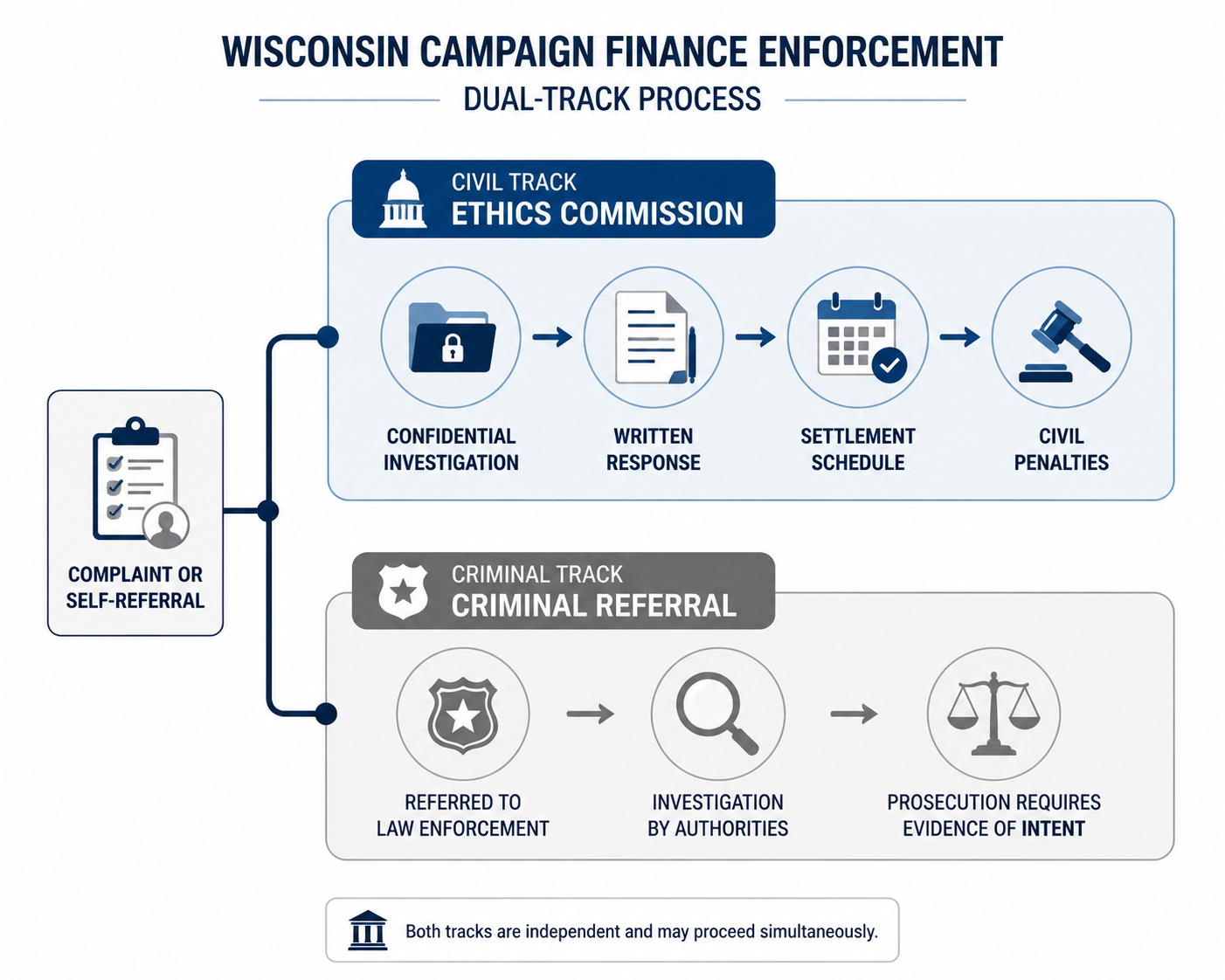
That confidentiality rule is more than an administrative footnote. It blocks a common but sloppy sentence: “the investigation found.” Unless the Commission releases a final action or another authorized public document exists, outsiders do not know what the Commission has found, whether it has accepted a response, whether staff have requested more records, or whether a settlement has been offered. Public reporting can describe the self-referral, the complaint, the campaign filings, and the Commission’s published procedure. It cannot fill in the confidential middle.
In practice, the civil workflow is usually less theatrical and more document-heavy than campaign coverage suggests. The Commission or its staff will need records that reconcile reported contributions, bank activity, refunds if any, amendments, cash on hand, and the authority of whoever entered or certified the information. The respondent’s written answer matters because it can frame the discrepancy as a data-entry failure, a reconciliation mistake, a treasurer oversight, misconduct by a staffer, or something more intentional. Those categories lead to different consequences.
| Public event | Legal significance | What it does not prove |
|---|---|---|
| January report filed late and amended twice within hours | Creates a timeline for reporting accuracy and correction questions | Intentional misconduct |
| July 13 self-referral | Places the matter before the Wisconsin Ethics Commission | A finding that Chapter 11 was violated |
| July 16 third-party complaint | Provides a separate complaint trigger with a specific allegation | That the allegation has been accepted as true |
| July 16 filing showing $34,990 cash on hand | Shows the campaign’s reported cash position at that filing point | The full amount of any prior discrepancy |
Why the routine civil penalty may look small beside the public dollar figure
One uncomfortable feature of Wisconsin’s system is that the public dollar amount of a discrepancy and the routine civil settlement amount may not move in parallel. The Ethics Commission’s published settlement schedule for cash-balance discrepancies uses a formula of $100 plus 10% of the discrepancy, with a maximum of $500 per unreported transaction.[8] That schedule can make a civil settlement look modest compared with a reported six-figure or larger reporting collapse.
That does not mean the discrepancy is legally trivial. Settlement schedules are tools for standard civil resolution. They help produce consistent outcomes for recurring reporting violations, especially where the issue is corrected and the respondent accepts settlement. They are not a moral valuation of the error, and they are not a public audit report. A campaign can face a scheduled civil penalty and still have suffered a severe operational failure.
Nor does the schedule necessarily cap every conceivable outcome. If a respondent rejects a settlement, or if facts support a more serious theory, the Commission may have other civil enforcement options. Exact exposure cannot be calculated from the public reports alone because the missing facts are the ones that matter most: how many transactions were involved, whether the reports were corrected, who had access to the records, what the bank statements showed, and whether anyone knowingly caused false information to be reported.
This is where the Rodriguez file sits in the uncomfortable middle. The figures are too large to wave away as ordinary filing clutter. At the same time, Wisconsin law does not jump from a bad report to a criminal conclusion. The civil track can move on reporting duties and reconciliation evidence. A criminal theory would require something more specific.
Candidate liability and staff exposure are not the same question
Rodriguez cannot be erased from the legal analysis because she self-referred. A voluntary referral may matter to cooperation, timing, and remedial posture, but it does not by itself answer whether the committee satisfied Chapter 11 reporting obligations. The candidate and committee remain central to the Ethics Commission’s civil review because the reports were campaign reports.
Kara Spencer, the former campaign manager, occupies a different lane. Staff can be relevant to how a reporting failure happened: who entered data, who reconciled deposits, who reviewed the bank balance, who prepared amendments, and who told the candidate what cash was available. But staff liability is not identical to candidate or committee liability. A campaign finance report can create civil exposure for the committee even if the explanation is staff error. A staffer can face separate exposure only if the facts support duties, conduct, or intent attributable to that person.
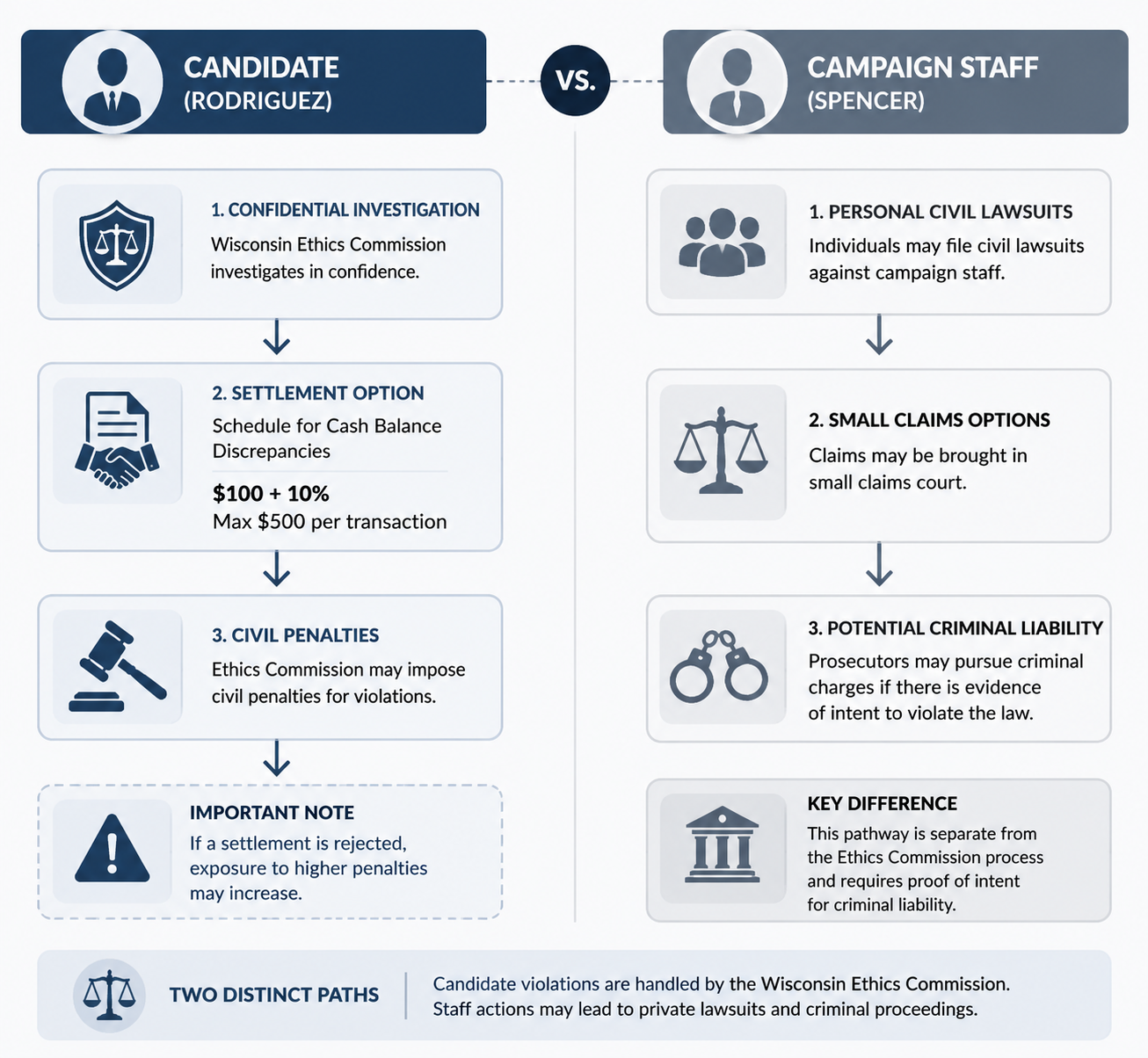
The public reporting on Spencer’s personal finances belongs in that limited context. WISN and WMTV reported that Spencer faced two small-claims lawsuits and an eviction proceeding involving more than $8,000 in unpaid rent before or during her tenure.[9][10] Those facts may explain why lawyers and investigators would look carefully at access, authorization, and bank records. They do not prove campaign finance misconduct. Personal financial pressure is not evidence of intent unless it connects to campaign money through records, testimony, or other admissible facts.
That distinction is especially important in a case where the public numbers are dramatic. A campaign that believed it had about $1.5 million but actually had around $200,000 was not merely dealing with a minor rounding problem.[3] The consequences would have reached budgeting, fundraising strategy, vendor commitments, and candidate decision-making. But even a devastating internal cash surprise does not identify who caused the discrepancy or whether it was negligent, reckless, or intentional.
The third-party complaint adds a trigger, not a verdict
The Wisconsin Federation of Republican Women’s July 16 complaint alleged a $1,500 unreported donation.[5] In enforcement terms, the complaint matters because it gives the Commission a specific allegation to process under its complaint procedure. In political terms, it also gave opponents a public hook. Those are different facts.
A complaint does not substitute for the Commission’s reasonable-suspicion threshold. The respondent still has the written-response opportunity described by the Commission’s procedure, and the Commission’s work remains confidential unless and until a public action is authorized.[7] The better way to read the complaint is procedural: it may help define the issues before the Commission, but it does not tell the public what the Commission has concluded.
What would have to change for criminal exposure to become more than a possibility
Wisconsin’s civil campaign finance process can coexist with a possible law enforcement referral, but those tracks should not be collapsed. The Ethics Commission may handle civil reporting violations through its own process. A criminal theory would require evidence that supports criminal elements, including intent where the relevant offense requires it. Public reporting has not confirmed law enforcement involvement; WISN reported that local police departments it contacted did not respond.[6]
The public record therefore supports only a conditional statement. If evidence showed that someone knowingly falsified reports, converted campaign funds, concealed transactions, or misled the candidate, treasurer, Commission, or vendors, the matter could move beyond routine civil enforcement. If the evidence instead shows poor controls, rushed reporting, duplicate entries, and failed reconciliation, the case may remain principally a Chapter 11 civil matter, even if the dollar figures are embarrassing and politically damaging.
The unresolved point is not whether the cash collapse was serious. It was serious on the public facts. The unresolved point is what the records show about knowledge, authorization, and intent. Those are not adjectives; they are evidentiary questions.
Where the public record stops
As of Q3 2026, the Rodriguez matter presents a serious Wisconsin campaign finance enforcement roadmap: apparent duplicate contributions, a late and twice-amended filing, a self-referral, a third-party complaint, and a later cash-on-hand figure far below the amount the candidate reportedly believed existed. Those facts are enough to explain why Chapter 11, the Ethics Commission complaint process, settlement schedules, candidate responsibility, staff conduct, and possible referral questions all matter.
They are not enough to state a final finding. The Ethics Commission process is confidential by law, the public record does not establish the Commission’s conclusions, and confirmed law enforcement action has not been reported. Wisconsin law leaves the case where careful campaign finance analysis often leaves a bad report: in a civil enforcement process that can be significant without yet proving crime.
References
- WisPolitics report on apparent duplicate contributions, WisPolitics, 2026.
- Milwaukee Journal Sentinel report on Rodriguez campaign finance errors, Milwaukee Journal Sentinel, July 13, 2026.
- Wisconsin Watch report on Rodriguez campaign cash discrepancy, Wisconsin Watch, July 2026.
- News reports on Rodriguez self-referral to Wisconsin Ethics Commission, multiple news outlets, July 13, 2026.
- WDEX report on Wisconsin Federation of Republican Women ethics complaint, WDEX, July 16, 2026.
- WISN report on Rodriguez July campaign finance filing and law enforcement inquiries, WISN, July 2026.
- Complaints, Wisconsin Ethics Commission.
- Settlement Schedules, Wisconsin Ethics Commission.
- WISN report on Kara Spencer small claims lawsuits and eviction proceeding, WISN, July 15, 2026.
- WMTV report on Kara Spencer small claims lawsuits and eviction proceeding, WMTV, July 15, 2026.
Comments
Join the discussion with an anonymous comment.