
Roger Rogoff’s appointment and firing as U.S. Attorney for the Western District of Washington lasted long enough to become a headline and not long enough to explain itself. On July 15, 2026, all 17 active and senior judges of the district court appointed him before 8 a.m. PDT; by about 8:54 a.m., the presidential personnel office had sent an email removing him, citing 28 U.S.C. § 541(c) and Article II. The district had been without a Senate-confirmed U.S. Attorney since Nicholas W. Brown resigned in mid-2023, so the 54-minute episode was not the beginning of the dispute. It was the visible point at which a vacancy statute, an expired interim appointment, a title change, and a removal theory all met in the same inbox.[1][2][3]
That is why the better way to understand the Rogoff appointment and firing is not as a one-morning collision between federal judges and the White House. It is as a conflict over the machinery Congress wrote into 28 U.S.C. § 546: who keeps a federal prosecutor’s office operating when the ordinary Senate-confirmed route has not produced a confirmed U.S. Attorney.
The statute matters before the personalities do
Section 546 is short, but it does real work. It does not merely authorize an interim U.S. Attorney. It sets out a timed sequence. When a U.S. Attorney’s office becomes vacant, the Attorney General may appoint someone to serve temporarily. That appointment is capped at 120 days. If no presidentially appointed and Senate-confirmed U.S. Attorney has taken office by then, the district court may appoint a U.S. Attorney to serve until the vacancy is filled.[4]
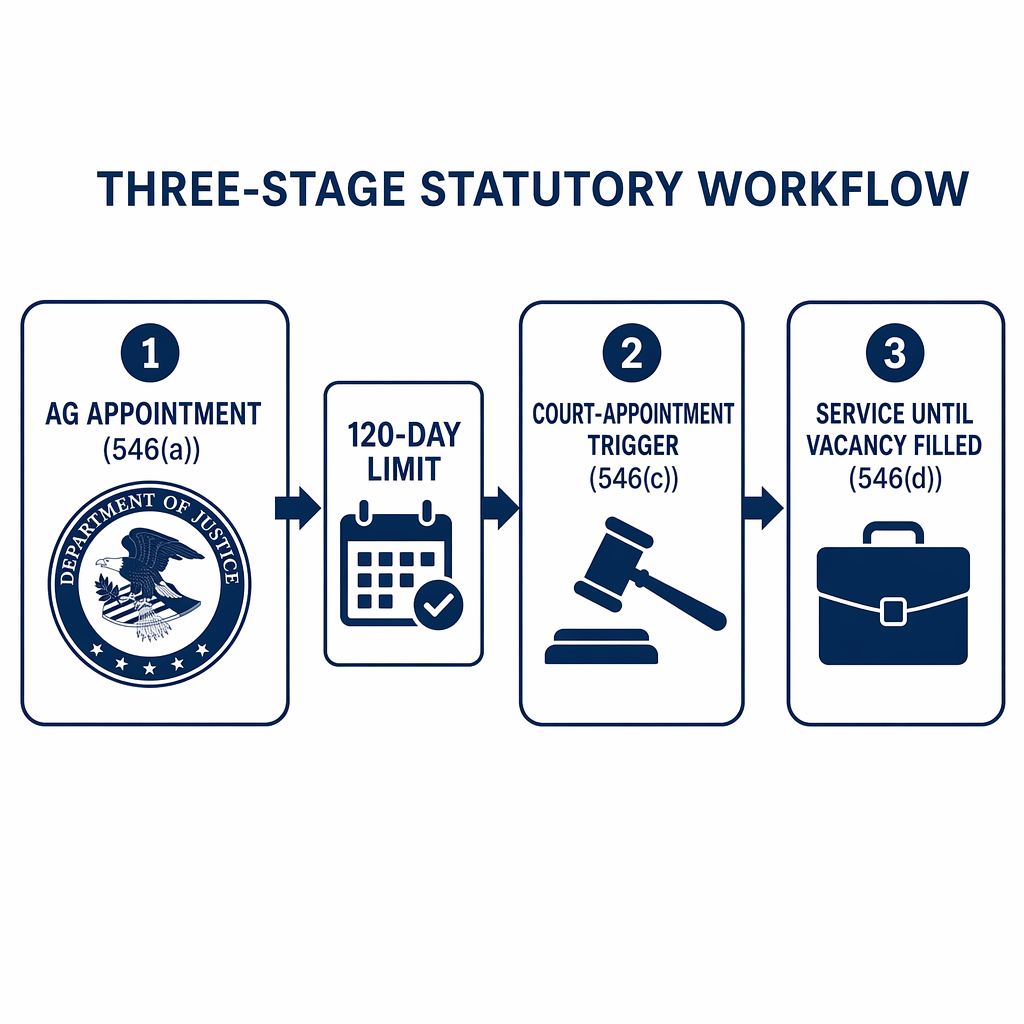
| Stage | What § 546 does | Why it mattered in Seattle |
|---|---|---|
| Attorney General appointment | The Attorney General may appoint an interim U.S. Attorney when a vacancy exists. | This is the executive branch’s initial vacancy-management tool. |
| 120-day limit | The Attorney General’s interim appointment may not continue indefinitely. | The clock is the statutory pressure point; once it expires, another actor enters. |
| Court appointment | The district court may appoint a U.S. Attorney to serve until the vacancy is filled. | This is the backstop the Western District of Washington judges invoked when they appointed Rogoff. |
The design is easy to flatten into a fight over “who gets to pick the prosecutor.” But the statute is more precise than that. Congress gave the executive branch the first move, imposed a time limit on that move, and then assigned the next move to the district court if the vacancy remained unfilled. That court appointment does not make the office permanent. It holds the office open until the vacancy is filled through the ordinary process.[4]
That structure explains why the Western District’s order had institutional significance beyond Rogoff himself. The court was not choosing a prosecutor in the abstract. It was invoking a statutory backstop after a vacancy had persisted for years and after the Attorney General’s temporary appointment mechanism had already been used.
The hinge was not Rogoff. It was Floyd’s title.
The Western District’s vacancy began long before July 2026. Tessa Gorman had served as U.S. Attorney until she was fired in January 2025. Charles Neil Floyd then served as interim U.S. Attorney. When his § 546(a) 120-day period expired around February 2026, the administration did not place a Senate-confirmed U.S. Attorney into the office. Reporting instead described a title change: Floyd was retitled as “first assistant” while the top post remained vacant.[2][3]
That distinction matters because § 546 is triggered by the status of the office, not by whether the same person keeps making day-to-day decisions. If a temporary U.S. Attorney reaches the statutory limit, and the office remains vacant, the statute points toward court appointment. Retitling the same functional leader as first assistant does not look like a new Senate-confirmed appointment. It looks like a way to keep the office operating while avoiding the particular legal consequence Congress attached to the 120-day mark.
The available reporting does not establish every internal Justice Department decision that led to Floyd’s retitling. It does support a narrower and more important point: the Western District of Washington was not the only district where title-shifting appeared after the 120-day interim period. Similar tactics were reported in New Jersey, Nevada, and Virginia, including the New Jersey sequence involving Alina Habba and Desiree Leigh Grace.[2][3]
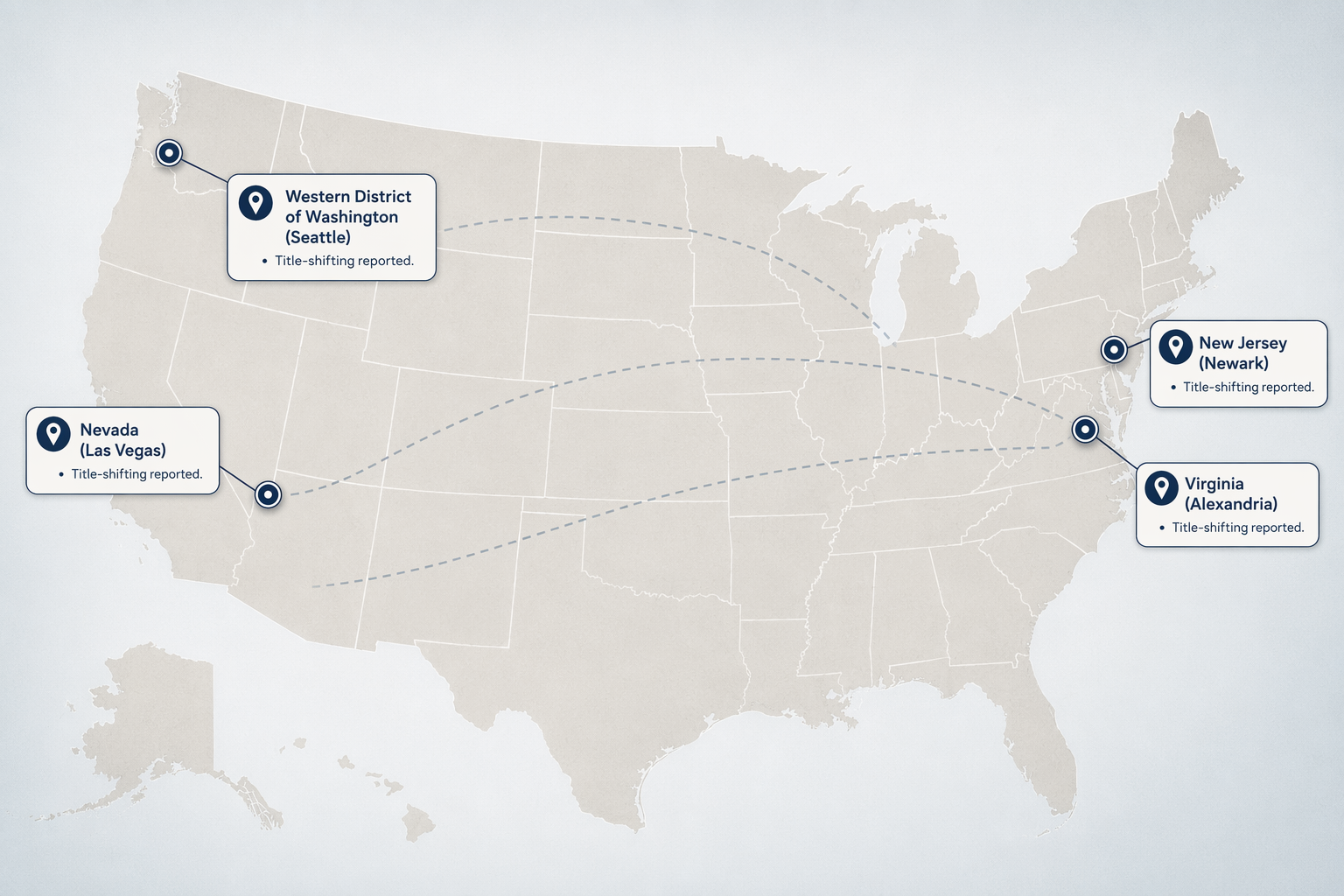
This is the point at which the legal story stops being a curiosity about one Seattle prosecutor. Section 546’s court-appointment trigger is not ornamental. If the executive branch can appoint an interim U.S. Attorney for 120 days, then leave the office formally vacant while keeping the preferred person in operational control under another title, the court-appointment backstop becomes much easier to postpone. Whether one calls that aggressive vacancy management or circumvention, the statutory pressure release Congress wrote into the system is being stepped around.
The unanimity of the Western District’s order is therefore more than a political footnote. The appointment was made by all 17 active and senior judges, appointed by five presidents from both parties.[1][2][3] That does not settle the legal questions that followed. It does, however, make the event harder to reduce to a partisan skirmish. The court acted as an institution using the statute Congress gave it.
Why the firing raised a different question
Once Rogoff was appointed, the dispute shifted. The question was no longer only whether the administration had avoided § 546’s court-appointment trigger before July 15. It became whether the President could remove a U.S. Attorney whom the district court had just appointed under that trigger.
The removal email reportedly cited § 541(c), which says that each U.S. Attorney is “subject to removal by the President,” along with Article II.[1][2][3] If that provision reaches every U.S. Attorney regardless of appointing authority, the administration’s position is straightforward: Rogoff held the office of U.S. Attorney, and the President removed him.
The harder question is whether § 541(c) applies in the same way to a court-appointed U.S. Attorney serving under § 546. That is not a question the Supreme Court has squarely answered. Nor is it resolved by saying that the President ordinarily controls federal prosecutors. The ordinary rule is important, but this is a statutory appointment device that deliberately places the interim appointment decision in the district court after the executive branch’s 120-day authority has run.
A 1979 Office of Legal Counsel opinion is often invoked here, but it does less work than some accounts suggest. As described by later bar association and academic treatments, OLC concluded that the Attorney General could not remove a court-appointed U.S. Attorney and that only the President could do so. It did not definitively resolve whether the President may remove such an officer at will, or whether § 541(c)’s removal language clearly covers officers appointed by courts rather than by the President.[5][6]
That distinction is not lawyerly hair-splitting. It separates who lacks removal power from what removal power the President affirmatively has. The first proposition is narrower. The second is the one Rogoff’s firing appears to test.
The Berman standoff left the same seam exposed
The closest modern warning came from the 2020 standoff involving Geoffrey Berman, the U.S. Attorney for the Southern District of New York. Berman had been appointed by the district court under § 546 after an interim period. When Attorney General William Barr announced that Berman was stepping down, Berman initially refused to leave, arguing that he had not resigned and that he served under a court appointment. The episode ended without a judicial ruling because Berman departed after his deputy was allowed to assume the office.[7][6]
That ending mattered. The Berman dispute made the removal question visible, but it did not decide it. No court had to say whether § 541(c) gives the President at-will removal authority over a court-appointed U.S. Attorney, whether some cause requirement might be implied, or whether the statutory structure creates a constitutional problem if removal does not sit with the President.
Rogoff’s situation is cleaner in one respect and more abrupt in another. The court appointment was formal and unanimous. The removal came almost immediately. If litigated, the case would not require reconstruction of a weekend press conference or a disputed resignation. It would begin with a court order and an email.
Principal officer, inferior officer, and why neither label solves everything
The Appointments Clause question sits underneath the removal question. If an interim U.S. Attorney is a principal officer, then judicial appointment would be constitutionally suspect because principal officers must be appointed by the President with Senate confirmation. If the officer is inferior, Congress may vest appointment in the President alone, department heads, or courts of law.
The case law gives strong support to the inferior-officer side, but not a Supreme Court holding directly on court-appointed interim U.S. Attorneys. Morrison v. Olson treated judicial appointment of prosecutors as constitutionally permissible in relevant language and specifically referenced § 546(d) as an example; the First and Ninth Circuits have treated interim U.S. Attorneys as inferior officers. Edmond v. United States later framed inferior-officer status around supervision and removal, among other considerations. Heilpern’s George Mason Law Review article emphasizes that the Supreme Court has never squarely resolved the classification for court-appointed interim U.S. Attorneys.[5]
That is why confident claims on either side tend to run too far. It is too quick to say that Rogoff was plainly insulated from presidential removal merely because the court appointed him. It is also too quick to say that § 541(c) plainly ends the matter, because the statutory text can be read against a separate appointment provision that deliberately activates only after the Attorney General’s temporary authority expires.
Heilpern’s analysis is useful precisely because it does not pretend the statute is elegant. The article describes the interim U.S. Attorney statute as “a mess” and identifies “nonfrivolous textual arguments” that § 541(c) may not extend to U.S. Attorneys appointed by a court under § 546.[5] That is scholarship, not controlling law. But it marks the removal issue as a real statutory problem rather than a talking point.
There is also pressure from modern removal doctrine. If the President cannot remove a court-appointed U.S. Attorney, then some removal authority must sit elsewhere, possibly with the appointing court. Heilpern notes that such an arrangement would raise questions after Seila Law’s treatment of presidential removal limits in the single-director agency context.[5] That does not mean Seila Law decides Rogoff’s case. A U.S. Attorney’s office is not the CFPB, and § 546 is not an independent-agency statute. But Seila Law explains why the constitutional stakes do not disappear once the statutory argument becomes plausible.
What Rogoff could litigate, and what he has not yet litigated
Rogoff has retained HKM Employment Attorneys LLP and publicly described the situation as “untenable, not constitutional, and not legal.” He has said he is considering legal options. As of July 19, 2026, no complaint had been filed.[2][3]
If litigation is filed, the first fight may not be the merits. A court would need to address standing, the proper defendant, available remedies, and whether the dispute is justiciable in the posture Rogoff chooses. The merits question would then require the court to reconcile at least four layers: § 546’s appointment sequence, § 541(c)’s presidential-removal language, the Appointments Clause distinction between principal and inferior officers, and Article II removal doctrine.
The relief question could be just as practical as the theory. A successful challenge might seek reinstatement, a declaration about the invalidity of the removal, or some narrower remedy tied to compensation or office status. Each route would change the institutional consequences. Reinstatement would put the court-appointed prosecutor back into a presidentially accountable prosecutorial office. A declaratory ruling might answer the legal question without fully restoring operational control. A narrower employment remedy might leave the vacancy machinery largely unresolved.
For the U.S. Attorney’s Office itself, the legal uncertainty is not abstract. Criminal charging decisions, civil enforcement work, plea negotiations, personnel supervision, and interagency coordination require someone with authority to act for the office. Section 546 exists because vacancies in these offices cannot simply wait for ordinary politics to clear.
The narrower lesson of the 54 minutes
The Rogoff episode is easy to overread if it begins and ends with the clock. A 54-minute tenure sounds like an institutional insult, a partisan dare, or a provocation. It may have elements of all three. But the legal context is more useful than the spectacle.
First, Congress wrote § 546 to prevent Attorney General interim appointments from becoming indefinite. Second, the administration used a title-shifting arrangement that allowed Floyd to remain in operational control after the 120-day period while the office stayed formally vacant, a tactic reported in multiple districts. Third, when the Western District judges used the court-appointment mechanism, the administration invoked § 541(c) and Article II to remove the court’s appointee almost immediately.
That sequence does not answer the removal question. It identifies the question accurately. The issue is not whether the President has broad control over federal prosecution in ordinary circumstances, or whether judges may ever appoint interim prosecutors. The unresolved question is narrower: after § 546’s 120-day executive-branch period has expired and a district court appoints a U.S. Attorney to serve until the vacancy is filled, may the President remove that court-appointed officer at will under § 541(c) and Article II?
As of July 19, 2026, no court has answered that question in Rogoff’s case because no case has been filed. The 54 minutes are therefore not self-explanatory. They are the third act of a statutory conflict over § 546, after the 120-day trigger was avoided and before any court has decided whether the President may remove a court-appointed U.S. Attorney at will.
References
- Trump Administration Fires Roger Rogoff, U.S. Attorney, Minutes After His Appointment, The New York Times.
- Trump fires U.S. attorney in Washington, Roger Rogoff, on heels of court appointment, CBS News.
- White House Rapidly Fires Seattle Judges' US Attorney Pick, Bloomberg Law.
- 28 U.S.C. § 546 — Vacancies, U.S. House Office of the Law Revision Counsel.
- Interim United States Attorneys, George Mason Law Review, Vol. 28.
- Concern over the Attorney General's Conduct: Removal of Mr. Geoffrey Berman, New York City Bar Association.
- The Unusual Firing of Geoffrey Berman, New York State Bar Association.
Comments
Join the discussion with an anonymous comment.