
The Rogoff v. Trump lawsuit starts with the clock, not the campaign context. On July 15, 2026, the judges of the Western District of Washington appointed Roger Scott Rogoff as interim United States attorney under 28 U.S.C. § 546(d); according to the complaint filed six days later, President Trump purported to remove him 54 minutes after that appointment took effect, and Rogoff sued on July 21 seeking a declaration that the removal was unlawful and an injunction reinstating him to office.[1][2]
That is a tight procedural collision. It is also why the case is not merely another entry in the running fight over executive power. The office had been without a Senate-confirmed U.S. attorney since Nicholas W. Brown resigned in June 2023, leaving the district with a vacancy exceeding three years.[2] Congress has a statute for that problem. The question is whether that statute also leaves the President with the power to undo the court’s appointment almost immediately.
What Rogoff Is Actually Asking For
The complaint’s requested relief matters. Rogoff is not only asking for a retrospective declaration that the firing was legally ineffective. He is asking the district court to put him back in the job. NBC News and The Hill describe the complaint as seeking declaratory relief and reinstatement after Trump’s attempted removal of a court-appointed interim U.S. attorney.[2]
That remedy choice turns a clean statutory question into an institutional one. If Rogoff were asking only for a declaration, the court could decide whether the President’s notice had legal effect and stop there. Reinstatement asks a federal judge to direct who occupies a federal prosecutorial office while the executive branch objects. Even before Article II enters, that is not ordinary injunction terrain.
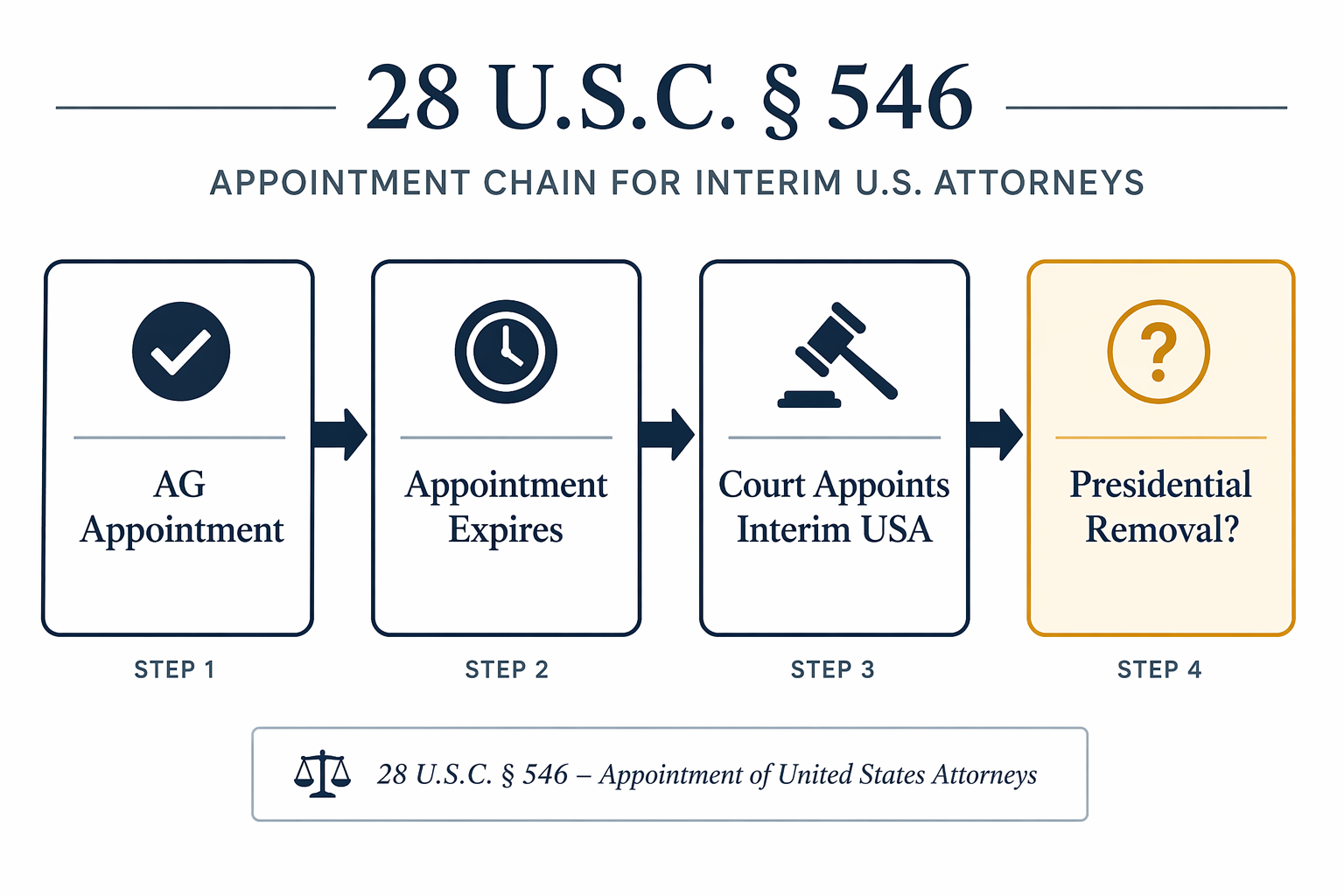
Still, the complaint is not built around atmospherics. Its strongest count is statutory. Rogoff’s argument begins with the sequence Congress wrote into § 546: the Attorney General may appoint an interim U.S. attorney; that appointment expires after a defined period unless a presidential nominee is confirmed; if the appointment expires, the district court may appoint a United States attorney to serve until the vacancy is filled.[3]
The Statutory Hook Is Real
Section 546 does several distinct things, and the distinctions are doing most of Rogoff’s work. Subsection (a) authorizes the Attorney General to appoint a United States attorney for a district in which the office is vacant. Subsection (c) limits that Attorney General appointment to 120 days, unless a presidentially appointed and Senate-confirmed United States attorney fills the office sooner. Subsection (d) then provides that if an appointment expires under subsection (c), “the district court for such district may appoint a United States attorney to serve until the vacancy is filled.”[3]
The statute expressly describes appointment sources and service duration. It does not expressly say that the President may remove a court-appointed interim U.S. attorney. Nor does it say the President may not. That silence is the hinge.
| Statutory stage | What § 546 says | Why it matters in Rogoff |
|---|---|---|
| Vacancy exists | The Attorney General may appoint a United States attorney for the district. | The executive branch gets the first interim appointment mechanism. |
| Attorney General appointment expires | The Attorney General appointment is time-limited under subsection (c). | The statute anticipates that an interim executive appointment may run out. |
| Court appointment follows | The district court may appoint a United States attorney to serve until the vacancy is filled. | Rogoff’s authority came from the court, not from the President or Attorney General. |
| Presidential removal attempted | The statute contains no express removal provision for a court-appointed appointee. | The complaint treats that omission as legally significant; DOJ is likely to treat it as constitutionally irrelevant. |
Rogoff’s best textual point is that Congress knew how to assign the interim appointment power and did so sequentially. The Attorney General receives the first temporary appointment power; after that authority expires, the district court receives a different appointment power lasting until the vacancy is filled by the ordinary presidential appointment and Senate-confirmation process. On that reading, a presidential removal power would give the executive branch a way to erase the court’s statutory role without following the confirmation route Congress referenced.
Andrew Kent Ross’s 2026 Brooklyn Law Review article supplies the most developed version of that theory before Rogoff filed suit. Ross argues that Congress did not intend § 546(d) appointees to be removable by the President and that allowing presidential removal would undercut the judicial appointment mechanism Congress created for expired interim appointments.[4] That does not make the complaint a winner. It does mean the statutory claim has architecture; it is not just a label attached to a separation-of-powers grievance.
The difficulty is that statutory silence cuts both ways. A plaintiff can say Congress’s omission of presidential removal language is meaningful because the officeholder was appointed by the court under a special vacancy statute. The government can answer that removal is not the kind of power Congress must spell out when the officer performs executive functions. That answer has force even before DOJ files a brief.
The Likely Government Answer Has Not Yet Been Briefed
As of July 22, 2026, the government has not filed its response. The administration’s position is known only from public statements, not from a motion to dismiss or merits brief. Acting Attorney General Todd Blanche put the expected argument plainly in a social-media statement reported by NBC News: “District court judges can appoint a temporary U.S. Attorney, and POTUS can fire them.”[2]
That sentence is not a brief, but it previews the likely frame. DOJ can be expected to say that a United States attorney exercises executive power, prosecutes in the name of the United States, and cannot be insulated from presidential removal merely because a district court made a temporary appointment under a vacancy statute. The administration also has an older Office of Legal Counsel position available to it, which NBC News identified as part of the legal backdrop to the dispute.[2]
Rogoff therefore needs more than the observation that § 546(d) lacks a removal clause. He needs the court to treat the appointment source and statutory sequence as limiting the President’s power over this particular inferior officer. That is plausible. It is also untested at the appellate level in this configuration.
The Constitutional Question Is Narrower Than It Looks
The ordinary question, “Can the President fire a U.S. attorney?” is too broad for this case. Senate-confirmed United States attorneys are presidential appointees, and the usual removal premise is not seriously in doubt. Rogoff’s case asks whether the same removal premise applies to an inferior officer appointed by Article III judges under a statute Congress enacted to keep a district’s prosecutorial office functioning during a vacancy.
That matters because the Appointments Clause permits Congress to vest the appointment of inferior officers in the President alone, heads of departments, or courts of law. Section 546(d) uses that third option. The harder question is what follows after appointment: if courts may appoint the interim officer, may Congress also make the officer resistant to presidential removal for the duration of the vacancy, or does Article II require presidential control because the officer prosecutes federal crimes?
The available materials do not support a confident answer. The Congressional Research Service has described interim and acting U.S. attorney arrangements as raising open legal questions, including questions about appointment and tenure mechanisms.[5] That caution is appropriate here. The Supreme Court has removal-power decisions with broad language, and it has appointments decisions recognizing court appointment of inferior officers, but it has not squarely decided this exact combination.
Why Morrison Helps Rogoff, and Why It Does Not End the Case
Rogoff’s side will naturally reach for Morrison v. Olson because it upheld a statutory arrangement involving a court-appointed independent counsel. Paul Cassell’s Volokh Conspiracy analysis defended § 546(d) against constitutional attack on Morrison-based grounds, arguing that the statute allowing judges to appoint interim U.S. attorneys is constitutional.[6] That is useful for Rogoff on the appointment side of the case.
But Morrison is not a perfect fit for the removal question Rogoff now presents. The case did not involve a President who removed a court-appointed interim United States attorney less than an hour after appointment. It also sits uneasily beside later Supreme Court removal-power decisions that emphasize presidential control over officers exercising executive power. A district court could find Morrison sufficient to uphold the appointment mechanism while still treating removal as a separate question.
Why Myers and Seila Law Help DOJ, and Why They Also Do Not End the Case
The government’s strongest constitutional instinct will be Myers-style. Myers is famous for broad language about the President’s removal authority over executive officers, and later cases such as Seila Law have reinforced a general skepticism toward statutory limits on presidential removal of officials exercising executive power. Steven Calabresi’s Volokh Conspiracy essay took the more aggressive view that court appointment of a U.S. attorney raises serious Article II problems after Seila Law and argued that the President can fire a court-appointed U.S. attorney.[7]
Those materials give DOJ a serious answer, not a shortcut. Myers involved a presidentially appointed postmaster, not a court-appointed interim prosecutor serving under a vacancy statute. Seila Law involved removal restrictions for the head of an independent agency, not a district court’s temporary appointment under § 546(d). The government can generalize from those cases; Rogoff can distinguish them. The missing piece is a controlling appellate rule for this precise arrangement.
Hundley and Kinsella Show the Backdrop, Not the Rule
The earlier removals of court-appointed interim U.S. attorneys Hundley in the Eastern District of Virginia and John Kinsella in the Northern District of New York may explain why lawyers were watching this issue before Rogoff filed. They do not supply a rule of decision. The research record identifies Rogoff as the first ousted court-appointed U.S. attorney to sue, while Hundley and Kinsella did not file comparable litigation after their February 2026 removals.[2]
That distinction is important for litigation analysis. Prior removals can show that the administration’s view was not invented for Rogoff alone. They cannot answer whether a court must accept that view when the removed officer asks for declaratory and injunctive relief.
The Remedy May Be the Hardest Practical Ask
Even if Rogoff survives the statutory and constitutional defenses, reinstatement is a separate fight. Courts are more familiar with declaring legal rights than with ordering the executive branch to accept a particular prosecutor as the United States attorney for a district. The requested injunction would affect who supervises federal prosecutions, who signs filings, who makes charging judgments, and who speaks for the United States in that district.
That does not make reinstatement unavailable. If the court concludes that Trump’s removal notice was void, reinstatement may be the only relief that gives effect to the court’s own § 546(d) appointment. But the remedial step is constitutionally sensitive in a way the statutory merits question is not. A judge could agree that Rogoff has a serious legal theory and still hesitate over the form, timing, or breadth of injunctive relief.
Where the Case Stands at the Pleading Stage
Rogoff has a real statutory opening because § 546(d) gives the district court an appointment role after the Attorney General’s interim authority expires and does not expressly provide for presidential removal of the court-appointed officer. Ross’s pre-filing scholarship makes that reading serious enough to require engagement, not dismissal by slogan.[3][4]
DOJ has a powerful answer because United States attorneys perform executive functions, and the Supreme Court’s removal-power cases give the executive branch substantial language to work with. The public version of the administration’s position is simple: judges may appoint temporarily, but the President may fire.[2] The filed version will likely be more elaborate, and it may matter how directly the government leans on Article II rather than statutory interpretation.
The point worth holding onto is the narrowness of the unresolved question. This is not a referendum on whether U.S. attorneys are executive officers. They are. It is not a general test of whether courts can ever appoint inferior officers. The Appointments Clause says Congress may vest such appointments in courts of law. The hard question is what removal power attaches when Congress uses that option for an interim United States attorney and the President attempts removal before a Senate-confirmed replacement exists.
No appellate court has supplied the rule that makes that question easy. The statute gives Rogoff more than a colorable theory; Article II gives DOJ more than a fallback defense; and the reinstatement request adds remedial friction even if the merits move Rogoff’s way. At this stage, certainty would be the least lawyerly reaction to the complaint.
References
- General Order Appointing Roger Scott Rogoff as United States Attorney, United States District Court for the Western District of Washington, July 15, 2026.
- Seattle U.S. Attorney Roger Rogoff sues over Trump firing him, NBC News.
- 28 U.S. Code § 546 - Vacancies, Cornell Legal Information Institute.
- Tenuous Appointments: The President's Claimed Power to Remove Court-Appointed Interim United States Attorneys, Brooklyn Law Review, 2026.
- Interim and Acting U.S. Attorneys Raise Open Legal Questions, Congressional Research Service.
- The Statute Allowing Judges to Appoint Interim U.S. Attorneys Is Constitutional, The Volokh Conspiracy, July 28, 2025.
- Can a Federal District Court Appoint a New U.S. Attorney? Can the President Fire a U.S. Attorney Appointed by a Federal Court?, The Volokh Conspiracy, May 10, 2020.
Comments
Join the discussion with an anonymous comment.