
The legally important event in the Romanian proceedings was not an arrest, a televised exit from a courthouse, or another round of public claims about Andrew Tate. It was the Bucharest Court of Appeal’s December 2024 ruling that the first DIICOT case could not proceed to trial because the investigative file failed preliminary chamber scrutiny. The court ordered the removal of critical evidence, including initial victim testimonies and defendant statements, and identified concrete defects in how prosecutors had handled charge explanations, charge presentation, and asset-confiscation allegations.[1]
That is where any serious legal analysis of the Romanian charges against Andrew Tate has to begin. The ruling did not decide that the defendants were innocent. It also did not say that the alleged victims were lying. It said something narrower and more institutionally consequential: before the state may put a person on trial, prosecutors must build a file that satisfies the procedural conditions for trial. In a trafficking case dependent on contested coercion narratives and vulnerable testimony, that distinction is not a technicality. It is the boundary between accusation and adjudication.

The Gate That Did Not Open
Romania’s preliminary chamber stage matters because it sits between investigation and trial. It is not a public trial in miniature, and it should not be flattened into a U.S. probable-cause hearing or a U.K. case-management step. Its function is more exacting in a civil-law file-based system: the judge reviews whether the indictment, investigative acts, and evidence collection meet the legal requirements for sending the case forward.
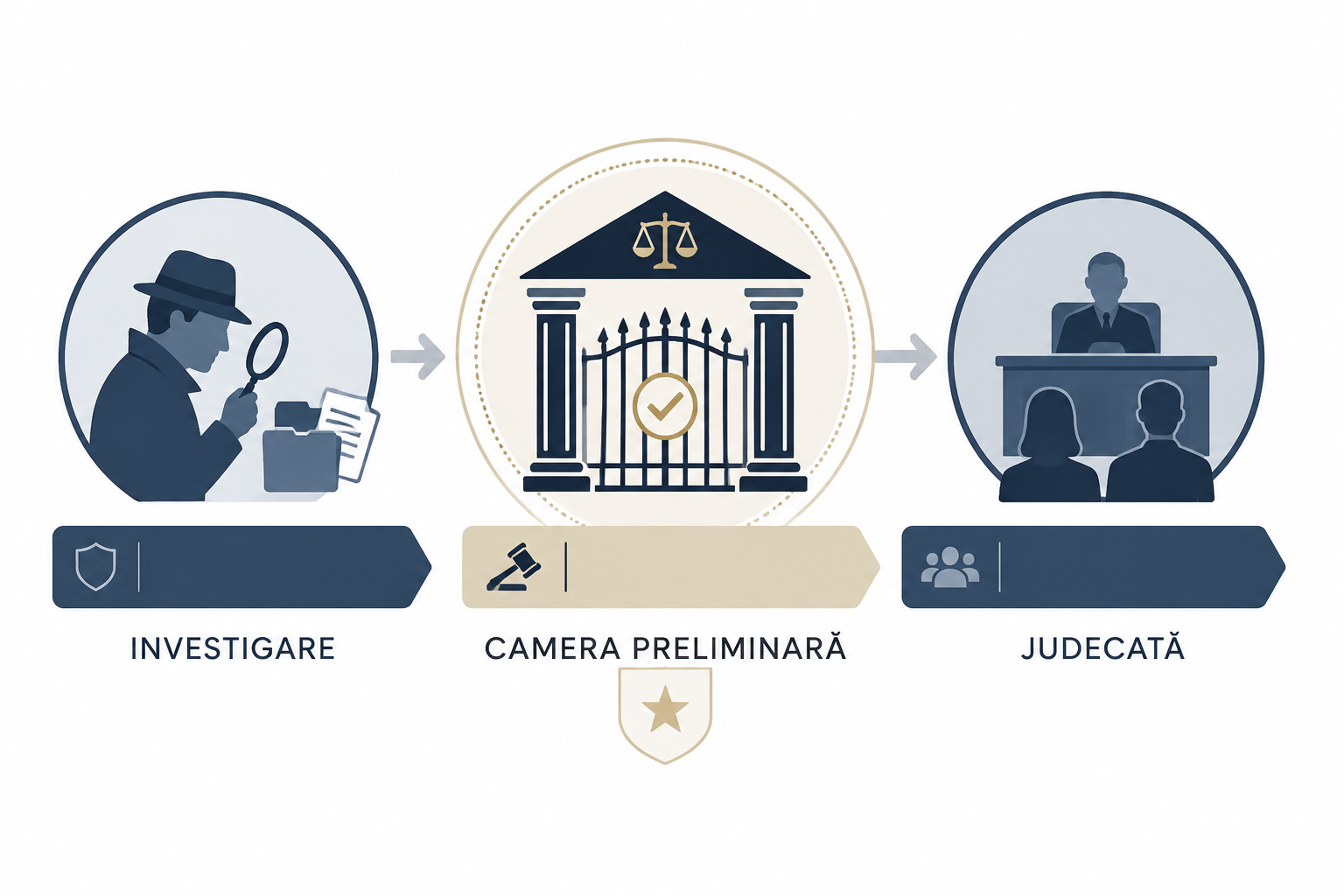
That gatekeeping role is particularly significant in a post-communist criminal procedure framework. The point is not simply administrative efficiency. It is to prevent an investigative authority from converting a politically or socially charged accusation into a trial without judicial inspection of how the case was assembled. When the defendant is globally visible, public attention tends to reward whichever side can claim a moral headline. The preliminary chamber is designed to ask a colder question: did the prosecution comply with the rules that make trial legitimate?
In December 2024, the Bucharest Court of Appeal answered that question against DIICOT in the first case. According to the reported ruling, prosecutors had failed to adequately explain the charges to one alleged victim under Article 307 of Romania’s Criminal Procedure Code; had improperly presented charges involving the two female defendants, Georgiana Naghel and Alexandra-Luana Radu; and had failed to specify the amounts tied to asset confiscation in the indictment.[1]
Those are not cosmetic defects. A charge-explanation failure affects whether a participant in the process understands the legal significance of the accusation being investigated. Improper charge presentation affects notice and defense preparation. Failure to specify confiscation amounts affects property exposure and the clarity of the indictment. Each defect concerns the state’s obligation to say, with legal precision, what it is doing to whom and on what basis.
Why Excluding the Evidence Changed the Case
The sanction gave the ruling its force. The court did not merely admonish prosecutors and permit the case to continue unchanged. It ordered evidence removed from the case file, including initial victim testimonies and defendant statements.[1] In a trafficking prosecution, those categories can be central. Initial accounts may shape the factual architecture of coercion, recruitment, control, and exploitation. Defendant statements may frame admissions, denials, timelines, or contradictions. Once removed, the prosecution file is not the same file with a warning label attached; it is a materially altered case.
That consequence protects defendants from being tried on evidence collected through defective procedure. It also can damage complainants. If a victim’s early testimony becomes unusable because prosecutors failed to comply with the Code, the harm is not borne only by the accused or by the state. A complainant may be forced into repeated testimony, face credibility attacks built around inconsistencies between admissible and inadmissible accounts, or see a case delayed until its factual coherence deteriorates.
That is why the December 2024 ruling should not be treated as a defense celebration or as a bureaucratic mishap. The court’s intervention was a real check on prosecutorial power, but the need for that intervention exposed a weakness in the investigative phase. In serious criminal cases, procedural discipline is not a favor to defendants. It is what allows allegations to be tested without contaminating the process that alleged victims are relying on.
The Two Romanian Tracks Must Stay Separate
The Romanian proceedings are easy to misstate because there is more than one investigative track. The first DIICOT case, brought in 2023, involved seven alleged victims and charges including human trafficking, rape, and forming an organized crime group.[2] That is the case affected by the December 2024 preliminary chamber ruling.
A second investigation, launched in August 2024, has been reported as involving 35 alleged victims and expanded allegations including trafficking minors, sex with a minor, money laundering, and witness tampering.[2] As of July 2026, that second investigation should be understood as distinct from the first. Treating it as a simple continuation of the failed 2023 case would overstate what the available record supports; treating it as proof that prosecutors have fixed the defects would do the same.
| Romanian track | Reported scope | Procedural status relevant here |
|---|---|---|
| First DIICOT case | Seven alleged victims; charges included human trafficking, rape, and forming an organized crime group | Blocked from proceeding to trial after the December 2024 preliminary chamber ruling |
| Second DIICOT investigation | Thirty-five alleged victims; allegations include trafficking minors, sex with a minor, money laundering, and witness tampering | Distinct investigation still pending as of July 2026 |
The separation matters because procedural failure in one file does not decide the merits of another. It may, however, reveal institutional pressure. If prosecutors expanded or rebuilt the investigation after the first case encountered preliminary chamber resistance, the relevant legal question is not whether the new allegations sound more serious. It is whether the new file can do what the first one did not: translate the accusation into admissible evidence, properly presented charges, and an indictment specific enough for trial.
The “Loverboy Method” Is a Theory, Not a Shortcut
The prosecution theory has often been described in public discussion through the language of the “loverboy” or “Romeo pimping” model. The Polaris Project, writing in a U.S.-law-oriented framework, describes this as a grooming pattern in which traffickers feign romantic relationships to coerce victims into commercial sex.[3] That description may help explain why an allegation can involve apparent intimacy, travel, promises, online content, or emotional dependency without losing its coercive character.
But that explanatory model is not itself a Romanian indictment. The Polaris source frames the concept through U.S. anti-trafficking law, and its precise relationship to Romanian trafficking statutes requires careful Romanian-law verification before being treated as a statutory match.[3] The legal task for DIICOT is not to persuade the public that a pattern sounds manipulative. It is to prove, within the Romanian charging framework, the legally required acts, means, purposes, and evidentiary links for each defendant and each alleged victim.
That distinction becomes important at the preliminary chamber stage. Grooming theories often depend on a sequence of communications, changes in personal dependency, movements of money, housing arrangements, sexual or labor exploitation, and the alleged victim’s account of pressure or deception. If the first statements are excluded, if the indictment lacks specificity, or if the charges were not properly presented, the narrative may still be morally legible to the public while legally unstable in court.
This is the hard part of trafficking prosecution. Coercion need not look like a locked room. It may be emotional, financial, reputational, or relational. Yet criminal procedure still requires particularized proof. A legal system that lowers that demand because the alleged conduct is grave risks convicting through atmosphere. A prosecution service that mishandles early testimony risks making real coercion harder to prove.
A Check on DIICOT, and a Warning to DIICOT
DIICOT’s institutional role gives the ruling wider significance. Specialized anti-organized-crime and anti-trafficking prosecutors operate in cases where secrecy, speed, and investigative complexity can be real necessities. Those same conditions can also expand prosecutorial discretion beyond the point where ordinary procedural safeguards feel like obstacles. The preliminary chamber exists precisely for the moment when a powerful prosecution unit says the case is ready and a judge must decide whether the file proves that readiness.
The December 2024 ruling suggests that Romanian criminal procedure can still perform that checking function at a meaningful point. It did not wait until trial to discover that foundational evidence and charge presentation were compromised. It forced the consequences before the defendants were placed in the posture of trial accused on a defective file.
The same ruling also raises the less comfortable question: why did a high-profile trafficking case arrive at that stage with these defects at all? The answer cannot be supplied from the available public materials. It may involve complexity, error, haste, internal prosecutorial judgment, or disputed interpretations of Romanian procedure. What can be said is narrower: the court identified defects serious enough to keep the case from going to trial and to remove important evidence from the file.[1]
For legal systems emerging from authoritarian legacies, that combination is familiar. Reform architecture may create real judicial controls, but those controls often reveal investigative habits that have not fully adjusted to adversarial pressure, rights-based notice, and evidence-exclusion consequences. The Tate case is not proof that Romania’s system failed. It is evidence that the system’s checking mechanism operated, and that it had something serious to check.
Judicial Controls Were Later Lifted, but the Investigation Did Not End
The April 2026 lifting of judicial controls fits the same institutional pattern, though it should not be overstated. A Bucharest court removed the remaining judicial control measures, including regular police check-in requirements, while the underlying investigation continued.[4] The ruling did not resolve the second investigation. It addressed whether ongoing restrictions still had adequate legal grounds.
Reuters reported that the Tates’ lead lawyer described the decision as restoring “the principle that liberty cannot be restricted without solid legal grounds.”[4] That statement is an adversarial framing, not a neutral holding to be adopted wholesale. Still, the court’s action is relevant because it shows continued judicial willingness to ask whether restrictions remain justified while prosecutors investigate.
Pretrial restrictions can become punishment by duration if courts do not revisit them with discipline. The April 2026 decision therefore reinforces, rather than replaces, the lesson of the preliminary chamber ruling: Romanian courts were not simply deferring to DIICOT because the allegations were serious or because the defendants were notorious.
The UK Proceedings Add Pressure, Not an Answer
The United Kingdom proceedings sit near the edge of this analysis, not at its center. A Romanian court granted the U.K.’s request to extradite Andrew and Tristan Tate, but only once Romanian legal proceedings are concluded.[5] Separately, the BBC reported that the Crown Prosecution Service authorized 21 charges in May 2025, including human trafficking, rape, and sexual assault.[6]
That sequencing matters because it creates delay pressure. Romanian proceedings must run their course before extradition can take effect, and defense lawyers have argued that the second Romanian investigation could push extradition far into the future.[5] But the U.K. material does not cure or deepen the Romanian preliminary chamber defects. It simply shows that the defendants face cross-jurisdictional legal exposure governed by separate procedural systems.
For readers tracking the broader chronology, the cross-border sequence is important. For the Romanian procedural question, it is secondary. The December 2024 ruling stands or falls on what Romanian prosecutors did inside the Romanian case file.
What the Case Shows
The December 2024 ruling shows a criminal procedure system capable of blocking a major prosecution before trial when the file does not satisfy legal requirements. That is not a small institutional fact. In a case surrounded by notoriety, moral certainty, and political noise, a court required the prosecution to meet procedural standards and imposed evidentiary consequences when it did not.
The same ruling shows how costly investigative-stage failures can be in trafficking prosecutions built around contested coercion models. If prosecutors rely on a grooming theory, early testimony, charge clarity, and evidentiary handling become more important, not less. The state must be able to explain the coercion theory in legally usable terms, attach it to specific defendants and alleged victims, and preserve the evidence that gives the theory trial value.
Nothing in the ruling proves innocence. Nothing in the second investigation proves guilt. What the Romanian proceedings reveal is more structural: procedure can act as substantive protection against prosecutorial overreach, but when prosecutors mishandle that procedure, both defendants and complainants may be left with a damaged process before any court reaches the merits.
References
- A Romanian court says the Andrew Tate case can't go to trial because of missteps by the prosecutors — AP News
- Legal affairs of the Tate brothers — Wikipedia
- The Tate Brothers and the Basics of Romeo Pimping — Polaris Project
- Romanian court lifts judicial controls against Andrew Tate, pending investigation — Reuters, April 6, 2026
- Romanian court grants UK's request to extradite Andrew Tate, once local legal cases are concluded — Courthouse News Service / AP
- Andrew and Tristan Tate to face 21 charges in UK — BBC
Comments
Join the discussion with an anonymous comment.