
Ronald Fischer's capture, the end point of a long America's Most Wanted fugitive story, did not turn on a single dramatic stroke. It began with a tip, moved through an existing fugitive apparatus, and ended with law enforcement locating him under an alias after more than 20 years on the run. The U.S. Marshals Service said Fischer, one of Rhode Island's longest-wanted fugitives, was arrested by members of the Rhode Island Violent Fugitive Task Force after coordination among the Marshals Service, FBI, Rhode Island State Police, and the Coast Guard.[1]
The striking part is the compression. CBS News reported that the interval from tip to arrest was about 48 hours, and that Fischer had used 17 known aliases, carried the nickname “master yachtsman,” and was associated with a sailboat called Silver Lining.[2] Those details can sound like fugitive folklore. Procedurally, they explain a harder point: ordinary local process loses power when the person subject to it becomes mobile, maritime, and administratively scattered.
The tip mattered because somebody could lawfully act on it. A state murder conviction existed. A federal unlawful-flight layer existed. A task force already had a structure for moving information across agencies. And because Fischer's fugitive life had a maritime edge, the Coast Guard's participation was not ornamental; it answered a jurisdictional problem that local officers could not solve by themselves.

That is why the Ronald Fischer fugitive capture legal case is useful beyond the peculiar facts of one defendant's flight. It shows three mechanisms doing different work. Trial in absentia prevented absence from defeating adjudication. The federal Unlawful Flight to Avoid Prosecution statute supplied a separate federal charge and federal fugitive resources. The task-force model converted that legal posture into a physical arrest.
The Conviction That Flight Did Not Erase
The first important act happened long before the arrest. Fischer was tried in Rhode Island in 2005 after being accused in the killing of Cheryl Gingerich's father, and People reported that he fled during the trial before being convicted.[3] The reported sentence attached to the conviction was life with parole eligibility after 25 years, but sentencing had not yet occurred after his capture.[3]
That distinction matters. A conviction is not the same thing as a completed criminal judgment ready for every downstream consequence. But it is also not nothing. Once the trial continued and a verdict was returned, Fischer's absence no longer had the same power to suspend the adjudicative work of the state court.
Trial in absentia is easy to describe badly. It should not be treated as a convenience device for finishing a case without the accused. The procedural premise is that the defendant's absence is knowing and voluntary. Secondary reporting on Fischer's case indicates that Rhode Island proceeded on that kind of voluntary-absence theory, broadly consistent with the principle reflected in Federal Rule of Criminal Procedure 43, under which a defendant who was initially present may lose the ability to stop proceedings by voluntarily absenting himself after trial has begun.[3]
There is a caveat worth keeping in view: the exact Rhode Island statutory or rule provision applied in Fischer's trial has not been independently verified here from a primary Rhode Island legislative or court-rule source. The safer conclusion is narrower. Available reporting supports that the trial continued after Fischer fled, that the conviction survived his absence, and that the case remained capable of sentencing once he was returned.
That preserved conviction did one job especially well. It kept the case from becoming a hostage to the defendant's mobility. It did not, however, solve the next problem: how to find and arrest a person who had left the ordinary reach of Rhode Island process for two decades.
What the Federal UFAP Warrant Added — and What It Did Not
The federal layer in Fischer's case is often the place where imprecision creeps in. An Unlawful Flight to Avoid Prosecution warrant is not a federalized copy of the state murder case. The statute, 18 U.S.C. § 1073, creates a separate federal offense for traveling in interstate or foreign commerce with intent to avoid prosecution, custody, confinement, or certain testimony obligations under state law.[4]
The same statute limits punishment to a fine, imprisonment for not more than five years, or both; and it states that violations may be prosecuted only on formal approval in writing by the Attorney General, Deputy Attorney General, Associate Attorney General, or an Assistant Attorney General.[4] That approval requirement is not trivia. It marks UFAP as a federal charging decision, not merely a clerical way to lend federal officers to a state warrant.
| Mechanism | Problem It Addressed | Limit It Could Not Solve Alone |
|---|---|---|
| Trial in absentia | Prevented voluntary flight during trial from nullifying adjudication | Did not itself locate or physically recover the fugitive |
| 18 U.S.C. § 1073 UFAP warrant | Created a separate federal unlawful-flight track tied to avoidance of state prosecution or confinement | Did not transform the state murder conviction into a federal murder prosecution |
| Violent Fugitive Task Force | Turned warrants, intelligence, and agency authorities into coordinated arrest capacity | Depended on valid legal predicates and participating agencies with relevant jurisdiction |
That separate-track quality is the point. Rhode Island had the murder prosecution. Federal authorities had an unlawful-flight offense that could justify federal fugitive involvement. The two tracks related to the same conduct pattern of evasion, but they did not collapse into one another.
For the state, UFAP made a practical difference because a fugitive who crosses state, national, or maritime boundaries can defeat the assumptions built into local policing. For the federal government, the charge supplied a defined legal interest: the flight itself. For Fischer, it means capture did not merely revive the Rhode Island sentencing issue; it also left him exposed to a separate federal prosecution for unlawful flight.
The Task Force as the Operational Bridge
A valid conviction and a federal unlawful-flight warrant still do not put hands on a defendant. Someone must receive the information, decide it is actionable, locate the person, and use the right authority in the right place. That is where the task-force model did the work the legal papers could not do by themselves.
The U.S. Marshals Service describes fugitive investigations as a central mission and says it works with federal, state, and local partners through regional and district fugitive task forces to locate and arrest violent fugitives.[5] In Fischer's case, the Marshals Service identified the Rhode Island Violent Fugitive Task Force as the arresting structure, with the FBI, Rhode Island State Police, and Coast Guard participating.[1]
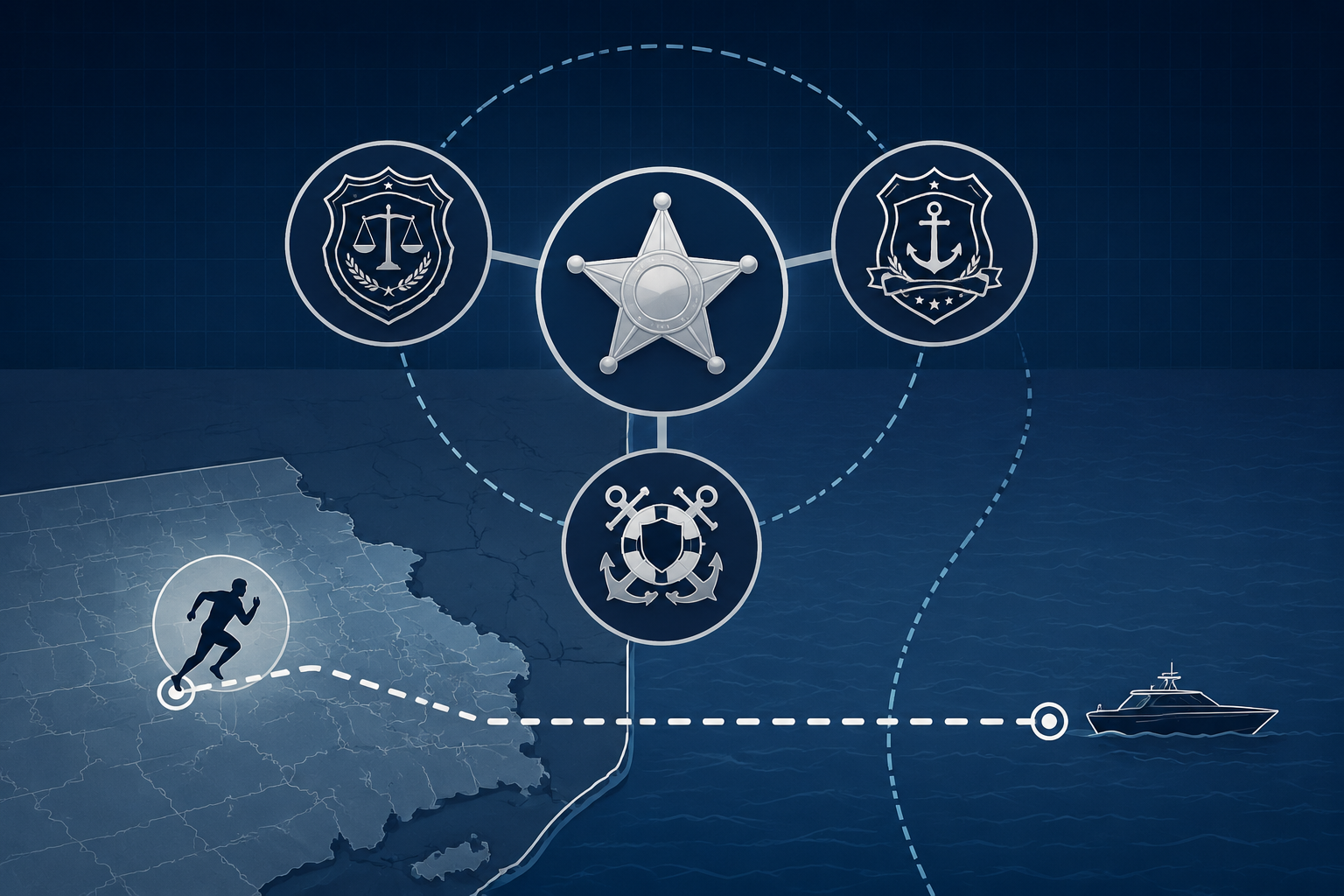
The value of that composition is not that more badges make a case more serious. It is that different agencies can answer different procedural seams. State police bring the originating prosecution and local case knowledge. The Marshals Service brings fugitive-investigation infrastructure. The FBI can assist where federal investigative channels are relevant. The Coast Guard can act where the case moves onto water.
That last point is unusually important here. Fischer's reported maritime profile was not simply color. If the relevant encounter involved high-seas or maritime circumstances, state law enforcement alone would face a practical and jurisdictional barrier. The Coast Guard's law-enforcement authority under 14 U.S.C. § 522 allows it to make inquiries, examinations, inspections, searches, seizures, and arrests upon the high seas and waters over which the United States has jurisdiction, subject to law.[6]
That does not mean the Coast Guard was enforcing Rhode Island murder law as a free-floating state proxy. It means the task force included an agency whose statutory authority fit the place where enforcement was needed. Once the fugitive case had both state and federal predicates, and once maritime interception became operationally relevant, the agency mix mattered.
The Human Cost of a Procedural Gap
The machinery should not obscure who waited while it had not yet reached him. The Providence Journal reported Cheryl Gingerich's response after Fischer's arrest, including her statement about the long delay and the effect on her family.[7] Former prosecutor Carl Ricci also commented on the case after the capture, underscoring that the prosecution had endured across a span in which personnel, memories, and institutions had to keep a dormant matter alive.[7]
That is the consequence of flight in a murder case. It does not merely postpone a docket event. It transfers uncertainty to the victim's family, leaves prosecutors preserving a case without a defendant in the courtroom, and forces investigators years later to translate an old conviction and warrant history into a lawful arrest in present conditions.
Why the Final 48 Hours Were Possible
The short answer to how Fischer was found is less important than the answer to why the system could move once he was found. A tip is information. It becomes enforcement only when the receiving agencies can connect identity, warrant status, jurisdiction, and arrest authority quickly enough that the fugitive cannot simply move again.
In Fischer's case, the preserved Rhode Island conviction supplied the adjudicative anchor. The UFAP warrant supplied a federal unlawful-flight track. The Violent Fugitive Task Force supplied the working relationship among agencies capable of acting across the relevant boundaries. The Coast Guard supplied the maritime piece that made a high-seas encounter legally executable rather than merely observable.
The colorful facts remain useful only insofar as they show the strain on ordinary process. Seventeen aliases mean repeated identity problems. A sailboat means mobility that does not respect county lines. A “master yachtsman” reputation means the case was not just a matter of checking last known addresses. None of that makes capture impossible. It makes single-agency, single-jurisdiction pursuit inadequate.
There is no need to overclaim closure. Fischer's Rhode Island sentencing remained pending after his arrest, and the UFAP matter remained a separate federal issue. What the capture demonstrates is narrower and more useful: no single mechanism closed the gap. Together, the conviction preserved despite voluntary absence, the federal unlawful-flight charge, and the multi-agency task-force structure converted a long-dormant state fugitive case into an executable arrest across jurisdictional lines.
References
- One of Rhode Island's Longest Wanted Fugitive Captured After More Than 20 Years on the Run, U.S. Marshals Service.
- CBS News report on Ronald Fischer's capture, CBS News.
- People report on Ronald Fischer's 2005 trial and flight, People.
- 18 U.S. Code § 1073 - Flight to avoid prosecution or giving testimony, Cornell Legal Information Institute.
- Fugitive Investigations, U.S. Marshals Service.
- 14 U.S. Code § 522 - Law enforcement, Cornell Legal Information Institute.
- Providence Journal report on Ronald Fischer's capture and family response, The Providence Journal.
Comments
Join the discussion with an anonymous comment.