
For a law firm deciding whether to put local AI hardware in offices that handle confidential client data, the immediate question is narrower than the geopolitics around AI chips: do the China export rules that restrict datacenter accelerators also catch compact systems such as NVIDIA’s RTX Spark or AMD’s Gorgon Halo? On the information available in July 2026, the practical answer is that both appear to sit below the Bureau of Industry and Security performance thresholds that trigger licensing treatment for covered datacenter GPUs: total processing performance below 21,000 and DRAM bandwidth below 6,500 GB/s.[1] That makes them very different procurement objects from H200-class or MI325X-class accelerators.
That answer should not be translated into “safe to buy” without qualification. The classification is inferred from published product information, not from a public official ECCN classification for these specific SoCs. Neither product had shipped to consumers as of July 2026, and independent benchmarks were not yet available. For a firm with China offices, restricted-sector clients, or hardware refresh cycles that run longer than regulatory patience, purchase approval should be treated as a compliance assessment event, not a routine laptop accessory decision.
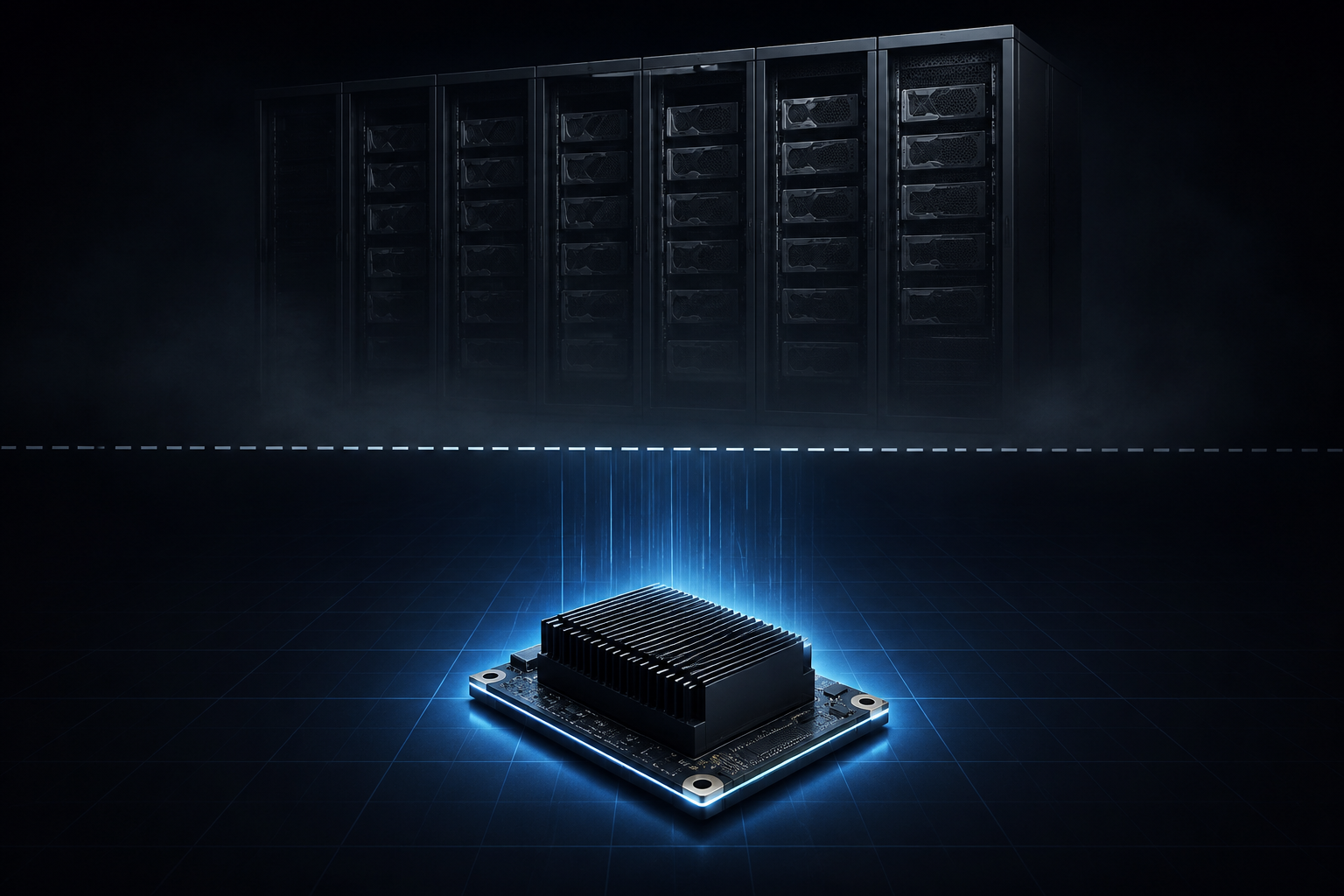
Why These Local AI Chips Are Not Being Treated Like H200s
The export-control distinction starts with what the devices are built to do. NVIDIA describes RTX Spark as a compact local AI system built around a Blackwell GPU, 6,144 CUDA cores, 128GB of unified memory, an approximately 80W TDP, and a vendor-stated 1 petaflop FP4 performance claim, with availability planned for fall 2026 and Windows on Arm support through Microsoft.[2] TechPowerUp’s specification summary also identifies a 20-core Grace Arm CPU and positions the device inside the RTX software ecosystem rather than as a rack-scale accelerator.[3]
AMD’s Gorgon Halo is being positioned differently, but still in the same broad procurement category: a local AI SoC rather than a datacenter export-control workhorse. Tom’s Hardware reported AMD’s emphasis on up to 192GB of unified memory and x86-native compatibility as advantages for local AI work.[4] TechSpot’s coverage similarly treated Gorgon Halo’s large unified memory pool and Q3 2026 availability as the reasons it may appeal to users who want local inference capacity without moving workloads into cloud infrastructure.[5]
| Device | Published positioning | Procurement significance |
|---|---|---|
| NVIDIA RTX Spark | Blackwell GPU, 6,144 CUDA cores, 128GB unified memory, roughly 80W TDP, vendor-stated 1 petaflop FP4 claim, fall 2026 availability.[2] | Looks like a compact local AI system, not a datacenter accelerator built around the bandwidth and aggregate performance profile that drives current licensing thresholds. |
| AMD Gorgon Halo | Zen 5 CPU, RDNA 3.5 GPU positioning, up to 192GB unified memory, x86-native compatibility, Q3 2026 availability.[4][5] | May be attractive for local AI deployments where memory capacity and compatibility matter more than rack-scale training throughput. |
| H200 / MI325X class | Datacenter GPU category addressed by recent China licensing and policy changes.[1] | The category procurement teams should not casually analogize to local consumer-grade SoCs without checking threshold and classification language. |
The important procurement point is not that one vendor’s device is more elegant than the other’s. It is that the public facts describe compact local systems with unified memory, not accelerators whose published performance and memory-bandwidth profile clearly crosses the current controlled datacenter threshold. A law firm does not need to decide whether Blackwell, RDNA 3.5, Arm, or x86 is the more interesting architecture to reach that first compliance screen.
The Direct Export-Control Question
Under the current threshold framing described in the available materials, licensing is triggered by technical characteristics associated with covered advanced datacenter chips, including total processing performance and DRAM bandwidth thresholds. The working figures in the research record are TPP below 21,000 and DRAM bandwidth below 6,500 GB/s.[1] RTX Spark and Gorgon Halo, based on their published positioning and specifications, appear to fall below those thresholds.
That comparison can be misleading if it starts from brand names rather than from classification criteria. Export-control analysis does not become stricter merely because a device has NVIDIA or AMD silicon inside it. Nor does it disappear because the product is sold as consumer-grade or office-friendly. The relevant question is whether the specific hardware, in the specific configuration being exported or transferred, meets controlled technical parameters or otherwise falls under an applicable restriction.
On the materials available now, neither RTX Spark nor Gorgon Halo has been publicly shown to meet the controlled datacenter GPU threshold. That is a narrower conclusion than saying the devices are officially cleared, permanently safe, or irrelevant to export compliance. It means the published specifications do not point to the same licensing treatment that has been applied to higher-end datacenter accelerators.
What Is Still Unsettled
Three caveats matter before a procurement team writes this into a standard hardware catalog. First, the performance record is not independently complete. RTX Spark’s 1 petaflop figure is a vendor-stated FP4 claim, and the published AMD materials emphasize memory capacity and platform compatibility rather than a final independently tested export-control profile.[2][4][5] FP4 marketing numbers are useful for understanding product intent, but they are not a substitute for classification documentation.
Second, neither product had shipped to consumers as of July 2026. NVIDIA’s announced availability was fall 2026, while coverage of Gorgon Halo pointed to Q3 2026.[2][5] Until devices are in the channel, law firm buyers are working from announcements, briefings, and reseller statements. Those can support early planning, but they should not be treated as final compliance evidence.
Third, no public official ECCN classification for these specific SoCs has been identified in the available materials. An internal buyer can reasonably infer that the devices are below the current thresholds; the buyer cannot turn that inference into an official classification just by repeating it in a risk memo. That distinction matters if the hardware will be shipped to an overseas office, assigned to personnel in China, serviced by a foreign affiliate, or used for work involving clients that already trigger enhanced sanctions, export-control, or national-security review.
The Indirect Risk Is Procurement Exposure, Not Hidden Datacenter Status
The harder conversation inside a law firm is usually not whether a compact local AI box secretly becomes an H200. It is whether the firm is standardizing on hardware whose supply, pricing, firmware support, or cross-border servicing could be affected by a regulatory climate aimed at more powerful chips.
Recent policy movement gives procurement teams a reason to ask that question. PBS reported an August 2025 arrangement under which NVIDIA and AMD would pay the US government 15% of revenues from certain datacenter GPU sales to China.[6] Morgan Lewis later described a January 2026 BIS shift toward case-by-case licensing, including a 50% US-first supply cap, mandatory independent US lab testing per shipment, KYC requirements for cloud infrastructure-as-a-service, and restrictions on remote access by restricted entities.[1] Reuters then reported a May 31, 2026 subsidiary loophole closure after chips had reached Chinese firms through subsidiaries.[7]
Those measures are not cited here because they directly classify RTX Spark or Gorgon Halo as controlled. The available materials do not say that. They matter because they change the behavior of vendors, OEMs, distributors, cloud partners, and customers around anything that resembles AI compute. A desktop-sized local AI system can be outside the licensing threshold and still be caught in allocation reviews, conservative reseller policies, or support limitations that appear after a firm has built workflows around it.
The policy environment also affects business planning. Brookings wrote on June 17, 2026 that the United States had “exactly zero market share of the AI chip market in China,” a conclusion about market position rather than a classification rule.[8] Tom’s Hardware characterized the January 2026 supply cap as making China a “spillover market.”[9] Semiconductors Insight’s analysis of the H200 policy shift similarly treated export policy as a moving commercial constraint around datacenter AI hardware.[10] For a law firm, the useful reading is not that local AI SoCs are suddenly prohibited. It is that vendors may make roadmap, availability, and support decisions under pressure from rules that were written with larger accelerators in mind.
What Law Firm Buyers Should Ask Before Standardizing
The right procurement response is documentation, not panic. If RTX Spark or Gorgon Halo is being evaluated for offices that handle sensitive client data, the approval packet should ask vendors and resellers for concrete statements that can survive a later audit, ownership change, or cross-border deployment request.
- Ask for the vendor’s export-control classification position for the specific SKU, including whether an ECCN has been assigned or whether classification is based on self-assessment.
- Ask whether the same SKU, firmware, memory configuration, or accelerator module is sold or supported in China, Hong Kong, or through regional subsidiaries.
- Ask whether remote management, diagnostic access, model-update services, or warranty replacement could involve personnel or infrastructure in restricted jurisdictions.
- Ask whether future performance unlocks, firmware updates, or higher-memory configurations could change the export-control analysis.
- Ask distributors to identify allocation constraints, tariff assumptions, and any contractual right to substitute a different AI-capable SKU.
- Ask internal conflicts, risk, and client-matter teams whether any planned use involves export-controlled client data, sanctioned parties, or matters with country-specific technology restrictions.
The answers should be attached to the purchase record, not left in a sales thread. A future reviewer will care less that the device was marketed as local AI hardware and more that the firm checked the classification basis, deployment geography, support model, and client-risk overlay at the time of purchase.
The Procurement Judgment
RTX Spark and AMD Gorgon Halo appear likely to be legally exportable to China under the current threshold-based rules described in the available materials, because their published specifications do not put them in the controlled datacenter GPU category. That is the cleanest answer a legal technology buyer can use today, and it is the answer that prevents over-reading every China-related chip story as an automatic licensing bar.
That answer is still not a blanket approval. For firms with China offices, international device movement, restricted-sector clients, or long refresh cycles, these purchases should be approved through a compliance-aware hardware process. The risk is not only whether the device is prohibited on day one. It is whether the firm can document why it was approved, where it may be used, who can support it, and what happens if the regulatory or supply-chain position changes before the hardware is retired.
This article is informational analysis, not legal or compliance advice. Firms should obtain matter-specific guidance before exporting, transferring, supporting, or assigning AI-capable hardware in jurisdictions or client contexts that raise export-control, sanctions, or national-security concerns.
References
- Morgan Lewis analysis of BIS case-by-case licensing shift, Morgan Lewis, January 2026.
- NVIDIA official RTX Spark announcement with Microsoft, NVIDIA Newsroom.
- TechPowerUp spec summary, TechPowerUp.
- Tom’s Hardware AMD executive reaction, Tom’s Hardware.
- TechSpot coverage of AMD’s Gorgon Halo positioning, TechSpot.
- PBS reporting on the August 2025 15% revenue-sharing deal for datacenter GPU sales to China, PBS, August 2025.
- Reuters reporting on subsidiary loophole closure, Reuters, May 31, 2026.
- Brookings analysis declaring US has exactly zero market share of the AI chip market in China, Brookings, June 17, 2026.
- Tom’s Hardware analysis of the 50% cap making China a spillover market, Tom’s Hardware, January 2026.
- Semiconductors Insight analysis of the H200 export policy shift, Semiconductors Insight.
Comments
Join the discussion with an anonymous comment.