
The legal implications of Ryan Gold’s NFL gambling suspension start with a narrower record than the public shorthand suggests. The NFL said the Arizona Cardinals personnel executive was suspended indefinitely for two gambling-policy violations: disclosing non-public information about 2026 draft selections to a third party, and placing parlay bets on NFL and college games, including some from a team facility on an NFL-issued device.[1] That is serious conduct for a league employee. It is not, by that label alone, a public criminal case.
That distinction matters because the conduct sits at an awkward boundary. Draft information is not a securities instrument. A team employee is not automatically a statutory insider in the way a corporate officer may be under securities law. Yet a draft market can still be distorted when someone with non-public team information moves it outside the club, especially if the information reaches bettors before the relevant selection window closes.
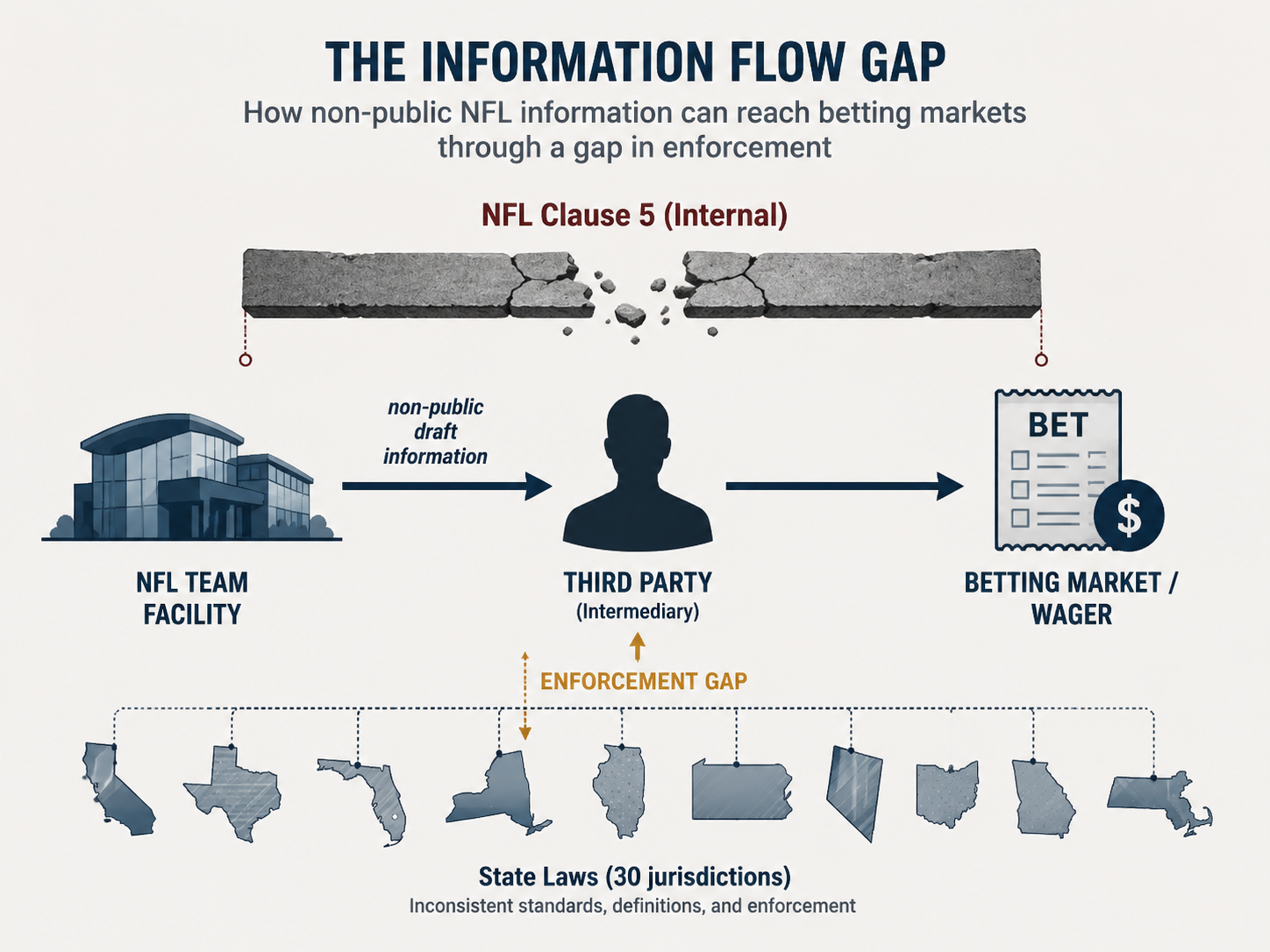
The NFL’s public statement frames Gold’s case as an internal gambling-policy matter. It confirms the indefinite suspension and the appeal right, but it does not identify the third party, the sportsbook, the location of every wager, the dollar amounts, or whether any outside regulator referred the matter to law enforcement.[1] Those omissions are not incidental; they define the outer edge of what can responsibly be inferred.
What Clause 5 Actually Carries
The load-bearing rule is Clause 5 of the NFL Gambling Policy, which has been described as prohibiting league and club personnel from using or disclosing non-public information for gambling purposes.[2] That is the closest thing in the NFL system to an insider-information rule. It does not need a wager to be placed by the employee who discloses the information; the disclosure itself can be the policy problem if it is connected to gambling use.
The rule’s strength is practical rather than statutory. The NFL can condition employment and access on cooperation with its gambling policy. It can review devices it controls, interview personnel under league rules, discipline employees, and restrict future participation in league work. In Gold’s case, the allegation that some bets were placed from a team facility on an NFL-issued device is exactly the kind of fact that gives an internal investigation traction.[1]
But those tools should not be confused with public investigative powers. A league investigation is not a grand jury investigation. The NFL does not obtain wiretaps, execute search warrants, compel testimony from outside third parties in the same manner as prosecutors, or create criminal exposure merely by naming a policy violation. Its process can produce enough proof for workplace discipline while still falling short of what a state prosecutor or federal agent would need for a charge.
That is why the wording of the public announcement matters. The NFL did not say Gold fixed a game, manipulated player performance, bribed anyone, or coordinated with a betting ring. It said he disclosed non-public draft selections and placed prohibited bets.[1] Those facts can be highly material to a sportsbook or regulator. They still require a separate legal hook before they become a criminal case.
There is also a version-control problem. The full current NFL Gambling Policy for the 2025/2026 period has not been publicly released in the materials available here. Public analysis of Clause 5 relies on the 2022 policy text and secondary reporting.[2] That does not make the rule irrelevant; it does mean any close reading should avoid pretending that the public has the same policy file the league applied internally.
Draft Information Is a Particularly Bad Fit for Easy Legal Analogies
The draft is not a normal game market. A large, late-moving wager on a draft selection may reflect scouting judgment, rumor, social-media timing, sportsbook mispricing, or genuine non-public information. Legal Sports Report quoted SuperBook USA’s John Murray saying, “Almost every large bet you take on the draft is sharp,” a useful reminder that draft markets are structurally information-sensitive even when no one has broken a law.[2]
That feature complicates enforcement. If a bettor wagers that a team will draft a player because the market has moved, that is different from a club employee giving the bettor a selection before the round is announced. If a sportsbook limits or rejects draft bets because they look sharp, that is risk management. If a state rule prohibits a team employee from using confidential team information to place or assist a wager, that becomes a regulatory question. The same market movement can look different depending on who knew what, when they knew it, and how the information reached the bet.
Gold’s case, as publicly described, is therefore not merely another employee-betting story. The draft-selection allegation is the legally distinctive fact. A parlay on NFL and college games would already violate league restrictions for many personnel. The alleged transmission of non-public 2026 draft selections to a third party adds the harder question: whether the conduct only breached an employment-policy duty, or also violated a state gambling-law prohibition aimed at insider wagering.
State Law Is Where the Boundary Starts to Move
The absence of a federal sports-betting insider-trading statute leaves states to do much of the work. That produces a patchwork rather than a single national rule. The relevant question is not simply whether a state allows sports betting. It is whether the state permits draft wagering, how it defines prohibited participants, whether it covers confidential information, and what mental state or betting connection must be proved.
At least roughly 30 states permit draft wagering under varying insider-prohibition regimes, which means the legal treatment of the same information flow may turn on the forum.[3] A sportsbook account, a team facility, a bettor’s residence, a mobile device location, and the state where the market is offered may all matter. The public Gold record does not supply enough detail to map those contacts conclusively.
Arizona is the useful example because Gold worked for the Cardinals. Secondary reporting on Arizona HB 2772 describes the state as permitting draft wagering while requiring bets to be placed before “the earliest affected round” begins, and notes provisions that could reach insider betting by team employees.[3] That summary suggests a possible state-law concern, but it does not by itself establish that Gold, the third party, or any recipient bettor committed an Arizona offense.
The evidentiary questions would be basic and unforgiving. What exact information was disclosed? Was it accurate? Was it material to a posted market? Did the recipient bet or cause someone else to bet? Where was the bettor located? Did the applicable state rule cover that person and that event? Did the rule prohibit disclosure, use, wagering, or all three? A league can discipline on a broader internal standard. A prosecutor or regulator has to fit facts to a specific authority.
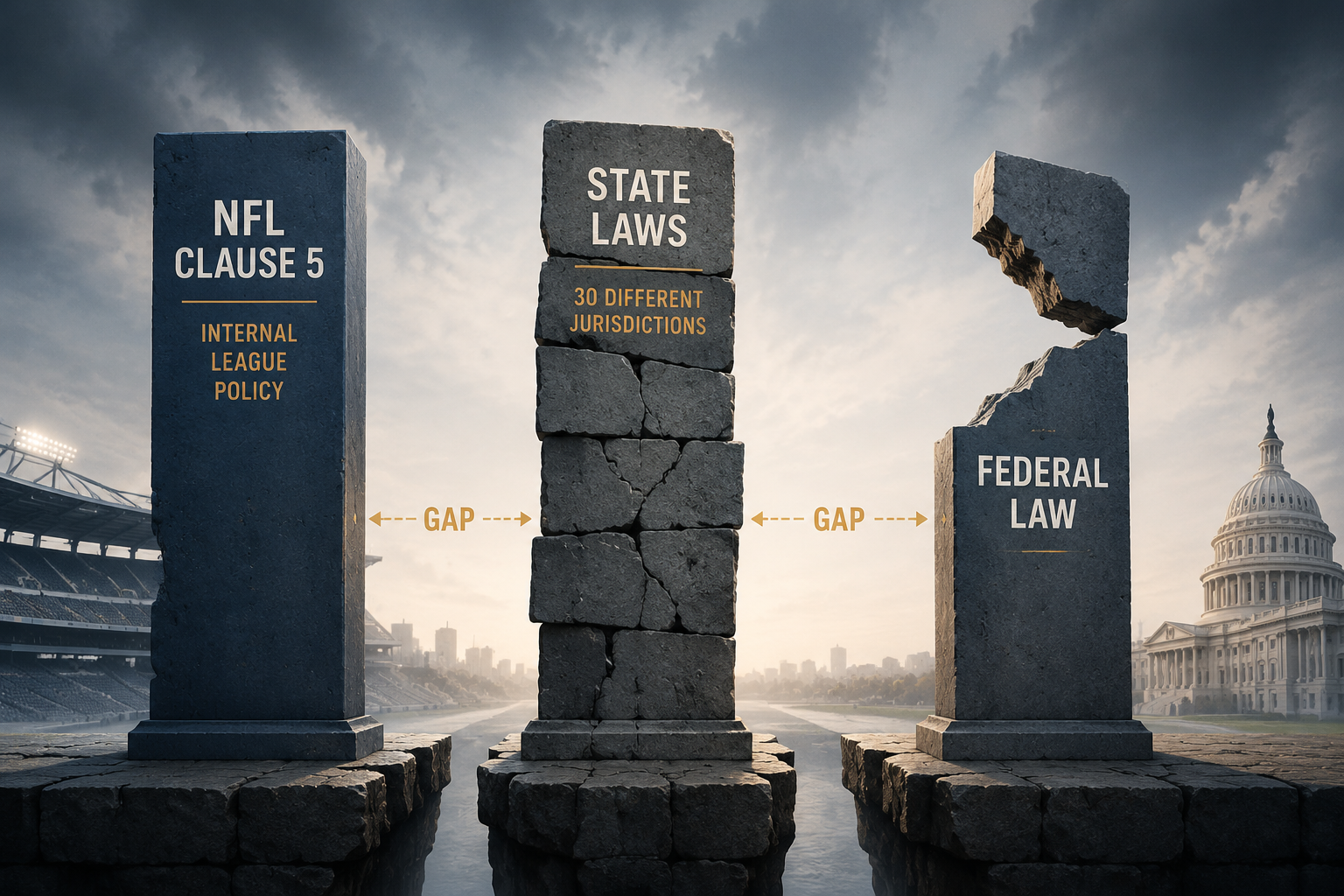
This is the same three-layer problem that appears across football gambling discipline: contract and employment obligations, league-policy enforcement, and possible public-law exposure. The broader framework is discussed in How a Single NFL Gambling Violation Triggers Three Legal Layers. Gold’s case is sharper because the alleged information was draft information rather than injury gossip or a direct wager on a team game by a player.
Why Porter Is the Right Comparison Only Up to a Point
The Jontay Porter case shows how sports-betting conduct can become a federal criminal matter, but it should not be flattened into the Gold fact pattern. Porter’s 2024 federal wire fraud conviction involved manipulating game performance to affect prop bets, including withdrawing early from games.[4] That is active event manipulation. Gold’s public allegations concern information sharing and prohibited betting, not manipulating a game or a player’s performance.
That difference matters for charging theory. A manipulation case can be built around deception affecting a betting market and the integrity of the sporting event itself. An information-sharing case may require a different route: a state insider-betting prohibition, a fraud theory tied to sportsbook terms and transmissions, a conspiracy theory if there are coordinated bettors, or no public charge at all if the proof stops at an internal-policy breach.
The 2025 federal indictments involving Terry Rozier and Chauncey Billups are a similar calibration point. Yahoo Sports described those NBA matters as a federal gambling probe that escalated beyond league self-policing in October 2025.[5] They show that law enforcement can enter sports-betting integrity cases when the alleged conduct, evidence, and jurisdictional hooks support it. They do not prove that every league gambling suspension is waiting to become a federal indictment.
No Public Federal Case Does Not Mean No Legal Risk
NBC Sports reported Gold’s suspension as the product of an NFL investigation, with no apparent FBI involvement or federal charge disclosed.[6] That is significant, but only in the negative sense. It tells us what is not publicly present. It does not tell us that outside authorities reviewed every underlying record, declined prosecution, or lacked jurisdiction.
The better inference is narrower: based on the public record, the NFL found enough to impose an indefinite internal suspension, while no public criminal case has been announced. Whether that remains an internal matter depends on facts that have not been released, especially the conduct of the third party and any bettor who may have used the draft information.
For compliance purposes, the risk is not limited to the person who clicks the wager button. If a club employee passes protected draft information to someone who then bets in a draft-legal state with an insider-use prohibition, the employee, recipient, bettor, and operator may each appear in a different part of the inquiry. The operator’s duties may include monitoring suspicious activity and reporting to regulators. The league’s duties may include protecting competitive integrity and enforcing employment restrictions. Those duties are related, but they are not identical.
The NFL’s Enforcement Record Adds Context, Not a Rule
Gold is not the first NFL gambling matter to raise questions about unequal visibility. Legal Sports Report has pointed to the 2022 Tom Brady unretirement betting incident as an earlier example used in debates over how the league treats insider-information concerns.[2] That episode is useful context for enforcement consistency, but it does not resolve Gold’s legal exposure because the alleged conduct and proof base are different.
The universe of non-player discipline is also larger than the public often sees. In 2024, Roger Goodell said the NFL had disciplined 25 league and team personnel for gambling-policy violations, beyond the 13 publicly named players discussed in the same reporting.[7] That statistic matters because front-office, scouting, medical, analytics, and football-operations personnel may hold market-moving information without ever appearing in a box score.
The public tends to understand player betting cases faster because the prohibited relationship is easier to see: the player participates in the event, or at least belongs to the competition. Personnel cases are messier. A scouting executive may not affect a game outcome, but may know a draft decision before the market does. A trainer may not bet, but may know an injury status before official release. A staffer may not intend to help a bettor, but may disclose information into a network that quickly becomes one.
Where Internal Discipline Ends
Gold’s suspension shows what the NFL can do without proving a public crime. It can treat non-public draft information as protected league information. It can prohibit disclosure for gambling purposes. It can bar bets by covered personnel, especially on NFL and college football markets. It can rely on device, facility, and employment-policy evidence. It can impose an indefinite suspension subject to whatever appeal mechanism applies to non-player personnel.[1]
What it cannot do is make “insider trading” a legal conclusion simply by using an insider-information rule. Securities insider-trading doctrine does not transfer wholesale to sports betting. Federal prosecutors may have fraud, conspiracy, wire, or other theories in a sufficiently developed case, as the NBA-related matters show, but there is no general federal sports-betting insider-trading statute that automatically covers a team employee’s misuse of draft information.
That leaves the state-law layer carrying more weight than it was designed to carry uniformly. Some jurisdictions may have rules broad enough to reach disclosure or use of confidential team information in draft markets. Others may focus on prohibited bettors, event participants, or operator controls. Some may permit the wager type but restrict timing. The result is not a clean national line between discipline and prosecution; it is a forum-specific inquiry.
The narrow conclusion is the safest one. The Gold case exposes a gap where league discipline, state gambling law, and federal criminal law do not line up neatly. The NFL’s label establishes the internal violation it chose to announce. Whether the same conduct becomes a regulatory case or a criminal prosecution depends on the facts, the recipients, the bets, the jurisdiction, and the authority willing and able to prove more than a policy breach.
References
- NFL suspends Cardinals personnel executive Ryan Gold indefinitely for violating league's gambling policy, NFL.com
- NFL Betting Insider Trading Rule, Legal Sports Report
- NFL suspends Cardinals scouting director for gambling policy violations, Gambling Insider
- Pro Athlete Sports Betting Penalties, SuperLawyers
- NBA's gambling scandal should terrify the NFL and commissioner Roger Goodell for one primary reason, Yahoo Sports
- NFL suspends Cardinals executive Ryan Gold indefinitely for gambling violation, NBC Sports
- NFL disciplined 25 league, team personnel for gambling policy violations, Roger Goodell says, Yahoo Sports
Comments
Join the discussion with an anonymous comment.