
The unusual part of Ryan Gold’s suspension is not only that the NFL made it indefinite. It is that the league paired that sanction with a limiting sentence: its investigation found “no reason to believe the integrity of any NFL game was affected.” Gold, then a personnel executive for the Arizona Cardinals, was suspended after the NFL said he shared confidential, non-public information about 2026 draft selections with a third party and placed multiple parlay bets on NFL and college football games, including bets made from the Cardinals’ facility and on an NFL-issued mobile device.[1]
That combination is the center of the legal problem. The league described conduct that sits close to the machinery of competitive trust: inside information, team premises, league equipment, football betting. But it did not say Gold altered a game, influenced a player, manipulated a roster decision for betting purposes, or caused a bet to be placed on the basis of a compromised game outcome. The sanction therefore reads less like punishment for proven competitive injury and more like discipline for a category of conduct the NFL views as intolerable because it threatens the credibility of the enterprise.

The Conduct Matters More Than the Label
“Indefinite suspension” is a broad label. In Gold’s case, the underlying conduct matters because it joins two different compliance concerns that are often blurred in public discussion. The first is information asymmetry: a front-office employee allegedly disclosed non-public draft-selection information to someone outside the organization. The second is prohibited betting: he allegedly placed multiple football parlays, including through league-linked access points.[1]
Those are serious violations if the facts are as stated. Draft information is commercially and competitively sensitive even when it does not decide the score of a game. A team employee using an NFL-issued device or team facility to bet also defeats one of the easier compliance lines to administer: no betting where the league can plausibly say its own systems, premises, or credentials were involved.
The NFL’s announcement says the investigation included interviews and review of electronic records.[1] That is not a full procedural record, but it is enough to show the league is presenting the case as an internal compliance investigation rather than a monitoring alert alone. The press release does not identify the third party who received the draft information, does not say whether that person placed bets, and does not disclose whether any betting market moved because of the information. Those omissions matter because they limit what can fairly be inferred from the league’s own account.
The narrower conclusion is still significant: the NFL is willing to use its most severe open-ended gambling sanction against a non-player executive even when it does not claim that a game itself was compromised. That is not the same as saying the discipline is irrational. It does mean the league is enforcing a risk model, not merely responding to demonstrated game harm.
Why Non-Player Personnel Are in a Different Policy Box
The post-2023 NFL gambling policy is not a single rule applied identically to everyone. Players operate under football-centered restrictions: no betting on NFL games, no sharing inside information, no betting at team facilities or while traveling with the team, no asking others to place bets, no entering a sportsbook during the season, and no daily fantasy football. Non-player personnel face a broader rule: they may not bet on sports at all.[2]
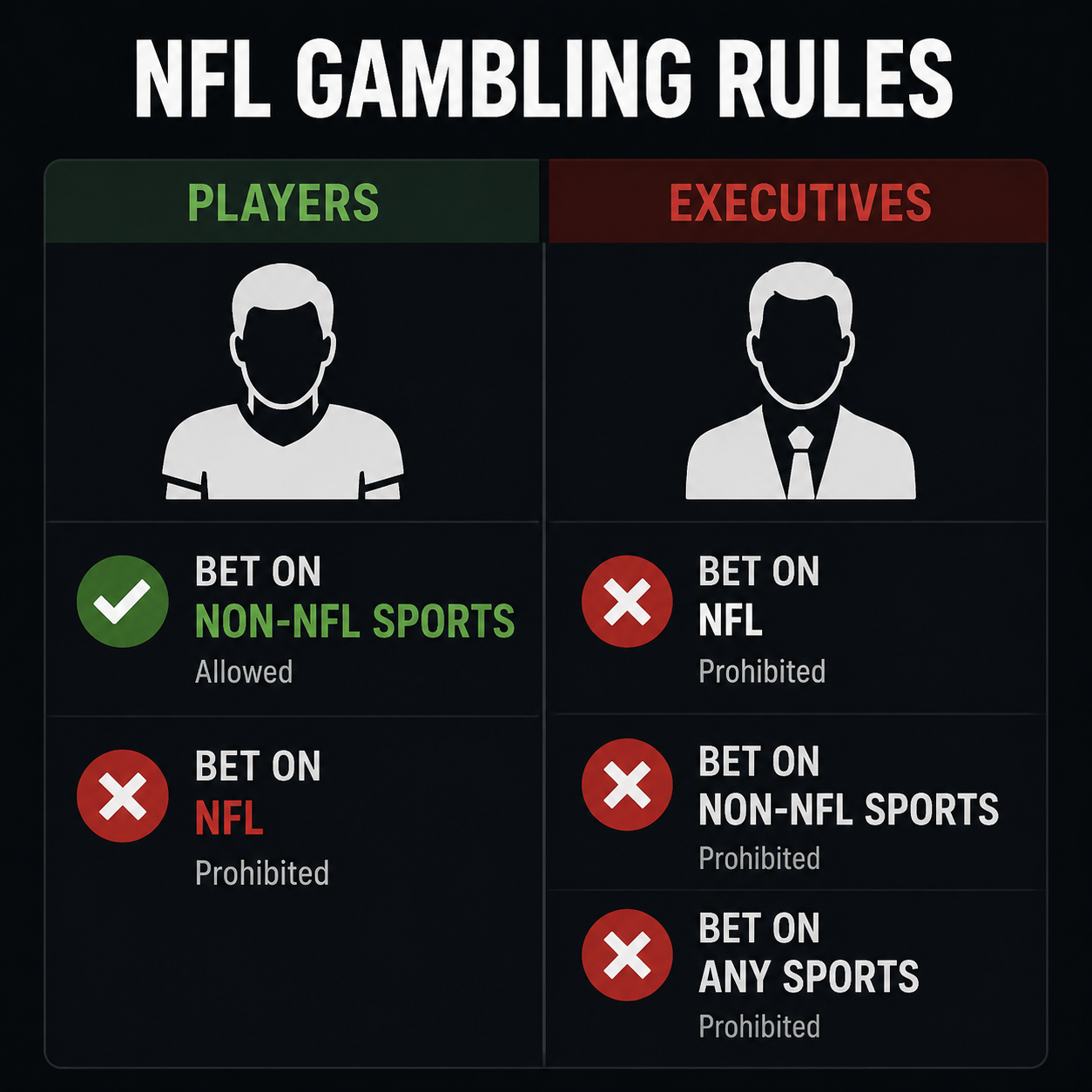
That asymmetry is not accidental. Players are covered by a collective bargaining relationship and by player-specific disciplinary structures. A front-office employee is closer to confidential team strategy, scouting evaluations, draft boards, injury analysis, and trade discussions, but farther from the NFLPA protections that shape player discipline. The league therefore has more room to frame the employee’s conduct as a workplace and integrity violation, but less public procedural architecture to point to when the sanction is challenged.
| Category | Policy posture described in available materials | Practical consequence |
|---|---|---|
| Players | May bet on some non-NFL sports, but may not bet on NFL games or use inside information, team facilities, team travel periods, sportsbooks during the season, proxies, or daily fantasy football. | The policy is centered on football integrity and player-specific access. |
| Non-player personnel | Subject to a blanket prohibition on sports betting. | The policy reaches beyond direct NFL game risk and into perception and institutional trust. |
Gold’s alleged conduct crosses both sets of concerns. If a player had placed NFL parlays from a team facility, that alone would trigger a serious policy problem. For a personnel executive, the inside-information allegation makes the case more structurally important. The executive is not merely a bettor subject to a rule; he is part of the information-control system the rule is designed to protect.
Integrity, Perception, and the Word the League Has to Choose Carefully
Sports leagues use “integrity” to cover more than one thing. At its narrowest, it means games are not fixed, manipulated, or influenced by betting interests. At a broader institutional level, it means fans, teams, media partners, regulators, and betting-market participants can believe the league’s outcomes are legitimate. Gold’s case falls in the space between those definitions.
The NFL’s own compliance leadership has acknowledged that some gambling restrictions are about perception rather than direct game integrity. In June 2023, chief compliance officer Sabrina Perel explained that limits on non-NFL betting for league personnel were tied to public perception concerns, not only to whether someone could affect the outcome of an NFL game.[3]
That admission does not prove that Gold’s suspension was pretextual or excessive. It does something more useful: it supplies the policy vocabulary needed to read the sanction accurately. If an executive with confidential draft access bets on football and shares non-public draft information, the NFL does not have to wait for proof that a game was corrupted before it acts. But if the league is disciplining perception risk, it should not silently borrow the moral force of game-fixing language unless the facts support it.
That distinction affects proportionality. A lifetime or indefinite exclusion for manipulating a game rests on one theory: the product itself was attacked. An indefinite suspension for leaking draft information and violating a betting policy rests on another: the employee created intolerable doubt about the controls around privileged information and football wagering. Both can justify serious discipline. They do not require the same proof, and they should not be defended with the same rhetoric.
The Procedure Is Doing More Work Than the Press Release Shows
As of July 19, 2026, Gold has not filed an appeal or received an appeal ruling. Any assessment of the next stage is therefore pre-appeal analysis, based on the NFL’s general disciplinary structure and prior litigation over commissioner authority, not on a Gold-specific appellate record.
That caution is necessary because the appeal posture for a front-office executive is less transparent than the one sports lawyers are used to seeing in player discipline. Player cases move against the background of the collective bargaining agreement, NFLPA representation, collectively bargained procedures, and a body of arbitration litigation. Non-player personnel may be bound by employment agreements, club policies, league constitutions, and incorporated gambling rules, but the public does not see the same negotiated procedural map.
The commissioner-centered model is familiar. NFL disciplinary authority for conduct detrimental has historically allowed appeal to the commissioner or a league-appointed designee, rather than to a fully independent adjudicator. Courts have been deferential to that model in player cases when it is grounded in collectively bargained arbitration. The best-known example is Brady v. NFL, where the Second Circuit upheld commissioner authority in the Deflategate discipline under the labor-arbitration framework.
Brady is relevant but not portable in a simple way. It tells us that courts can tolerate a league commissioner serving as a powerful disciplinary decision-maker when the parties bargained for that structure and the dispute is reviewed under deferential labor-arbitration standards. It does not answer, by itself, what process is owed to a non-player executive who lacks NFLPA representation and whose appeal rights may come from different documents. The league may still have strong contractual authority. The point is that the source of that authority matters.
A constitutional due-process claim would face a separate threshold problem. The NFL is a private league, not the government. Unless a challenger can plausibly connect the discipline to state action, the Constitution’s due process clause is not the natural vehicle. The more realistic questions are contractual, arbitral, employment-based, and procedural: Did the policy give intelligible notice? Was the evidence disclosed enough to contest it? Was there a meaningful opportunity to respond? Did the sanction track the risk the league actually identified?
Those questions are not technicalities. They are what allow a league to distinguish compliance discipline from public-relations discipline after the press release has already done its reputational work. If the NFL wants indefinite suspension to remain credible in a case without stated game compromise, the appeal process has to carry the weight that the announcement leaves out.
The Jontay Porter Comparison Has a Narrow Use
Jontay Porter belongs in this discussion only as a boundary marker. Porter’s NBA case involved federal wire-fraud charges tied to alleged game manipulation and betting schemes, a different legal theory from Gold’s league-discipline case.[4] Porter is useful because he shows what it looks like when the allegation is not only improper betting or inside information, but affirmative conduct connected to game outcomes.
Gold has not been charged criminally based on the available record, and the NFL has not said he affected a game. Treating the two matters as equivalent would flatten the legal analysis. The more precise comparison is this: Porter sits near the criminal manipulation end of the spectrum; Gold sits in the league-control zone of confidential information, prohibited betting, and institutional perception risk.
Information Leaks Are Not a Side Issue
The draft-information allegation should not be treated as an accessory to the betting allegation. In a legalized sports betting environment, confidential sports information can have value even when it does not concern play-calling or game effort. Draft intentions may affect betting markets, prediction markets, media markets, fantasy behavior, and commercial decisions around teams and players.
Academic sports-law commentary has long warned that sports “insider trading” does not map neatly onto securities law, even though the policy concern is familiar: people with privileged information can profit, or help others profit, before the market receives the information on equal terms.[5] Gold’s case is a practical version of that problem. The NFL does not need a Securities Exchange Act theory to discipline a team employee for misusing league or club information. It does, however, need to explain whether the information leak increased actual betting risk, market unfairness, internal governance risk, or public-perception risk.
The unidentified third party is therefore not a minor missing fact. Without knowing who received the information, whether that person bet, whether the information traveled further, or whether the leak intersected with any market, outside observers cannot measure the full harm. That does not prevent discipline. It does limit the confidence with which anyone can say the sanction was proportionate.
The Betting Market Explains the League’s Sensitivity
The NFL’s sharp response is easier to understand against the size of the market it now inhabits. The American Gaming Association estimated that $30 billion would be legally wagered on the 2025 NFL season.[6] That number does not prove that any individual violation affects a game, and it should not be used as a substitute for evidence in Gold’s case. It does show why the league treats betting-related perception as a business-critical compliance interest.
Legalized wagering creates a strange institutional posture for leagues. They benefit from betting engagement and commercial partnerships, while also policing the people whose access could make the market look unsafe. The more betting becomes part of the commercial environment around football, the less plausible it is for a league to respond only after a game is actually compromised. Compliance systems are built to stop earlier conduct: access misuse, proxy betting, facility betting, device misuse, and leaks.
The difficulty is that early intervention can look overbroad if the league does not separate its interests. Protecting the outcome of games is one interest. Protecting the credibility of confidential information controls is another. Avoiding headlines that imply insiders are betting from team facilities is a third. They overlap, but they are not identical. A serious disciplinary system can recognize all three without pretending they are the same.
The Enforcement Gaps Will Become Harder to Ignore
Gold’s case also exposes a less dramatic but important design problem: the farther the NFL’s gambling controls extend beyond players, the more uneven the procedural terrain becomes. League employees, club employees, consultants, contractors, agents, vendors, data partners, and family-adjacent intermediaries do not all sit in the same contractual relationship with the NFL.
One documented gap is agents. Available analysis has noted that the NFL does not have a written gambling policy for agents, even though agents may possess or receive sensitive information about players, injuries, negotiations, and team intentions.[7] That does not mean agents are unregulated in every respect, and it does not mean an agent could freely misuse confidential information without consequence. It does mean the policy map is less complete once the league moves outside the player and club-employee core.
Comparisons with other leagues should be handled cautiously because publicly available policy summaries may not capture later updates. As of the comparative materials available in 2023, the NBA, MLB, and NHL had different approaches to sports wagering restrictions, reflecting different judgments about who may bet, on what sports, and under what conditions.[7] That variation is useful not because another league has solved the problem, but because it shows that “integrity” rules are policy choices, not natural laws.
What Gold’s Case Precedent Actually Is
The Ryan Gold suspension is a precedent, but not for the proposition that every gambling violation by a non-player employee will merit indefinite exclusion. The facts the NFL chose to emphasize are too specific for that: confidential draft information, a third-party disclosure, football parlays, team-facility use, and an NFL-issued device.[1] A weaker case without inside information, league equipment, or football betting would not necessarily support the same sanction.
The stronger precedent is institutional. The NFL has now shown that it can impose severe discipline on a front-office executive for gambling-related conduct even while expressly declining to say any game was affected. That puts non-player personnel on notice that the league’s enforcement model reaches perception-threatening conduct, information-control failures, and prohibited betting environments before it reaches proven game compromise.
For compliance officers, the practical lesson is not to wait for the appellate fight. The policy needs to say which conduct is barred, which devices and locations create aggravating factors, how inside information is defined, what happens when third parties are involved, and what procedural rights exist after an investigation. Those details are not decorative. They are what make a severe sanction legible when the league’s own factual statement stops short of finding compromised games.
For lawyers advising regulated sports organizations, Gold’s case is also a reminder that private discipline can survive without constitutional due process and still face legitimacy problems if the process is opaque. Notice, evidence access, an opportunity to respond, and proportional sanctions are not only litigation defenses. They are the operating system for credible self-regulation.
The NFL may be able to defend Gold’s indefinite suspension on the facts it disclosed. But the more often it uses perception risk as a basis for severe discipline, especially against non-union personnel and other actors outside the player framework, the more pressure it will face to make the procedures and proportionality standards visible.
References
- NFL suspends Cardinals personnel executive Ryan Gold indefinitely — NFL.com
- NFL Gambling Rules 2024: Sports Betting for Football Players — Sportico, 2024
- Is NFL gambling policy protecting integrity or perception? — Yahoo Sports, June 2023
- Federal prosecutors exploring prediction market insider trading — CNN, March 30, 2026
- “If Only You Guys Knew What I Knew” — Marquette Sports Law Review
- AGA Estimates $30 Billion in Legal Wagering on 2025 NFL Season — American Gaming Association
- NFL Gambling Policy Can Benefit From Small Modification — Ifrah Law
Comments
Join the discussion with an anonymous comment.