
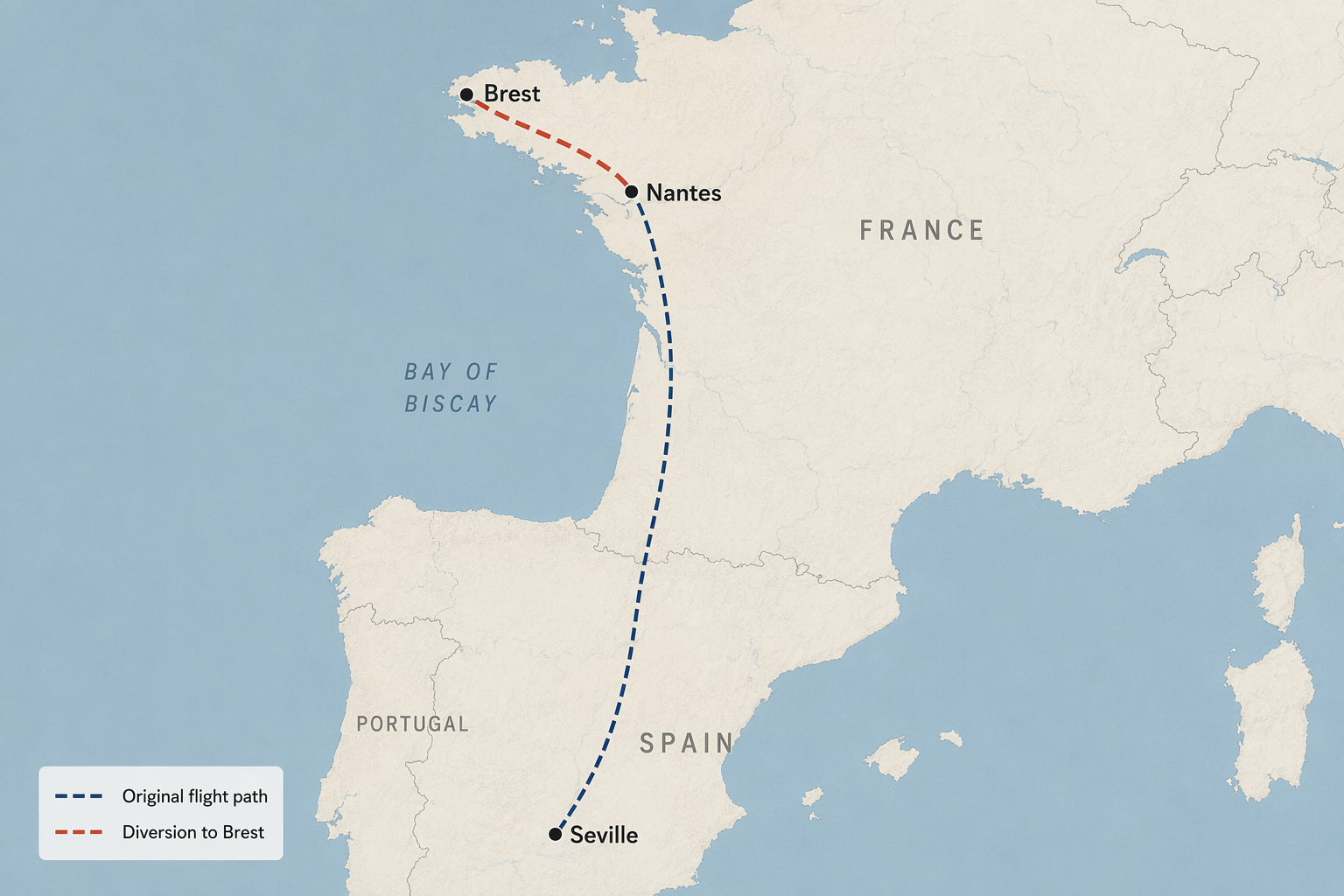
Ryanair FR5448 presents the kind of EU261 dispute that looks simple only if one stops at the first label. The Seville-to-Nantes flight was not delayed because Ryanair’s aircraft suffered a routine technical fault or because the carrier canceled for commercial reasons. It was disrupted after an Air Nostrum CRJ-1000 operating IB1222 suffered a tire-burst event at Nantes, leaving debris and reported significant wing damage and blocking the airport’s single runway for around four hours.[1][2][3] FR5448, a Ryanair Boeing 737-800 registered EI-EBK, then diverted to Brest after declaring “Mayday Fuel,” and passengers ultimately reached Nantes more than four hours late.[1][2]
That chain gives Ryanair a real defense argument. A runway blocked by another carrier’s emergency is not the airline’s own operational failure in the ordinary sense. But it does not end the legal inquiry. Under EU261, the question is not merely whether the first disruption was outside Ryanair’s control. It is also whether Ryanair can prove it took all reasonable measures to avoid the long delay once that disruption met its own flight planning.
Why the compensation question is live
The money at issue is not complex. Seville to Nantes is roughly an under-1,500 km intra-EU itinerary, placing the claim in the up-to-€250 compensation band when arrival at the final destination is delayed by at least three hours, subject to the carrier’s defenses.[4] The reported delay of more than four hours therefore clears the usual timing threshold if the passenger’s final destination was Nantes and no separate itinerary facts change the analysis.[1][2][4]
The more difficult question is not eligibility in the abstract. It is whether Ryanair can avoid payment by showing extraordinary circumstances and reasonable measures. Those two questions are often collapsed in public coverage. They should not be.
| Issue | What matters for FR5448 |
|---|---|
| Compensation trigger | A delay of at least three hours at Nantes on a sub-1,500 km route can place passengers in the €250 band. |
| Extraordinary circumstances | The runway closure resulted from another airline’s tire-burst emergency at Nantes, not from Ryanair’s own aircraft. |
| Reasonable measures | Ryanair still must show that its fuel, alternate, holding, and diversion planning left no reasonable way to avoid the compensation-triggering delay. |
| Missing evidence | The public record does not yet show departure fuel, landing fuel at Brest, dispatch assumptions, or Ryanair’s claim decisions. |
The runway blockage is Ryanair’s strongest fact
Nantes matters because it is a single-runway airport. Once IB1222’s tire-burst event left debris on that runway, arriving traffic had no second runway to absorb the disruption. Reports describe the closure as lasting about four hours, with the Air Nostrum aircraft sustaining very significant structural damage to the wing.[1][3] On those facts, Ryanair can credibly argue that the immediate airport unavailability was external, sudden, and operationally binding.
That is a serious point, not boilerplate. A carrier approaching a destination where the only runway has just been closed by debris from another airline’s emergency does not control the runway reopening time, the inspection process, or the airport’s traffic management decisions. If the defense were limited to identifying an external event, Ryanair would be in a strong position.
But EU261 defenses are not supposed to work by noun alone. “Runway closure,” like “weather” or “air traffic control,” describes the source of the disruption. It does not by itself prove that the operating carrier did everything reasonably available to reduce or avoid the passenger’s compensable delay.
Wallentin-Hermann keeps the fuel decision in play
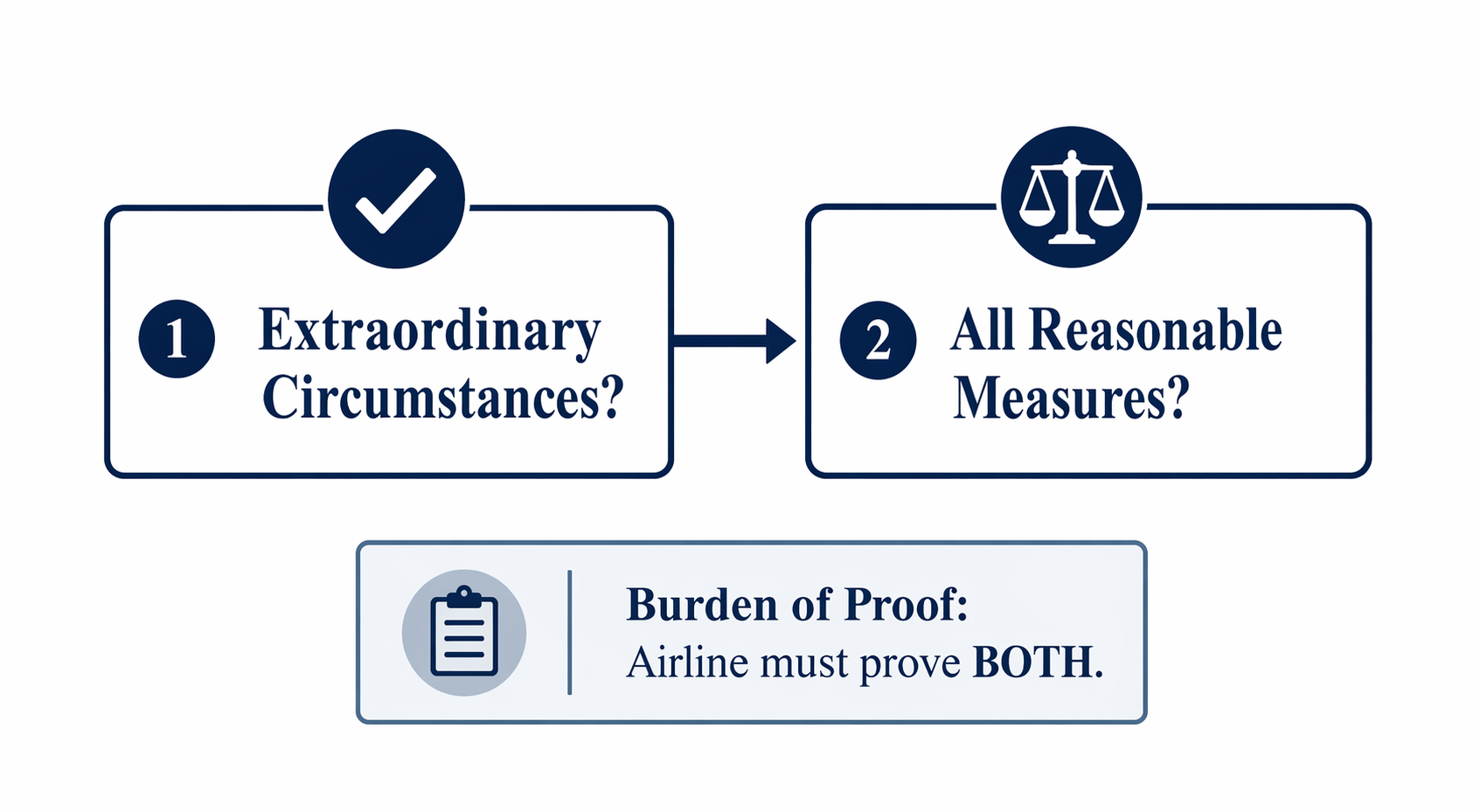
The controlling hinge is the CJEU’s approach in Wallentin-Hermann. The airline must show not only that the event was extraordinary, but also that the cancellation or long delay could not have been avoided even if all reasonable measures had been taken.[5] That second burden is where FR5448 becomes legally uncomfortable for Ryanair.
Ryanair’s public position, as reported, is that the aircraft’s fuel remained above final reserve fuel and complied with applicable regulatory requirements.[2] That statement deserves to be taken seriously. A Mayday Fuel declaration is not proof that an aircraft was “nearly out of fuel,” and phrasing the event that way risks turning a safety communication into a damages argument. Final reserve fuel has a specific operational function; remaining above it is not a trivial fact.
Still, regulatory fuel compliance and EU261 reasonable measures are not identical inquiries. A flight can be dispatched legally and still leave a court or claim body with questions about whether the airline’s planning choices were reasonable in the particular disruption. For FR5448, the relevant question is narrower than a broad attack on Ryanair’s fuel culture: given a scheduled arrival into a known single-runway destination, what contingency assumptions did dispatch use, what alternate planning was selected, how much holding was available, and when did Brest become the operationally necessary choice?
The distinction matters because Ryanair’s statement answers one allegation more cleanly than another. It is a strong answer to loose claims that the aircraft ran out of fuel. It is a weaker answer to the EU261 question if the passenger argues that the aircraft carried too little margin to wait, sequence, or divert without producing a delay over the compensation threshold. The available public facts do not prove that argument. They make it a live evidentiary issue.
What a claimant would need to test
A serious passenger claim would not rest on the words “Mayday Fuel” alone. It would press for the operational record behind the diversion. The most probative materials would be ordinary aviation documents, not commentary about the airline’s reputation.
- Actual fuel on departure from Seville and fuel remaining on landing at Brest.
- The operational flight plan, including destination, alternate, contingency, and reserve assumptions.
- The time at which the crew learned Nantes was unavailable and the expected reopening information then available.
- Holding time available before diversion became necessary.
- Why Brest was selected and whether any other operationally reasonable option could have reduced the final arrival delay.
- Ryanair’s EU261 claim-handling position, including whether it denies compensation solely on extraordinary circumstances or also addresses reasonable measures.
Those facts would also protect Ryanair if its planning was robust. If the record shows that the aircraft departed with ordinary and reasonable contingency fuel, that Nantes became unavailable only when the flight was already constrained, and that Brest was the safest practical diversion, the extraordinary-circumstances defense becomes much harder to dislodge.
The Mayday label helps neither side as much as it first appears
A Mayday Fuel declaration is operationally important. It tells air traffic control that the aircraft needs priority because available fuel has reached a state where further delay cannot be accepted. Reports indicate FR5448 declared Mayday Fuel and squawked 7700 before diverting to Brest.[1][2] That is enough to explain why passengers and observers treated the event as serious.
It is not enough to decide legal liability. For passengers, the declaration supports the inference that fuel planning and diversion pressure are central to the case, rather than a peripheral safety detail. For Ryanair, the declaration can be consistent with a disciplined safety decision made while still above final reserve fuel. Neither inference substitutes for the underlying fuel data.
This is where some public framing overreaches. “Fuel emergency” is a fair description of the declaration. “Nearly ran out of fuel” is a much heavier factual claim unless supported by independently verified fuel quantities. The public materials identified so far do not provide that independent number.
The May 2026 fuel-cost statement is useful, but not controlling
One recent EU signal belongs in the background, not at the center. In May 2026, EU Transport Commissioner Apostolos Tzitzikostas stated that airlines still had to pay compensation where flights were canceled because of a fuel crisis, and that fuel-price-driven cancellations did not automatically qualify as extraordinary circumstances.[6] That statement was made in the context of fuel-price pressures, not a third-party runway blockage at Nantes.[6]
Its relevance to FR5448 is therefore analogical. It reinforces the point that cost-driven or internally managed operational constraints should not be relabeled as extraordinary simply because they involve fuel. It does not answer whether an unrelated airline’s tire-burst event closing a single runway was extraordinary. Nor does it establish that Ryanair’s fuel load was unreasonable.
That limited use is enough. The legal pressure on Ryanair does not come from the Commissioner’s statement alone. It comes from the combination of a qualifying passenger delay, a safety-significant fuel declaration, a destination whose single runway was unavailable, and a CJEU burden that requires proof of reasonable measures even after an external event is shown.
Historic fuel-policy disputes should not carry this case
Ryanair’s past public controversies over fuel policy may tempt claimants to widen the frame. There is reporting on earlier disputes, including Ryanair threatening legal action after a documentary about its fuel policy and safety.[7] But the available materials do not provide a final public judgment that would decide FR5448’s fuel-planning question.
For litigation or claims handling, that history is a weak substitute for the dispatch record. A decision-maker is more likely to care about what fuel FR5448 actually carried, what the crew knew when Nantes closed, and whether Ryanair had any reasonable way to avoid a more-than-three-hour arrival delay. Generalized suspicion may explain why the case attracts attention; it does not prove the EU261 elements.
Current exposure assessment
As of July 20, 2026, the public record is still thin. The incident is only fourteen days old. There are no cited BEA findings in the available materials, no confirmed passenger lawsuits or class actions, and no public disclosure showing whether Ryanair has paid or denied FR5448 EU261 claims. That absence should be treated as procedural silence, not exoneration or liability.
Passengers have a viable claim because the reported final-arrival delay exceeds the compensation threshold and because Ryanair’s defense must satisfy the reasonable-measures burden, not merely point to the Air Nostrum runway closure. Ryanair has a plausible extraordinary-circumstances defense because the immediate airport unavailability appears to have been caused by an unrelated carrier’s emergency at a single-runway airport. The defense is not secure unless Ryanair can prove that its fuel and diversion planning met the Wallentin-Hermann standard.
References
- Ryanair flight FR5448 to Nantes is declaring an emergency due to low fuel, AirLive.
- Fuel Emergency: Ryanair Boeing 737 Diverts After Iberia Jet Blocks Nantes Runway, Simple Flying.
- Air Nostrum Tire Burst: Nantes FOD Runway Closure, FOD News.
- Air passenger rights, Your Europe.
- Fuel Shortage as Extraordinary Circumstance Under EC261, Flyclaimer.
- Airlines still have to pay compensation if flights cancelled due to fuel crisis, EU says, The Guardian, May 2026.
- Ryanair threaten legal action after documentary on fuel policy, safety, Wikinews.
Comments
Join the discussion with an anonymous comment.