
Jennifer Quijano’s July 15, 2026 guilty plea was the third in the Sam Nordquist torture-murder case, a prosecution involving seven charged defendants and a record that included TikTok communications, cell phone data, motel surveillance, and witness statements.[1] Earlier pleas by Patrick Motyka on June 2 and Precious Arzuaga on June 26 had already moved the case away from the posture of a single trial narrative and toward a scattered set of admissions, evidence files, and remaining defendants.[1][2]
There is no verified public record tying the Nordquist investigation to an AI tool. That boundary matters. The case is useful here for a narrower reason: it shows the kind of ordinary modern criminal file in which digital evidence can come from several platforms, devices, cameras, and witnesses before lawyers ever see a discovery index. The tracking question raised by cases like Nordquist is not whether this case secretly used AI. It is whether the justice system now has a reliable way to know when similar evidence streams were collected, filtered, searched, summarized, or prioritized by AI before they reached court.
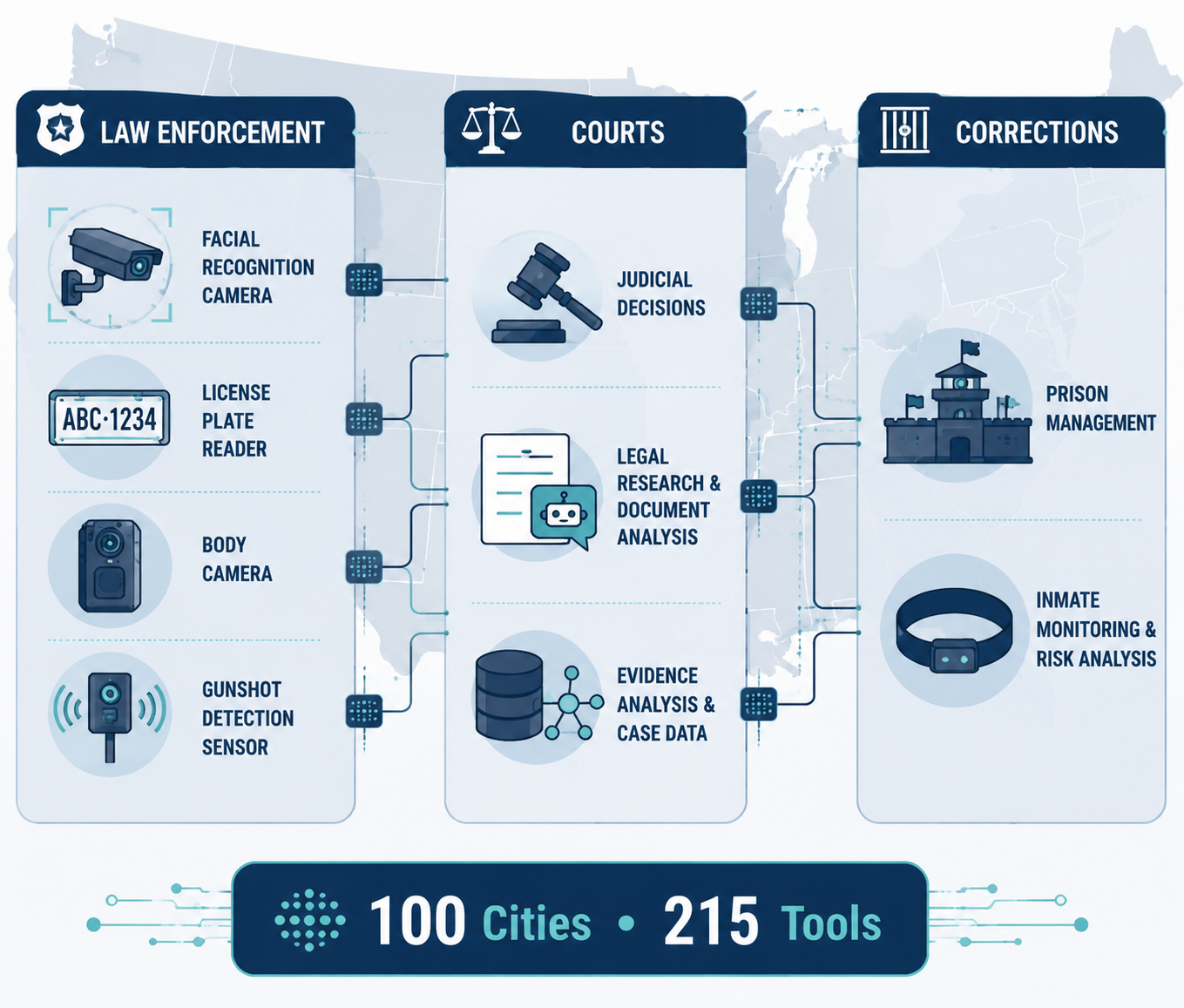
That is where the Justice and AI Tracker, or JAI-T, is more than a technology map. The Georgetown Evidence for Justice Lab project has documented 215 distinct AI tools across law enforcement, courts, and corrections in the 100 largest U.S. cities.[3][4] The database does not say that every digital-heavy case contains AI. It says something more concrete and harder for legal professionals to ignore: AI tools are already present across the institutions that generate, manage, and adjudicate criminal cases.
The evidence file is no longer just a file
A criminal defense lawyer looking at a discovery production may see a surveillance clip, a phone extraction report, a license plate hit, a body-camera video, or a transcript. What may be less obvious is whether an automated system helped select that clip, flag that plate, review that footage, translate that audio, rank that lead, or route that record to an investigator.
The Nordquist case, as publicly reported, involved digital communications and surveillance evidence, but not reported AI use.[1] That distinction should not make the tracking problem feel remote. It should make it feel procedural. If AI is disclosed only when someone knows to ask, and if agencies do not maintain public or litigable inventories, the first person forced to reconstruct the system may be a defense attorney working backward from a discovery packet.
That is why a tool inventory matters even when it does not prove misconduct. It changes the first question from “Could AI be involved?” to “Which agencies in this jurisdiction use which tools, for which functions, and under what rules?” For more on the discovery side of that same problem, Lex Machina Review has separately examined AI discovery and Brady compliance in the Sam Nordquist case.
What JAI-T actually tracks
JAI-T’s most important contribution is not that it gives AI in criminal justice a single label. It does the opposite. It separates tools by justice sector and use case, which is exactly what lawyers, court administrators, and procurement officials need before they can make any serious oversight judgment.[3][4]
| Tracked dimension | Why it matters legally and operationally |
|---|---|
| Justice sector: law enforcement, courts, or corrections | The same AI label can describe an investigative tool, a court administration tool, or a supervision tool, each with different disclosure, procurement, and due process implications. |
| Use case: what the tool is doing | A facial recognition search, a gun detection alert, an ALPR scan, and a public-facing chatbot do not raise the same evidentiary or administrative questions. |
| Deployment location | City-level tracking helps practitioners see whether a tool is part of a local agency’s ordinary workflow rather than a hypothetical future adoption. |
| Tool identity | Knowing a product or system exists is the first step toward asking about validation, vendor terms, human review, audit logs, and error handling. |
The dominant categories identified through JAI-T reporting include facial recognition, gun detection, automatic license plate readers, body camera footage review, and non-evidentiary AI such as public-facing chatbots.[5] That list is worth reading slowly. Some tools sit close to evidence creation or lead generation. Others may shape access to court information or public services without becoming trial exhibits. A chatbot that gives court users procedural information is not the same legal object as a facial recognition search used to identify a suspect.
The rarer examples widen the field without defining it. JAI-T materials and related discussion have pointed to deployments such as jury chatbots and autonomous police vehicles, including in Miami-Dade.[3][5] Those are eye-catching, but they are not the center of gravity. The routine tools are more likely to appear in the path of ordinary cases: a camera feed reviewed at scale, a license plate database queried before a stop, a body-camera archive searched before a charging decision, or an agency chatbot answering a courthouse visitor.
Visibility, however, is not accountability. An inventory can tell a lawyer that a category of tool exists in a city. It does not necessarily disclose the vendor contract, the training data, the model version, the confidence threshold, the audit history, the human reviewer’s role, or whether a particular case file passed through the system. JAI-T narrows the information gap, but it does not by itself create a duty to explain.
The city map is not the whole map
The Department of Justice’s own AI inventory reinforces the point that AI adoption is not confined to local police departments or municipal courts. DOJ reported 315 documented AI use cases in its 2025 inventory, updated January 30, 2026, reflecting a 30.7% year-over-year increase.[6] That figure measures documented use cases across the department; it should not be confused with evidence that every use case is deployed in criminal prosecution or that every use case affects defendants.
Still, the federal inventory matters because it shows institutional adoption moving faster than the public conversation tends to admit. City agencies, federal agencies, courts, and corrections systems are not waiting for a single national AI statute to tell them whether to experiment. They are buying, piloting, adapting, and cataloging tools under existing procurement rules and agency policies.
For lawyers, the practical consequence is uneven visibility. A DOJ use case may appear in a formal federal inventory. A city tool may appear in JAI-T. A county-level deployment, a vendor add-on, or a local workflow automation may be much harder to find. That unevenness is where constitutional litigation, public records work, procurement review, and courtroom disclosure obligations begin to overlap.
The oversight layer is serious, but mostly advisory
The governance materials that emerged around criminal justice AI in late 2025 and 2026 should not be dismissed as window dressing. They are careful attempts to impose sequence and vocabulary on a field that often hides inside procurement categories. The problem is that they largely remain guidance.
The Council on Criminal Justice’s National Task Force on Artificial Intelligence released guiding principles on October 30, 2025, followed by a User Decision Framework in March 2026.[7][8] The framework is useful because it treats AI adoption as a workflow rather than a press release. Agencies are asked to define the problem, classify the tool, evaluate procurement, plan implementation, and monitor performance over time.[8]
| CCJ phase | The question a legal professional should hear inside it |
|---|---|
| Problem definition | What institutional problem is the tool supposed to solve, and is AI necessary for that task? |
| Classification | Is the tool evidentiary, investigative, administrative, supervisory, or public-facing? |
| Procurement | What did the agency require from the vendor before purchase, including explainability, validation, audit access, and data protections? |
| Implementation | Who uses the tool, who reviews outputs, and what happens when the tool is wrong or unavailable? |
| Monitoring | How will the agency test performance after deployment, detect drift, document errors, and decide whether to continue use? |
That sequence is practical because it puts responsibility before deployment and after launch. Many AI policies lean heavily on procurement promises, as if the hard part ends when the contract is signed. In criminal justice, the harder questions often arrive later: after a tool has become routine, after staff turnover, after a vendor update, after a defendant asks how an investigative lead was generated, or after a court employee has to explain a system no one trained them to audit.
Stanford Law’s March 2026 policy lab white paper took a more institutional route. It concluded that “AI capabilities and products are being deployed without sufficient understanding of how they work” and recommended a dedicated AI governance entity built around startup feasibility, expertise, transparency, stability, influence, and responsiveness.[9] That proposal recognizes a problem that individual judges, line prosecutors, public defenders, and court clerks cannot solve case by case: no single hearing can substitute for a standing institution that can evaluate systems before and after they enter public use.

The ABA/NAPCO guardrails, published in 2026, push the conversation toward familiar legal pressure points: transparency and explainability, independent validation, human oversight, ethical procurement, and continuous review.[10] Their value is not that they invent new courtroom instincts. It is that they connect AI governance to doctrines and rules lawyers already use when evidence or witness confrontation is at stake, including Daubert, Frye, Rule 702, Crawford, and Brady.[10]
Those references matter because AI rarely arrives in court wearing a clean label. It may appear as a forensic method, an investigative lead, a risk assessment, a transcript, a translation, a summary, a records search, or a tool that shaped what the government preserved and produced. Existing doctrine gives lawyers places to press: reliability, confrontation, expert foundation, exculpatory disclosure, and the scope of human review. But pressure points are not the same as a comprehensive inventory requirement.
Where the gap remains
The uncomfortable part is not that agencies are using AI. Police departments, courts, and corrections systems have always adopted technologies before appellate doctrine catches up. The more immediate problem is that deployment can become operationally normal before it becomes publicly legible.
JAI-T helps with legibility. It gives practitioners a starting map across the 100 largest U.S. cities and identifies 215 tools that would otherwise be scattered across contracts, agency pages, vendor materials, meeting minutes, and public records requests.[3] But a map does not answer whether a tool was validated for a local population, whether its error rates were measured after deployment, whether staff were trained to challenge outputs, whether defense counsel received adequate notice, or whether a court administrator can suspend use when performance changes.
This is also where adoption and effectiveness have to stay separate. A database entry shows that a tool has been identified. A DOJ inventory entry shows a documented use case. A governance framework shows that expert groups have articulated principles. None of those facts proves that a tool works as marketed, that it improves justice outcomes, or that it has been tested against the legal burden it may eventually affect.
For legal teams, the current posture is investigative. Ask whether the relevant agency uses facial recognition, ALPR, body-camera review software, gun detection, transcription, translation, summarization, risk scoring, or public-facing AI. Ask whether the tool appears in JAI-T, a federal inventory, a procurement file, or an agency policy. Ask who reviewed the output and whether logs, thresholds, prompts, confidence scores, vendor documentation, or validation records exist. In criminal cases, those questions may be discovery questions before they become admissibility questions.
The broader tracking problem has started to surface across very different criminal justice contexts, including cases where AI’s role may be evidentiary, administrative, or simply hard to rule out. Lex Machina Review has covered similar tracking concerns in Kamar Williams Missing Twins Update Exposes Legal AI Tracking Gaps and related admissibility issues in AI Evidence and Criminal Charges for Fatal Reckless Driving.
The Nordquist pleas are not evidence of AI use. They are a reminder of the kind of case file now moving through the system: digital, fragmented, and dependent on tools most outsiders cannot easily see. JAI-T makes the scale of criminal justice AI more visible. Visibility is not governance. Until advisory frameworks are tied to enforceable procurement, disclosure, validation, and monitoring duties, lawyers and court staff will keep tracking AI’s presence faster than institutions are required to explain it.
References
- Third defendant Jennifer Quijano pleads guilty in Sam Nordquist murder case, 13WHAM, July 15, 2026
- Precious Arzuaga pleads guilty in Sam Nordquist murder, Democrat & Chronicle, June 26, 2026
- Justice and AI Tracker, Justice and AI Tracker
- Justice and Technology Initiative, Georgetown Evidence for Justice Lab
- Promise & Peril of Justice AI, Harvard Data-Smart City Pod, April 22, 2026
- DOJ AI Inventory, U.S. Department of Justice, January 30, 2026
- National Task Force on Artificial Intelligence Releases Guiding Principles for the Use of AI in Criminal Justice, Council on Criminal Justice, October 30, 2025
- Assessing AI for Criminal Justice: A User Decision Framework, Council on Criminal Justice, March 2026
- AI in Criminal Justice: Why Governance Matters and How to Make It Work, Stanford Law School, March 27, 2026
- AI in the Criminal Courts: Balancing Innovation and Justice, NAPCO/ABA, April 2026
Comments
Join the discussion with an anonymous comment.