
As of July 19, 2026, the Sara Duterte impeachment trial is no longer a prospective 2027 story. It is an active Senate impeachment proceeding, now on Day 7, with a trial plan that carries it into Q1 2027 if the approved calendar holds. The Senate impeachment court began trial on July 6, approved 92 trial days, and is proceeding on a Monday-to-Wednesday schedule: 62 days for the prosecution and 30 for the defense.[1][2]
That calendar matters because the legal consequence at the end is not only removal from the vice presidency. Under Article XI of the 1987 Philippine Constitution, conviction in an impeachment case can also carry permanent disqualification from holding public office. For Duterte, who remains a central figure in the 2028 presidential field, the trial’s timing and the Senate’s vote-count rule are now part of the legal merits of the moment, not just scheduling details.[3]

| Current Procedural Point | Status on July 19, 2026 |
|---|---|
| Senate trial | Ongoing; trial opened July 6, 2026.[1] |
| Trial day | Day 7, based on the approved Monday-Wednesday trial schedule and current date.[2] |
| Approved trial calendar | 92 trial days: 62 prosecution days and 30 defense days.[2] |
| Projected endpoint | Q1 2027, according to reported prosecution and Senate-calendar projections; not a fixed constitutional deadline.[2][3] |
| Unresolved threshold issue | Whether conviction still requires 16 votes from a 24-member Senate, or whether a reduced denominator can apply because three senator-judges are unavailable. |
| 2028 consequence | Permanent disqualification depends on conviction and on how the timing question is later resolved. |
Lex Machina Review does not usually live in Philippine constitutional politics. This proceeding belongs here because it is a live comparative-procedure case study: a constitutional text that looked administrable on paper is being forced to answer filing-trigger, calendar, quorum, and penalty questions in real time.
The Legal Timeline So Far
| Date or Period | Procedural Event | Why It Matters |
|---|---|---|
| December 2024 | Three impeachment complaints were filed by Akbayan, militant groups, and religious leaders.[4] | The Supreme Court later treated filing, not House action, as the event that triggers the constitutional one-year bar.[5] |
| February 5, 2025 | The House fast-tracked the first impeachment through 215 votes, with no negative votes, and transmitted the articles to the Senate within hours.[4] | The speed of the House action became less important than the earlier filing dates once the Supreme Court ruled on the one-year bar. |
| July 2025 | The Supreme Court, sitting en banc, nullified the first impeachment in Duterte v. House of Representatives.[5] | The Court held that Article XI, Section 3(5)'s one-year bar is triggered by complaint filing and that due process applies at all stages of impeachment.[5] |
| January 28, 2026 | The Supreme Court denied reconsideration with finality and clarified that 'session days' means calendar days on which the House actually holds session.[5] | That clarification shaped the corrected House process for the next impeachment attempt. |
| February 23-May 11, 2026 | Four new complaints proceeded through House Committee on Justice hearings, answer periods, clarificatory hearings, and witness testimony.[4][6] | The second impeachment was built to avoid the procedural defects that had undone the first. |
| May 2026 | The House Committee on Justice found probable cause by a 53-0 vote, and the plenary later approved the second impeachment by 257-25-9.[4][6] | The vote sent the case back to the Senate with a procedurally more developed record. |
| July 6, 2026 | The Senate impeachment trial began.[1] | The proceeding moved from House accusation to Senate adjudication. |
| July 2026-Q1 2027 | The Senate impeachment court approved 92 trial days, with reported completion projected into Q1 2027.[2][3] | The projection places any conviction and disqualification question close enough to the 2028 election cycle to make timing legally consequential. |
Why the First Impeachment Failed
The first impeachment is easy to misread if the story begins with the House vote. On February 5, 2025, 215 House members voted to impeach Duterte, with no negative votes, and the articles were transmitted to the Senate within hours.[4] That looked, procedurally, like the decisive act. The Supreme Court later said it was not the constitutional starting point that mattered most.
Article XI, Section 3(5) of the 1987 Constitution bars the initiation of impeachment proceedings against the same official more than once within one year. The dispute was over the verb. Did proceedings begin when the House acted? Or did they begin when the earlier complaints were filed? In July 2025, the Supreme Court answered that question unanimously: filing triggered the one-year bar.[5]
That holding made the December 2024 complaints legally operative. Because complaints had already been filed by Akbayan, militant groups, and religious leaders, the February 2025 fast-track action fell inside the one-year prohibition as the Court understood it.[4][5]
The Court’s second holding is just as important for the present trial: due process, or fairness, applies during all stages of the impeachment process.[5] That does not convert impeachment into an ordinary criminal trial. It does mean the House cannot treat impeachment as a purely political channel immune from timing rules, notice, answer periods, and procedural fairness.
When the Court denied reconsideration with finality on January 28, 2026, it also clarified that 'session days' means calendar days on which the House actually holds session.[5] That clarification narrowed another ambiguity. The next House process would have to be slower not because caution was politically attractive, but because the Court had made timing part of constitutional validity.
The Second Impeachment Was Built Around the Supreme Court Ruling
The second impeachment, running from February 23 to May 11, 2026, was not simply a reprise with larger numbers. Four new complaints moved through the House Committee on Justice with notice, answer periods, clarificatory hearings, and witness testimony.[4][6] Those procedural steps are not decorative after Duterte v. House of Representatives. They are the architecture that makes the second impeachment different from the first.
The Committee on Justice found probable cause by a 53-0 vote. The House plenary then approved impeachment by 257 votes in favor, 25 against, and 9 abstentions.[4][6] The larger number does not answer the merits. It does, however, show that the House rebuilt the process through a committee record before asking the Senate to sit as an impeachment court.
For an international reader, the division of labor is important. The House impeaches; it does not remove. Its vote functions like a constitutional accusation. The Senate tries the case. Removal and disqualification can occur only after Senate conviction under Article XI.
What the Four Articles Allege
The articles of impeachment carry serious allegations, but the trial’s legal roadmap does not require treating each allegation as already proven. At this stage, they identify the charges the Senate must hear and the evidentiary lanes the prosecution has chosen.
| Article | Allegation | Procedural Significance |
|---|---|---|
| Article I | Misuse of confidential funds, including ₱500 million in Office of the Vice President funds and ₱650 million in Department of Education funds.[4] | This is a documentary and accounting-heavy article likely to depend on fund releases, liquidation records, and witness explanation. |
| Article II | Unexplained wealth and SALN discrepancies, including AMLC reports showing ₱6.77 billion in covered and suspicious transaction reports from 2006 to 2025 across accounts linked to Duterte and Carpio.[4] | This article reaches the longest factual period and the most complex financial record. |
| Article III | DepEd bribery allegations, including the Madriaga affidavit, NBI forensic handwriting analysis, and PSA certification validation.[4] | This article turns on witness credibility and document authentication. |
| Article IV | Assassination threats against President Ferdinand Marcos Jr., First Lady Liza Araneta Marcos, and Speaker Martin Romualdez.[4] | The prosecution chose to present this article first, despite its numerical placement. |
The prosecution’s trial sequence is Article IV, then Article I, then Article III, then Article II.[7] That order is not numerically tidy. It appears designed to begin with the alleged threat conduct before moving into fund misuse, bribery, and the broader wealth allegations. The choice affects how senator-judges first encounter the case, but it does not change the constitutional vote required for conviction on any article.
The Senate Calendar Is Long, but Not Self-Executing
The Senate impeachment court’s approved 92-day calendar is the practical source of the Q1 2027 timeline. It allocates 62 trial days to the prosecution and 30 to the defense, with sessions set for Monday through Wednesday.[2] That makes Q1 2027 a projected completion window, not a constitutional deadline.
This distinction matters because trial calendars are vulnerable to witness availability, evidentiary disputes, interlocutory motions, and judicial intervention on threshold questions. The reported Q1 2027 endpoint should therefore be read as a working schedule approved by the Senate impeachment court, not as a guaranteed date on which the vice presidency or the 2028 race will be legally settled.[2][3]
There is also a witness-count uncertainty in the public record. The prosecution count of 57 witnesses is consistent in the available reporting. Defense-witness figures diverge, with one report describing 45 and another describing 96. The operative number should be checked against the Senate Pre-Trial Order before treating either figure as controlling.[2][7]
The Vote-Count Question Is the Trial’s Hardest Procedural Problem
Article XI, Section 3(8) requires conviction by the concurrence of two-thirds of all members of the Senate. In the ordinary 24-member Senate, that has meant 16 votes. The problem in this trial is that three senator-judges are unavailable: Senator Jinggoy Estrada is detained after a plunder conviction, Senator Ronald 'Bato' dela Rosa is reportedly hiding in connection with an ICC warrant, and Senator Rodante Marcoleta was arrested for plunder on July 3, 2026.[3][7]
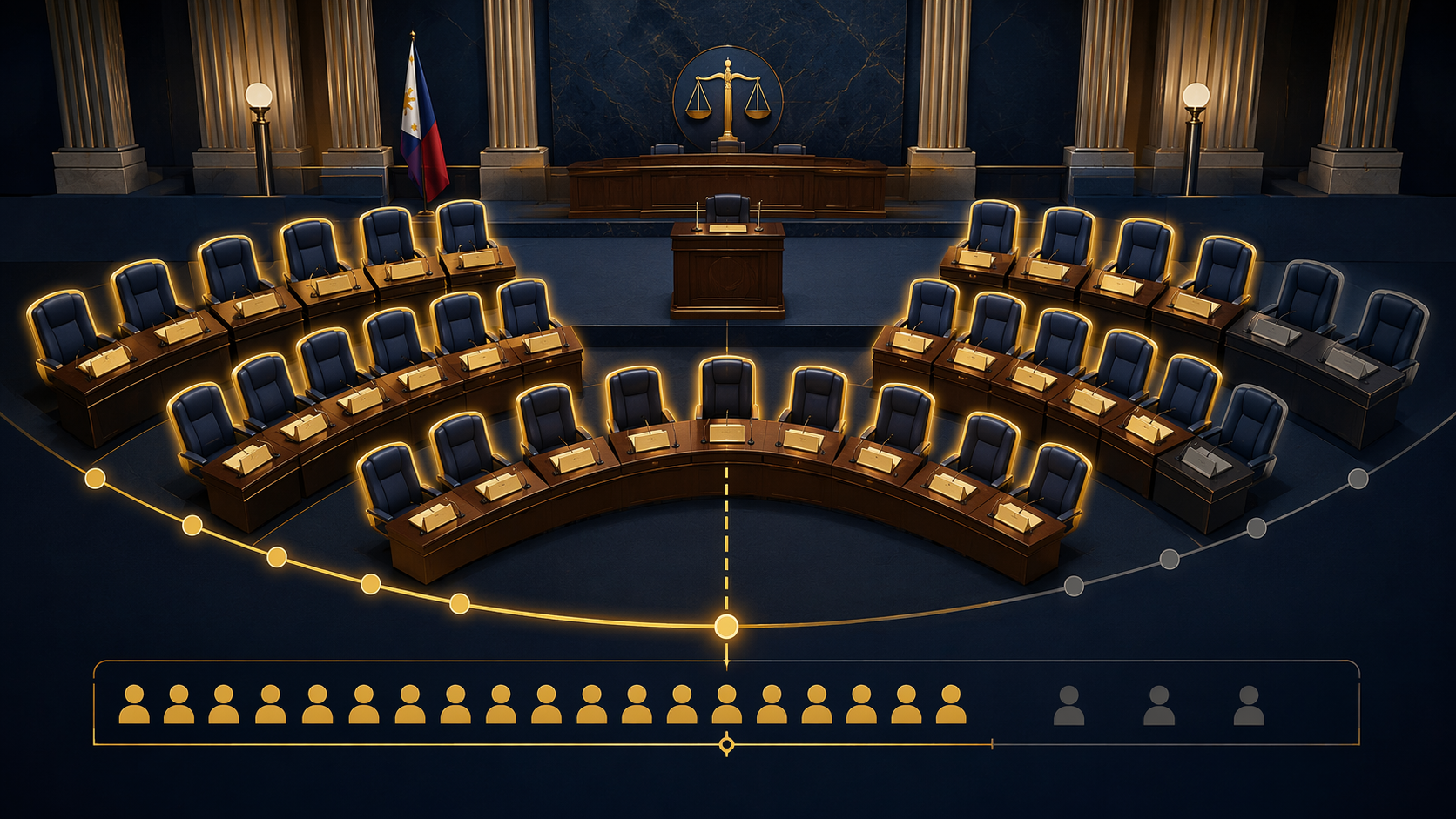
House prosecutor Representative Gerville Luistro has floated a reduced-threshold argument based on Avelino v. Cuenco, the 1949 doctrine associated with excluding members who are beyond the chamber’s coercive power from certain denominator calculations. Senate President Win Gatchalian has maintained that 16 votes are still required. A minority-bloc petition seeking Supreme Court clarification remains unresolved.[3][7]
That is the point at which arithmetic becomes constitutional law. If 'all members' means the full 24-seat Senate regardless of unavailability, the traditional 16-vote threshold controls. If the Avelino argument applies, the denominator could be reduced. The materials available as of July 19, 2026, do not support treating the reduced-threshold position as settled.
| Interpretation | Practical Effect | Current Legal Status |
|---|---|---|
| Traditional Article XI reading | Two-thirds of 24 senator-judges means 16 votes to convict. | Position maintained by Senate President Gatchalian; not displaced by a final Supreme Court ruling.[3] |
| Reduced-denominator argument | Unavailable senator-judges could be excluded from the denominator under an Avelino v. Cuenco theory. | Raised by House prosecutor Rep. Gerville Luistro; Supreme Court clarification remains pending.[3][7] |
The Senate can proceed with trial while the threshold dispute remains live, but it cannot make the uncertainty disappear by scheduling alone. A final vote taken under one denominator and later challenged under another would push the proceeding back toward the Supreme Court, this time not on initiation but on conviction mechanics.
Removal and Disqualification Are Separate Consequences
Article XI, Section 3(7) provides that judgment in impeachment cases shall not extend further than removal from office and disqualification to hold any office under the Republic of the Philippines. Removal is immediate upon conviction. Disqualification is the penalty with the larger 2028 consequence.
The reason is straightforward. Duterte can be removed from the vice presidency only while she still holds that office. But a permanent disqualification penalty would reach beyond the current term. If validly imposed before the relevant 2028 election filing and qualification deadlines, it could become the legal mechanism that prevents a presidential candidacy.[3][7]
That does not mean the 2028 question is already resolved. The available materials support a narrower conclusion: conviction would expose Duterte to permanent disqualification; the effect of that penalty on a future candidacy depends on timing and on any later litigation over how election authorities apply the impeachment judgment.
Why This Proceeding Is Unusual Under the Post-1987 Framework
The Philippines has had impeachment proceedings before, but the Duterte case is unusual because it has already produced a Supreme Court ruling on initiation and may yet produce another on conviction thresholds. The post-1987 constitutional design gave the House and Senate distinct impeachment functions, but this proceeding is testing what happens when those functions depend on filing dates, session-day counts, unavailable senator-judges, and an election calendar.[8]
That is why treating the trial as a single yes-or-no political vote misses the legal action. The first House case failed at the filing-trigger stage. The second survived into Senate trial because the House rebuilt its process after the Supreme Court’s due-process ruling. The Senate trial now turns on proof, calendar management, and an unresolved denominator problem.
What Must Happen Next
The next lawful steps are procedural before they are political. The prosecution must present its case in the order it selected: Article IV, Article I, Article III, and Article II.[7] The defense then receives the trial time allocated to it under the Senate calendar.[2] The Senate impeachment court must rule on evidentiary and procedural disputes as they arise.
- If the trial calendar holds, the case reaches completion in Q1 2027 rather than ending in 2026.[2][3]
- If the Supreme Court resolves the threshold petition before final voting, the Senate will have clearer guidance on whether 16 votes remain necessary.[3][7]
- If the Court does not resolve the issue before voting, any conviction or acquittal close to the disputed threshold may invite further litigation.
- If Duterte is convicted, removal follows immediately and permanent disqualification becomes the central 2028 legal issue.
- If she is acquitted, the impeachment route will not itself bar a 2028 candidacy.
As of July 19, 2026, the honest boundary is narrow but firm: the Senate trial is ongoing; Q1 2027 is a projection, not a deadline; the traditional 16-vote conviction threshold remains contested but not displaced; and permanent disqualification from the 2028 race depends on conviction and timing questions that have not yet been finally litigated.
References
- Impeachment trial of Philippine Vice President Sara Duterte begins — Al Jazeera
- Senate impeachment court approves 92 trial days — Philstar.com
- Sara Duterte Impeachment Trial: Everything you need to know — Inquirer.net
- Second impeachment of Sara Duterte — Wikipedia
- House impeachment complaint vs VP Duterte barred by 1-year rule — Supreme Court of the Philippines
- Philippine VP Sara Duterte impeached for a second time — BBC
- Stage set for historic Sara Duterte trial, with her 2028 dreams on the line — Rappler
- Impeachment in the Philippines — Wikipedia
Comments
Join the discussion with an anonymous comment.