
On May 13, 2026, Washington created the kind of record that treaty lawyers cannot wish away later. In Riyadh, the United States signed a civil nuclear cooperation agreement that permits Saudi Arabia to enrich uranium. In Muscat, U.S. negotiators pressed Iran to give up 440.9 kilograms of uranium enriched to 60 percent and accept a twenty-year moratorium on enrichment. The two messages were not separated by a shift in administration, a new statute, or even a cooling-off period. They arrived on the same day.[1]
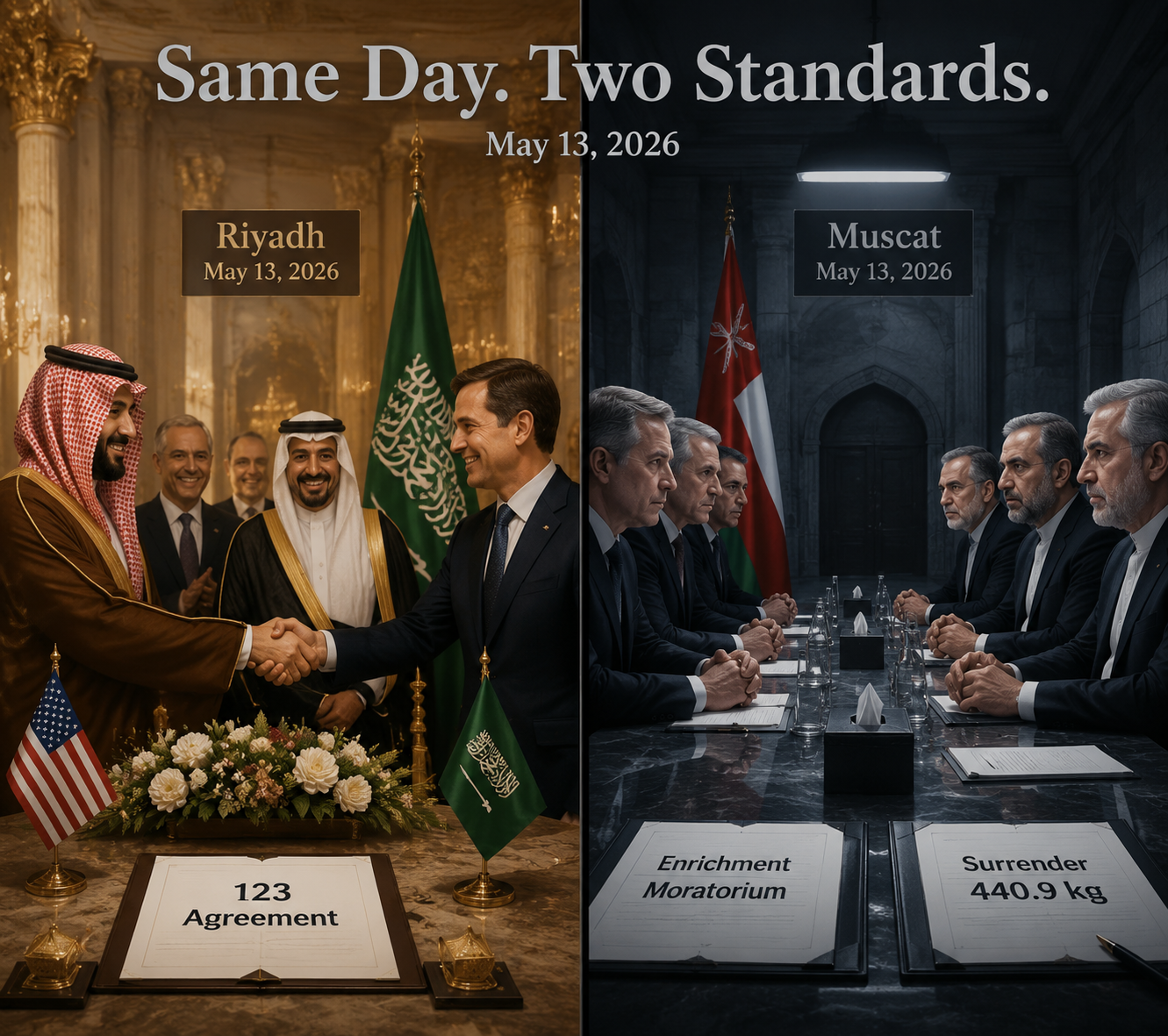
That simultaneity is now the legal fact around which the international-law implications of Saudi uranium enrichment turn. The issue is not whether Iran has complied with its safeguards obligations. It has not, and the International Atomic Energy Agency Board of Governors said so on June 12, 2026.[1] Nor is the issue whether Saudi Arabia and Iran are strategically interchangeable. They are not. The problem is more technical and, for that reason, harder to dismiss: a state demanding zero enrichment from one non-nuclear-weapon party to the Nuclear Non-Proliferation Treaty has just accepted enrichment by another regional non-nuclear-weapon party under terms whose verification architecture is still not public.
Iranian hardliners did not need to invent a grievance from whole cloth. They needed an exhibit. The May 13 split screen gave them one.
The Legal Asymmetry Is in the Permission Structure
A U.S. nuclear cooperation agreement under Section 123 of the Atomic Energy Act is not merely a diplomatic handshake. It is the legal channel through which the United States authorizes significant nuclear cooperation with another state. The agreement sets nonproliferation conditions for transfers, consent rights, safeguards, and restrictions on sensitive activities such as enrichment and reprocessing.[2]
That is why the enrichment term matters. A 123 agreement that bars enrichment and reprocessing sends one legal signal. A 123 agreement that permits enrichment sends another. The Saudi agreement falls in the second category, and it does so while the United States was pressing Iran to accept an enrichment moratorium of two decades.[1]
This does not mean the NPT contains a simple, self-executing entitlement to any enrichment program a state wants. Article IV protects the right of parties to develop nuclear energy for peaceful purposes, but that right is conditioned by Articles I and II and has always been filtered through safeguards, export controls, supplier-state policy, and judgments about proliferation risk. U.S. practice has long treated enrichment as legally and strategically sensitive, not as an ordinary commodity covered by the peaceful-use clause.
That careful position becomes harder to explain when the distinction appears to depend less on the activity than on the identity of the state performing it. If enrichment is too proliferation-sensitive for Iran as a legal category, why is it acceptable for Saudi Arabia without the Additional Protocol in force? If the answer is compliance history, regional alignment, or negotiated safeguards, then those distinctions must be visible and defensible. They cannot remain inside classified annexes and still do all the legal work demanded of them.
The Additional Protocol Problem
The safeguards question is where the criticism moves from political accusation to treaty-system risk. Saudi Arabia’s enrichment permission is not paired, at least on the public record, with the Additional Protocol. That matters because the Additional Protocol gives the IAEA broader tools to detect undeclared nuclear material and activities. Comprehensive safeguards remain important, but they do not provide the same inspection reach.
The public record is also incomplete in a second respect. The Section 1264 waiver report associated with the Saudi arrangement was classified, leaving the precise bilateral safeguards terms unclear. The IAEA Board of Governors must still approve the bilateral safeguards arrangement, which means implementation is not simply a matter of U.S. and Saudi preference.[1]
That pending approval could matter in several ways. The Board might press for more intrusive arrangements. It might delay approval. It might approve a structure that still leaves critics arguing that enrichment has been normalized without the verification tools usually treated as necessary for confidence. None of those outcomes can be assumed in advance, but the uncertainty itself is part of the legal picture.
The Congressional Research Service captured the practical question with unusual economy: “Will it be more challenging to negotiate enrichment limits if the United States is greenlighting a Saudi enrichment program with less intrusive safeguards?”[1] That is not a slogan about hypocrisy. It is the problem negotiators will face across the table. Once an enrichment concession is documented, the burden shifts to explaining why one NPT party’s enrichment is tolerable under a less intrusive verification posture while another’s must be eliminated.
Iran’s Non-Compliance Matters, but It Does Not Erase the Precedent
Any serious analysis has to keep two facts in view at once. First, Iran’s safeguards record is not clean. The IAEA Board of Governors’ June 12, 2026 non-compliance finding is a legal event, not a talking point.[1] It gives the United States and its partners a real basis to treat Iran differently from a state without the same compliance record.
Second, differential treatment still has to be explained in legal terms that others can repeat without embarrassment. Compliance history can justify stricter demands. It does not automatically justify a public posture in which one state is told that enrichment itself must disappear while another is granted permission to enrich before the safeguards terms are publicly legible.
The 440.9-kilogram figure also requires discipline. It describes the amount of Iranian uranium enriched to 60 percent identified in the negotiating context, but its current verified status is unknown after more than 97 days without confirmed inspection access.[1] Treating that number as a live, fully verified inventory would overstate what inspectors can currently know. Treating the uncertainty as irrelevant would be just as careless, because the whole point of safeguards is to reduce precisely this kind of fog.
This is where the Saudi arrangement cuts most sharply. The United States can argue that Iran’s conduct warrants exceptional restrictions. But when it simultaneously accepts Saudi enrichment without a publicly established Additional Protocol baseline, it makes the exceptional nature of the Iran demand easier for Tehran to reframe as discriminatory enforcement rather than compliance-based enforcement.
How the Asymmetry Entered Iran’s Withdrawal Argument
The most consequential development is not rhetorical outrage in Tehran. It is the movement of the asymmetry into legislative form. Iranian member of parliament Malek Shariati introduced a “triple urgency” bill in March 2026 that would move Iran toward withdrawal from the NPT, explicitly invoking asymmetric enforcement.[1]
The timing requires care. The bill was introduced before the May 13 Saudi agreement, so the Saudi deal should not be described as having caused the legislation. That would be a stronger claim than the evidence supports. The better reading is narrower: Iranian hardliners already advancing an NPT withdrawal route are using the U.S.-Saudi enrichment concession as additional legal-political ammunition for a case framed around unequal treatment.
Nor has the bill’s introduction accomplished withdrawal. A “triple urgency” procedure signals legislative priority and political intent; it is not the same thing as enactment, deposit of a withdrawal notice, or completion of the NPT’s withdrawal process. The distinction matters because legal analysis should not convert hardliner maneuvering into a completed treaty rupture.
Still, introduction is not trivial. Withdrawal arguments do not become dangerous only at the moment a notice is filed. They become dangerous when they acquire a repeatable legal form: one state cites Article IV, points to another state’s enrichment permission, highlights the absence of comparable pressure, and claims that the treaty bargain has been politically emptied. That is the terrain Shariati and like-minded actors are working.
The Bulletin of the Atomic Scientists’ observation, quoted in the Arms Control Association’s analysis, put the political optics bluntly: “While going to war over Iran’s uranium enrichment program, President Trump has given both South Korea and Saudi Arabia his blessing to acquire enrichment and reprocessing programs.”[1] The sentence is useful because it shows why the argument travels. But the legal vulnerability does not depend on the sharpness of that phrasing. It depends on the underlying permission structure.
What the NPT System Has to Defend
The NPT survives through distinctions. Nuclear-weapon states and non-nuclear-weapon states are treated differently. Peaceful-use cooperation is distinguished from weapons acquisition. Safeguarded nuclear activity is distinguished from undeclared activity. Supplier permissions are distinguished from treaty rights. Compliance-based pressure is distinguished from raw political preference.
Those distinctions do not need to satisfy every government to remain legally functional. They do need to be administrable by inspectors, diplomats, sanctions officials, and counsel who must defend them in rooms where hostile states quote yesterday’s exception back at today’s demand. A regime built on controlled access to sensitive fuel-cycle technology cannot treat its own rationales as disposable.
The Saudi case is not identical to the Iran case. Iran’s non-compliance finding, its unresolved safeguards issues, and the uncertainty surrounding its 60-percent enriched uranium stockpile all justify heightened concern. But the United States has made the harder argument for itself by granting a regional partner enrichment permission under still-unclear safeguards while demanding that Iran accept zero enrichment for twenty years.
That is the international law implication that should worry even those who support close U.S.-Saudi cooperation. The damage is not that Iran has found a persuasive moral defense for its nuclear conduct. It has not. The damage is that Iran’s withdrawal advocates have been handed a documented asymmetry they can place inside a treaty argument, and the NPT system now has to spend legal capital explaining why that asymmetry is principled rather than preferential.
References
- Saudi Arabia's Gilded Nuclear Sweetheart Deal, Arms Control Association, June 2026.
- The U.S. Atomic Energy Act Section 123 At a Glance, Arms Control Association.
Comments
Join the discussion with an anonymous comment.