
As of July 18, 2026, there is no federal SAVE Act or SAVE America Act obligation to implement. The bill has passed the House, stalled in the Senate, failed once as a reconciliation amendment, and reappeared through a July reconciliation framework and a separate rider strategy. Those are different legal states. House passage changed the bill’s political posture; Senate failure preserved the status quo; amendment and rider attempts changed enactment risk, not enforceable duties.
For legal teams, the useful question is not whether Congress has “moved on voter ID.” It is narrower: which event changed legal status, and which event merely changed the odds that a legal status change could happen later? On that question, the timeline is still open, but the compliance answer is not: no federal implementation deadline has been triggered.
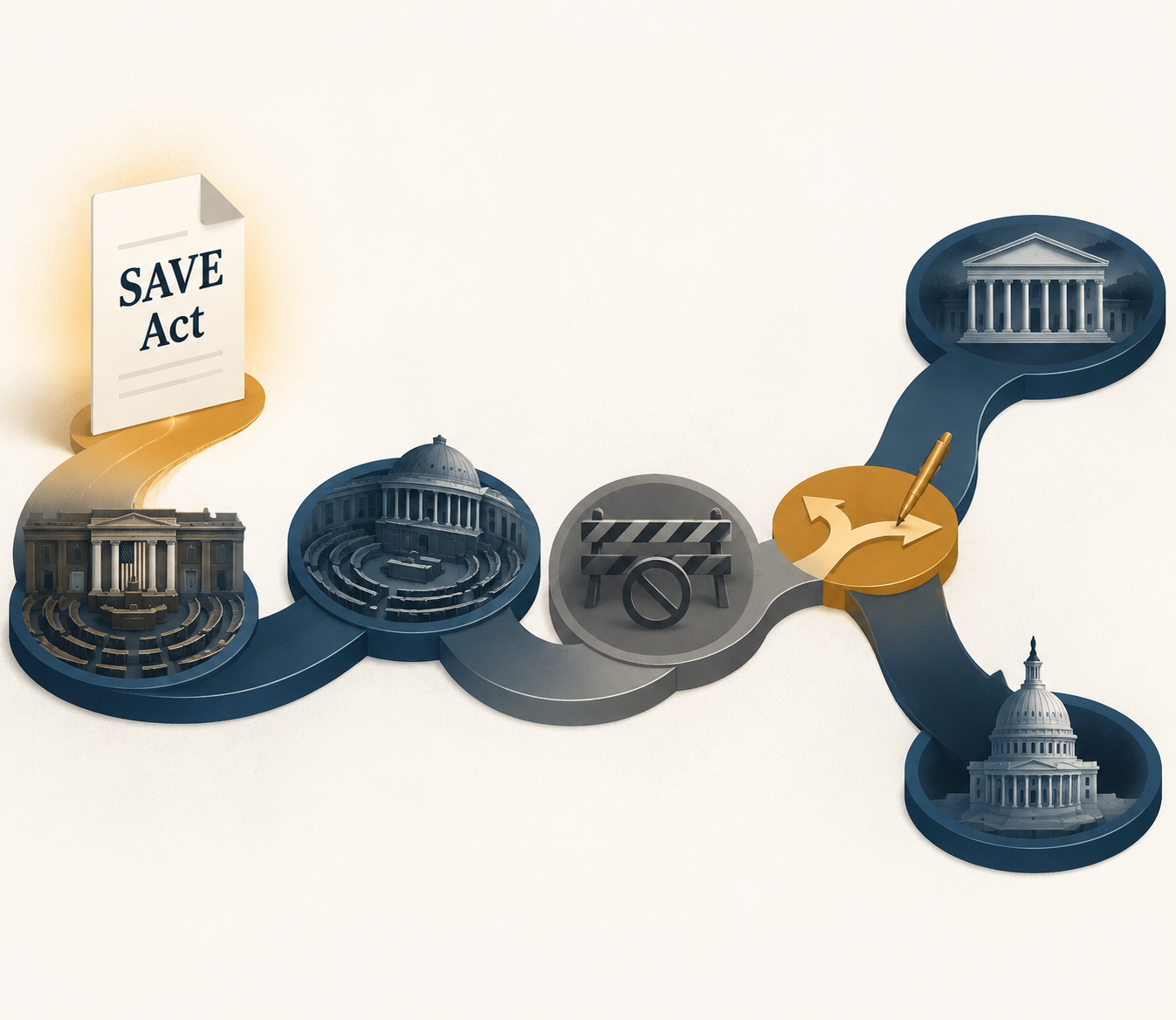
The Five Procedural Phases So Far
| Phase | Date or period | Procedural event | Legal effect |
|---|---|---|---|
| 1 | April 10, 2025 | Original SAVE Act, H.R. 22, passed the House 220-208 | No federal obligation; Senate did not advance it |
| 2 | February 11, 2026 | SAVE America Act, H.R. 7296 / S. 1383, passed the House 218-213 | No federal obligation; Senate action remained necessary |
| 3 | March-April 2026 | Senate floor debate ended in a 53-47 stall below the 60-vote threshold | No enactment; filibuster math controlled |
| 4 | June 5, 2026 | Reconciliation amendment failed 48-50 | No attachment to that reconciliation vehicle |
| 5 | July 2026 | Renewed reconciliation framework and separate rider route remained pending | No enactment; procedural risk remained alive |
Phase 1: H.R. 22 Passed the House, Then Stopped
The first federal SAVE Act event that matters for this timeline occurred on April 10, 2025. H.R. 22 was introduced and passed the House by a 220-208 vote, then failed to advance in the Senate.[1] That House vote is often treated as the start of the implementation story, but it did not create a federal proof-of-citizenship requirement. It created a live bill on the Senate side.
That distinction matters because election offices do not implement House-passed bills. They implement enacted statutes, agency rules, court orders, state directives, and sometimes emergency guidance. H.R. 22 never crossed that line.
Phase 2: The 2026 SAVE America Act Was a New House-Passed Vehicle
The 2026 version arrived as the SAVE America Act, H.R. 7296 / S. 1383. NACo described it as a more restrictive version and reported that the House passed it 218-213 on February 11, 2026.[2] Readers looking for a provisions-level breakdown of the proof-of-citizenship, voter ID, and mail-voting restrictions can compare the timeline here with what the SAVE America Act does to voter ID and mail voting.
The legal status after February 11 was still simple: passed House, not enacted. The bill had a clearer political mandate within the House majority than H.R. 22 had, but the Senate still had to supply either ordinary passage or a viable procedural substitute.
The county-administration consequences already looked concrete at this stage. NACo warned that the measure would have major impacts on county election administration, including the work of checking documentary proof and managing registration systems.[2] That is useful impact evidence. It is not evidence that counties had a new federal duty in February 2026.
Phase 3: The Senate Debate Produced a Stall, Not a Statute
The Senate sequence is the point where sloppy timelines usually do the most damage. During March-April 2026 floor debate, Majority Leader John Thune acknowledged that supporters lacked the votes to overcome the Senate’s 60-vote filibuster threshold, and the vote stalled at 53-47 after debate.[3] A 53-vote showing is politically meaningful. It is also seven votes short of cloture in the ordinary Senate path.
For compliance purposes, that difference is the whole story. A bill can have a majority, occupy floor time, and still fail to advance. The Senate stall did not send text to the President. It did not require federal agencies to issue guidance. It did not require states or counties to change registration forms. It did, however, explain why supporters started looking for procedural vehicles that did not depend on a 60-vote cloture route.
Phase 4: The June Reconciliation Amendment Failed 48-50
The next important event was not a new stand-alone passage vote. It was an attachment attempt. On June 5, 2026, the Senate rejected a bid to attach SAVE Act language to a reconciliation bill by a 48-50 vote.[4][5] Four Republicans — Lisa Murkowski, Mitch McConnell, Susan Collins, and Thom Tillis — joined all Democrats in opposition.[5]
That vote matters because reconciliation is the vehicle supporters would prefer if they cannot clear 60 votes. But the June amendment did not become law and did not become part of the reconciliation package. It narrowed the immediate path, rather than closing every later path.
The four Republican defections also matter procedurally more than rhetorically. In a reconciliation setting, the question is not only whether the majority wants the policy. It is whether the text can survive budget-process constraints and whether enough majority senators are willing to keep it attached once those constraints are tested.
Phase 5: The July 2026 Reconciliation Push Keeps the Bill Alive
As of July 16, 2026, House Republicans had relaunched the effort through a new reconciliation framework authorizing $10 billion in election-related grants conditioned on SAVE-like provisions.[3] That is the current reason the SAVE Act implementation legal timeline in 2026 cannot be closed as a dead bill. The relevant status is pending, not enacted.
The grant-condition framing is not incidental. It appears designed to give the measure a budgetary hook: money goes out, conditions attach, and the policy travels with the spending. The harder question is whether that hook is strong enough under the Byrd Rule, which limits extraneous matter in reconciliation. Legislative Procedure’s analysis frames that as an unresolved procedural problem, not a settled green light, and Democracy Docket reports that budget experts doubt the approach will survive Byrd Rule scrutiny.[3][6]
That caveat should not be softened into a prediction. The Byrd Rule question is an obstacle point; it is not a court judgment and not a final Senate ruling in this vehicle. A compliance memo that says “SAVE Act enacted through reconciliation” would be wrong. A risk memo that says “SAVE-like conditions remain pending through reconciliation, with Byrd Rule vulnerability” would be much closer to the actual posture.
The Rider Route Is Separate, and Weaker in the Senate
The other route is a rider: the House attached a narrower SAVE America Act measure to a national security funding bill, with the Senate expected to strip those provisions.[3] The legal point is the same as with reconciliation, but the procedural mechanics are different. A rider can move because the underlying bill is moving; it can also disappear because the Senate refuses the non-germane or politically contested attachment.
Expected stripping is not the same thing as stripped text. Until the Senate acts, the rider remains a monitoring item. But it should not be treated as a parallel enacted law, and it should not be merged with the July reconciliation framework as though Congress were considering one unified path. Legal status depends on vehicle, text, chamber action, and final passage.
Why Implementation Would Be Operationally Hard
The reason lawyers and administrators keep watching an unenacted bill is not mystery. If a federal proof-of-citizenship requirement were enacted close to the 2026 midterms, implementation time could compress quickly. Election offices would have to translate statutory text into intake procedures, document review, voter communications, provisional handling, list maintenance, staff training, and litigation response.
The document-access problem is not abstract. Brennan Center estimates say more than 21 million Americans lack ready access to the citizenship documents that the SAVE Act model would require.[7] The same research points to Kansas’s prior proof-of-citizenship law, under which about 31,000 eligible voters — 12% of applicants — were blocked from registering before the law was halted.[7] Those are advocacy-source estimates, but they are also among the clearest public figures for what proof-of-citizenship administration can mean in registration systems.
A separate Brennan Center discussion of newer SAVE Act bills cites Utah’s review finding zero instances of noncitizen voting among more than 2 million voters.[8] That finding does not prove that every state has the same incidence profile. It does show why implementation debates often separate into two tracks: the asserted integrity rationale on one side, and the measurable document-burden problem on the other.
State Parallels Do Not Make a Federal Law
State activity is relevant context, but it should not be folded into the federal timeline. Center for American Progress reports that 14 states have SAVE Act-like laws, while only New Hampshire and Wyoming — the latter exempt from the National Voter Registration Act — can enforce such requirements for federal elections.[9] That is not a substitute for federal enactment. It is a separate layer of registration-law risk.
New Hampshire illustrates the litigation side of that risk. CAP reports that the state’s law was struck down in May 2026 on First and Fourteenth Amendment grounds and is under appeal.[9] That case may be useful to lawyers watching how courts handle documentary proof requirements, but a state-law appeal does not answer whether Congress will pass the SAVE America Act or whether a federal version would survive review.
Constitutional Risk Remains Predictive
The constitutional materials belong after the enactment timeline because they address what would likely happen if the bill became law. Erwin Chemerinsky’s SCOTUSblog analysis of voting identification and the Constitution Center’s discussion of the SAVE America Act both point toward serious constitutional vulnerability for a federal proof-of-citizenship requirement.[10][11] That is important litigation context. It is not settled Supreme Court disposition of the SAVE America Act.
The distinction is more than cautionary phrasing. A likely challenge does not suspend a statute before enactment, and a predicted ruling does not bind administrators before a case is filed, briefed, and decided. If Congress enacts a version in late 2026, the first operational problem may still be immediate implementation guidance, even if every serious legal team expects emergency litigation.
What Is Outside This Timeline
A separate April 2026 executive order concerning mail-in ballot procedures and citizenship verification is related election-law material, but it is not part of the SAVE Act’s legislative timeline. It should be tracked separately because executive implementation, statutory enactment, appropriations riders, and reconciliation conditions produce different legal authorities and different litigation records.
The same separation applies to broad claims about voter fraud, partisan motive, or campaign strategy. Those debates explain why the bill attracts attention. They do not establish whether text has passed both chambers, survived Senate procedure, been signed, or become enforceable.
Q3 2026 Legal Status
The clean status as of July 18, 2026 is this: the original SAVE Act passed the House in April 2025 and stopped; the more restrictive SAVE America Act passed the House in February 2026; the Senate ordinary path stalled at 53-47 after debate; a June reconciliation amendment failed 48-50; and a July reconciliation framework plus a separate national-security-bill rider remain procedural vehicles to watch.[1][2][3][4][5]
None of those events has created a current federal implementation obligation. The live monitoring points are narrower: how the Senate treats the July reconciliation framework under the Byrd Rule, whether rider language is stripped from the national security funding bill, and whether any late-2026 enactment attempt leaves election administrators with a compressed compliance window before the midterms.
References
- Five Things to Know About the SAVE America Act, Bipartisan Policy Center
- House passes SAVE America Act; Major impacts on county election administration, National Association of Counties
- House Republicans relaunch SAVE America Act push in new reconciliation package, Democracy Docket
- Senate Republicans Pass Reconciliation Bill After Marathon Amendment Voting Session, National Low Income Housing Coalition
- Senate rejects bid to revive SAVE America Act, but the war isn't over, Democracy Docket
- Can Reconciliation Save the SAVE America Act?, Legislative Procedure
- SAVE Act Would Undermine Voter Registration for All Americans, Brennan Center
- New SAVE Act Bills Would Still Block Millions, Brennan Center
- The SAVE Act May Be Stalled in Congress, But State Versions Are Being Advanced All Across the Country, Center for American Progress
- The Supreme Court and voting identification, SCOTUSblog, March 2026
- The Constitution and the SAVE America Act, Constitution Center
Comments
Join the discussion with an anonymous comment.