
The oddest feature of the SAVE America Act is that its most obvious premise may make its strongest constitutional challenge harder to bring. Noncitizen voting in federal elections is already unlawful, and every state already limits voting to citizens. That redundancy is not just a policy point. It matters to standing. If Congress lacks power to impose a federal citizenship-proof rule because voter qualifications belong to the states, the clean plaintiff would be a state defending that reserved authority. But a state whose own law already uses citizenship as the baseline has a hard time showing the concrete injury Article III requires.
That is the constitutional paradox. The introduced House version of the SAVE America Act appears to move beyond regulating election administration and into defining who may register for federal elections. Yet because the bill’s citizenship rule tracks the states’ existing citizenship baseline, the federalism objection may be procedurally stranded before a court ever reaches the merits. Professor John J. Martin has framed this as the central defect: the Constitution assigns voter qualifications to the states, not to Congress, even for federal elections.[1]
The analysis below concerns the introduced House version and the legislative posture as of July 2026. The Senate has not passed the bill, and the text may change before any possible enactment. In its current described form, the proposal would require documentary proof of citizenship and a REAL ID-compliant photo ID for voter registration in federal elections, a layered requirement broader than ordinary photo ID rules.[2]
The Constitutional Line Is Not Between Strict and Lenient ID Rules
The familiar voter ID question asks whether a rule burdens the right to vote too much. That question matters, but it is not the first one here. The threshold question is whether Congress is regulating the “Times, Places and Manner” of federal elections under Article I, Section 4, or whether it is setting voter qualifications, a subject the Constitution ties to state law.
Article I, Section 2 provides that electors for the House of Representatives in each state must have the qualifications required for electors of the most numerous branch of that state’s legislature. The Seventeenth Amendment uses the same state-linked qualification rule for Senate elections. The Electors Clause similarly leaves presidential elector appointment to the states, subject to constitutional constraints. Congress has substantial authority over the mechanics of federal elections, but that is not the same as power to decide who is an eligible elector.
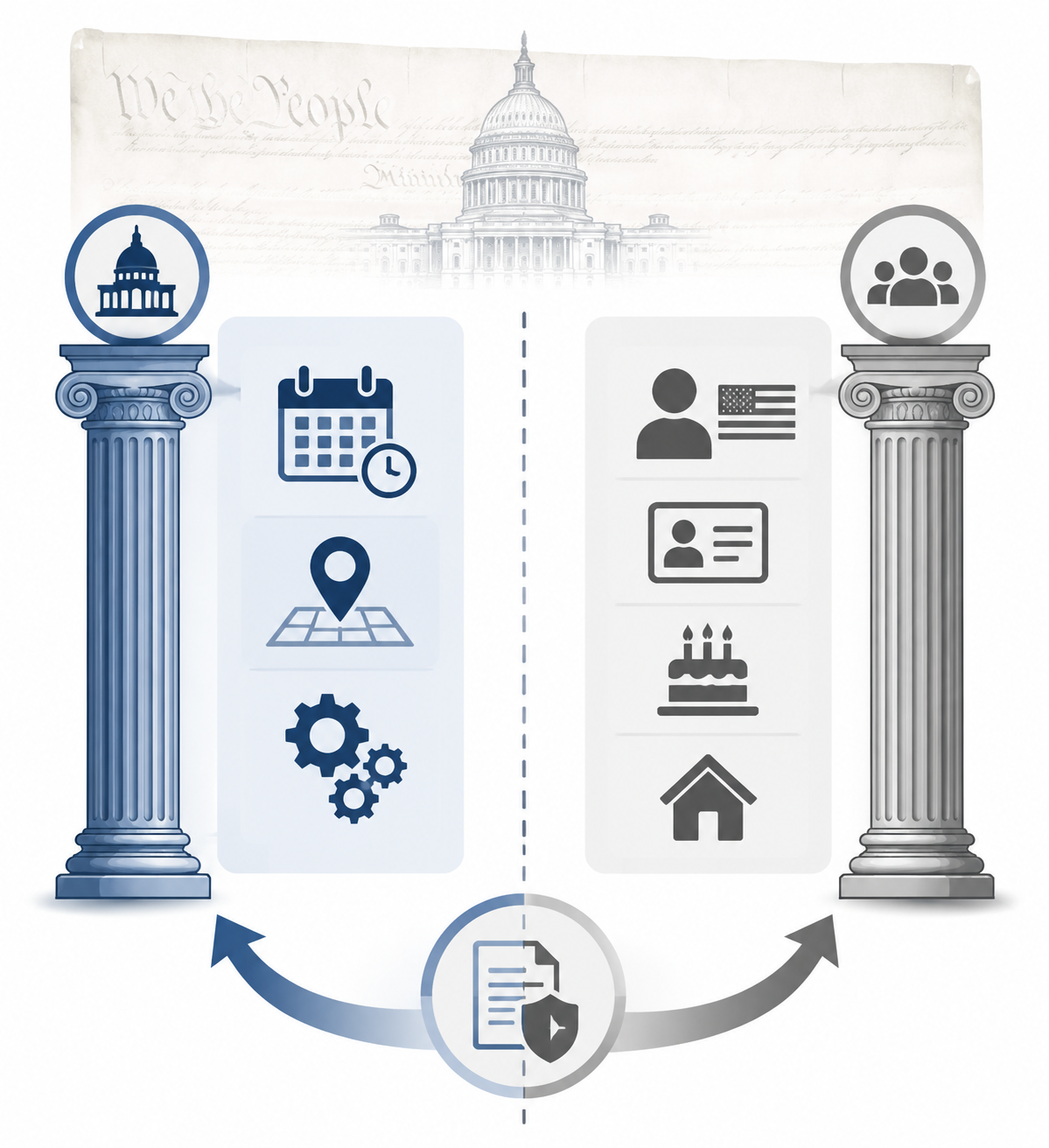
Arizona v. Inter Tribal Council of Arizona is the load-bearing precedent because it addressed almost this boundary, though from the opposite direction. Arizona had required voter-registration applicants to provide documentary proof of citizenship. The National Voter Registration Act required states to “accept and use” a federal registration form that did not demand Arizona’s documentary proof. The Supreme Court held that the federal form requirement preempted Arizona’s added documentation rule for federal elections.[3]
For present purposes, the most important part of Justice Scalia’s majority opinion is not simply the preemption holding. It is the limiting principle. The Court treated the Elections Clause as broad when Congress regulates the mechanics of federal elections, including registration procedures. But it expressly distinguished those procedural rules from voter qualifications. Scalia wrote that “nothing in the Constitution lends itself to the view that voting qualifications in federal elections are to be set by Congress.”[3]
That sentence does real work. It is why the SAVE America Act cannot be evaluated as though any federal registration rule is automatically a “manner” regulation. Registration is often administrative. A deadline, a form field, a statewide database check, or a signature requirement may regulate the process by which eligible voters are placed on the rolls. But a federal rule that says an applicant may not be registered unless she produces certain citizenship documents begins to look less like process and more like an eligibility condition.
When Proof Becomes Qualification
A proof requirement can be described as evidence rather than qualification. That description has some force. Citizenship itself remains the substantive criterion; the document is the method of proving it. But constitutional analysis should not stop at labels. If an eligible citizen cannot register because she lacks the specific documents Congress accepts, the legal effect is not merely evidentiary. The proof rule has become a condition of federal electoral participation.
That is why the SAVE America Act is materially different from a routine instruction about how a registration office processes forms. The reported requirement is not only that a voter attest to citizenship, or that officials verify eligibility through existing records when available. It is that the registrant present documentary proof of citizenship, such as a passport, birth certificate, or naturalization certificate, together with a REAL ID-compliant photo ID.[2]
| Rule Type | Constitutional Character | Why It Matters |
|---|---|---|
| Registration deadline | Election administration | It governs when eligible voters must act. |
| Polling place assignment | Election administration | It governs where eligible voters cast ballots. |
| Federal form design | Election administration, unless it alters eligibility | It governs how officials collect information. |
| Documentary proof of citizenship as a precondition to registration | Potential qualification rule | It can exclude an otherwise eligible citizen who cannot produce the required document. |
The stronger constitutional objection does not depend on proving that Congress secretly wants to change the citizenship qualification. It depends on operation. A rule can preserve the word “citizen” while changing who counts as administratively eligible to register. If Congress supplies the exclusive federal evidence needed to satisfy a state-law qualification, and if failure to produce that evidence prevents registration, Congress has done more than regulate the manner of an election.
Inter Tribal Council anticipated the state side of this problem. The Court recognized that Arizona remained entitled to enforce its voter qualifications and could ask the Election Assistance Commission to include state-specific instructions on the federal form. If the Commission refused, Arizona could challenge that refusal under the Administrative Procedure Act. That remedial discussion would have been unnecessary if Congress could itself define the citizenship-proof threshold as a matter of qualification.[3]
The SAVE America Act turns the Arizona dispute inside out. In Arizona, a state tried to add documentary proof to a federally governed form. Under the SAVE America Act, Congress would impose the proof rule nationally. But the same boundary remains: the Elections Clause allows Congress to displace state rules about the mechanics of federal elections; it does not allow Congress to replace state judgments about voter qualifications.
The Standing Problem Is Not a Technicality
A court does not reach that structural question unless a proper plaintiff gets through the courthouse door. For a state plaintiff, the required injury would need to be more than disagreement with Congress. The state would have to show that the federal statute concretely invades its own sovereign authority to set qualifications, forces it to alter a state-law eligibility rule, or otherwise causes an administrable injury traceable to the federal law and redressable by a court.
That is where the redundancy becomes legally awkward. Because all 50 states already prohibit noncitizen voting, a federal citizenship requirement does not obviously force any state to accept voters it excludes or exclude a category of voters its law affirmatively admits.[1] The state can object that Congress has crossed a constitutional line, but Article III generally requires an injury, not a well-developed merits argument.
The best hypothetical state plaintiff would be a state that chooses a different qualification rule for some relevant election and can show that the federal statute displaces it. The research materials identify a narrower possibility: a state choosing to permit noncitizen voting in local elections could create a justiciable controversy. But that would not necessarily test federal-election qualifications, and no state currently provides the clean federal-election conflict that would make the structural claim straightforward.
Election administration costs might supply another theory, but they do not cleanly present the qualification question. A state could say the statute forces officials to redesign registration systems, train staff, reject applications, and manage documentary review. Those are real burdens if the law takes effect. Yet an implementation-cost theory risks recasting the case as a dispute over administrative burden rather than the deeper point: whether Congress has assumed a power the Constitution withholds.
That distinction matters in litigation planning. A state standing theory built on costs may get into court more easily than an abstract sovereignty theory, but it may also invite the court to uphold the statute as a permissible federal rule governing registration mechanics. The cleaner the merits theory becomes, the harder the injury is to identify. The easier the injury becomes, the more the merits theory may drift away from the structural defect.
The Voter-Burden Claim Is More Available, but Less Clean
Voters and voting-rights organizations would likely have a more conventional path to standing. An eligible citizen who cannot register because she lacks a compliant citizenship document or photo ID has a concrete injury. An organization that must divert resources to help voters navigate the requirement may also have a familiar standing theory, depending on the facts.
But that claim sounds in burden, not structural allocation. Courts would likely analyze it under the Anderson-Burdick framework, which weighs the character and magnitude of the burden against the government’s asserted interests. Crawford v. Marion County Election Board is the unavoidable caution. The Supreme Court upheld Indiana’s photo ID law, and that precedent makes it difficult to assume that a stricter federal ID rule would automatically fail.[4]
The SAVE America Act would still be materially harder to defend than the Indiana law in Crawford on the facts described in the research materials. It combines documentary proof of citizenship with REAL ID-compliant photo identification, and the Brennan Center has reported that a 2023 survey found 21 million Americans lack ready access to citizenship documents.[5] That figure should not be treated as a judicial outcome predictor. It is a burden estimate from a single survey, and courts will ask who the plaintiffs are, what documents they lack, what alternatives exist, and how the statute operates in practice.
The absence of a free-ID safety valve would also matter if the introduced version lacks one. Crawford placed weight on Indiana’s system as a whole, including mechanisms that reduced the burden for some voters. A federal rule that requires both citizenship documentation and compliant photo ID without comparable access measures would present a different record. Still, different is not the same as doomed. Anderson-Burdick often turns on evidentiary detail, and courts may credit the government’s interests in voter-roll integrity even when the evidence of unlawful voting is limited.
This is why the voter-burden route is both practical and unsatisfying. It is easier to find injured plaintiffs, but the remedy may be narrower and the doctrine less hospitable. A court could enjoin applications of the statute to certain voters, demand alternative verification procedures, or uphold the law after balancing. None of those outcomes necessarily answers whether Congress had authority to impose the proof-of-citizenship condition in the first place.
Criminal Penalties Sharpen the Federalism Concern
The bill’s penalty provisions add pressure at the implementation level. Campaign Legal Center describes the proposal as exposing election officials to criminal penalties, including up to five years’ imprisonment, for registering voters without compliant documents.[6] That fact should not be made to carry more than it can. Criminal penalties do not by themselves prove that Congress exceeded the Elections Clause.
They do, however, clarify the practical consequence of treating documentary proof as mere paperwork. The official at the counter is not deciding an abstract federalism question. She is deciding whether to process an eligible voter’s application when the voter’s name has changed, the birth certificate is unavailable, the passport has expired, the REAL ID marker is missing, or the document combination does not fit the statutory template. If the wrong decision carries criminal exposure, officials will predictably err toward rejection or delay.
That implementation pressure reinforces the qualification analysis because it shows how the rule operates. The statute would not simply ask officials to collect information. It would threaten them for registering voters without the specified proof. In practical terms, the document becomes the gateway to the franchise, and the federal government supplies the key.
What a Court Might Actually See
The strongest merits brief would lead with Inter Tribal Council. It would argue that Congress may regulate federal registration procedures, but it may not make documentary proof of citizenship a federally imposed eligibility condition. It would emphasize that the Constitution incorporates state voter qualifications for House and Senate elections, and that Scalia’s opinion expressly rejected congressional power to set those qualifications.
The strongest plaintiff, however, may not exist. A state challenging the statute as an invasion of reserved qualification authority must show an injury distinct from the fact that Congress has legislated in a field the state says is reserved. Because the citizenship baseline is already universal among the states, the federal rule may not create the kind of conflict that makes state standing straightforward.
A voter case would be easier to file and harder to win on the cleanest theory. The plaintiffs would have injuries: rejected applications, document barriers, resource diversion, or chilled registration activity. But the court may frame the case as a voting-burden challenge and apply Crawford-inflected balancing rather than decide whether the Elections Clause permits Congress to impose the citizenship-proof rule at all.
There are ways these paths could converge. A voter plaintiff could argue that the burden is especially severe because Congress lacked independent authority to impose it. An organization could pair Anderson-Burdick claims with a structural claim. A state could develop a concrete implementation injury while preserving the qualification argument. But none of those theories eliminates the basic procedural tension: the party best positioned to describe the structural injury may have the least obvious Article III injury, while the party most plainly injured may present the case through a less favorable doctrinal lens.
The Narrow Bottom Line
The introduced House version of the SAVE America Act likely pushes past Congress’s Elections Clause authority if its documentary proof-of-citizenship rule functions as a precondition to registration for federal elections. Under Inter Tribal Council, Congress may regulate the mechanics of federal elections, but voter qualifications remain tied to state law. A federal rule that excludes otherwise eligible citizens unless they produce federally specified citizenship documents looks like qualification-setting in operation, even if it is drafted as verification.
That is the merits answer. The litigation answer is less satisfying. Because all states already require citizenship to vote, the clean state-sovereignty challenge may struggle to identify the concrete injury Article III demands. The more available challenge may come from voters or organizations burdened by the documentation and photo ID requirements, but that route is likely to proceed under Anderson-Burdick and Crawford rather than the structural theory that most directly exposes the constitutional defect.
References
- Citizenship voting requirement in SAVE America Act has no basis in the Constitution — The Conversation, March 2025
- Explainer: SAVE, SAVE America and MEGA Acts — Issue One
- Arizona v. Inter Tribal Council of Ariz., Inc., 570 U.S. 1 (2013) — Supreme Court
- The Constitution and the SAVE America Act — National Constitution Center
- New SAVE Act Bills Would Still Block Millions of Americans from Voting — Brennan Center
- What You Need to Know About the SAVE Act — Campaign Legal Center
Comments
Join the discussion with an anonymous comment.