
As of July 19, 2026, the SAVE America Act is not federal law. The bill passed the House 218–213 on February 11, 2026, then failed to advance in the Senate after an April 2026 cloture vote fell short at 53–47, with Sen. Lisa Murkowski voting against proceeding.[1][2] Supporters have not abandoned it: as of Q3 2026, they are pursuing both standalone legislation, including H.R. 9368, and possible budget-reconciliation strategies.[1][2] That posture matters for lawyers and election administrators because the bill is stalled, not buried.
Here, “SAVE America Act” refers to the federal voter-registration proposal often shortened to the “SAVE Act.” It is not the Campus SaVE Act, which concerns campus sexual-violence prevention, and it is not USCIS’s SAVE program, the Systematic Alien Verification for Entitlements database used for benefits-related immigration-status checks. The overlap is more than a naming nuisance; several legal and administrative debates around the voter bill now touch the DHS SAVE database, but the bill and the database are separate things.
What the SAVE America Act would change
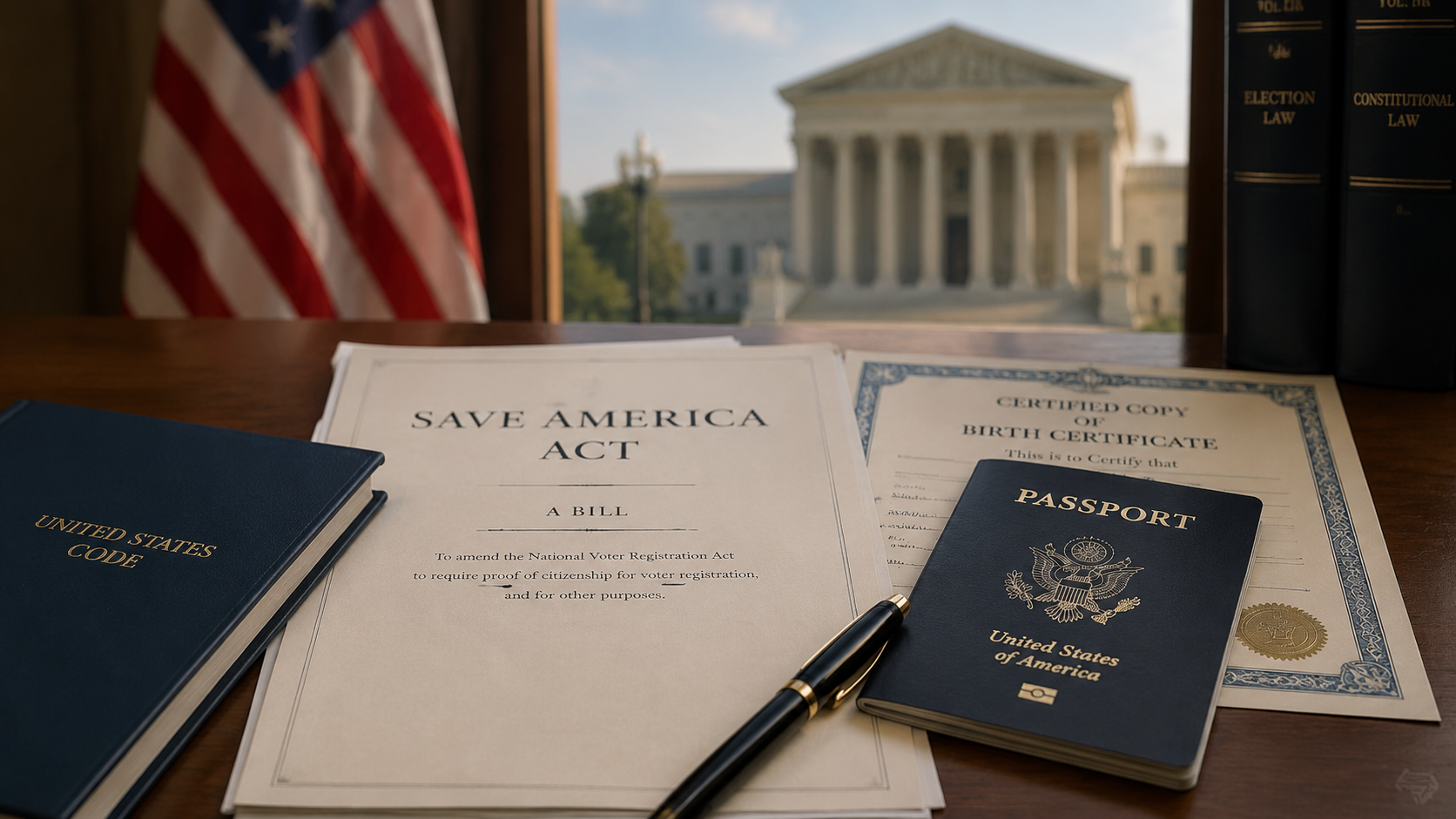
The bill’s central move is to make documentary proof of U.S. citizenship a condition of voter registration for federal elections. The materials supporting the bill describe a passport or certified birth certificate as the principal documents, and analyses of the proposal warn that this structure would effectively end ordinary online and mail registration for many applicants because the voter would have to present citizenship documents in person.[3]
That is a much larger intervention than a routine database check. Current federal voter-registration practice relies on attestation under penalty of perjury, state list-maintenance systems, identification rules, and post-registration verification tools. The SAVE America Act would move the legal burden to the front counter: no qualifying document, no completed registration. For a county clerk, the operative question would not be whether the applicant is eligible in fact, but whether the file contains the document the federal statute recognizes.
| Registration function | Current practical position | SAVE America Act effect described in the research record |
|---|---|---|
| Proof of citizenship | Applicants attest citizenship and states use existing verification and list-maintenance tools | Applicants would need documentary proof such as a passport or certified birth certificate |
| Online registration | Available in many states as a standard registration channel | Would be functionally curtailed where citizenship documents must be presented in person |
| Mail registration | A core federal registration channel under modern election administration | Would be functionally curtailed for applicants who cannot satisfy documentary proof remotely |
| Election-official compliance | Errors may trigger administrative, civil, or state-law consequences depending on context | Officials could face criminal penalties for registering voters without correct documents |
The bill also includes a nationwide photo ID mandate. Analyses from voting-rights and policy organizations describe the mandate as more restrictive than every current state requirement except Ohio’s, including because it would prohibit student IDs and most tribal IDs.[4] For voters who already use a passport-style document for other legal purposes, that may sound minor. For administrators, the hard cases are elsewhere: a tribal citizen with a government-issued tribal credential, a student whose state accepts a campus ID under existing law, or an older voter whose records do not line up cleanly across agencies.

The document problem is not theoretical
The largest numbers in the debate should be read carefully, but they are still administratively important. Research cited by voting-rights analysts estimates that more than 146 million American adults lack a valid passport, while approximately 69 million married women lack a birth certificate matching their current legal name.[3] Those figures do not prove that all of those people would be unable to register. They do show why a passport-or-birth-certificate model would produce predictable document-matching problems before a clerk ever reaches the question of citizenship.
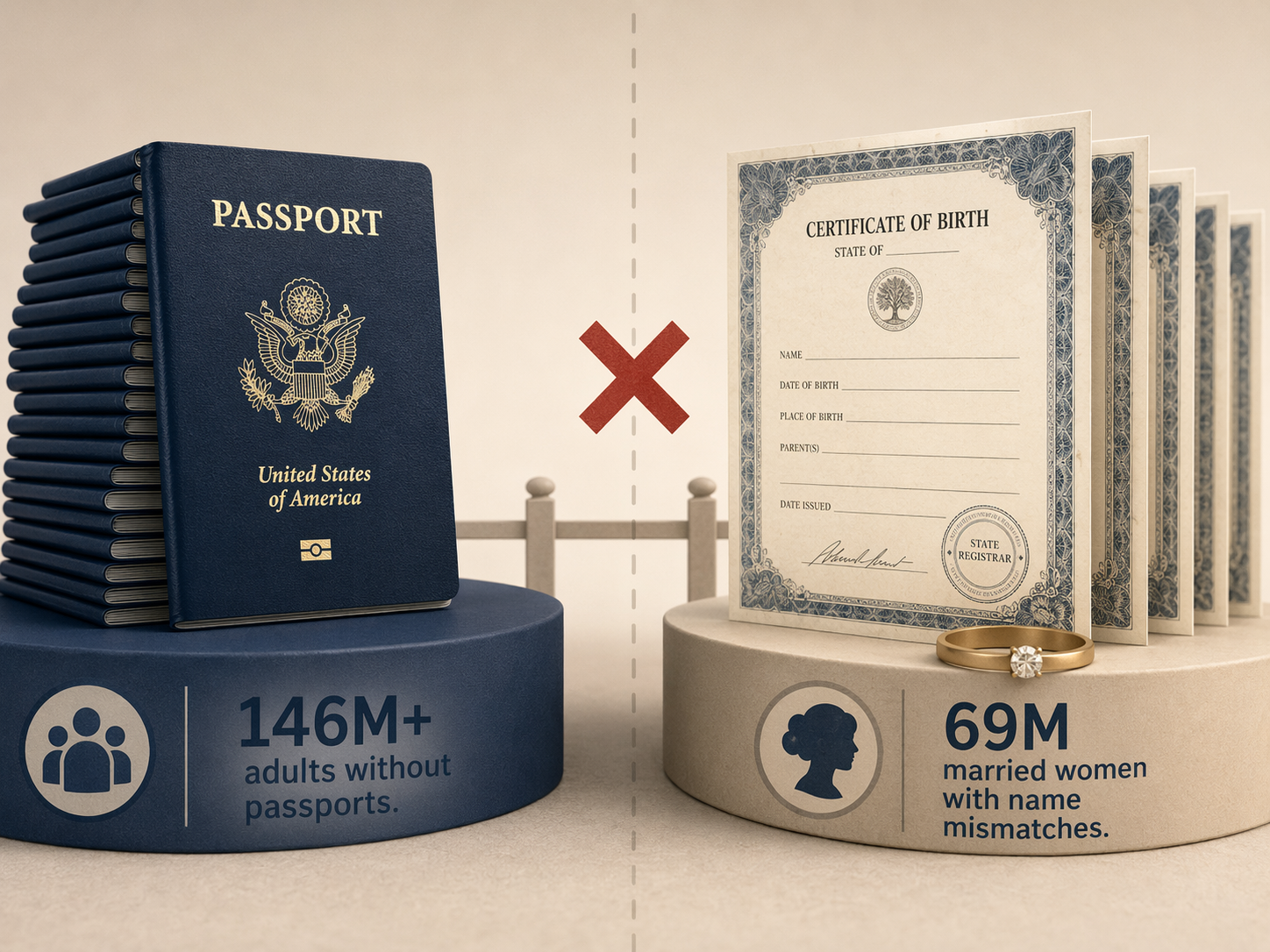
Name changes are the obvious example. A certified birth certificate may establish birth in the United States, but it may not establish that the person standing at the counter, using a married name, is the person named on that certificate. A clerk then has to decide whether additional records are sufficient, whether the voter must return, and whether accepting the file creates personal legal risk. The statute’s pressure point is not just the applicant’s paperwork; it is the official’s exposure when paperwork is incomplete, mismatched, or unfamiliar.
State experience with documentary proof of citizenship gives a better warning than broad slogans. Kansas’s prior documentary-proof system blocked about 31,000 eligible citizens from registering, and later review found that 99% of those affected were confirmed citizens.[3][5] That does not mean the federal bill would reproduce Kansas’s numbers exactly. It does mean that a documentary screen can misclassify eligible citizens at meaningful scale, especially when the legal rule is stricter than the documents people ordinarily possess.
Criminal penalties would change clerk behavior
The SAVE America Act would expose election officials to criminal penalties of up to five years in prison for registering an applicant without the correct citizenship documents, including in circumstances described by critics as good-faith error.[3][6] This is one of the bill’s most consequential design choices. Criminal exposure does not merely punish misconduct after the fact; it changes how cautious officials behave in the first place.
A clerk facing prison time has a rational incentive to reject uncertain files, demand extra paperwork, escalate ordinary registration questions to counsel, or slow processing until a supervisor signs off. That may be exactly what some supporters want. But it also means the bill would convert ambiguous document review into a personal-risk decision for front-line staff. The voters most affected would be the ones whose citizenship is real but whose records are least standardized.
That compliance effect is easy to underestimate from Washington. A federal statute can say “documentary proof” in one line. A local office has to train temporary workers, update forms, redesign intake scripts, preserve records, document rejection reasons, answer provisional-ballot questions, and defend close calls later. If the penalty provision remains as described, the safest administrative answer in doubtful cases will often be “no,” even when the legally correct answer might be “yes, after clarification.”
The DHS SAVE database fight cuts against easy verification claims
Supporters of documentary citizenship requirements often speak as though federal verification is a clean backstop. The 2026 litigation record is less tidy. On June 22, 2026, Judge Sparkle Sooknanan of the U.S. District Court for the District of Columbia ruled that a DHS expansion of SAVE database use for voter-record checks was unlawful under the Privacy Act, the Social Security Act, and the Administrative Procedure Act.[7] Reporting and legal analysis indicate that the expanded system had processed more than 60 million voter records before the ruling.[7][8]
The ruling does not decide the constitutionality of the SAVE America Act. It does, however, weaken the practical claim that citizenship verification can simply be solved by routing voter data through a federal database. If the database pathway is unlawful, inaccurate in application, or limited by the statutes that created it, then the burden shifts back to documentary review at registration offices.
Accuracy problems also appear in the administrative record. Brennan Center analysis describes one Missouri county where half of the voters flagged through SAVE-related review were later confirmed to be citizens.[3] A county-level example should not be inflated into a national error rate. It is still the kind of example election lawyers watch closely, because a false positive in this setting is not an abstract database defect; it is a citizen placed at risk of removal, delay, or investigation.
Why the Senate failure did not end the bill
The April 2026 cloture vote is the reason the bill is not law. A 53–47 vote is a majority, but not the 60 votes needed to advance under ordinary Senate procedure.[2] For status purposes, that is the cleanest answer: the House passed it, the Senate did not advance it, and no federal obligation has taken effect.
The less tidy answer is that supporters are looking for another vehicle. Legislative-procedure analysis as of July 2026 describes two live possibilities: a standalone bill strategy and an effort to move SAVE Act language through budget reconciliation.[1][2] Reconciliation would matter because it can avoid the ordinary 60-vote cloture barrier, but it is not a magic tunnel for any policy Congress wants to pass.
The obstacle is the Byrd Rule. A reconciliation provision must have more than an incidental budgetary effect; if the policy effect dominates and the fiscal effect is merely a hook, the provision is vulnerable to a point of order.[2] A bill whose central function is to set voter-registration documentation rules, photo ID rules, and election-official penalties faces an obvious incidental-effect problem. That does not make reconciliation impossible as a matter of politics, but it makes the path legally and procedurally uncertain.
This is also where comparison to adjacent proposals matters. Issue One’s 2026 explainer distinguishes the SAVE Act from related measures such as the MEGA Act and tracks the emergence of H.R. 9368 as a standalone strategy.[1] The names and vehicles may shift, but the operational question remains whether Congress can attach the documentary-proof architecture to a bill that can actually clear the Senate.
The Elections Clause question remains unresolved
The constitutional issue is not simply whether Congress may regulate federal elections. Article I, Section 4 gives Congress authority over the “Times, Places and Manner” of congressional elections. The harder question is whether a federal documentary-proof requirement crosses from regulating election administration into imposing or altering voter qualifications, an area Article I, Section 2 ties to state qualifications for the most numerous branch of the state legislature.
Professor John J. Martin of Quinnipiac Law has argued that the SAVE Act exceeds Congress’s Elections Clause power because voter qualifications are constitutionally delegated to the states rather than Congress.[9][10] That is a serious textual argument, but it has not been tested in a direct challenge to the enacted SAVE America Act because there is no enacted SAVE America Act to challenge. Standing and ripeness issues may also complicate any pre-enforcement lawsuit if Congress moves again.
The distinction matters for compliance planning. If the bill passes, states and voting-rights plaintiffs would likely argue that Congress has regulated eligibility rather than procedure. Supporters would likely answer that the bill merely enforces the existing citizenship qualification for federal voters. Neither side can responsibly cite a final SAVE Act merits ruling, because none exists as of July 2026.
Who would feel the bill first
Eligible voters without passports, voters whose birth certificates do not match current legal names, tribal voters whose IDs are excluded, students relying on student IDs, naturalized citizens with document-access delays, and rural voters who depend on mail or online registration would encounter the bill as a paperwork rule before they encountered it as a constitutional controversy. The immediate burden would be producing the right document in the right form at the right place.
Election officials would feel it as a training, intake, and liability problem. State election directors would need to issue guidance quickly. County clerks would need to reconcile federal requirements with state registration systems. Legislative counsel would need to identify conflicting state statutes. Voting-rights litigators would look for plaintiffs whose citizenship is uncontested but whose documents fail the federal rule. Prosecutors and inspectors general would inherit a statute that turns registration-file defects into potential criminal matters.
The bill’s national effect would also vary by state. States with robust online registration, broader acceptable-ID rules, or mail-heavy registration systems would have more operational redesign to do. States already closer to documentary or photo-ID models would still need to compare their systems against the federal bill’s narrower document list and penalty structure. A familiar state-law ID regime would not automatically equal compliance.
What legal teams should treat as current risk
No state or local election office should implement SAVE America Act registration requirements as though they are current federal law. The bill has not been enacted. Existing obligations under the National Voter Registration Act, the Help America Vote Act, state registration statutes, court orders, and current voter-ID rules remain the operative framework unless and until Congress changes them.
The live risk is preparatory. Counsel should monitor the standalone bill and reconciliation tracks, preserve analyses of how current state systems handle citizenship attestation and ID review, and identify categories of voters who would face document-matching problems if the bill moved quickly. Election offices should be especially cautious about informal database matching or citizenship-screening programs after the June 2026 Sooknanan ruling, because federal verification tools carry their own statutory constraints.[7]
The SAVE America Act is therefore best understood in three parts: stalled in the Senate, still available as a legislative vehicle, and sweeping enough that enactment would require immediate legal, technical, and training work. It is not a present registration requirement. It is a live compliance risk.
References
- Issue One explainer, Issue One.
- Legislative Procedure blog, Legislative Procedure.
- Brennan Center analysis, Brennan Center for Justice.
- Vote.org analysis, Vote.org.
- Center for American Progress analysis, Center for American Progress.
- Campaign Legal Center analysis, Campaign Legal Center.
- NPR report on the Sooknanan ruling, NPR.
- Brennan Center analysis of DHS SAVE database expansion, Brennan Center for Justice.
- Constitution Center blog on the SAVE Act, National Constitution Center.
- Legal Talk Network podcast with Professor John J. Martin, Legal Talk Network.
Comments
Join the discussion with an anonymous comment.