
If the SAVE America Act became federal law, state election officials would not be making one adjustment. They would be rebuilding three parts of the election system at once: registration, in-person identification, and mail voting. As of Q3 2026, that remains a contingent federal obligation, not an enacted one. The Senate vote stalled at 53-47 after March 2026 debate, reconciliation and amendment strategies remain under discussion, and President Trump filed an amendment to add further mail-voting restrictions.[1]
The compliance question is therefore immediate even though the federal mandate is not. County clerks, state election directors, legislative counsel, and litigators have to read the bill as an operating system: who must show what, when, through which channel, and what happens when the record does not match the person standing at the counter or returning a ballot.
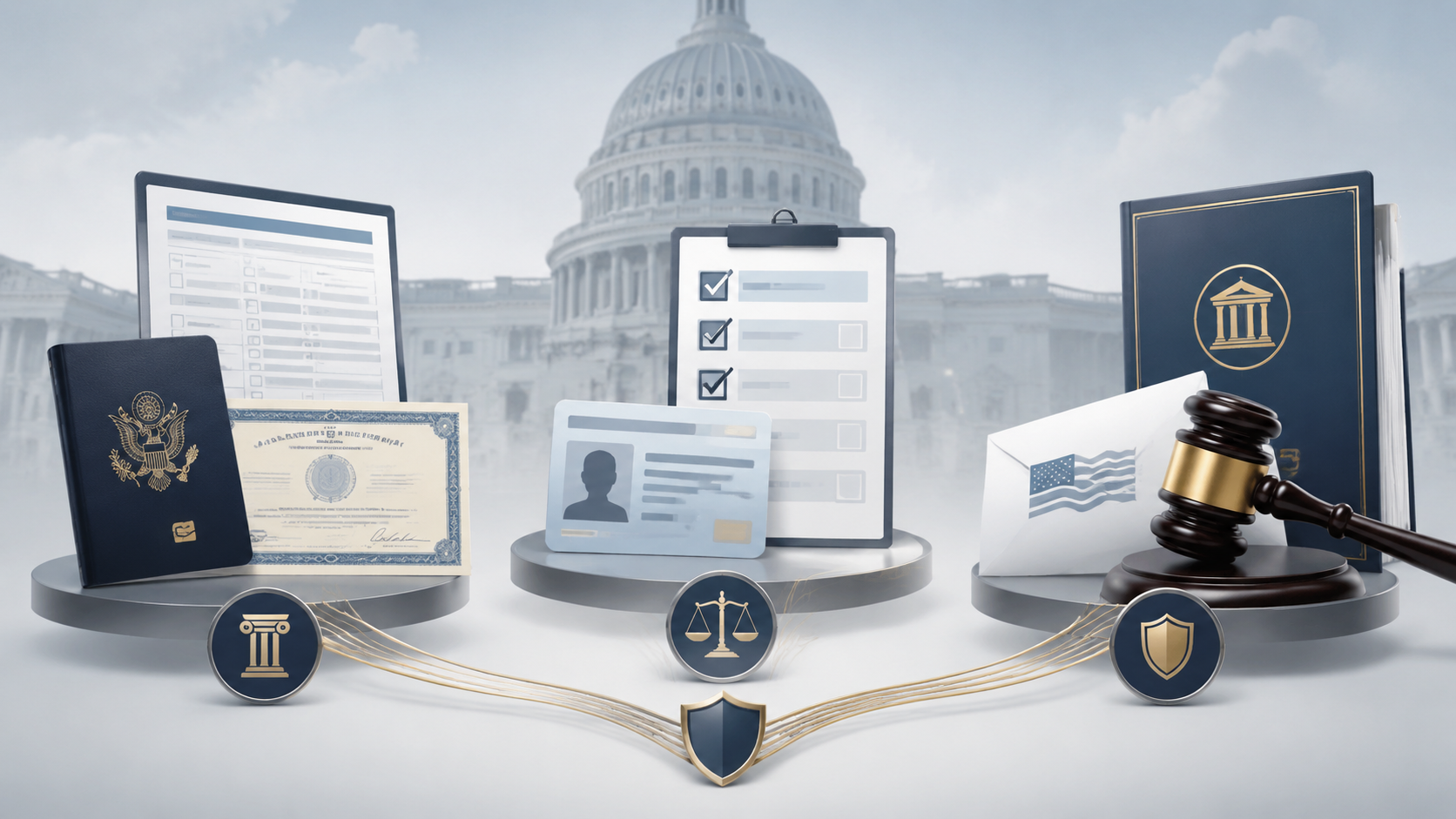
The shorthand debate over voter ID and a mail-in ballot ban compresses the politics, but the bill text is more exacting than the slogan. H.R. 22 would require documentary proof of U.S. citizenship for voter registration, establish a narrower national voter ID list, and restrict mail-ballot eligibility and documentation; companion MEGA Act provisions would further eliminate universal vote-by-mail, permanent absentee lists, and post-Election Day ballot-receipt rules in affected jurisdictions.[2]
The First Compliance Shock Is Registration
The proof-of-citizenship requirement is the provision most likely to turn a familiar registration process into a document-review process. Under the SAVE America Act framework, applicants would have to present documentary proof of citizenship when registering to vote. Analyses of the bill describe qualifying documents as items such as a U.S. passport, a REAL ID-compliant identification document that indicates citizenship, a military ID paired with proof of service, or a government-issued photo ID paired with a birth certificate or other citizenship document.[2][3]
That structure matters because modern registration systems are not built around every applicant walking into an office with original citizenship papers in hand. Online registration, mail registration, registration drives, and same-day intake all depend on an application being checked against government records after submission. A documentary-proof rule changes the front end: the applicant must satisfy the citizenship-document requirement before the registration can be accepted.
Vote.org’s summary of the SAVE Act has put the practical point plainly: the bill would effectively end online voter registration and registration by mail because applicants would have to present documents in person or through a process capable of documentary verification.[3] That is not a small software patch. It changes staffing, public notices, intake scripts, rejection forms, cure procedures, poll-book timing, and the volume of provisional or last-minute disputes.
The document-access numbers identify where the pressure points would appear. The Brennan Center has estimated, citing YouGov, Pew, and Census-based data, that more than 21 million U.S. citizens lack ready access to qualifying citizenship documents, 146 million do not have passports, and 69 million married women have birth certificates that do not match their current legal names.[4] Those figures do not prove that every affected person would be unable to vote. They do show the scale of voters and applicants who may need an additional document, a name-change record, an agency appointment, or a cure path before registration can be completed.
Name mismatch is not a side issue. It is one of the first places a clean statutory rule becomes an administrative queue. A birth certificate may prove citizenship under one name, a driver’s license may show another, and the voter-registration application may reflect a married, divorced, hyphenated, or otherwise changed legal name. The bill’s real-world burden therefore does not stop at “bring a document.” It includes determining which office can accept secondary name-change evidence, whether copies are sufficient, how long a pending applicant remains in limbo, and what notice must be sent when the clerk cannot reconcile the record.
Kansas is the cautionary administrative precedent, not because it forecasts identical results everywhere, but because it shows what documentary proof of citizenship can do once it is placed at the registration gate. The Center for American Progress reports that Kansas’s proof-of-citizenship regime blocked roughly 31,000 eligible citizens, about 12 percent of applicants, while catching virtually zero noncitizens.[5] That is an advocacy-source analysis and should be read as such, but the operational signal is still concrete: document rules can generate large applicant-suspense files even when noncitizen-registration findings are rare.
New Hampshire’s 2025 town elections supply a more recent, narrower example. CAP reports that about 250 voters were turned away before the state’s law was struck down, with the state appealing.[5] That is not evidence of a national failure rate. It is evidence of the kind of immediate election-day and pre-election litigation record that can form when documentary requirements take effect before voters, clerks, and local procedures have adjusted.
The Voter ID List Is National, but Not Generous
The voter ID provisions are easier to summarize but still disruptive. The SAVE America Act would set a national list of acceptable in-person voter identification documents. The key legal feature is not merely that Congress would impose a voter ID rule; it is that the proposed federal list is narrower than the regimes now used in nearly every state.
The Institute for Responsive Government’s state-by-state analysis found zero states fully compliant with the SAVE America Act’s in-person voter ID list.[6] That finding is doing important work. It means the bill would not simply federalize existing strict-ID states and leave everyone else alone. Even states that already require ID would have to compare each accepted document, fallback procedure, provisional-ballot cure rule, religious-objection accommodation, student-ID rule, tribal-ID rule, and nonphoto alternative against the federal list.
For administrators, that produces a familiar but underappreciated risk: the sign at the polling place is often the last thing corrected. Statutes change first, statewide guidance follows, poll-worker manuals are revised, local training happens under deadline pressure, and voters arrive with the ID they used successfully in the last election. A federal list narrower than state practice would require election offices to train poll workers not only on what counts, but on what used to count and no longer does.
That distinction will matter in litigation. A plaintiff challenging implementation would not need to prove that voter ID is categorically unlawful. The more likely cases would contest specific mismatches: rejected student IDs, tribal documents, expired IDs, address discrepancies, provisional-ballot cure deadlines, or unequal application across counties. A state defending the law would need a record showing that local officials had clear, timely, and uniform instructions.
Mail Voting Is Restricted in the Bill and Squeezed Further by the MEGA Act
The administration’s public framing is blunt. The White House’s SAVE America Act page states: “No Mail-in Ballots (Except for Illness, Disability, Military or Travel).”[7] That line is useful because it states the administration’s posture, but it is not a substitute for statutory parsing. The bill and companion measures work through eligibility rules, documentation rules, ballot-request requirements, ballot-return requirements, and deadlines.
At the voter level, the practical question is whether a person can receive and cast a ballot without appearing in person. Under the SAVE America Act framework described in cross-bill analyses, mail voting would be limited to specified categories, and voters would have to provide identification documentation with ballot requests and with returned ballots.[2][8] That is a different administrative problem from requiring ID at a polling place. Instead of one poll worker checking one person in real time, election staff would have to review mailed or uploaded copies, track missing or defective documentation, notify the voter, manage cure windows, and preserve chain-of-custody and privacy safeguards.
The burden would not fall evenly across states because existing mail systems vary widely. Some states mail ballots to all active registered voters. Some maintain permanent absentee lists. Some accept ballots after Election Day if postmarked by Election Day. Others require receipt by close of polls. A federal mail-voting restriction does not land on a single state template; it lands on dozens of different statutory machines.
| Provision | Operational effect described in the research materials | Jurisdictions flagged as affected |
|---|---|---|
| Eliminate universal vote-by-mail | States could no longer automatically send ballots to all eligible voters under universal mail systems | 8 states plus D.C. |
| Eliminate permanent absentee lists | Voters who are now on continuing absentee lists would have to make new requests under a changed system | 9 states plus D.C. |
| Require ballot receipt by Election Day | Ballots accepted under postmark-plus-receipt rules would be rejected if received after Election Day | 15 jurisdictions affecting 43% of 2024 voters |
Those figures come from Issue One’s explainer on the SAVE, SAVE America, and MEGA Acts: the MEGA Act would eliminate universal vote-by-mail in 8 states plus D.C., eliminate permanent absentee lists in 9 states plus D.C., and require ballot receipt by Election Day in 15 jurisdictions that covered 43 percent of 2024 voters.[8] The numbers are not abstractions. They identify which parts of the mail-voting infrastructure would have to be unwound rather than merely revised.
Eliminating universal vote-by-mail changes the outbound side of election administration. A state that now sends ballots automatically would have to build or revive a request-based process, define who may request a ballot, design forms, verify eligibility, reject defective requests, and explain to voters why a ballot that arrived automatically in the last cycle will not arrive automatically in the next one.
Eliminating permanent absentee lists changes the voter’s relationship with the office. A voter who has long relied on a continuing absentee status—because of age, disability, work schedule, caregiving obligations, or ordinary preference under state law—would have to reenter the request process. The legal exposure is not just ballot denial. It includes notice adequacy, disability access, military and overseas voting interaction, and whether state and county offices had enough time to identify affected voters before deadlines began to run.
The Election Day receipt rule creates a different consequence: a ballot can be validly cast by the voter under the old state rule and still arrive too late under the new federal rule. That kind of change tends to produce emergency litigation because the relevant facts become visible only when ballots are in transit, voters have already acted, and the margin or volume of late-arriving ballots is known.
The Missing Transition Period Is Not a Drafting Detail
The bill’s major provisions are not paired, in the research materials, with federal funding or a transition period. That omission is not a background policy complaint. It affects whether the mandate can be implemented without uneven county-level practice, emergency rulemaking, and rushed litigation.
A documentary-proof regime requires secure document handling, front-line training, database changes, new rejection codes, cure notices, and public education. A narrower voter ID list requires revised manuals, poll-worker training, voter-facing materials, and provisional-ballot instructions. Mail-voting restrictions require new request forms, return-envelope instructions, ID-copy processing, ballot-tracking modifications, and potentially the dismantling of universal-mail or permanent-absentee systems.
Those tasks do not occur at “the state” level in any clean sense. State officials issue rules and build systems, but local offices process applications, answer phones, reject defective forms, accept cures, train temporary workers, and sit in court when a voter or campaign says the rollout violated federal law. A mandate that is uniform on paper can become nonuniform in practice if counties receive the same rule but not the same time, money, staffing, or technical capacity.
The Federal Bill Is Stalled, but the Legal Environment Is Not
The Q3 2026 status matters because legal professionals should not treat the SAVE America Act as current federal law. The federal bill has stalled after the 53-47 Senate vote, and the path forward depends on legislative tactics still under discussion.[1] But the underlying compliance issue is already live because states have been moving their own SAVE-like laws.
CAP’s 50-state survey reports that 14 states have enacted SAVE Act-like laws since the 2024 election, including 7 documentary-proof-of-citizenship laws and 5 verification-check laws.[9] Again, the source is an advocacy organization, but the finding is useful because it separates federal enactment risk from state implementation risk. Election lawyers may be litigating or advising on proof-of-citizenship systems before Congress resolves the federal bill.
The central federalism boundary remains Arizona v. Inter Tribal Council. The Supreme Court’s 2013 decision limits state documentary-proof-of-citizenship enforcement against the federal registration form, which the research materials describe as limiting state DPOC laws to state and local elections in 44 states.[10] That creates a split-screen compliance problem: a state may try to impose documentary proof for some elections or through some registration channels while federal-form registration remains governed by a different rule.
That boundary is likely to shape litigation over state copycat laws and any eventual federal enactment. If Congress itself imposes a documentary-proof rule for federal elections, the preemption analysis changes. If states act without that federal mandate, Arizona v. Inter Tribal Council remains a constraint. The important point for practitioners is to keep the source of authority separate: state DPOC statute, federal-form rule, federal SAVE America Act proposal, or companion MEGA Act provision.
That same caution applies across the broader 2026 election-law landscape. Adjacent regulatory fights, including AI election laws, are already forcing campaigns, vendors, and election offices to track rapidly changing state obligations. SAVE-like laws add another layer, but one that lands closer to the voter file, registration counter, absentee-ballot desk, and courtroom.
As of Q3 2026, the SAVE America Act is best understood as a pending federal intervention with unusually large transition, funding, preemption, ballot-access, and litigation questions. The companion MEGA Act provisions and state-level copycat laws make the issue operationally relevant before any final federal enactment.
References
- The Senate will finally vote on the SAVE America Act, Votebeat, March 2026.
- H.R.22 - 119th Congress, Congress.gov.
- The SAVE Act: What Every American Voter Needs to Know, Vote.org.
- New SAVE Act Bills Would Still Block Millions, Brennan Center.
- The SAVE Act: Overview and Facts, Center for American Progress.
- State-by-State In-Person Voter ID Changes Required Under the SAVE America Act, Institute for Responsive Government.
- The SAVE America Act, White House.
- Explainer: SAVE, SAVE America and MEGA Acts, Issue One.
- The SAVE Act May Be Stalled in Congress, But State Versions Are Being Advanced All Across the Country, Center for American Progress.
- What You Need to Know About the SAVE Act, Campaign Legal Center.
Comments
Join the discussion with an anonymous comment.