
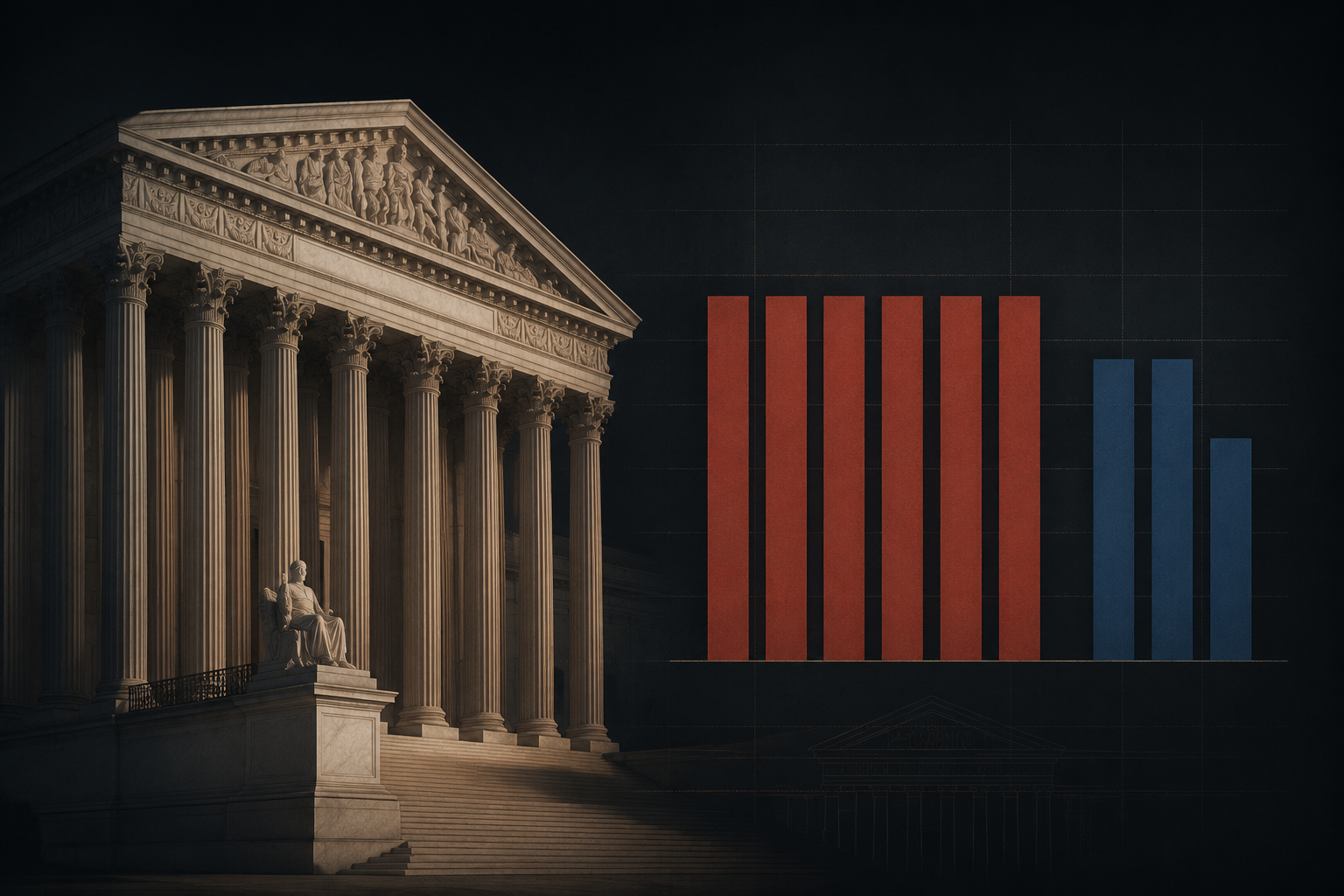
The easiest way to cut through the rhetoric is to start with the count. In 2025, the Trump administration prevailed in 20 of 24 emergency-docket rulings, an 83% win rate, while filing 19 emergency applications in its first 20 weeks in office — equal to the Biden administration's total over four years and more than the combined Obama and George W. Bush totals over 16 years [1].
The Scale Is What Makes the Pattern Harder To Ignore
| Metric | Trump-era record | Why it matters |
|---|---|---|
| Emergency-docket win rate in 2025 | 20 of 24 rulings, or 83% | The administration was winning far more often than losing [1] |
| Emergency applications filed in the first 20 weeks | 19 filings | That matched Biden's four-year total and exceeded the combined Obama and Bush totals over 16 years [1] |
| Cumulative shadow-docket decisions tracked through late June 2026 | 28 decisions: 21 for the administration, 7 against | The pattern did not disappear after 2025 [2] |
| Unexplained rulings in 2025 | 7 of 24 | The Court often acted without saying why [1] |
That filing volume matters because it changes the denominator. A win rate only looks impressive if the Court is taking a handful of unusual applications. Here, the Trump administration was flooding the emergency docket in a compressed span, and the comparison to prior administrations makes that pace look exceptional rather than routine [1]. By late June 2026, the Brennan Center's tracker still showed the same directional tilt: 28 shadow-docket decisions on Trump administration actions, with 21 for the administration and 7 against [2].

The Voting Breakdown Does the Interpretive Work
The voting pattern is what turns filing volume into a legitimacy question. Justice Jackson voted against the administration in all 24 emergency rulings, Justice Sotomayor in 22, and Justice Kagan in 21; Justice Thomas and Justice Alito voted against the administration only once each [1]. On the face of it, that is not a random scatter of outcomes. It is a durable bloc structure, and it is the kind that makes clients, litigants, and reporters start asking whether the Court is applying a stable legal theory or just arriving at a predictable result.
The conservative majority's near-uniform 6-3 alignment in these emergency matters strengthens that impression [1]. The alignment does not prove a political motive. It does, however, create a record that is difficult to explain away as a string of isolated merits judgments with no common thread.
The Counterexamples Matter Too
A fair account cannot pretend the Court always sided with the administration. It did not. In Trump v. Illinois, the Court ruled against the administration on National Guard funding in a 6-3 cross-ideological majority, and in A.A.R.P. v. Trump it also ruled against the administration under the Alien Enemies Act [1]. Those cases matter because they keep the discussion from collapsing into a one-note indictment. They show that the Court was still capable of crossing ideological lines when the justices thought the legal position required it.
But the existence of counterexamples does not erase the larger run of results. It narrows the claim to what the record can actually support: a strong statistical tilt, not a universal one.
Seven Unexplained Rulings Change the Tone
Seven of the 24 emergency rulings in 2025 were issued without any written explanation [1]. That fact matters more than it would in ordinary docket housekeeping. When the same side keeps winning and the Court keeps declining to explain why, the burden shifts to everyone else to infer the rule from the pattern. The Brennan Center's own critique is that the Court "must explain why it keeps ruling in Trump's favor," and that is a normative argument rather than a neutral fact [3]. But the underlying concern is easy to understand: unexplained orders are harder to reconcile with a court that wants its neutrality to be self-evident. That silence does not prove bad faith, but it does make the pattern look less like a series of accidental alignments and more like an institutional habit.
What the Numbers Support, and What They Do Not
The data support the allegation of political bias in Trump rulings as a serious, empirically grounded concern. They do not prove that any justice acted in bad faith. That distinction matters. A shared conservative theory of executive power, emergency relief, and deference in national-security-adjacent disputes could explain part of the alignment without requiring a finding of partisan manipulation. The record does not rule that out. What the record does show is enough to warrant suspicion: an unusually heavy stream of emergency filings, an 83% win rate, a near-unified conservative bloc, a persistent cumulative tilt into 2026, and several unexplained orders [1][2]. That combination is stronger than anecdote and weaker than proof of intent. It is the kind of record that makes the bias allegation hard to dismiss, even for readers who are not eager to call the Court political by instinct.
References
- Looking back at 2025: the Supreme Court and the Trump administration, SCOTUSblog, January 2026, https://www.scotusblog.com/2026/01/looking-back-at-2025-the-supreme-court-and-the-trump-administration/
- Supreme Court Shadow Docket Tracker: Challenges to the Trump Administration, Brennan Center, late June 2026, https://www.brennancenter.org/our-work/research-reports/supreme-court-shadow-docket-tracker-challenges-trump-administration
- Supreme Court Must Explain Why It Keeps Ruling in Trump's Favor, Brennan Center, https://www.brennancenter.org/our-work/analysis-opinion/supreme-court-must-explain-why-it-keeps-ruling-trumps-favor
Comments
Join the discussion with an anonymous comment.