
The phrase “SCOTUS green card processing pause ruling” points to a real confusion, not a real case. In June 2026, the Supreme Court did issue a green-card-related immigration decision, but it was not about a USCIS processing pause. Separately, a federal district court in Rhode Island did vacate USCIS hold policies affecting nationals of 39 countries, but that was not a Supreme Court ruling.
The clean split is this: Blanche v. Lau, decided by the Supreme Court on June 23, 2026, concerns when a returning lawful permanent resident may be treated as an applicant for admission at the border after alleged criminal conduct.[1] Dorcas International Institute v. USCIS, decided by the District of Rhode Island on June 5, 2026, concerns USCIS memoranda that froze green card, work permit, and naturalization adjudications for nationals of 39 travel-ban countries.[2]
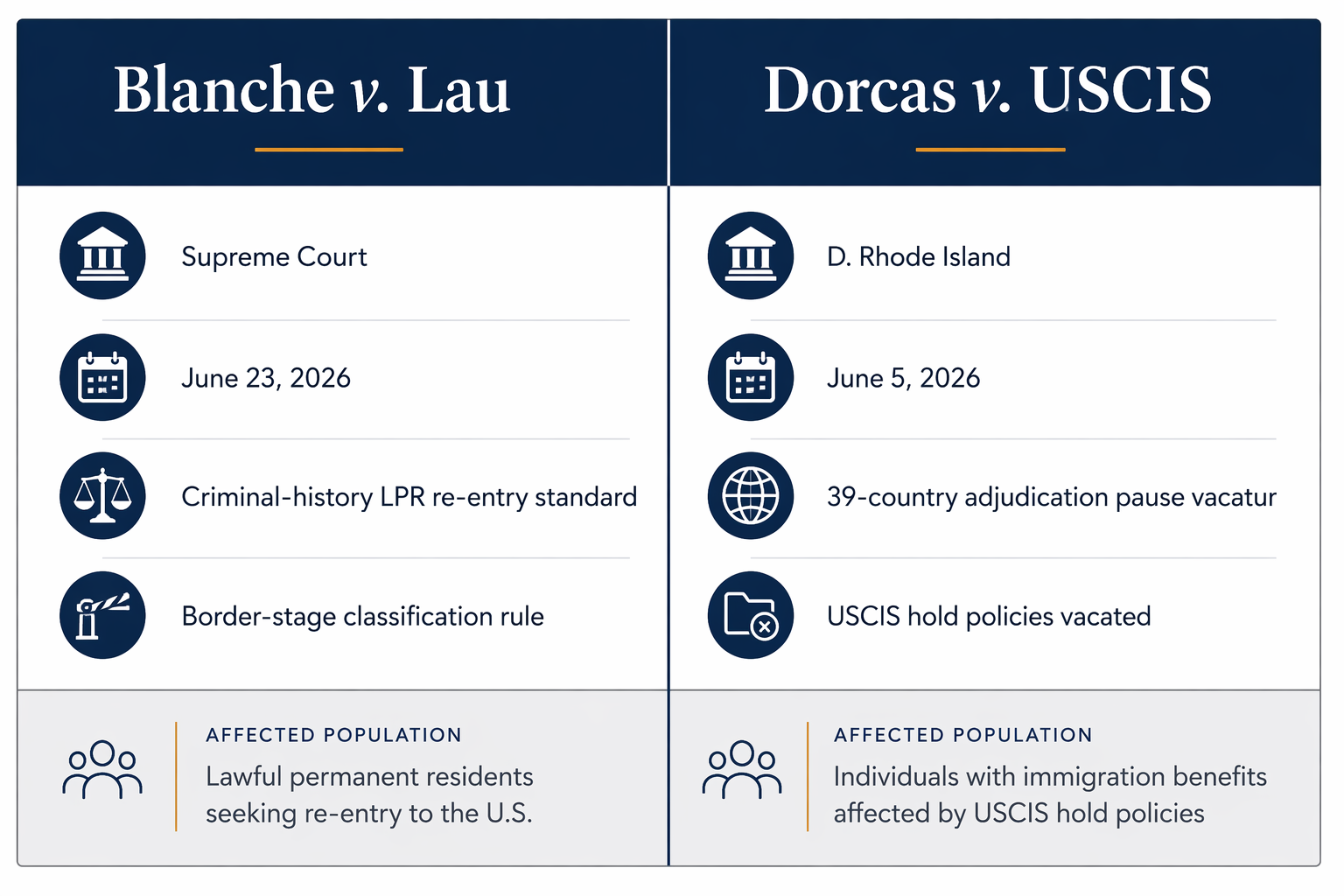
| Question | Blanche v. Lau | Dorcas v. USCIS |
|---|---|---|
| Court | U.S. Supreme Court | U.S. District Court for the District of Rhode Island |
| Date | June 23, 2026 | June 5, 2026 |
| Main issue | Border-stage classification of a returning LPR with alleged criminal conduct | USCIS hold policies affecting benefit adjudications for nationals of 39 countries |
| Affected population | Returning lawful permanent residents with possible criminal inadmissibility issues | Nationals of the 39 covered countries with pending green card, work permit, or naturalization matters |
| What changed | The Court rejected a heightened clear-and-convincing evidence requirement at the border classification stage | The district court vacated USCIS policy memoranda PM 602-0192 and PM 602-0194 |
| What it is not | Not a ruling on USCIS processing pauses | Not a Supreme Court decision and not finally settled while the appeal proceeds |
What Blanche Actually Decided
Blanche v. Lau was a 6–3 Supreme Court decision. Justice Thomas wrote the majority opinion, and Justice Jackson dissented, joined by Justices Sotomayor and Kagan.[1] The case turned on a narrow but consequential procedural question under the Immigration and Nationality Act: what showing is required before border officials may treat a returning lawful permanent resident as an applicant for admission.
That question matters because a lawful permanent resident ordinarily has a different posture from a first-time visa holder or noncitizen seeking initial admission. But the INA identifies circumstances in which an LPR returning from travel may be regarded as seeking admission, including certain criminal grounds. The dispute in Blanche was not whether USCIS must resume adjudicating applications. It was whether the government needed clear-and-convincing evidence, at the border, that the returning LPR had committed a crime involving moral turpitude before placing him in the applicant-for-admission category.[1]
The Court held that INA § 240(c)(2) did not impose that clear-and-convincing standard at the initial classification stage. Put less ceremonially: the border officer did not need to have the same level of proof, at that first moment, that the government would later need to prevail on inadmissibility in formal proceedings.[1]
That is the part most likely to be lost in an intake note. Blanche does not collapse the entire case into the border officer’s first assessment. It separates the process into two stages. At the border, the government may classify the returning LPR as an applicant for admission based on the statutory “commission” language. Later, in removal proceedings, the government still must prove inadmissibility under the applicable framework, and the later inquiry requires a conviction or admission for the criminal ground at issue.[3]
For counsel, that difference changes the conversation. A returning green card holder with a criminal-history issue may face a more vulnerable threshold moment at inspection, but Blanche does not mean the government has already won the removal case. Nor does it mean every alleged offense automatically triggers inadmissibility. The border classification question and the merits of removability or inadmissibility remain separate legal questions.
The Supreme Court also did not decide whether trademark counterfeiting is a crime involving moral turpitude. That question remained open on remand.[3] Describing Blanche as “the case where the Court held counterfeiting is a CIMT” would create a second bad shortcut inside the first one.
Justice Jackson’s dissent warned that the majority’s approach gave the government a “massive blank check” in this setting.[4] That phrase is not just a quotable dissent line. It names the civil-liberties concern that follows from lowering the evidentiary threshold at the airport or port of entry: the returning LPR may be forced into the applicant-for-admission lane before the government has assembled the proof it must later carry.
Why Blanche Is Not a Processing-Pause Case
Nothing in Blanche required USCIS to process or stop processing green card applications. The case was about inspection and admission classification for a returning LPR. It did not involve USCIS policy memoranda freezing adjudications. It did not involve nationals of the 39 travel-ban countries as a class. It did not produce an order telling USCIS how to handle pending I-485, employment authorization, or naturalization files.
The practical harm in calling Blanche a “SCOTUS green card processing pause ruling” is that it sends the wrong people to the wrong risk analysis. A lawful permanent resident returning through an airport with a possible criminal inadmissibility issue needs advice about inspection, detention risk, parole, charging documents, and later removal-hearing proof. A foreign national waiting on a held USCIS benefit application needs a very different conversation about agency policy, the district court order, and appellate uncertainty.
Both conversations may be urgent. They are not interchangeable.
What Dorcas Actually Vacated
Dorcas International Institute v. USCIS is the case that belongs in the processing-pause discussion. On June 5, 2026, the District of Rhode Island vacated USCIS policy memoranda PM 602-0192 and PM 602-0194, which had placed holds on green card, work permit, and naturalization adjudications for nationals of 39 travel-ban countries.[2]
The difference in remedy is important. Blanche concerned the vacatur of a removal order in an individual Supreme Court case posture. Dorcas vacated agency policy memoranda. That makes Dorcas the relevant case for pending benefit files affected by the 39-country adjudication hold, not because it is larger or smaller than Blanche, but because it operates on a different administrative object.
USCIS later issued an alert acknowledging the court order on the hold policies.[5] That does not turn the Rhode Island decision into a Supreme Court ruling. It also does not answer every operational question a lawyer or compliance team might have about timing, backlogs, security checks, or file-by-file adjudication after the order. Vacating a hold policy and obtaining a completed benefit adjudication are not the same event.
The affected population is also different. Dorcas matters for nationals of the 39 countries whose green card, employment authorization, or naturalization adjudications had been frozen under the USCIS memoranda.[2] It does not govern whether a returning LPR with an alleged criminal issue may be treated as an applicant for admission at the border. If a client alert has one sentence covering both groups, that sentence is probably doing too much work.
The Appeal Keeps Dorcas Unsettled
Dorcas should not be described as a final nationwide settlement of the processing-pause issue. The government appealed to the First Circuit on June 12, 2026.[2] That appellate posture matters for anyone advising applicants, employers, or institutions that need to know whether the agency’s adjudication environment has stabilized.
The careful formulation is narrower: the District of Rhode Island vacated the USCIS memoranda imposing the 39-country hold, and the government has appealed. That statement gives the client the benefit of the ruling without implying that the Supreme Court has spoken, that the appeal is over, or that every delayed application now has a guaranteed adjudication date.
For global mobility teams, the distinction affects triage. A pending work authorization renewal that had been held under the memoranda belongs in the Dorcas bucket. A green card holder returning from abroad after an alleged offense belongs in the Blanche bucket. A naturalization applicant from one of the covered countries may need Dorcas analysis. A lawful permanent resident worried about being treated as seeking admission after foreign travel may need Blanche analysis. The overlap is the word “green card,” not the legal issue.
A Better Way to Label the June 2026 Rulings
When a colleague or client uses “SCOTUS green card processing pause ruling,” the fastest correction is not a lecture on the term’s defects. It is a classification table in prose: which court, which date, which legal question, which affected population, and which remedy.
- Use Blanche v. Lau for the Supreme Court’s June 23, 2026 decision on returning LPRs, border-stage admission classification, and alleged criminal inadmissibility.
- Use Dorcas v. USCIS for the District of Rhode Island’s June 5, 2026 vacatur of USCIS hold memoranda affecting nationals of 39 countries.
- Add the appeal status when discussing Dorcas: the government appealed to the First Circuit on June 12, 2026.
- Do not say the Supreme Court ruled on the 39-country processing pause unless a later Supreme Court action actually occurs.
- Do not say Blanche decided whether trademark counterfeiting is a CIMT; that issue remained open on remand.
That classification discipline is more than cosmetic. It preserves the right risk conversation. Blanche tells counsel what to watch at the border and what proof issues remain for later proceedings. Dorcas tells counsel what happened to the USCIS hold policies and why the processing-pause litigation remains active. Neither should be described as a Supreme Court ruling on a green card processing pause.
References
- Court sides with government in dispute over rights of green-card holders accused of committing a crime, SCOTUSblog, June 2026
- Judge blocks Trump’s sweeping freeze on immigration benefits for 39 countries, Courthouse News Service
- Supreme Court Addresses Rights of Green Card Holders in Blanche v. Lau, Ogletree Deakins
- Supreme Court sides with Trump administration in immigration case involving green card holders, AP News
- Court Order on Hold Policies, USCIS
Comments
Join the discussion with an anonymous comment.