
A fraud search rarely looks like a law-school conflicts problem while it is happening. In April 2026, federal agents served 22 simultaneous search warrants in a Minnesota fraud probe, with FBI, DHS, and Minnesota Bureau of Criminal Apprehension personnel involved in the operation.[1] On paper, that may read as coordinated enforcement. In a suppression file, it becomes a set of harder questions: which officer entered which location, whose warrant authority was being used, which devices or records were seized by whom, and which jurisdiction’s exclusionary rule later governs when the evidence is offered in court.
That is the practical edge of a multi-state fraud search-warrant fight. The admissibility fight may not turn only on whether the search satisfied the Fourth Amendment. It may turn on whether a state constitution supplies broader protection, whether that state rejects a good-faith exception, and whether the court hearing the prosecution is willing to look past the forum label to the officer who actually conducted the search.
The pressure on this issue is not theoretical in 2026. The White House announced the creation of a DOJ National Fraud Enforcement Division in January 2026, including a Midwest Strike Force aimed at fraud involving federal programs.[2] Separately, a January 2026 analysis of the DOJ Criminal Fraud Section’s 2025 year in review described an enforcement apparatus with about 200 lawyers, a Health Care Fraud Data Fusion Center, and a reported return of $106.76 for every $1 spent.[3] Those institutional details do not decide any suppression motion. They explain why defense lawyers are more likely to see fraud files where federal agents, state investigators, local officers, data analysts, and out-of-state witnesses have already been blended into one investigative narrative.
The case file will try to make the search look jurisdiction-neutral
By the time a defense lawyer receives discovery, the cleanest-looking document may be the least useful one. A federal complaint, state indictment, or omnibus investigative report will often describe “law enforcement” as if that phrase answers the authority question. It does not. Suppression litigation needs names, agencies, oath status, warrant attachments, return inventories, device extraction logs, affidavit paragraphs, and chain-of-custody entries.
The reason is simple enough to be missed: state search-and-seizure law can matter even when federal law appears satisfied. The Yale Law Journal’s 2017 note on competing exclusionary rules in multistate investigations reports that nearly half of states have established search-and-seizure protections broader than the Fourth Amendment.[4] It also notes that, at least as of 2007, the highest courts of 14 states had rejected the good-faith exception to their state exclusionary rules.[4] Those are not academic footnotes in a fraud warrant case. They can change whether bank records, phone extractions, office files, business ledgers, or premises evidence survive.
A prosecutor may respond that the evidence was seized under a valid warrant and that the prosecution is pending in a court whose ordinary suppression doctrine is less protective. That may be right in a particular jurisdiction. But it is not a complete answer to the conflicts question, because state courts have not settled on one national rule for multistate search-and-seizure conflicts.
Five approaches, five different facts that suddenly matter
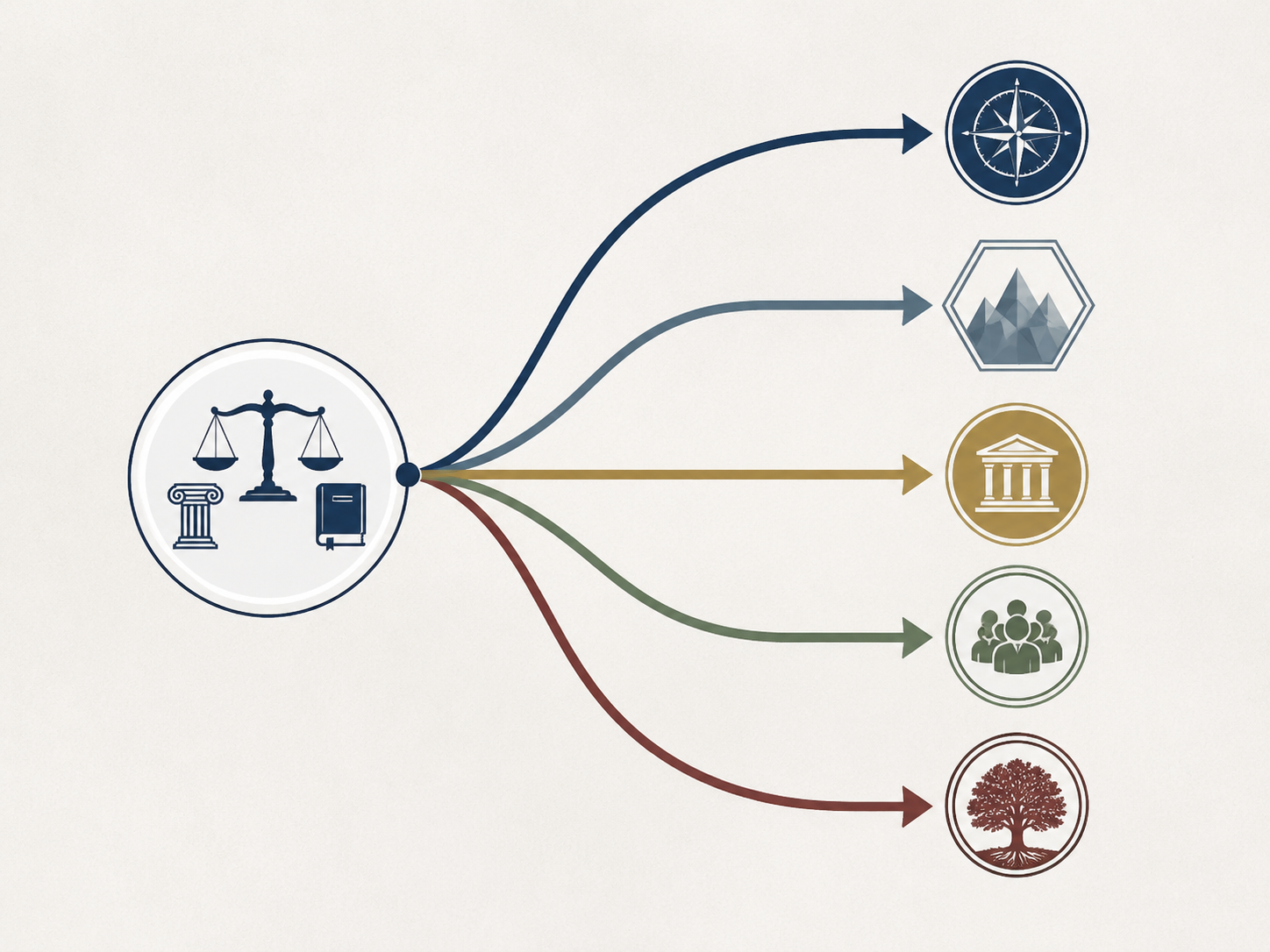
The Yale framework is useful because it gives names to the choices courts have already been making. It identifies five approaches state courts have used in multistate search-and-seizure conflicts: forum procedural law, territorialist, multifactor balancing, state-constitutional analysis, and exclusionary-rule analysis.[4] The point is not to memorize a taxonomy. The point is to know which fact becomes decisive under each approach before the suppression deadline has passed.
| Approach | What the court tends to privilege | What defense counsel should collect early |
|---|---|---|
| Forum procedural law | The law of the court where the prosecution is pending | Forum suppression cases, forum constitution text, forum exclusionary-rule doctrine, and any precedent treating suppression as procedural |
| Territorialist | The law of the place where the search or seizure occurred | Exact search location, warrant-issuing court, place of device access, place of records production, and where officers physically handled the evidence |
| Multifactor balancing | Several contacts, including forum interests, location, officer conduct, defendant residence, and prosecutorial use | A contact map showing officers, agencies, locations, warrants, victims, records custodians, devices, and charging venue |
| State-constitutional analysis | Whether the forum state’s own constitution limits the court’s admission of the evidence | State constitutional text, independent state-law cases, preservation language, and any doctrine separating state protections from the Fourth Amendment |
| Exclusionary-rule analysis | The purpose and reach of the exclusionary rule at issue | Which rule is deterrent, judicial-integrity, or privacy-based; whether good faith applies; and which officer the rule is supposed to regulate |
The forum procedural approach is attractive to prosecutors because it keeps the admissibility question inside the court already hearing the case. If State B prosecutes, State B’s suppression rules apply. The search may have occurred elsewhere, and out-of-state officers may have done the work, but the forum treats exclusion as a matter of local procedure. For defense counsel, the immediate burden is to find any limit in forum precedent. Some states describe exclusionary rules as procedural; others may ground them in constitutional guarantees or judicial integrity. That distinction can decide whether the forum can simply apply its own rule and move on.
The territorialist approach makes the place of the search matter most. That sounds cleaner than it is. In fraud cases, the “place” may be a home office in one state, a business premises in another, a cloud account accessed through a warrant served on a provider, bank records produced from a compliance center, or a phone seized in one state and searched later somewhere else. Counsel should not accept a single location label in the warrant return. The question is where the constitutionally relevant intrusion occurred.
Multifactor balancing gives courts room to account for messy investigations, but that flexibility has a cost. A balancing court may ask which state has the stronger interest, where the defendant resides, where the crime was felt, where officers acted, and where the evidence is being used. The defense file therefore has to be built like a jurisdictional chronology, not just a Fourth Amendment motion. If the record leaves the court with a vague sense of interstate cooperation, the state will usually have the easier story.
State-constitutional analysis changes the posture. The defense is no longer asking only whether one state should borrow another state’s rule. It is asking whether the forum court’s own constitution permits the court to admit the evidence. That is often the cleaner route when the prosecuting state has broader protections than the federal floor. It also requires discipline: the motion should separate the state constitutional argument from the federal Fourth Amendment argument, preserve independent state grounds, and avoid treating federal good faith as if it automatically answers the state question.
Exclusionary-rule analysis focuses less on geography and more on the purpose of suppression. If a state’s rule exists to deter its own officers, an out-of-state officer may complicate the remedy. If the rule protects judicial integrity or individual privacy, the forum court may have a stronger reason to exclude evidence offered in its own proceedings. This is where the officer’s identity stops being administrative detail and becomes doctrine.
Why the good-faith exception can become the whole fight
In federal court, litigators are used to the gravitational pull of good faith. In state constitutional litigation, that assumption can be dangerous. The Yale note’s observation that the highest courts of 14 states had rejected a state-law good-faith exception as of 2007 is dated, but still important as a warning against shortcuts.[4] A lawyer who stops at “the officers relied on a warrant” may miss the state-law rule that makes reliance irrelevant, insufficient, or materially different.
That matters especially in fraud investigations because the challenged evidence often comes from documents and devices that appear facially orderly. The constitutional violation, if there is one, may be buried in an overbroad attachment, a stale affidavit paragraph, a mismatch between the warrant and the premises searched, a search of digital material outside the warrant’s scope, or an officer’s assumption that another agency’s authority covered the act. If the applicable state rule rejects good faith, the court’s attention may shift from officer reasonableness to the warrant’s defect and the rule’s remedy.
The broader-protection point carries the same practical consequence. Nearly half of states having search-and-seizure protections beyond the Fourth Amendment means “federal law was satisfied” is sometimes only the beginning of the analysis.[4] In a multistate fraud case, counsel should ask which state supplies the most protective rule that can plausibly govern the evidence, then build the factual record that gives the court a lawful path to apply it.
The law-of-the-officer idea matches the work suppression lawyers already do
The Yale note proposes a “law-of-the-officer” approach: apply the search-and-seizure law of the officer who conducted the search.[4] No court has adopted that proposal as governing doctrine, and it should not be cited as if it were. Its value is different. It gives defense counsel a coherent way to organize the record around the person who used state power rather than the caption on the charging document.
That framing has an intuitive fairness to it. If a Minnesota state investigator searches a business file, a federal agent images a phone, a local officer enters a residence, and an out-of-state prosecutor later offers the combined evidence, a jurisdiction-neutral report hides the very actor suppression doctrine may need to regulate. The law-of-the-officer approach asks the court to reconnect the evidence to the officer’s authority and to the sovereign that constrained that officer at the time of the search.
As litigation strategy, the framework points to several questions that should be answered before drafting the motion:
- Which officer or agent physically entered each premises, seized each item, copied each device, or requested each records production?
- Was that person acting as a federal officer, state officer, local officer, task-force member, deputized agent, or assisting officer?
- Which warrant authorized the act, which judge issued it, and what jurisdiction supplied the warrant procedure?
- Did the evidence later move across state lines before review, extraction, filtering, or charging use?
- Which state’s search rule would be most protective if tied to that officer’s conduct?
Those questions are not limited to academic conflicts cases. They are the difference between arguing about a generic “multi-agency investigation” and arguing about the particular officer who crossed the threshold, held the warrant, opened the drawer, plugged in the extraction tool, or sent the records demand.
Fraud warrants make the officer-by-officer record harder to reconstruct
Fraud searches create a special kind of evidentiary sprawl. One warrant may target office records. Another may cover a residence. A third may reach electronic devices. A subpoena or warrant may pull bank or platform records from a custodian outside the charging state. Agents may divide responsibilities by expertise rather than jurisdiction: one team handles premises entry, another handles digital triage, another handles financial records, and another writes the narrative report.
That division of labor can make the suppression issue look smaller than it is. The affidavit may be federal, the search team mixed, the premises local, the device analysis remote, and the prosecution state-based. If counsel waits until the motion deadline to sort those layers, the state’s most convenient characterization may harden into the record.
A July 2026 report that the Georgia Bureau of Investigation issued a search warrant at a local mobile home center in connection with a multi-state fraud investigation is a smaller public example of the same procedural shape: state-level warrant activity tied to alleged fraud that crosses state lines.[5] The public report does not answer any conflict-of-laws question. It shows why the question cannot be confined to federal mega-cases.
A defense framework for preserving the choice-of-law issue
The first task is reconstruction. Counsel needs a search chart before a suppression theory. For each category of evidence, the chart should identify the location, warrant, issuing court, executing officer, agency, legal status of the officer, time of seizure, later review location, and prosecutorial use. Without that chart, the motion risks arguing doctrine against a blurred factual record.
| Evidence category | Authority questions | Choice-of-law use |
|---|---|---|
| Premises evidence | Who entered, who searched, who seized, and which warrant covered the location? | Supports territorial, officer-focused, and state-constitutional arguments |
| Phones and computers | Who seized the device, who searched it, where extraction occurred, and whether a second warrant was used? | Separates physical seizure from digital search if different rules or locations apply |
| Bank and business records | Who served the demand, where the custodian responded, and which sovereign compelled production? | Prevents records evidence from being treated as jurisdictionless paperwork |
| Task-force evidence | Was the actor federal, state, local, deputized, or merely assisting? | Links conduct to the officer’s source of authority and possible state-law constraints |
The second task is to plead alternatives without making them look interchangeable. If the forum’s law is protective, counsel may lead with state-constitutional analysis. If the search occurred in a state with a stronger exclusionary rule, territorialism may do more work. If the executing officer belonged to a sovereign with a stricter rule, the law-of-the-officer framework may be persuasive even though it is not adopted doctrine. If the court prefers balancing, the same factual record should show why the protective state’s interest is not incidental.
The third task is to isolate the exclusionary rule from the search rule. A state may define the right one way and the remedy another. It is not enough to argue that a warrant was invalid under State A law; counsel also has to show why State A’s remedy should govern in State B’s proceeding, or why State B’s own constitution requires exclusion once the evidence is offered there. The remedy question is where good faith, judicial integrity, deterrence, and privacy all become more than labels.
The fourth task is preservation. Because no single framework commands a national consensus, the record should preserve the factual predicates for more than one approach. That means asking for discovery that identifies officer roles, not merely agency participation; requesting warrant materials and returns for every location; obtaining logs for digital searches; and resisting stipulations that collapse “the government,” “the state,” or “law enforcement” into one actor.
The venue of prosecution is not the only map
A multistate fraud prosecution will usually come with a confident map: where the charges were filed, where the alleged scheme operated, where the money moved, where the victims or programs were located. Suppression requires a second map. It traces state power at the moment of search and seizure.
That second map may show that the decisive admissibility issue is not the forum named in the caption, but the officer tied to the evidence. In a fractured conflicts landscape, the lawyer who can reconstruct that connection early has a real argument for the most protective available rule. The lawyer who cannot may be left fighting the prosecution’s abstraction after the record has already been written.
References
- Federal agents serve search warrants in Minnesota fraud probe, AP News, Apr. 28, 2026.
- FACT SHEET: President Donald J. Trump Establishes New Department of Justice Division for National Fraud Enforcement, White House, Jan. 2026.
- DOJ Criminal Fraud Section 2025 Year in Review: Major Developments and Enforcement Priorities, Mintz, Jan. 30, 2026.
- Competing Exclusionary Rules in Multistate Investigations: Resolving Conflicts of State Search-and-Seizure Law, Yale Law Journal, 2017.
- GBI issues search warrant at local mobile home center in connection to multi-state fraud investigation, WTOC, Jul. 17, 2026.
Comments
Join the discussion with an anonymous comment.