
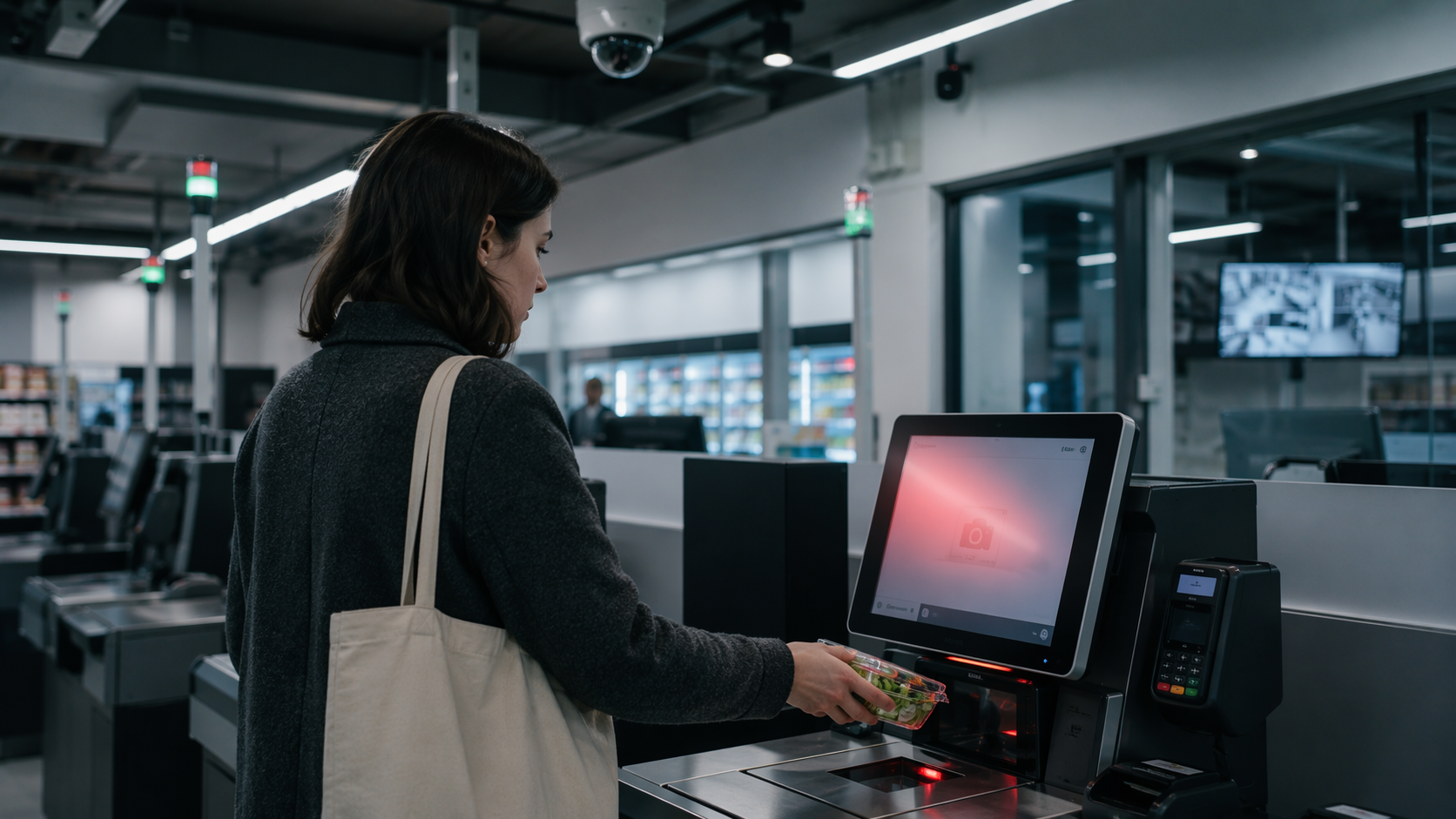
The self-checkout theft accusation usually does not begin with a dramatic shoplifting stop. It begins with a missed scan, a weight-sensor exception, a duplicated barcode, a customer moving too quickly, or a video flag that looks suspicious from the loss-prevention desk. Then the transaction stops being a checkout problem and becomes a proof problem: the customer is asked to explain, an employee repeats the accusation within earshot, police are called, a civil demand letter follows, or the customer’s image is retained in a surveillance system.
That is where legal analysis of self-checkout theft accusations becomes more complicated than a consumer-service script. A retailer may have a legitimate reason to investigate shrinkage. The liability question is narrower and more dangerous: when did suspicion become detention, publication, prosecution, or biometric processing without a legally sufficient basis?
The Point Where a Checkout Error Becomes a Claim
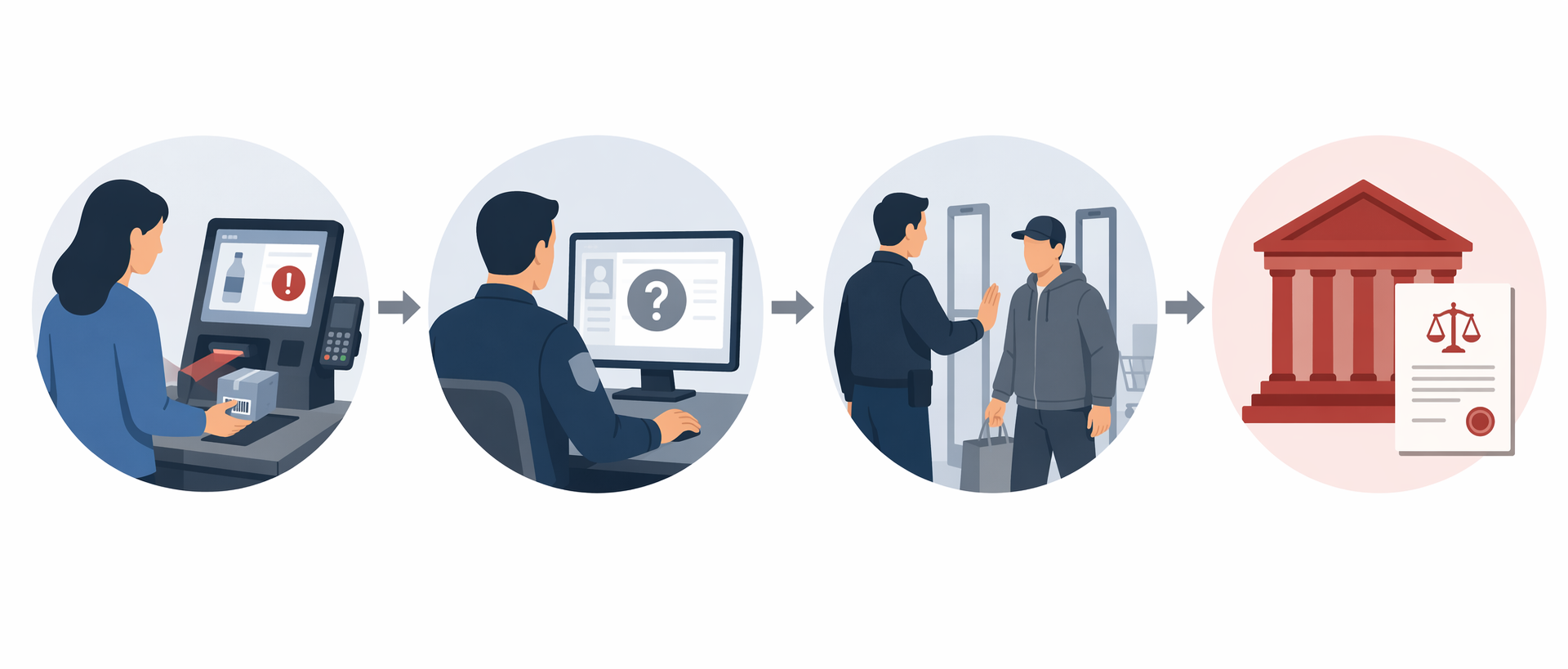
Four legal theories tend to appear when a self-checkout incident escalates. False imprisonment focuses on whether the customer was intentionally confined or restrained without adequate legal justification. Defamation focuses on whether a theft accusation was communicated to someone else in a way that harmed reputation. Malicious prosecution focuses on whether the retailer pushed the matter into criminal process without probable cause and with the required improper purpose or malice under the governing law. Biometric privacy claims focus on whether face recognition or similar technology captured, stored, matched, or shared identifiers in violation of a statute.
Those categories overlap in real files. A customer stopped at the door may also be accused in front of other shoppers. A store employee’s statement may become the basis for a police report. A civil recovery letter may arrive after the customer was never convicted. A face-recognition match may be part of the reason loss prevention approached the wrong person. The law does not treat those events as one undifferentiated “incident.” Each step creates its own evidentiary record and its own exposure.
Why the Lesleigh Nurse Verdict Still Frames the Risk
The most concrete warning remains the 2021 Mobile County, Alabama verdict in Lesleigh Nurse’s case against Walmart. A jury awarded Nurse $2.1 million after a self-checkout dispute that led to a civil demand letter even though the shoplifting charge was dismissed, according to accounts of the case.[1]
The verdict matters less because it predicts a normal case value, and more because it shows how a low-dollar checkout allegation can be converted into a high-exposure legal event. The alleged loss did not need to be large for the jury to hear a story about accusation, prosecution, and post-dismissal collection pressure. In a premises-liability or retail tort file, that sequence is exactly where defense-friendly facts begin to erode.
One figure from the Nurse trial is especially provocative, but it needs careful handling. Expert testimony reportedly stated that Walmart had charged approximately 1.4 million people over two years and collected more than $300 million through civil demand letters.[1] That is not the same thing as an independently audited national finding about all retailers, and it should not be repeated as if it were established outside that litigation. It is still important because it put a jury in front of a system-level civil recovery narrative rather than a single-store misunderstanding.
For counsel, the civil demand letter is often the document that changes the temperature of the case. A retailer can argue it was trying to recover losses. A plaintiff can argue the retailer kept pressing a theft theory after the criminal basis weakened or disappeared. The difference will usually turn on timing, content, internal review, and whether anyone reconsidered the accusation before sending a demand.
The Claims Are Built From Small Factual Choices
False Imprisonment
False imprisonment exposure starts with restraint. In a self-checkout file, restraint may be physical, verbal, or practical: an employee blocks the exit, directs the customer to a room, keeps the receipt or merchandise, tells the customer they cannot leave, or creates a situation where a reasonable person would believe leaving is not permitted. The stronger the retailer’s shopkeeper-privilege argument, the more the file will focus on reasonable suspicion, reasonable manner, and reasonable duration under the applicable state law.
The duration question is rarely just a stopwatch issue. A short stop can still look abusive if the accusation was thin, the employee was loud, or the customer was threatened with arrest. A longer stop can become more defensible if staff promptly reviewed video, checked receipts, involved a supervisor, and released the customer once the mistake was apparent. The bad fact is the preventable delay after the store has enough information to know the customer may be innocent.
Defamation
Defamation turns on communication. A quiet request to review a receipt is not the same litigation fact as “you stole that” shouted near the exit. Publication may occur in front of other customers, family members, police, store contractors, or employees who had no need to hear the accusation. In some jurisdictions and fact patterns, accusing someone of theft can carry heightened reputational significance, but privilege, truth, opinion, and qualified reporting defenses will matter.
The self-checkout setting adds a recurring evidentiary problem: employees often describe what the system showed them, not what they personally saw. “The machine flagged you” may feel safer than a direct accusation, but it still can communicate suspicion. If the underlying flag was wrong and the statement travels beyond those who needed to investigate it, the technology does not necessarily insulate the speaker.
Malicious Prosecution
Malicious prosecution claims are harder than embarrassed-customer claims because they usually require more than a mistaken accusation. The plaintiff generally must show that a criminal or quasi-criminal proceeding was initiated or continued without probable cause, that the proceeding ended favorably to the plaintiff, and that the defendant acted with the mental state required by that jurisdiction. The exact elements vary by state, which is why these claims should not be flattened into a national rule.
The factual triggers are familiar: police are called before video is reviewed, an employee signs a complaint after learning the item may have scanned incorrectly, a store pushes charges based on a policy rather than individualized facts, or the retailer continues to pursue civil recovery after dismissal. Booking, fingerprinting, court appearances, missed work, and searchable criminal records can turn a checkout dispute into a damages case with a much longer tail.
Biometric Privacy and Surveillance
Biometric privacy risk is not limited to the moment a customer is stopped. It can arise earlier, when a retailer captures or analyzes a face, compares it against a watchlist, retains a template, or shares information with a vendor. The claim depends on the statute. Illinois-style biometric litigation is not the same as a general consumer-protection theory, and a state without a private biometric right of action may produce a very different case.
The Federal Trade Commission’s Rite Aid order is the regulatory counterpart to the private tort story. In December 2023, the FTC announced a five-year ban on Rite Aid’s use of facial recognition technology after alleging that the company’s deployment generated thousands of false positives and disproportionately affected Black and Asian customers.[2] That was not a self-checkout false-imprisonment verdict, but it is directly relevant to retail surveillance governance: false positives at scale can become an enforcement problem, not merely a customer-relations problem.
The Numbers Show Pressure From Both Directions
Retailers did not adopt self-checkout enforcement in a vacuum. Shrinkage is real, and self-checkout creates opportunities for intentional theft, accidental non-scans, barcode switching, and simple user error. Capital One Shopping Research reported in January 2026 that self-checkout can see up to four times the shrinkage of staffed registers, comparing 3.75% with 0.21%.[3] ZipDo’s cited annual loss figure of $15.3 billion belongs in the same general risk discussion, although it should be treated as one estimate within a broader range rather than a precise measure of every retailer’s experience.[4]
That economic pressure explains why retailers invest in exception reporting, cameras, receipt checks, and AI-assisted monitoring. It does not answer the legal question created by false positives. A system that identifies more suspected events also creates more moments when an employee must decide whether to stop a person, accuse them, call police, or send a demand. The operational benefit and the tort exposure are connected, but they are not the same metric.
The consumer-side data is imperfect but too large to dismiss. LendingTree’s October 2025 survey of 2,050 respondents reported that 14% of self-checkout users said they had been falsely accused, and that 36% of theft incidents were accidental.[5] Because the survey is self-reported, it cannot establish a verified false-accusation rate across the retail sector. It does, however, support the narrower and more useful conclusion: a meaningful share of shoppers report accusation experiences, and accidental conduct is part of the self-checkout risk environment.
| Evidence Point | What It Supports | What It Does Not Prove |
|---|---|---|
| Nurse v. Walmart verdict | A self-checkout accusation can produce substantial jury exposure when prosecution and civil demand practices are part of the story. | It does not set a national value for every mistaken self-checkout accusation. |
| FTC Rite Aid order | Retail facial-recognition false positives can trigger regulatory enforcement at scale. | It does not decide private liability in every checkout-surveillance case. |
| LendingTree survey | Consumers report a measurable volume of false accusations and accidental theft events. | It does not independently verify each incident or establish causation. |
| Shrinkage research | Retailers face financial incentives to monitor self-checkout more aggressively. | It does not justify every detention, accusation, or police referral. |
AI Surveillance Makes the Escalation Faster
AI surveillance changes the tempo of the file. A cashier may miss a scan and resolve it at the register. A computer-vision system can flag a gesture, send an exception to a monitor, store the event, and invite loss prevention to treat the customer as a suspect before anyone has asked the simplest question: did the item actually scan?
The Everseen/Walmart “NeverSeen” narrative captures the evidentiary problem. Employees reportedly used the nickname “NeverSeen” for Everseen’s technology because of frequent errors.[6] That kind of internal language can matter. If a retailer knows a system frequently misfires but still lets the alert drive stops, trespass bans, civil demands, or police reports, the case stops looking like an isolated mistake.
This is not an argument against computer vision as a category. It is an argument against treating the alert as if it were adjudication. The alert may be a reason to review a transaction. It is not, by itself, a witness with memory, judgment, and cross-examination exposure. When employees cannot explain what the system detected, how often it errs, who reviewed the clip, or why the customer was still accused after review, automation becomes a discovery burden.
Legislatures Are Beginning to Treat Self-Checkout as a Staffing and Safety Issue
The policy environment is also moving. As of April 2026, USA TODAY reported that seven states — California, Connecticut, Massachusetts, New York, Ohio, Rhode Island, and Washington — were considering restrictions on self-checkout.[7] Those proposals were pending as of that report and could change, stall, or pass in amended form. Their significance is not that they create immediate nationwide liability. Their significance is that self-checkout is being reframed as a labor, safety, theft, and consumer-protection issue rather than a purely operational store-design choice.
For in-house counsel, proposed restrictions can become relevant even before enactment. They show what lawmakers, unions, consumer advocates, and regulators are watching: staffing ratios, age-restricted goods, theft prevention, customer monitoring, and the burdens shifted onto shoppers. A retailer defending a false-accusation case may eventually face a jury that already understands self-checkout as a contested practice, not a neutral convenience.
Case Value Depends on the Escalation, Not the Price Tag
Settlement benchmarks should be used carefully. The Humanoid Liability guide places brief detention matters in a rough $5,000 to $50,000 range and false-arrest matters involving booking in a rough $50,000 to $300,000-plus range.[8] Those figures are orientation points for practitioners, not promises of value. Jurisdiction, video evidence, employee conduct, criminal-case outcome, medical or emotional-distress evidence, reputational harm, and punitive-damages facts can move a case outside any guidepost.
The price of the allegedly missed item is often the least important number in the file. A $12 accusation can become expensive if the customer was held publicly, photographed, banned, charged, booked, or pursued through a civil demand process after exculpatory facts were available. Conversely, not every mistaken accusation creates a viable lawsuit. A prompt, private, reasonable inquiry that ends when the error is discovered may be unpleasant without becoming a strong claim.
The recurring litigation question is where the retailer could have stopped. Before the exit stop? Before the accusation was spoken in public? Before police were called? Before the civil demand letter was mailed? Before a face match was retained or shared? Those moments are where policies, training, vendor contracts, and incident reports become more important than the kiosk itself.
A Recurring Liability Category, Not a One-Off Checkout Dispute
Self-checkout false accusations now sit at the intersection of shrinkage economics, automated surveillance, civil recovery practices, and privacy regulation. The evidence does not support the lazy conclusion that every self-checkout stop is unlawful. It does support the more serious conclusion that the accusation pipeline is repeatable, documentable, and increasingly visible to juries, regulators, and legislators.
That is the litigation risk. A retailer may begin with a machine alert and end with a tort file, a regulatory inquiry, or a privacy claim. The legal exposure grows when the retailer treats suspicion as proof and makes the customer, the employee, and eventually counsel clean up the consequences.
Lex Machina Review provides source-cited editorial analysis only. This article is not legal advice for any particular customer, retailer, jurisdiction, or case.
References
- Lesleigh Nurse v. Walmart, Mobile County, Alabama, 2021.
- Rite Aid Banned from Using AI Facial Recognition After FTC Says Retailer Deployed Technology without Reasonable Safeguards, Federal Trade Commission, December 2023.
- Self-Checkout Shoplifting Statistics, Capital One Shopping Research, January 2026.
- Self-Checkout Theft Statistics, ZipDo.
- Self-Checkout Survey, LendingTree, October 2025.
- Everseen/Walmart “NeverSeen” Error Narrative.
- Seven States Are Considering Self-Checkout Restrictions, USA TODAY, April 2026.
- Humanoid Liability Guide.
Comments
Join the discussion with an anonymous comment.