
The hard part of the legal investigation into the Asheville Shakey's Bar shooting motive is that two things can be true at once. Police can say they have no evidence, at this early stage, that the gunman acted from bias or hate. Investigators can also keep asking whether bias evidence exists.
That distinction matters in this case because the reported sequence begins inside a gay bar and ends with gunfire directed at the building. Arturo Castillo Palomar, 26, of Saluda, North Carolina, was reportedly ejected from Shakey's in downtown Asheville for “concerning behavior” around 2 a.m. on July 15, 2026. He then returned and fired multiple rounds at the building before an Asheville Police Department officer on scene fired and killed him, according to reporting based on the State Bureau of Investigation's identification of the suspect.[1]

A shooting at a gay bar carries obvious fear for the people inside and for the wider LGBTQ+ community. It does not, by itself, prove a chargeable hate motive. That is the line a prosecutor would have to hold in court, and it is also the line public officials have to explain without sounding as if they have already closed the file.
Asheville Police Interim Chief Jackie Stepp publicly said there was “no evidence at this time that suggests the shooter had any type of bias or hate motive.”[2] The phrase “at this time” is doing real work. It is a preliminary evidentiary statement, not a legal conclusion about motive for all purposes and not a ruling from the district attorney.
The Washington Blade separately reported that the SBI confirmed the hate crime angle is “currently under investigation” and that findings will be turned over to the district attorney.[3] That report does not mean investigators have found bias evidence. It means the question has not been procedurally eliminated. As of July 20, 2026, five days after the shooting, that is the more careful reading.
What the early facts do, and do not, establish
The public record so far supports a narrow timeline, not a motive theory. Shakey's said in a July 15 Instagram statement that staff removed an individual whose “behavior caused concern,” locked the doors, called 911, and followed dispatcher instructions.[4] That sequence is important because it shows staff treating the person as an immediate safety problem before the shots were fired. It does not explain why he returned with a gun.
There is no public information, in the materials now available, about Palomar's prior record, personal history, communications, affiliations, or statements that would support an anti-LGBTQ+ motive. Body camera footage has not been released. The exact moments before the officer fired remain under investigation. Buncombe County District Attorney Todd Williams has not issued a public charging statement in the materials reviewed.
That leaves the case in an uncomfortable but familiar posture: the social meaning of the target is visible before the legal proof of motive is. Patrons and staff do not need a completed SBI file to understand why gunfire at a gay bar feels different from gunfire at an unmarked wall. But a hate crime classification requires more than the identity of the place attacked. It requires evidence connecting the defendant's conduct to a protected characteristic covered by the applicable law.
North Carolina's hate crime statute does not cover LGBTQ+ bias
North Carolina's state hate crime statute, N.C.G.S. § 14-401.14, covers acts committed because of race, color, religion, nationality, or country of origin. It does not include sexual orientation or gender identity.[5][6]
That omission is not a technical footnote. It controls the state-law analysis. If investigators never find evidence that Palomar acted from anti-LGBTQ+ bias, the hate crime question may remain only theoretical. But if investigators did find such evidence, North Carolina's current state enhancement framework still would not treat sexual-orientation or gender-identity bias as a covered category.
| Law | Covered bias categories relevant here | Consequence for the Shakey's analysis |
|---|---|---|
| N.C.G.S. § 14-401.14 | Race, color, religion, nationality, country of origin; not sexual orientation or gender identity[5][6] | Anti-LGBTQ+ motive would not trigger the North Carolina hate crime enhancement described in the current sources. |
| 18 U.S.C. § 249, the Shepard-Byrd Act | Includes crimes motivated by actual or perceived sexual orientation or gender identity[5] | A federal hate crime pathway could exist if evidence supports bias motivation and federal prosecutors pursue it. |
This is where casual discussion of the case can go wrong. Saying “North Carolina has a hate crime law” does not answer whether that law reaches this alleged motive. Saying “the shooting happened at a gay bar” does not answer whether investigators can prove bias. The operative state-law question is narrower: even assuming later evidence showed anti-LGBTQ+ motivation, is that category included in the statute? On the materials now available, the answer is no.
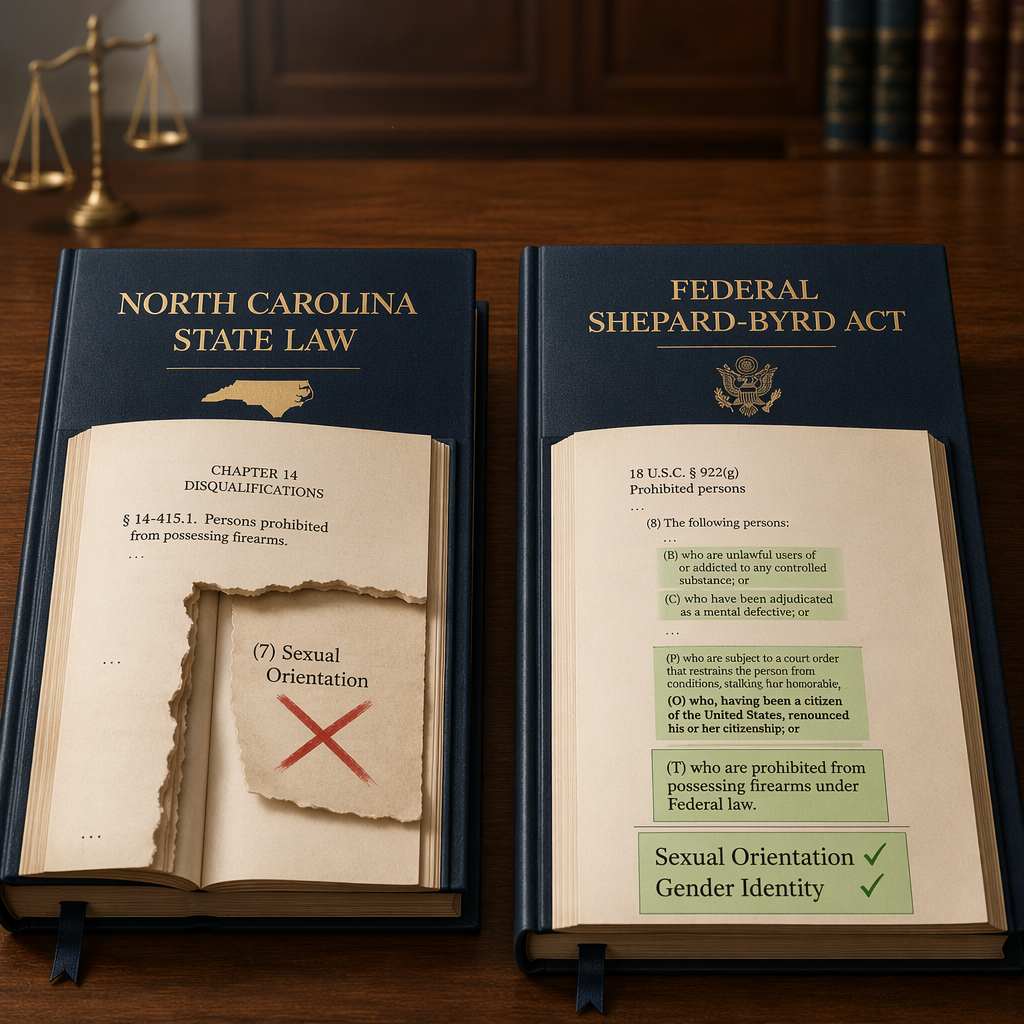
The broader statutory context confirms the gap rather than softening it. North Carolina has been identified as one of 13 states whose hate crime statutes exclude sexual orientation, and reporting on state hate crime protections has noted that no Southern state has a hate crime law covering anti-transgender crimes.[5] Those observations are useful context, but they are not necessary to decide the immediate state-law point. The text of the North Carolina coverage described in the current sources is enough.
The federal route is possible, not automatic
The federal Matthew Shepard and James Byrd Jr. Hate Crimes Prevention Act, codified at 18 U.S.C. § 249, is the statute that changes the legal map. Unlike North Carolina's statute, the federal law covers crimes motivated by actual or perceived sexual orientation or gender identity.[5]
That does not mean the Shakey's shooting is a federal hate crime. It means that if investigators uncover evidence of anti-LGBTQ+ motive, the relevant hate crime vehicle described by the current materials would be federal, not state. The FBI or federal prosecutors would still need evidence that satisfies the statute. The public record does not currently provide that evidence.
For practitioners, that distinction affects how the case should be evaluated. A state prosecutor can assess homicide, weapons, assault, property damage, or other state offenses if supported by the facts, but the LGBTQ+ bias enhancement described in public discussion is not available under North Carolina's hate crime statute as summarized in the available sources. A federal referral would require a different charging authority and a different evidentiary showing.
How to read “no evidence at this time”
There is a courthouse difference between “no evidence at this time” and “no hate crime as a matter of law.” The first is an investigative status statement. The second would be a legal conclusion, and on this record it would have to account for both the absence of public bias evidence and North Carolina's statutory omission.
Stepp's statement properly cautions against assuming motive from setting alone.[2] The reported SBI posture properly leaves room for new evidence.[3] Neither statement supplies what is missing from the other. The police chief's statement does not erase the possibility that investigators later find communications, statements, planning evidence, or other proof bearing on motive. The SBI's continued inquiry does not imply that such proof already exists.
The missing district attorney statement also matters. Police and the SBI investigate. Prosecutors decide what charges can be supported and, in a possible federal hate crime matter, whether state facts should be referred or coordinated with federal authorities. Until a charging authority speaks, public statements from law enforcement should be read as investigative markers, not final classifications.
The classification gap the case exposes
The Shakey's shooting does not need to be prematurely labeled to reveal the legal problem. The problem is visible in the conditional: if the SBI investigation produces no evidence of anti-LGBTQ+ bias, a hate crime charge may never become a live issue. If it does produce such evidence, North Carolina's state hate crime statute still does not provide the relevant LGBTQ+ bias enhancement.
That leaves federal law as the only hate crime pathway described by the current materials for sexual-orientation or gender-identity bias. The practical consequence is not just symbolic. It affects who investigates, who charges, what elements must be proved, and how quickly public reassurance can outrun the legal record.
For the people inside Shakey's, the immediate work was not statutory interpretation. Staff removed a person whose behavior alarmed them, locked doors, called 911, and followed instructions while danger returned to the building.[4] The law arrives after that, with categories that are both powerful and incomplete. In North Carolina, the incompleteness is the point: even compelling evidence of anti-LGBTQ+ motive would have to look beyond the state hate crime enhancement and toward the federal Shepard-Byrd Act.
References
- Suspect killed in officer-involved shooting outside Asheville bar identified: SBI, WLOS
- Gunman killed after opening fire outside North Carolina gay bar, The Advocate
- Authorities investigate officer-involved shooting outside Asheville gay bar, Washington Blade
- Shakey's posts statement after fatal shooting outside bar, WLOS
- NC Hate Crime Legislation | Speaking Into A Void, The Assembly NC
- North Carolina Hate Crime Laws 2026 - All You Need To Know, PRJ Law
Comments
Join the discussion with an anonymous comment.