
The legal center of the Shakira tax fraud acquittal is not fame, choreography, or the optics of a long-running celebrity dispute. It is a calendar. For the 2011 tax year, the Spanish Tax Agency, AEAT, proved 163 days of physical presence in Spain. Article 9.1 of Spain’s Personal Income Tax Law, LIRPF, uses 183 days in Spanish territory during the calendar year as one route to individual tax residence. The administration was therefore 20 days short, yet still argued that Shakira should be treated as Spanish tax resident by using the doctrine of sporadic absences to close the gap.[1][2]
The Audiencia Nacional rejected that construction in its 2026 ruling, described in public reporting as dated April 15 and first reported on May 18. The court held that the tax administration could not convert a proven 163-day presence into tax residence by counting days outside Spain as if they were Spanish days under the sporadic absences rule. It also rejected the idea that the taxpayer bore the burden of proving non-residence once AEAT had assembled a circumstantial file from travel, mobile, card, professional, and personal traces.[2][3]
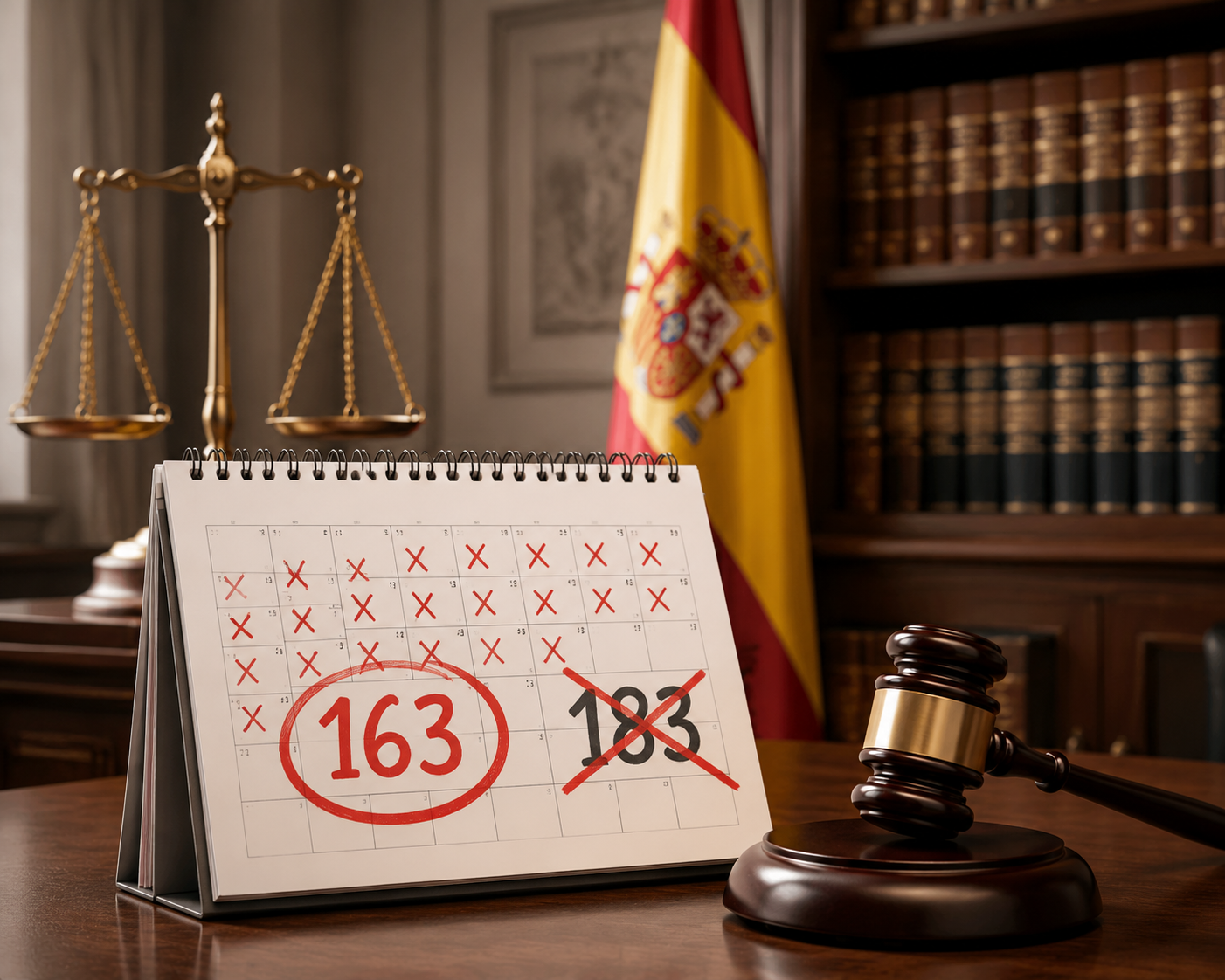
The 183-Day Rule Did the Work AEAT Wanted Doctrine to Do
Article 9.1 LIRPF provides several routes to Spanish tax residence. The most mechanical is presence in Spain for more than 183 days during the calendar year. A separate connecting factor looks to whether the taxpayer’s main base or center of economic activities is in Spain, and another presumption may arise where the taxpayer’s non-legally separated spouse and dependent minor children habitually reside in Spain.[1]
For advisers trained on residence tests that are broken into detailed day-counting categories, the Spanish rule can look deceptively simple. Burges Salmon’s comparison with the U.K. Statutory Residence Test is useful for precisely that reason: the U.K. framework is highly structured, while the Spanish test leaves substantial room for factual and evidentiary dispute around presence, absences, economic connections, and family links.[1]
That room is not unlimited. In the 2011 Shakira case, the proven number mattered because it was below the statutory threshold. The court did not say that 163 days is close enough to 183. It said the opposite: if the administration relies on the day-count route, it must prove the days. The missing 20 days could not be supplied by legal atmosphere.
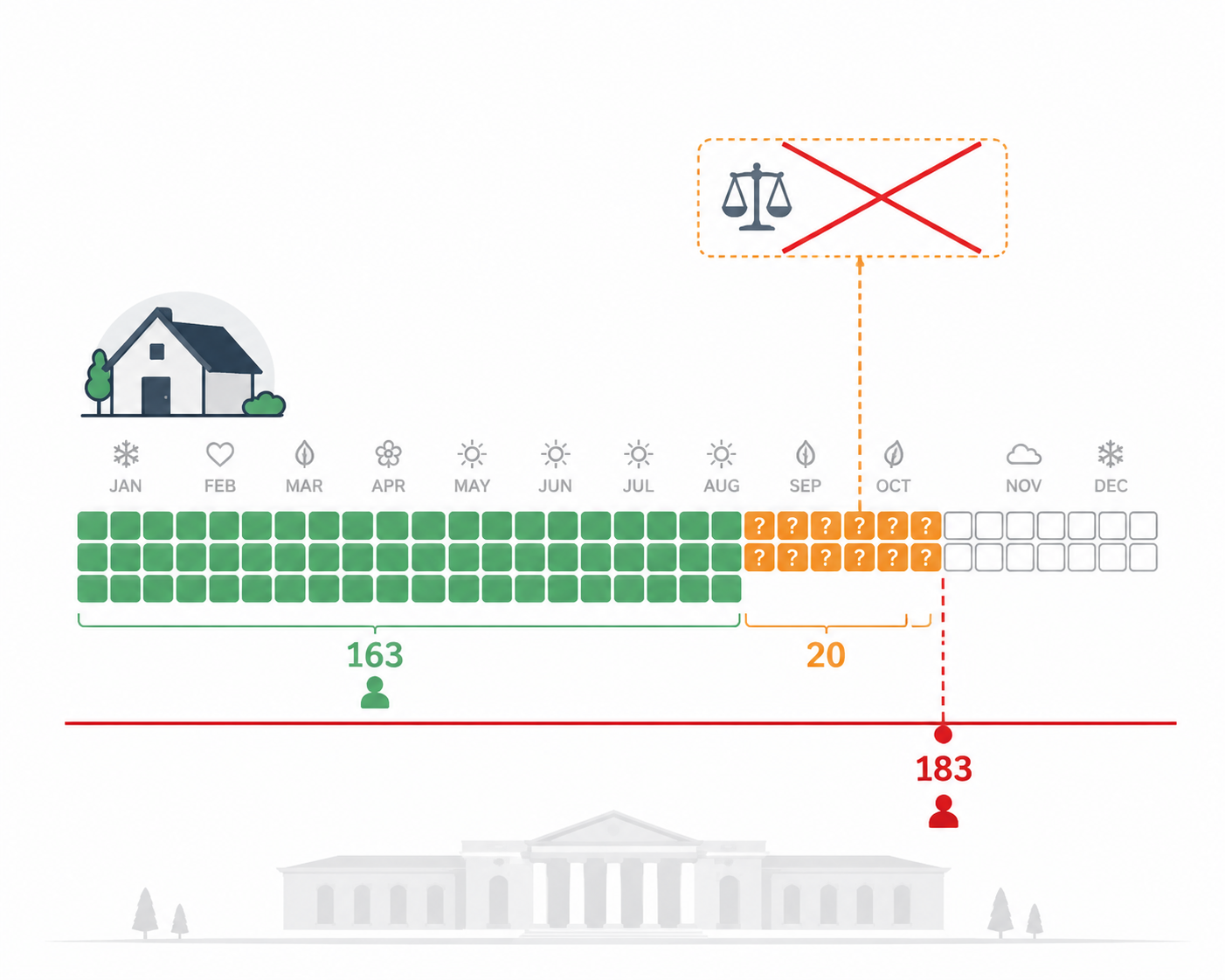
Why Sporadic Absences Could Not Supply the Missing 20 Days
The doctrine of sporadic absences has a sensible function when properly confined. It prevents a person who is ordinarily present in Spain from defeating residence merely by taking temporary trips abroad. If a taxpayer spends the year in Spain but leaves for short intervals, those absences may still be treated as part of Spanish residence unless the taxpayer proves tax residence elsewhere in the terms required by the statute.[1][2]
AEAT’s difficulty was that this was not the pattern the court found. The administration had not established that Shakira was present in Spain for most of the year and merely departed on temporary trips. It had established 163 days. Del Canto Chambers’ analysis of the ruling emphasizes the court’s distinction between using sporadic absences to characterize temporary departures from an already Spanish-centered presence and using the doctrine to manufacture the statutory threshold where the taxpayer was physically absent for most of the year.[2]
That distinction is the practical holding. Sporadic absences are not a reserve tank of deemed days. They do not allow the administration to say: we have less than 183 days, but the absences feel insufficiently foreign, so the threshold is met. The doctrine depends on the taxpayer’s habitual presence in Spain; it cannot be used to prove that habitual presence in the first place.
The evidentiary file assembled by AEAT was not trivial. Bloomberg Tax described a reconstruction built from flight records, mobile phone data, credit card activity, concert schedules, social media, and other traces.[3] Such materials can be probative. The point is narrower and more important: after the reconstruction is complete, the legal question remains whether the administration has proved the statutory fact it needs to prove. A mosaic is not a substitute for the rule it is trying to satisfy.
The Burden of Proof Stayed With the Administration
The ruling’s second major implication is evidentiary. AEAT’s approach, as rejected by the court, effectively required the taxpayer to disprove Spanish residence after the administration had presented enough circumstantial material to make residence plausible. The Audiencia Nacional did not accept that shift. The tax administration, not the taxpayer, bore the burden of proving that the statutory conditions for Spanish residence were met.[2]
This matters more than it may appear from outside tax litigation. Residence disputes are often reconstructed years later, when calendars have been overwritten, devices changed, assistants moved on, and travel evidence survives unevenly. If the burden can quietly migrate to the taxpayer whenever the administration produces a persuasive narrative, the 183-day test loses much of its statutory discipline. The taxpayer is then litigating against an impression rather than a threshold.
None of this means that mobile high-net-worth taxpayers are beyond scrutiny. AEAT has a legitimate concern when individuals with substantial Spanish links claim residence elsewhere while spending significant time in Spain. The ruling does not disable audits built on travel records, devices, bank activity, household evidence, or professional schedules. It insists that those materials be used to prove the legal test, not to relocate the burden after the test remains unproved.
The Family-Nucleus Argument Was Too Thin
AEAT also relied on personal connections in Spain. The court gave that argument limited force. Under Article 9.1 LIRPF, Spanish residence can be presumed where a taxpayer’s non-legally separated spouse and dependent minor children habitually reside in Spain. The 2011 dispute did not fit that statutory model. The relationship at issue was a non-marital romantic relationship, and there were no minor children forming the kind of legally relevant family nucleus contemplated by the provision.[1][2]
This is a modest but useful clarification. A partner, a home, press photographs, and public assumptions about where a relationship is centered may be relevant background facts. They do not automatically perform the function of a statutory presumption. The court’s treatment resists a common evidentiary shortcut: beginning with a social conclusion about where a person’s life appears to be and then reading the tax statute backward from that conclusion.
Costs Turned the Judgment Into a Rebuke
The award of costs against AEAT is not an ornament to the judgment. ECIJA’s analysis characterizes the costs award as a finding of temeridad, or procedural recklessness, signaling that the court was troubled not only by the administration’s losing conclusion but by the way the case was pursued on the evidence presented.[4]
That is unusual institutional weight. Tax authorities lose cases; not every loss implies a rebuke. Here, the costs award makes the judgment harder to describe as an ordinary difference over close facts. The court saw an administration that had 163 days, needed more than 183, and tried to bridge the gap through a reading of sporadic absences and proof burdens that the court found legally unsustainable.[4]
For practitioners, the costs point changes the tone of the precedent even while the appeal remains pending. It suggests that the court viewed the case as beyond aggressive interpretation. Still, it should not be overstated. A costs award in this case does not mean every disputed residency reconstruction is reckless, nor does it immunize taxpayers whose records are incomplete. It does, however, warn against treating circumstantial density as proof of the statutory day count.
The Money at Stake, and Why the Totals Differ
The financial scale helps explain why the case has drawn attention beyond Spanish tax procedure. El País reported the disputed package as including €24.7 million in personal income tax, €2.6 million in wealth tax, €27.4 million in penalties calculated at 125%, and approximately €9.2 million in interest.[5] Depending on whether interest is included, the case is described either as roughly €54.7 million in assessments and penalties or as a roughly €60 million-plus package.[5]
Those figures should not be blended carelessly with the separate criminal matter for later years. In 2023, Shakira settled a criminal tax case concerning the 2012–2014 tax years, accepted a €7.3 million fine, and received a three-year suspended sentence; in that matter, she conceded Spanish tax residence for the relevant period.[6][7] The 2011 acquittal does not undo that settlement. It concerns a different year, a different procedural posture, and the administration’s proof of residence for 2011.
What Advisers Should Take From the Ruling Now
The ruling is useful for advisers, but it is not a license to advise by anecdote. Its strongest immediate lesson is documentary: residence should be managed and evidenced in real time. Del Canto Chambers stresses the risk of trying to reconstruct residence only after the dispute has hardened, when the taxpayer is left defending old movements through partial records and administrative inferences.[2]
| Issue | Practical consequence |
|---|---|
| Physical presence | Maintain contemporaneous travel records that can support a full-year day count, not just isolated trips. |
| Sporadic absences | Do not assume days outside Spain can be neutralized unless the statutory and factual conditions for the doctrine are actually met. |
| Foreign residence | Keep certificates, filings, housing, work, and family evidence aligned before an audit begins. |
| Personal ties | Separate social facts from statutory presumptions; a relationship is not automatically a tax-residence family nucleus. |
| Administrative reconstruction | Test whether each category of evidence proves the legal threshold, rather than merely making residence plausible. |
For clients who move frequently, the difficult work is not only counting days. It is preserving evidence in a form that will survive adversarial review. A calendar prepared after an audit notice is weaker than travel records, leases, professional commitments, tax filings, and family evidence maintained consistently during the year in question. The Shakira ruling rewards statutory proof, not casual confidence.
The Beckham Law context is a useful contrast. Spain has specific rules for qualifying inbound expatriates under its special tax regime, but those rules do not eliminate ordinary residence analysis for taxpayers outside that regime or for years and facts not covered by it.[8] Advisers should resist the temptation to treat Spanish residence as a single question with one practical answer for all mobile individuals.
The Supreme Court Appeal Keeps the Hard Questions Live
The legal implications of the Shakira tax fraud acquittal remain provisional because AEAT has appealed. Bloomberg Tax reported that the Spanish Tax Agency had filed a Supreme Court appeal by July 17, 2026, arguing that the Audiencia Nacional erred on the residence analysis.[3] No public briefing schedule or decision timeline is available.
The appeal matters for three reasons. First, the Supreme Court may clarify whether sporadic absences can ever be used in cases where proven physical presence falls below 183 days and, if so, under what constraints. Second, it may address how explicit the administration’s proof must be before any evidentiary burden can move. Third, it may give fuller treatment to foreign tax-residence evidence, including the Bahamas certificate issue identified by ECIJA and the interaction with Spain’s rules on territories classified as non-cooperative jurisdictions.[4]
The repayment consequences are also not final. Bloomberg Tax reported that repayment of the approximately €60 million assessment package remains stayed while the appeal is pending.[3] The acquittal is therefore a significant clarification and a serious rebuke of AEAT’s method for the 2011 year, but its durability for future disputes depends on how the Supreme Court treats sporadic absences, proof burdens, and foreign residency evidence.
References
- High profile and high stakes: The Shakira Spanish tax case — Burges Salmon
- Avoid Mistakes: The Spanish Tax Residence Shakira Ruling — Del Canto Chambers
- Shakira Tax Win Set to Face Supreme Court Appeal in Spain; Shakira's Spain Tax Win Shows Whenever, Wherever, Proof Counts — Bloomberg Tax
- When the courts rule against the tax authorities — ECIJA
- Shakira secures €60 million victory — El País
- Reuters reporting on Shakira’s 2012–2014 Spanish tax settlement — Reuters
- BBC reporting on Shakira’s 2012–2014 Spanish tax settlement — BBC
- Tax residency in Spain for individuals, the Beckham Law — Think FIDE
Comments
Join the discussion with an anonymous comment.