
The legal story begins at the aircraft door in Düsseldorf, where German Federal Police reportedly boarded after landing and arrested a passenger accused of slapping a flight attendant who had asked him to take his assigned seat. The reported flight had departed Samsun, Turkey, and the confrontation began when a 44-year-old German national of Turkish origin refused to sit next to a woman, citing Sharia law; according to English-language reports relying on Bild, he then insulted the female crew member and struck her in the face when she intervened. He later confessed, was released pending proceedings, and faces possible charges under German Criminal Code §223 for bodily harm and §185 for insult.[1]
That is enough to explain the public attention around the reported Sharia-law flight assault, but not enough to explain why the case matters legally. The harder question is why German officers could treat an alleged assault in the cabin as a German prosecutable matter when the flight originated in Turkey and the aircraft may not have been German-registered.
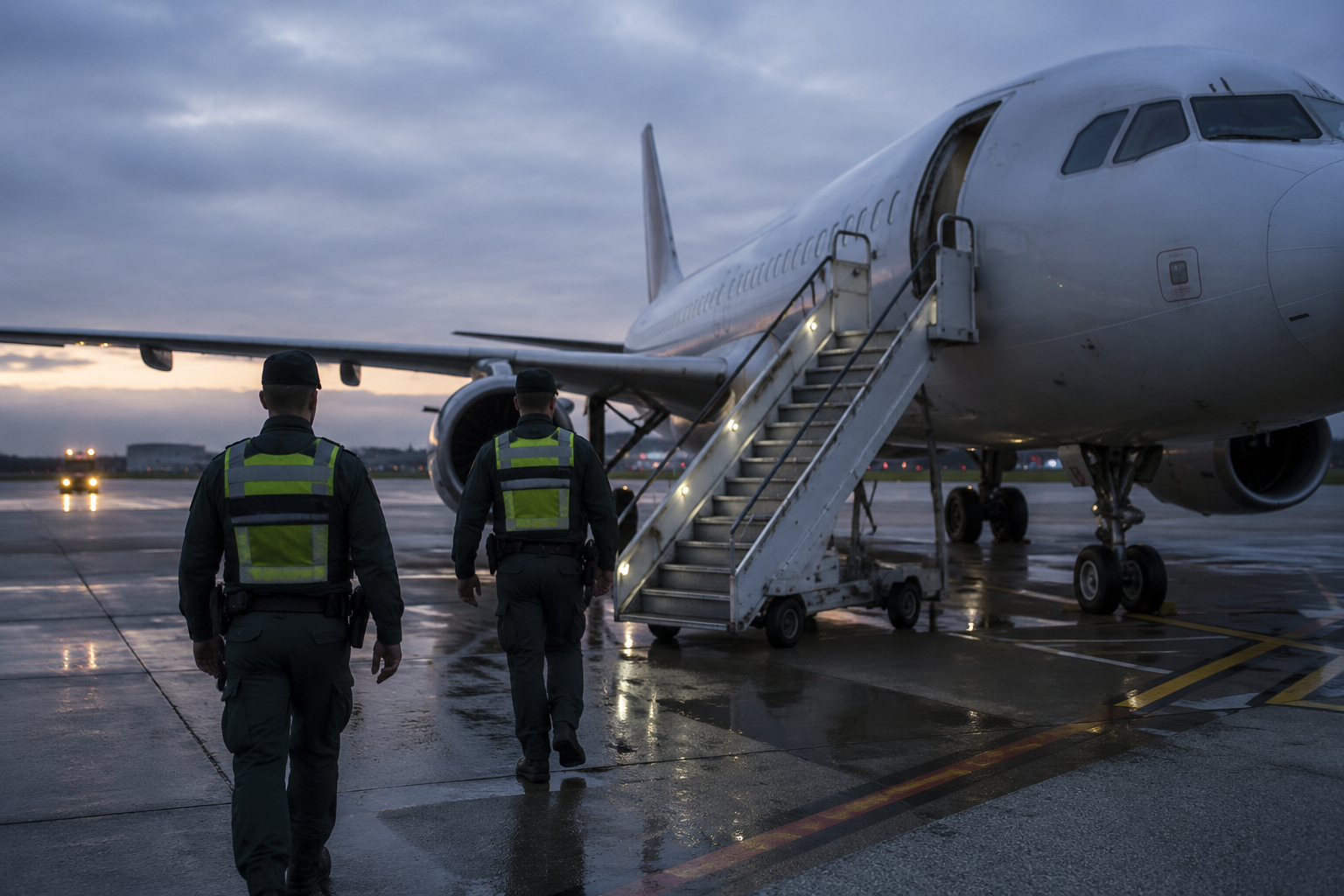
One factual caution belongs near the front. Turkish Airlines has denied that the incident occurred on one of its flights, telling the New York Post and Express that “the incident in question did not occur on a Turkish Airlines flight and is unrelated to Turkish Airlines.”[1] Initial English-language accounts identified Turkish Airlines because they followed Bild’s original reporting, but the carrier identification is disputed. The jurisdictional point does not depend on resolving that dispute. For the legal analysis, the decisive fact is that the aircraft landed in Germany.
What Germany Is Actually Prosecuting
The reported charges are ordinary German criminal-law categories applied to an unusual location. Section 223 of the German Criminal Code covers bodily harm and carries a maximum sentence of up to five years. Section 185 covers insult and carries a maximum sentence of up to one year.[1] The alleged facts map cleanly onto those labels: a slap to the face for bodily harm, and verbal abuse directed at the flight attendant and, reportedly, officers during the arrest for insult.
The flight attendant’s role should not disappear into the jurisdictional puzzle. Cabin crew are not courtroom abstractions; they are the people required to enforce seating, safety, and conduct rules in a confined aircraft, often before anyone with arrest powers can step in. Here, the reported religiously framed refusal to sit beside a woman became a compliance problem for the crew member, then allegedly became a physical assault on the same crew member. German police then had to convert that cabin episode into a file capable of surviving criminal procedure.
The Sharia-law detail matters because it is part of the reported confrontation. It is not, however, the legal engine of the case. Germany’s path to prosecution turns on jurisdiction over conduct aboard an aircraft, not on the passenger’s asserted reason for refusing the seat.
The Old Rule Made the Registration State the Center of Gravity
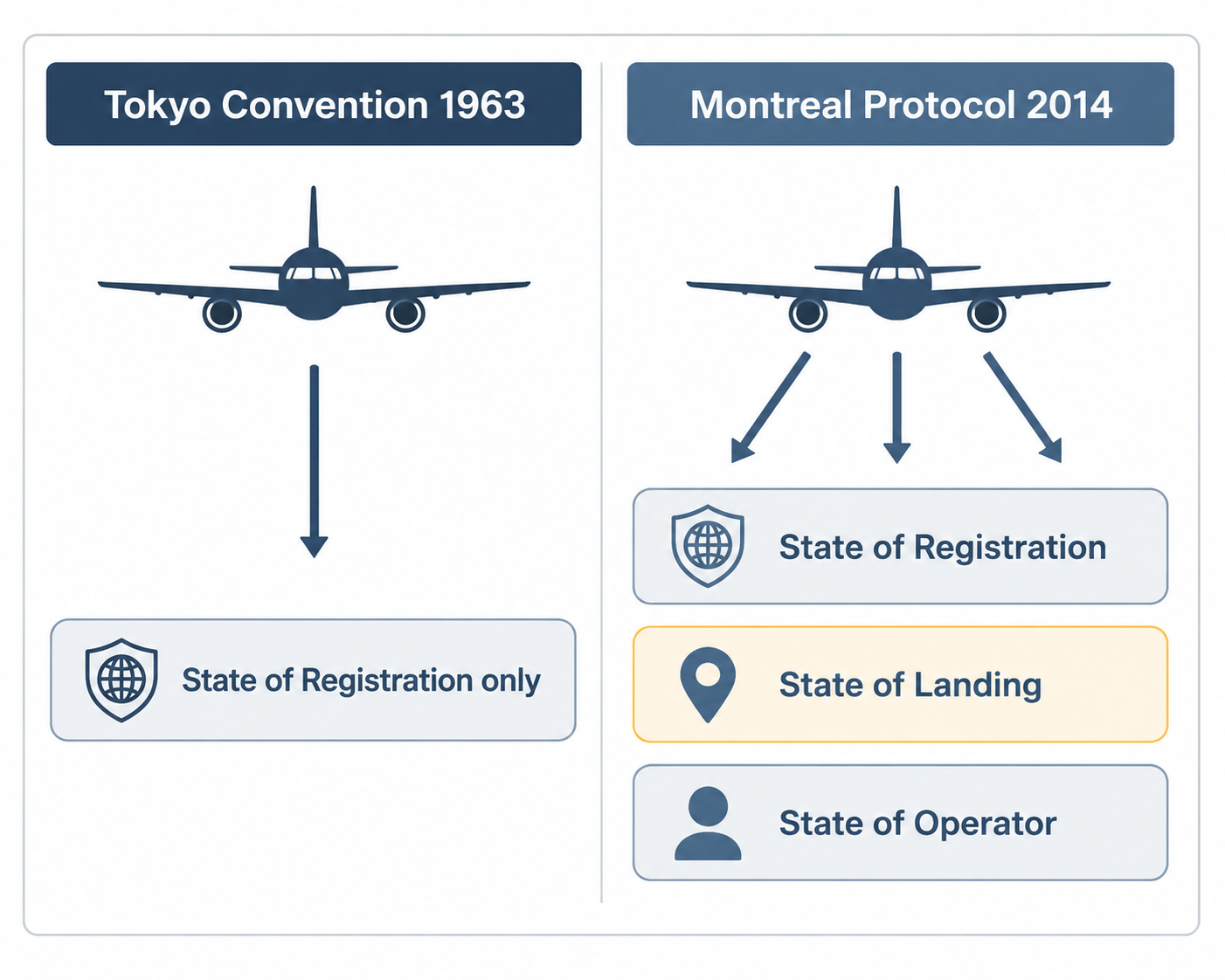
Under the original Tokyo Convention of 1963, jurisdiction over offenses and certain acts committed on board an aircraft was centered on the state of aircraft registration. That model made sense as a baseline rule in international aviation: aircraft move through many territories, and the registration state supplied a fixed legal anchor. But it also created a practical enforcement weakness. If the aircraft landed somewhere other than the registration state, the state physically receiving the aircraft, the crew, the witnesses, and the accused passenger could face limits on prosecution.[2]
In a cabin assault case, that distinction is not academic. The evidence arrives with the aircraft. The flight attendant is there. Other crew and passengers may still be reachable. The disruptive passenger can be met at the gate. If the landing state lacks a jurisdictional basis, the most convenient state for immediate enforcement may be left with detention and transfer questions rather than a straightforward domestic prosecution.
MP14 Gives the Landing State a Legal Door
The Montreal Protocol 2014 changed that architecture. Effective January 1, 2020, MP14 amended the Tokyo Convention framework by extending jurisdiction to the state of landing and the state of the operator, in addition to the state of registration.[2] That is the mechanism visible in Düsseldorf: Germany was not merely the place where the aircraft happened to stop; it was the state of landing, and MP14 gives that state a recognized basis to act.
| Framework | Jurisdictional emphasis | Effect in a Düsseldorf-style case |
|---|---|---|
| Tokyo Convention 1963 | State of aircraft registration | Germany’s position would depend far more heavily on whether another jurisdictional hook existed outside the landing itself. |
| Montreal Protocol 2014 | State of registration, state of landing, and state of operator | Germany can proceed as the landing state if the treaty conditions and domestic criminal-law requirements are satisfied. |
The point is not that MP14 automatically proves guilt or predetermines a sentence. It does something more preliminary and more important for enforcement: it keeps the case from falling into a jurisdictional gap at the moment when police can most practically intervene. Once German officers boarded, they were not only responding to a disturbance; they were acting in a legal environment that recognizes the landing state as more than a bystander.
That is why the disputed airline identity should be handled carefully but not allowed to obscure the main legal issue. If the aircraft was not operated by Turkish Airlines, the headline shorthand changes. The MP14 analysis still runs through Germany’s landing-state role, not through the commercial brand painted on the aircraft.
Why the Landing State Matters Operationally
Aviation law can make jurisdiction sound like a map exercise, but in unruly-passenger cases it is also a timing problem. Police do not meet an aircraft weeks later in the state of registration. They meet it at the arrival airport, after the captain and crew have managed the immediate safety risk and before passengers disperse into a terminal. MP14 aligns legal authority with that operational reality.
The Düsseldorf facts show the alignment clearly. The alleged victim was a crew member performing routine cabin enforcement. The alleged offender was still aboard or immediately available at arrival. The German Federal Police were able to board and arrest him after landing. The case could then be framed under German offenses rather than passed off as someone else’s problem because the conduct occurred in flight.[1]
Unruly Passenger Data Explains the Pressure for Enforcement Tools
The case also lands in a broader enforcement climate. HFW, citing IATA data, reported one unruly-passenger incident per 480 flights in 2023, worsening to one per 355 flights in 2024, based on 93,107 reports from more than 140 operators.[2] Those figures do not prove that MP14 caused more prosecutions, or that prosecution alone reduces cabin incidents. They do explain why airlines, regulators, and police agencies care about tools that make the landing airport a viable enforcement point.
For carriers, the operational burden appears before any lawyer files a charge. A crew member has to de-escalate or contain the conduct. The captain may have to decide whether to request police attendance on arrival or divert. The airline may have to preserve witness accounts, incident reports, and passenger information. The state that receives the aircraft is often the only state positioned to act while those facts are still fresh.
The Success Is Real, but the Treaty Map Is Still Thin
Düsseldorf is the tidy version of the story because the landing state had a path to act. The global picture is less tidy. Holland & Knight reported in January 2025 that MP14 had 52 parties and noted that the United States had not ratified it.[3] ICAO’s 2024 discussion of accelerating ratification referred to 47 states, a lower figure that may reflect timing or counting differences.[4] Either way, the ratification base remains limited when measured against the number of states participating in international aviation.
That limitation matters most in mixed-jurisdiction incidents. A flight may involve a state of departure, state of landing, state of registration, state of operator, passengers of multiple nationalities, and evidence scattered across all of them. MP14 improves the landing state’s position only where the relevant states have accepted the amended framework or where domestic law supplies another route. In a non-party setting, the old coordination problems can reappear.
The United States’ absence is especially conspicuous because of the scale of U.S.-connected aviation. A framework designed to close enforcement gaps loses practical reach when major aviation jurisdictions remain outside it. That does not make MP14 ineffective; it means its effectiveness is uneven. The protocol can work exactly as intended in one arrival airport while leaving comparable cases elsewhere dependent on narrower domestic statutes, registration-state action, or ad hoc cooperation.
Prosecution Is Only One Part of the Response
Criminal jurisdiction is not the only enforcement tool now under discussion. In the United Kingdom, a June 2026 proposal would allow drunk and disruptive passengers to face industry-wide flight bans through a national no-fly style database.[5] That kind of measure addresses a different point in the system. It is not about whether a landing state can prosecute a completed in-flight assault; it is about whether airlines and authorities can restrict future access to flights after serious misconduct.
The two approaches can coexist. MP14 is a jurisdictional instrument for criminal accountability after conduct occurs on board. A no-fly database is a preventive or administrative control aimed at future travel. Neither eliminates the need for clear evidence, fair process, and careful attribution. A passenger accused in a cabin incident still has defense rights; a crew member still needs the report to be taken seriously; police still need a legal basis that survives more than a headline.
What the Düsseldorf Case Proves—and What It Does Not
The Düsseldorf arrest proves a narrow but important point: when the state of landing has MP14-based jurisdiction and domestic offenses fit the alleged conduct, an international cabin assault need not vanish into registration-state formalities. The flight attendant did not have to be treated as the victim of a wrong that no convenient state could own. German officers could meet the aircraft, arrest the passenger, and process the case under German law.
It does not prove that every similar case will be prosecutable in the state where the aircraft lands. It does not resolve the carrier-identification dispute. It does not show that reported unruly-passenger increases are caused by any single social or legal factor. And it does not turn the reported Sharia-law refusal into the jurisdictional centerpiece. The centerpiece is MP14’s practical reallocation of authority to the state that receives the aircraft.
MP14 worked in the way it was designed to work for Germany as the landing state, while the limited ratification picture, including the United States’ absence, shows why the global framework still has gaps.
References
- Plane passenger invoked Sharia law to avoid sitting next to a woman — then attacked female flight attendant: cops, New York Post, July 17, 2026
- Flight Club: Unruly Passenger Behaviour on the Rise: Legal Remedies and Risk Mitigation for Airlines, HFW
- Trump 2.0: Will This Administration Ratify Montreal Protocol?, Holland & Knight, January 2025
- Accelerating the ratification of the International Unruly Air Passenger Treaty, ICAO Uniting Aviation
- Drunk and disruptive airline passengers could face industry-wide flight bans under new UK plans, Euronews, June 2, 2026
Comments
Join the discussion with an anonymous comment.