
A shipwreck discovery becomes a legal ownership dispute at the moment someone wants to do more than look. The first serious question is not how much the wreck is worth, how difficult the dive was, or how long the vessel has been missing. Absent a sovereign or statutory override, the first question is which doctrine is allowed to govern: salvage or finds.
That doctrinal choice is not cosmetic. Salvage rewards a party for recovering or protecting maritime property, but it leaves title elsewhere. Finds can transfer title to the finder, but only after abandonment is proven. The Sixth Circuit’s Fairport International decision is usually cited for the cleanest statement of the fork: the law of salvage and the law of finds “cannot be applied simultaneously.”[1]
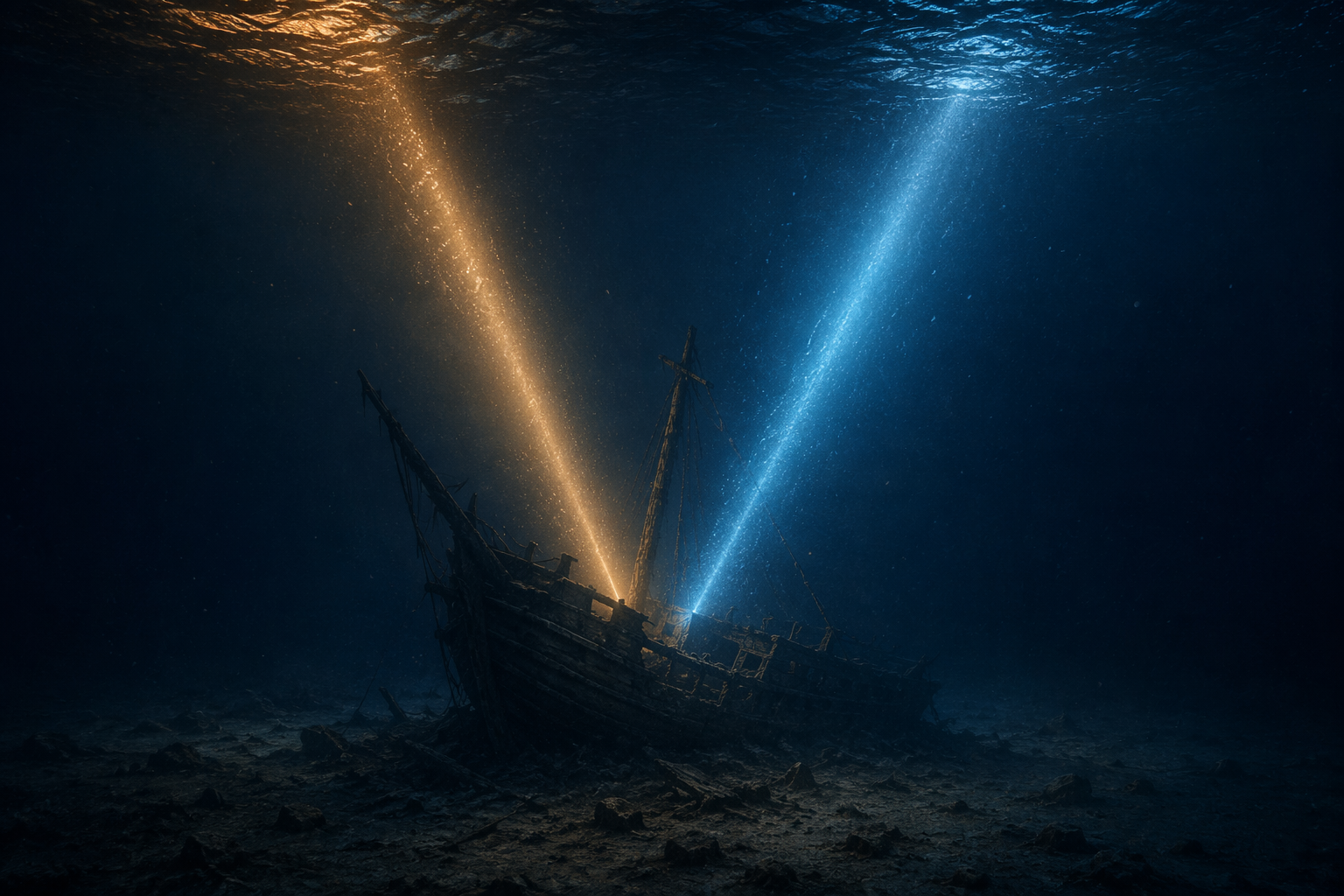
That is why shipwreck discovery legal ownership is a poor fit for the usual “finders keepers” instinct. The law does not start by admiring the discovery. It starts by asking whether anyone had legal title before the diver, archaeologist, investor, or salvage company arrived.
For readers following adjacent maritime-liability questions, the same instinct matters in other casualty settings too: before liability or ownership can be assigned, the legal status of the vessel and the applicable admiralty framework have to be identified. That is the connective tissue between wreck-ownership disputes and broader vessel-casualty analysis, including questions such as who bears liability after a ferry capsizes.
The Threshold Choice: Salvage or Finds
The practical difference can be stated without romance.
| Doctrine | What the claimant must show | What the claimant can receive |
|---|---|---|
| Salvage | A voluntary and successful effort to save or recover maritime property in peril | A salvage award and, in some circumstances, exclusive salvor-in-possession rights, but not title |
| Finds | Possession plus abandonment by the prior owner | Title to the property, if abandonment is proven |
The word “abandonment” carries the decisive weight. Property lost at sea is not treated as ownerless merely because it is inaccessible, old, or expensive to recover. Courts presume that lost maritime property has not been abandoned, and the party invoking the law of finds must prove abandonment by “strong and convincing evidence.”[1]
That burden explains why salvage is the default posture in many shipwreck cases. Salvage does not require the court to declare that title has vanished. It allows the court to recognize useful recovery work while preserving the legal interests of an owner, insurer, sovereign, or other claimant who has not legally abandoned the property.
The salvor-in-possession doctrine is the operational version of that compromise. A salvor that establishes possession and ongoing salvage activity may obtain exclusive rights to continue the salvage operation, but those rights are not ownership of the recovered property itself.[2]
Why Abandonment Is Hard to Prove
Abandonment is not proved by silence alone. A vessel may be lost, but an owner may still exist. Cargo may be unrecovered, but an insurer may have paid a claim and taken subrogated rights. A wreck may be centuries old, but a sovereign may claim continuing ownership. The court’s task is not to decide whether recovery was dramatic. It is to decide whether the prior owner relinquished title.
Direct abandonment is the cleanest case: an owner expressly gives up the property. Shipwreck cases rarely arrive so neatly. More often, the finder asks the court to infer abandonment from age, failed recovery attempts, the absence of a claimant, or the nature of the cargo. Those facts can matter, but the inference must satisfy the required evidentiary weight.
The Atocha is the familiar illustration of a law-of-finds outcome. The Spanish galleon sank in 1622, and the case has been treated as a leading example of finds because, after centuries, no owner appeared to claim the property.[3] It is tempting to make the Atocha stand for a broad proposition that old wrecks belong to finders. It does not. Its usefulness is narrower: it shows the kind of case in which the absence of an asserting owner, combined with the passage of time and the surrounding circumstances, can allow a court to apply finds.
The narrower lesson is the one practitioners can actually use. Age is evidence in context, not a substitute for abandonment. A wreck from the seventeenth century may be treated differently from a twentieth-century commercial vessel, but the distinction is not made by calendar alone. The court still asks what property is at issue, who might have succeeded to title, whether a sovereign or insurer is asserting rights, and whether the finder is asking the court to infer more than the record can support.
Titanic Shows the Pull of Salvage
RMS Titanic is a useful corrective to the idea that fame, depth, and difficulty naturally produce ownership. The Titanic litigation has centered on salvage rights, not a simple judicial handoff of title to the discoverer or recovery company. RMS Titanic Inc. was recognized as salvor-in-possession in the 1990s, with exclusive salvage rights associated with the wreck, and the U.S. government withdrew a challenge in January 2025 in related litigation over the company’s planned activities.[4]
The important word is “salvor.” A salvor-in-possession has a protected role because competing recovery operations can damage the site, scatter artifacts, and undermine the court’s ability to supervise the res. But exclusivity of salvage is not the same as ownership of the ship. It is a court-administered way to manage recovery and reward effort without pretending that effort alone answers title.
This is where many public accounts blur the doctrine. The salvor may be the party with equipment, capital, risk tolerance, and custody of recovered objects. That factual control can look like ownership from the deck of a recovery vessel. In court, possession is evidence of a legal relationship, not the end of the inquiry.
The Same Wreck Can Resist a Clean Label
The SS Central America shows why even the salvage/finds binary should not be used lazily. The vessel sank in 1857, and later litigation and recovery history have been discussed as involving differentiated treatment of the vessel and cargo rather than a single uncomplicated ownership answer.[5][6]
That complication matters in advising a client. A ship is not always legally identical to everything it carried. Hull, machinery, specie, personal effects, commercial cargo, and insured cargo may point toward different chains of title or different claimants. A court may have to identify the property item by item before deciding whether salvage, finds, or another rule controls.
A hypothetical example is enough to show the problem. Suppose a wreck contains a vessel structure, privately owned cargo, and government-marked equipment. The discovery team’s physical act is the same for all three: it locates and may recover objects from the seabed. The legal analysis is not the same. One category may invite a salvage award, another may raise abandonment questions, and another may be removed from the salvage/finds contest altogether.
Overrides Come Before the Salvage/Finds Fight
Some shipwreck disputes should not begin with salvage or finds at all. The threshold sequence has an earlier step: ask whether an overriding sovereign or statutory rule displaces both doctrines.
Warships and Government Vessels
Sunken military vessels and other government vessels raise sovereign-immunity concerns that can defeat both the salvor’s reward theory and the finder’s title theory. The National Park Service’s Abandoned Shipwreck Act guidelines recognize special treatment for sovereign vessels, and Odyssey Marine’s dispute with Spain over the Nuestra Señora de las Mercedes is the modern cautionary example: a private recovery operation could not convert a foreign sovereign vessel and its cargo into private property through possession.[7][8]
The doctrinal point is blunt. If the wreck is a protected sovereign vessel, the usual contest between “I saved it” and “I found abandoned property” may never open. Sovereign immunity answers the title question at a higher level.
The Abandoned Shipwreck Act
The Abandoned Shipwreck Act of 1987 adds another override for certain wrecks in U.S. state waters. For covered abandoned shipwrecks embedded in submerged lands or otherwise meeting the statute’s requirements, the ASA transfers title to the United States and then to the relevant state, and it bars application of both salvage law and the law of finds.[7]
That does not make the ASA a universal shipwreck statute. It matters only when the statutory predicates are met. But when they are met, a federal admiralty analysis that treats salvage and finds as the only possible choices is already off course.
Ancient Shipwrecks
The so-called ancient-shipwreck exception is better understood as a narrow judicial practice than as a magic label. Courts have sometimes been more willing to infer abandonment where a wreck is ancient and no owner appears, which is why the Atocha remains prominent in this area. But “ancient” does not by itself erase a sovereign claim, an insurer’s claim, or a statutory regime.
The practical mistake is to treat the exception as a shortcut around proof. It is not. It simply describes the sort of factual setting in which the required proof may be easier to assemble.
A Usable Sequence for Ownership Analysis
The cleanest way to analyze a new wreck is not to start with the recovery plan. Start with the legal status of the property before recovery.
- Identify the object precisely: vessel, cargo, personal property, military material, or archaeological remains.
- Check for overrides first: sovereign immunity, the Abandoned Shipwreck Act, or another controlling statutory regime.
- If no override applies, decide whether the claimant is seeking a salvage award or title under finds.
- If the claimant invokes finds, require strong and convincing evidence of abandonment.
- If abandonment is not proven, analyze salvage rights, possible exclusivity, and any award rather than title.
This sequence also disciplines the evidence. A sonar image proves location. A recovered artifact may prove possession. A recovery contract may prove investment and operational control. None of those facts, standing alone, proves abandonment. Conversely, a documented sovereign vessel may resolve the ownership issue before the salvor’s labor receives the court’s attention.
There is room for pressure around the edges of the salvage system. Modern deep-water recovery is expensive, technologically complex, and often privately financed. But those facts bear most naturally on awards, supervision, and exclusivity. They do not convert salvage into finds.
International heritage norms may influence how governments and cultural institutions talk about underwater sites, but they do not replace the controlling U.S. rules in a federal ownership dispute unless incorporated through applicable law. The lawyer’s first task remains jurisdictional and doctrinal: identify the property, identify any override, then determine whether salvage or finds governs.
References
- Series: Treasure, Salvage, and the Law of Finds: Exploring Maritime Jurisdiction, Liskow & Lewis, Nov. 2025
- Law of salvage, Wikipedia
- Who Owns Lost Ships?, PBS NOVA
- Titanic salvage legal battle, AP News
- SS Central America, Wikipedia
- Wreckonomics: Finders Keepers in Maritime Law, JSTOR Daily
- Abandoned Shipwreck Act Guidelines, National Park Service
- Odyssey Marine Exploration, Inc. v. Kingdom of Spain, Justia, 2011-09-21
Comments
Join the discussion with an anonymous comment.