
The SK Hynix leveraged ETF drop is easy to misread if the only chart on screen is a collapsing semiconductor basket. A roughly $1.5 trillion wipeout across AI chip stocks looks, at first glance, like a verdict on AI demand. For legal teams buying contract analysis, e-discovery review, legal research assistants, and drafting tools, that is the wrong first conclusion. The sharper point is more mechanical: a leveraged-product unwind around SK Hynix and related chip names turned violent, and it exposed how much of the AI software stack rests on a narrow memory supply chain.[1]
That distinction matters. Stock prices do not flow straight into next month’s legal AI invoice. A forced ETF rebalance does not mean associates will stop using AI-assisted first drafts. But the tools being sold into law firms and legal departments are not floating above hardware. They run through cloud compute, the cloud compute runs through Nvidia-class accelerators, and those accelerators depend on high-bandwidth memory. In that chain, SK Hynix is not just another ticker.

What Actually Broke
The clean version is this: investors piled into leveraged vehicles tied to SK Hynix and other AI-chip names, the trade reversed, and the product structure forced selling into a falling market. The KODEX SK Hynix leveraged fund had attracted about $3.4 billion in assets, then fell roughly 45% from its May debut and more than 60% from its June peak.[2] That is not ordinary disappointment. It is a product that had become large enough for its own mechanics to matter.
Leveraged ETFs do not simply express a view and sit still. They reset exposure, usually daily, to maintain a target multiple of the underlying move. When the underlying stock rises, that can mean buying more exposure into strength. When it falls sharply, it can mean cutting exposure into weakness. In a crowded single-stock trade, that rebalancing can turn a selloff into a queue.
Goldman Sachs estimated that leveraged ETF deleveraging accounted for 62% of local institutional net selling on the worst single day.[3] Asianomics modeling went further, estimating that on extreme volatility days, leveraged ETF rebalancing contributed 60% to 70% of total cash equity volume in SK Hynix.[3] Those figures are useful because they describe plumbing, not mood. They also need a label: the Asianomics work is granular single-author modeling, and the author has an ETF issuer affiliation. It helps explain the mechanism, but it should not be treated as an independently verified market census.
The same applies to the reported swap and dealer exposure. Asianomics estimated that a single swap dealer may hold about 0.92% of all SK Hynix shares, or roughly $10 billion, through deep in-the-money call options.[3] That does not prove a hidden conspiracy behind the trade. It does show why a product wrapper can become a market participant in its own right when exposure is large, concentrated, and repeatedly reset.
The Retail Damage Was Not Abstract
For anyone used to seeing chip selloffs written as a game of momentum and multiple compression, the retail-liquidation details are the part that should slow the room down. South Korea’s KOSPI had surged 116% from January to its June 22 peak, then fell 25% into a bear market, with seven market-wide circuit breakers triggered in 2026.[4] Regulators were not responding to a normal pullback.
Reuters reported that 1.2 million leveraged retail accounts reached margin-call levels and more than 300,000 accounts were liquidated.[4] On July 16, South Korea’s Financial Services Commission banned new single-stock leveraged ETF listings, tripled the minimum deposit to 30 million won, or about $20,300, and required qualified liquidity providers.[4]
| Market-structure fact | Why it matters |
|---|---|
| KODEX SK Hynix leveraged fund down roughly 45% from debut and more than 60% from peak | Shows the reversal was severe inside the product most closely tied to the stock |
| $3.4 billion in assets gathered before the drop | Shows the product had enough scale to create forced-flow consequences |
| 62% of local institutional net selling on the worst day attributed to deleveraging | Separates mechanical selling from a simple change in AI-demand expectations |
| 1.2 million leveraged accounts at margin-call levels and 300,000-plus liquidations | Shows the unwind reached retail balance sheets, not just index screens |
| FSC restrictions on new single-stock leveraged ETFs | Confirms regulators saw product design and leverage as part of the problem |
The U.S. wrapper layer added another amplifier. SK Hynix’s Nasdaq debut on July 10 came into the storm, with reported valuation figures around the high-$20-billion range depending on whether primary or total deal value was being counted.[5] Leveraged products from GraniteShares, Direxion, and ProShares helped route additional order flow around the name.[5] That does not mean U.S. products caused the entire move. It means the same stock could be pushed through multiple leverage channels at once.
Mechanical Selling Is Not the Same as Weak AI Demand
The selloff did hit the broader AI-chip complex. Semiconductor stocks as a group shed about $1.5 trillion in combined market value, and Micron alone lost roughly $350 billion.[1] Those are large enough numbers to invite sweeping claims. The evidence here supports a narrower reading: the price action reflected leverage, rebalancing, profit-taking, and crowded positioning around AI infrastructure stocks. It does not, by itself, show that enterprises stopped needing AI compute.
That narrower reading is reinforced by the supply picture. SK Hynix and Micron are reported to have sold out HBM capacity through 2026 and into 2027.[1] A company can have its equity de-rated while its physical output remains fully spoken for. Legal buyers should keep those ideas separate. A falling chip stock can affect capital markets, employee equity, customer confidence, and supplier negotiations. It does not automatically mean there is spare HBM capacity waiting to make AI inference cheaper next quarter.
The valuation side is not irrelevant, just not the center of the legal-technology issue. SK Hynix had reportedly gained about 260% year to date before the pullback while still trading at a forward price-to-earnings ratio under 10.[2] That combination can fuel both bullish and bearish investor arguments. A procurement team does not need to settle those arguments. It needs to know whether the infrastructure layer behind promised AI features is concentrated, capacity-constrained, and exposed to pricing pressure.
The Legal AI Link Runs Through HBM
Legal AI vendors are usually not buying SK Hynix shares. Most are not negotiating directly for HBM supply. Their exposure is less visible and more practical: they buy, rent, or depend on compute capacity that sits on top of GPUs, and those GPUs require high-bandwidth memory. If memory supply is tight, the constraint can show up as higher cloud costs, slower feature rollouts, usage caps, model-routing compromises, or delayed expansion of AI-assisted review capacity.
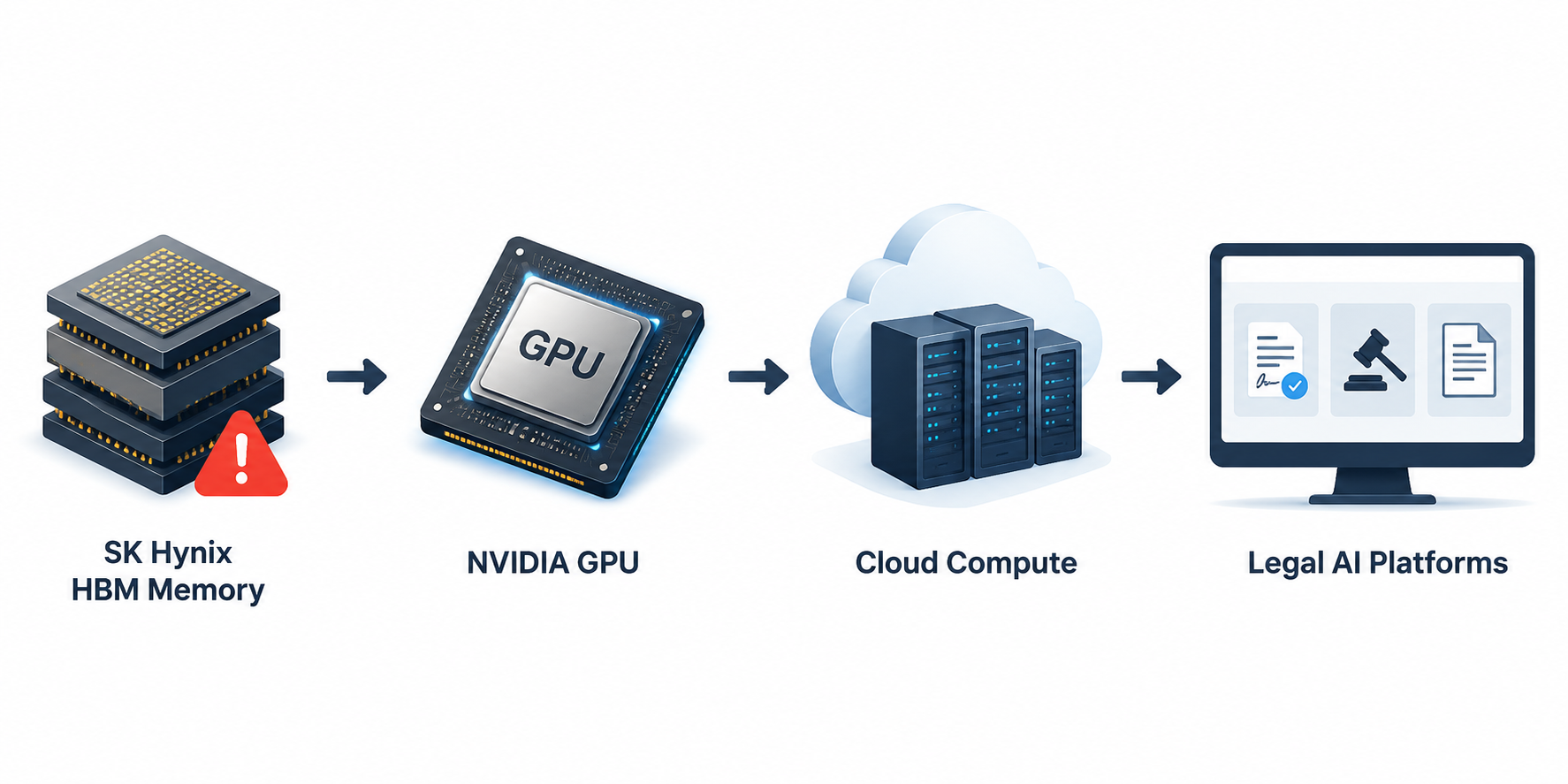
This is where SK Hynix’s market position becomes operationally relevant. The company holds roughly 56% of the global HBM market, according to the market materials underlying the selloff coverage.[2] That is not a decorative supply-chain fact. It means the legal AI stack depends on a component category where one supplier has unusually large weight, and where capacity commitments are already tight through the current product cycle.
For legal departments, the dependency is easiest to see in workflows that consume compute heavily or unpredictably. Large-scale e-discovery review can require burst capacity when productions arrive. Contract analysis platforms may need inference capacity across thousands of agreements during a diligence push. Legal research assistants and drafting tools look like simple subscription features to the lawyer at the keyboard, but every generated answer still has an infrastructure cost behind it.
The vendor phrase “cloud-based AI” does not remove this dependency. It often hides it. Cloud-based means the legal organization is not managing the hardware itself; it does not mean the hardware vanished. Someone is still paying for accelerated compute. Someone is still deciding which model runs at what latency, under which usage limits, and at what marginal cost.
Where the Cost Can Surface in Legal Products
The immediate mistake would be to ask whether the SK Hynix ETF crash will raise a specific legal AI subscription by a specific percentage next month. The research does not support that kind of direct pass-through claim. The better question is where a compute squeeze tends to appear when vendors have already promised AI capability faster than infrastructure costs stabilize.
- Renewal pricing: vendors may bundle AI into higher-tier plans, introduce usage bands, or reduce unlimited-use language where inference costs are material.
- Feature timing: roadmap items that require heavier model calls, long-context analysis, or batch processing can slip before lighter interface features do.
- Matter-level capacity: litigation-support teams may face queueing, throttling, or premium pricing when review volumes spike.
- Model selection: vendors may route some tasks to smaller or cheaper models, which can be sensible if disclosed and risky if hidden.
- Contract commitments: service-level language may avoid hard promises on AI latency, availability, or processing throughput unless the buyer asks directly.
None of those outcomes requires a vendor to be financially distressed. A well-run provider can still ration scarce compute or rewrite commercial terms when input costs change. That is why legal ops teams should treat compute assumptions as part of product diligence, alongside privacy, privilege protection, data retention, and model evaluation.
What Buyers Should Ask Without Turning Procurement Into Chip Analysis
Legal buyers do not need to become semiconductor analysts. They do need enough traceability to know whether a vendor’s AI roadmap is supported by capacity or merely by a slide. The useful questions are plain procurement questions.
- Which AI features are included in the base subscription, and which are subject to usage-based fees?
- Are there caps, throttles, fair-use policies, or priority queues for large matters or batch review?
- Does the vendor rely on one cloud provider, one model provider, or one class of GPU-backed compute for critical features?
- What happens to contracted pricing if the vendor’s compute costs rise during the term?
- Which roadmap items depend on expanded AI compute capacity rather than software development alone?
The answer “we use the cloud” is not enough. A better answer explains capacity planning, fallback models, service-level boundaries, and the commercial treatment of heavy use. A vendor does not need to name every infrastructure supplier to give a credible operational answer.
The Real Lesson From the Crash
The SK Hynix leveraged ETF crash should not be filed under “AI is over.” The more defensible reading is less theatrical and more useful: leveraged products amplified a crowded trade, forced selling moved through chip stocks, and the episode reminded everyone downstream that AI software depends on physical bottlenecks.
For legal professionals, the relevant exposure is not whether SK Hynix shares recover. It is whether the tools now being built into contract review, research, drafting, and discovery workflows have enough compute behind them to meet the promises in vendor decks and renewal calls. The crash did not prove weakening AI demand. It did make the supply-chain dependency harder to ignore.
References
- AI chip stocks erase $1.5 trillion as Nvidia, Broadcom and AMD sell off, Yahoo Finance, 2026.
- KODEX SK Hynix leveraged fund slumps after $3.4 billion rush, GuruFocus / TradingView, 2026.
- South Korea leveraged ETF deleveraging and SK Hynix market structure, Asianomics, 2026.
- South Korea tightens rules on leveraged single-stock ETFs after margin calls, Reuters, July 16, 2026.
- SK Hynix makes Nasdaq debut as leveraged chip products draw scrutiny, CNBC, July 10, 2026.
Comments
Join the discussion with an anonymous comment.