
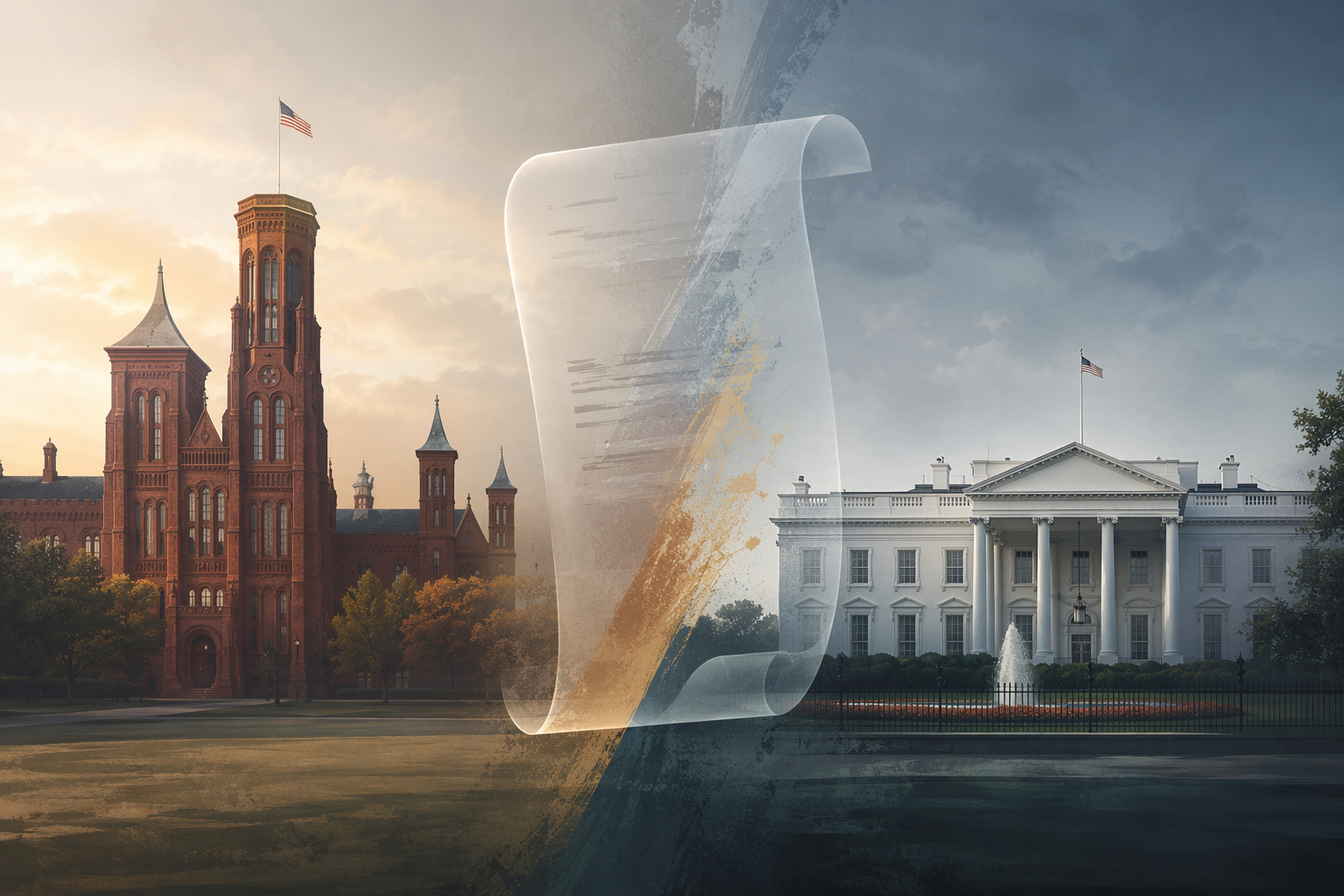
Executive Order 14253 did not merely announce a presidential view about history museums. Issued in March 2025 under the title “Restoring Truth and Sanity to American History,” it directed the vice president to work through the Smithsonian’s Board of Regents to remove what the order called “improper ideology,” targeted particular narratives about race and sex, and tied federal support to exhibit content at the Smithsonian Institution.[1] That is why the legal angle in the Smithsonian gender exhibits controversy starts somewhere narrower than the public argument over which objects belong on a wall: if curatorial authority is vested in the Board of Regents, what Article II authority lets the president command it?
The answer is not supplied by calling the Smithsonian “federal.” It receives federal appropriations, was created by Congress, and operates national museums on the Mall. But those facts do not make it a cabinet department, an executive agency, or ordinary presidential property. The harder question is whether the president may direct the Smithsonian as though it sits inside the usual executive chain of command. The strongest available authorities point the other way.
The Legal Problem Is the Command, Not the Preference
A president may criticize museum programming. Administration officials may argue that federally supported cultural institutions should reflect different priorities. Congress may legislate within constitutional limits. None of that resolves whether a White House order may require the Smithsonian to change exhibits, review personnel, or condition funding on content judgments.
That distinction matters because the Smithsonian’s governing form is unusual by design. The Institution is administered by a Board of Regents that includes the chief justice, the vice president, members of Congress, and citizen regents. In April 2026, a Yale Law Journal analysis described the March 2025 order as the first major modern confrontation between direct presidential control and the Smithsonian’s trust-instrumentality structure, arguing that the order exceeded presidential authority because operational and curatorial control belongs to the Regents rather than to the executive branch.[2]
That is a dry point with immediate consequences. If the Smithsonian were an executive agency, presidential direction over policy priorities would begin from familiar ground, even if particular applications raised statutory or constitutional objections. If it is instead an independent trust instrumentality governed by Regents, the president’s instruction must locate some separate legal lever: appointment power, statutory funding control, a valid condition attached by Congress, or a form of persuasion that stops short of command.
Why “Independent Trust Instrumentality” Is Not a Label
The most important Smithsonian cases do not treat the Institution as a normal executive-branch entity. In Dong v. Smithsonian Institution, the D.C. Circuit held in 1997 that the Smithsonian was not an “agency” for purposes of the Privacy Act, emphasizing its distinctive statutory structure and governance outside ordinary executive-agency classification.[2] The point was not that the Smithsonian is private. It was that Congress created something that does not map neatly onto the usual public-private or executive-independent categories.
Raven v. Sajet reached a different doctrinal issue but reinforced the same institutional oddity. In 2018, the U.S. District Court for the District of Columbia held that National Portrait Gallery selections were government speech, which defeated an artist’s First Amendment challenge to the museum’s refusal to display his work. At the same time, the court distinguished the Smithsonian from executive agencies and treated the relevant museum decision as the Smithsonian’s own institutional speech, not as a routine act of a department answerable to the president.[3]
That dual move is easy to misuse. Raven helps the Smithsonian resist certain private First Amendment suits because exhibit selection can be government speech. It does not follow that the president personally controls that speech. Government speech doctrine answers whether a private plaintiff may force inclusion or challenge exclusion; it does not automatically identify which government actor has authority to speak for a legally unusual institution.
The First Amendment Encyclopedia’s 2026 overview of Smithsonian exhibit control likewise frames the Institution as a hybrid public-law actor whose exhibit decisions implicate both government-speech doctrine and the special role of the Regents.[4] That hybrid status is exactly why the March 2025 order cannot be evaluated as if it were an instruction to the Department of the Interior or the National Archives.
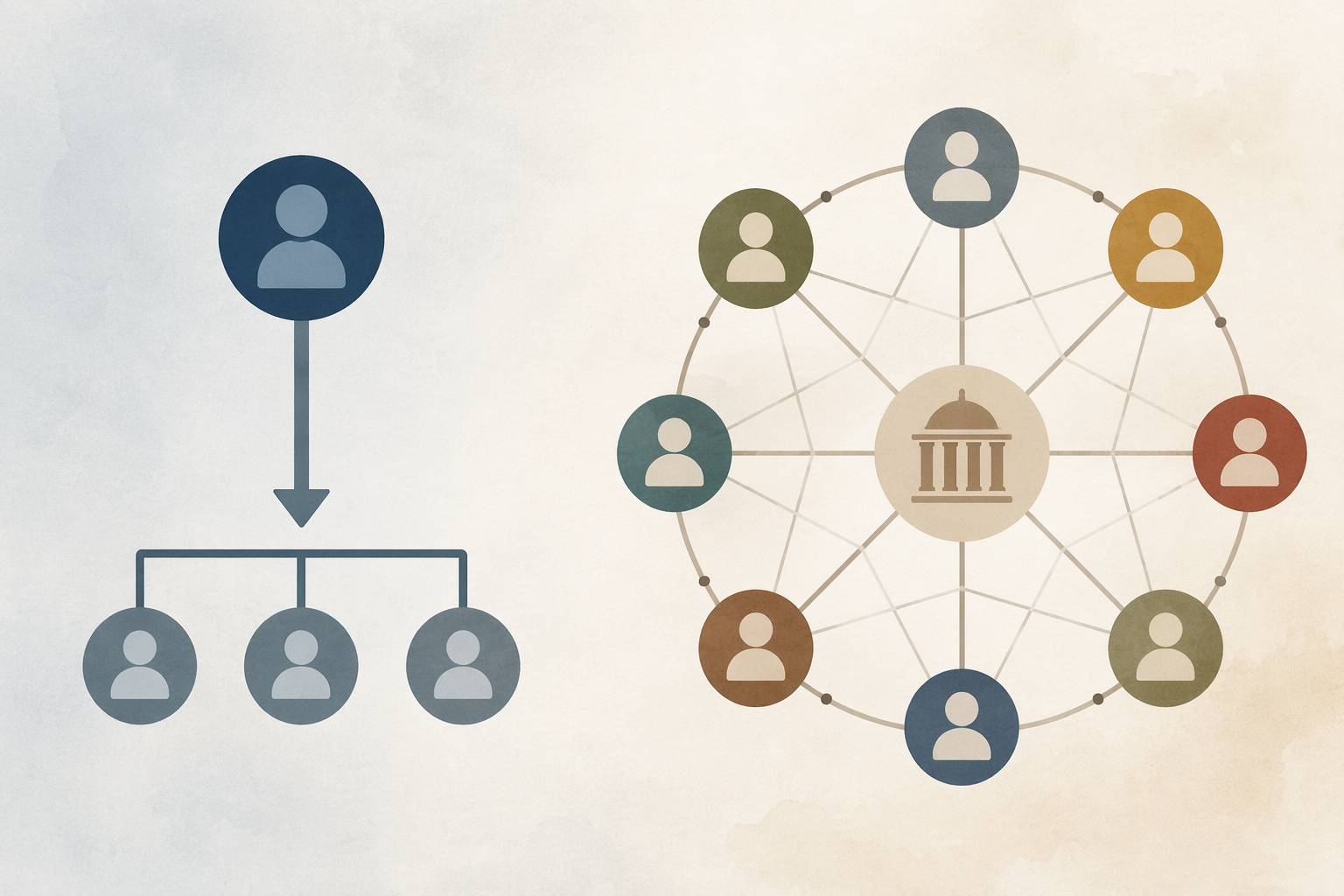
The 2024 Congressional Research Service report, as characterized by the Yale Law Journal, sharpened the point: efforts to revise Smithsonian operations based on the ideological stance of exhibits or research “would appear to be exclusively subject to the decisions of the entire Board of Regents.”[2] Because the report itself is being used here through Yale’s description, the conclusion should not be overstated as an adjudication. But as an institutional reading by Congress’s own research arm, it places the burden where it belongs: on anyone asserting that the president may bypass or command the Regents.
The Board of Regents Is the Actor That Matters
The March 2025 order tried to route action through the vice president, who sits on the Board of Regents. That drafting choice matters. It suggests an awareness that the Smithsonian’s governance does not present a simple presidential-subordinate relationship. But the vice president’s seat on the Board is not the same thing as presidential control over the Board, and a single Regent does not become the Institution’s curator-in-chief because the White House has issued a directive.
A board-governed instrumentality works through the legal authority of the board. Individual Regents may advocate, vote, delay, and negotiate. They do not ordinarily convert outside commands into institutional obligations unless the governing body validly adopts them. That is not formalism for its own sake. It determines who must deliberate, who may bind the Institution, who bears fiduciary or statutory responsibility, and who can be sued when an action is unlawful.
The Yale analysis treats this as the constitutional center of the dispute. If Congress vested curatorial and operational control in the Regents, then a presidential order directing exhibit content and personnel review is not merely a controversial policy preference. It is an assertion of executive authority over a body that has not been organized as an executive agency and whose governing statute points decision-making elsewhere.[2]
That is also why the absence of modern precedent matters. The available materials do not show a modern president exercising direct curatorial control over the Smithsonian in the way contemplated by the order. Presidential criticism, congressional pressure, appropriations disputes, and political controversy have long surrounded national museums. Direct executive command over exhibit substance is a different legal act.
What the Order and Pressure Campaign Reached
Once the legal frame is in view, the exhibit examples become more than culture-war inventory. They show the type of curatorial judgment the order and surrounding pressure sought to reach.
In August 2025, The Hill reported that the White House had identified 20 Smithsonian exhibits or materials as objectionable, including sections labeled “Transgender Identity” and “LGBTQ+ Activists.”[5] Those examples are significant because they sit inside the zone that museum professionals and Regents would ordinarily treat as interpretive judgment: what to collect, how to label, what context to give, and which historical actors to connect.
The same pattern appeared in the Amy Sherald episode. In July 2025, The New York Times reported that Sherald withdrew a National Portrait Gallery exhibition after learning that a painting depicting a transgender Statue of Liberty might be removed from the show.[6] For constitutional purposes, the salient fact is not whether one painting was artistically persuasive or politically provocative. It is that a content-specific concern about gender identity reportedly affected whether an exhibition could proceed at a Smithsonian museum.
The Atlantic’s July 2026 reporting added two administrative pressure points: Vice President JD Vance was reportedly holding up citizen-regent nominations, and a “Saving America’s Story” report named individual curators connected to contested museum work.[7][8] The exact number of vacant citizen-regent seats has been reported as changing in this period, so the safer conclusion is not a fixed vacancy count. The legally relevant point is that appointments pressure and public naming of staff can affect the same decision-making ecosystem even when no court has yet decided whether a particular act is unlawful.
Those examples do not prove that every contested decision was legally coerced. They do show why the command question is not abstract. Curators, museum directors, artists, and Regents are forced to act inside uncertainty: whether to treat the order as binding, whether to revise labels or delay exhibitions, whether to protect staff from political targeting, and whether refusal might trigger funding consequences.
Funding Is the More Plausible Workaround, and the Less Settled One
If direct presidential control is weak, money becomes the obvious route. The Smithsonian receives federal appropriations. OMB controls apportionment within the executive branch. Agencies and instrumentalities often experience legal authority first as a funding condition rather than as a command signed in large type.
NOTUS reported in June 2026 that the administration used OMB apportionment footnotes to restrict Smithsonian spending tied to exhibits or programs viewed as inconsistent with the executive order.[9] That mechanism matters because an apportionment footnote can operate quietly. It need not look like a museum official being ordered to remove a label. It can instead tell financial officers which funds may be obligated, under what conditions, and with what legal risk if they proceed.
The statutory tension is real. The Antideficiency Act makes officials wary of obligating funds outside authorized limits. If OMB says funds are unavailable or conditioned, institutional actors may comply to avoid personal or institutional risk. But the Impoundment Control Act restricts the executive’s ability to withhold funds that Congress has appropriated. If Congress appropriated money for Smithsonian operations and did not impose the content condition itself, an executive-created funding restriction may look less like apportionment and more like an unlawful impoundment.
The current record does not support a clean answer. According to NOTUS, the apportionment-footnote theory had not been tested in court as applied to the Smithsonian dispute.[9] That leaves lawyers with a familiar but uncomfortable posture: the instrument may be powerful enough to change behavior before it is judicially reviewed, while the merits remain unresolved.
Why the Funding Route Is Not the Same as Curatorial Authority
A valid funding condition can shape institutional choices. It still must come from a lawful source and operate within constitutional constraints. For the Smithsonian, that distinction is especially important because Congress’s creation of a board-governed trust instrumentality would be hollow if the executive could impose content control indirectly whenever direct command is unavailable.
The stronger executive argument would not be that the president owns Smithsonian speech. It would be that OMB may administer appropriations and prevent funds from being used for purposes inconsistent with lawful executive policy. The stronger answer is that appropriations administration cannot become a substitute charter amendment. If Congress has not placed ideological exhibit review in the president’s hands, a footnote should not silently move it there.
The First Amendment Does Not Supply an Easy Plaintiff
There is a temptation to translate the entire dispute into a First Amendment case: artist speech chilled, LGBTQ history suppressed, curators pressured. Some of those concerns are serious. But Raven makes the litigation posture harder than the public narrative suggests.
If exhibit selection is government speech, a private artist generally cannot compel the Smithsonian to display a work on First Amendment grounds. That was the result in Raven. The government-speech classification gives the Institution room to choose what it says through exhibitions.[3] But the same doctrine can make it more difficult for private parties to challenge pressure from another government actor, because the injury is not simply exclusion from a public forum.
The paradox is that the best constitutional objection may belong less to the excluded speaker than to the structure of authority itself. The question becomes whether the president has intruded on a governance arrangement Congress vested in the Regents. That is a separation-of-powers and statutory-structure claim before it is a conventional free-speech claim.
That posture affects remedies. A court might be asked to decide whether an OMB restriction is unlawful, whether officials exceeded statutory authority, or whether a particular action can be enjoined. But the existence of a contestable Article II overreach does not automatically identify a clean private right of action for every artist, curator, or visitor affected by the order.
Appointments Pressure Changes the Facts, Not the Charter
The citizen-regent nomination issue sits somewhere between law and leverage. A president and vice president may influence who joins the Board through the available appointment process. Political actors routinely seek board members who share their priorities. That does not itself prove unlawful interference.
But appointments pressure is not curatorial authority either. Holding seats open, delaying nominations, or seeking ideologically aligned Regents may change how the Board votes over time. It does not mean the president can treat the Board’s current legal authority as his own while those seats are vacant or contested. The same is true of public reports naming curators. They can discipline an institution in practical terms without resolving who has lawful decision-making power.
That difference is important for compliance officers and government lawyers. Practical pressure may be decisive inside an institution long before a court speaks. Legal authority, however, still has to be traced to a valid source. The Smithsonian’s structure makes that trace unusually demanding.
What the Authorities Support
The current authorities support a narrow conclusion, not a complete litigation forecast. Dong, Raven, the CRS characterization described by Yale, and the 2026 Yale Law Journal analysis all point away from treating the Smithsonian as an ordinary executive agency.[2][3] They also point toward the Board of Regents as the legally relevant actor for exhibit and operational decisions.
The exhibit examples involving gender identity and LGBTQ history show what the order and related pressure attempted to reach. They do not change the legal test. The question remains whether the president may command, condition, or indirectly force decisions that Congress placed in a board-governed trust instrumentality.
On the materials now available, the March 2025 executive order is best understood as constitutionally contestable Article II overreach against a uniquely structured institution. The strongest argument against it is not that Smithsonian exhibits are above politics. It is that the president has not been given ordinary executive control over the Smithsonian’s curatorial judgment, and the funding workaround remains unresolved rather than validated.
References
- Trump executive order to force changes at Smithsonian Institution targeting funding for programs with ‘improper ideology’, PBS NewsHour, March 28, 2025
- Fight at the Museum: Executive Overreach and the Future of the Smithsonian Institution, Yale Law Journal, April 2026
- Raven v. Sajet, 334 F. Supp. 3d 22, U.S. District Court for the District of Columbia, 2018
- Control of Smithsonian Institution Exhibits, First Amendment Encyclopedia, MTSU, updated July 9, 2026
- Trump administration Smithsonian shakeup exhibits, The Hill, August 22, 2025
- Amy Sherald Smithsonian censorship, The New York Times, July 24, 2025
- Trump Comes for American History Museum, The Atlantic, July 2026
- Smithsonian Trump Regents, The Atlantic, July 2026
- Trump Smithsonian budget OMB, NOTUS, June 5, 2026
Comments
Join the discussion with an anonymous comment.